The Doppler effect
🎯What you need to be able to do
- Explain the Doppler effect in terms of wavefronts bunching ahead of a source and stretching behind it.
- State that the source keeps emitting at its own unchanged frequency, and say what actually changes.
- Use \( f' = f\,v/(v \pm v_s) \) for a moving source and \( f' = f\,(v \pm v_o)/v \) for a moving observer, and choose the sign by checking the direction of the shift.
- Explain why the two cases are physically different, and say when the difference becomes large.
- Describe what happens when a source reaches the wave speed, and name the result.
- Use \( \Delta f/f = \Delta\lambda/\lambda = v/c \) for light when \( v \ll c \), and interpret redshift and blueshift.
- Explain applications: galaxy recession, radar speed measurement and Doppler ultrasound, including why a reflected wave is shifted twice.
📚Where the effect actually comes from
The mechanism first, because the formulas only make sense afterwards. A stationary source emits wavefronts as a set of concentric circles, evenly spaced in every direction. Now let the source move. It emits each new front from a point slightly further along than the last, so the fronts crowd together ahead of it and spread apart behind it. Crowded fronts mean a shorter wavelength and so a higher frequency; spread fronts mean the opposite.
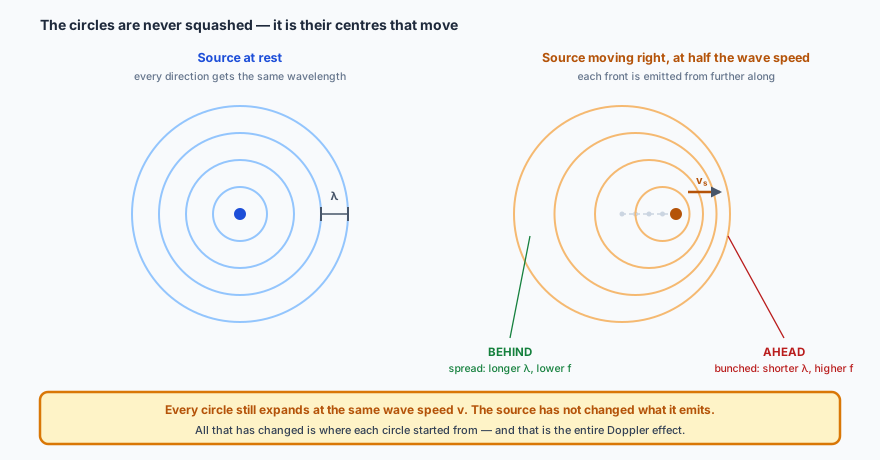
That single picture earns more marks than a recalled equation, and it is the thing to draw first in any Doppler question that asks you to explain.
🔄A moving source changes the wavelength itself
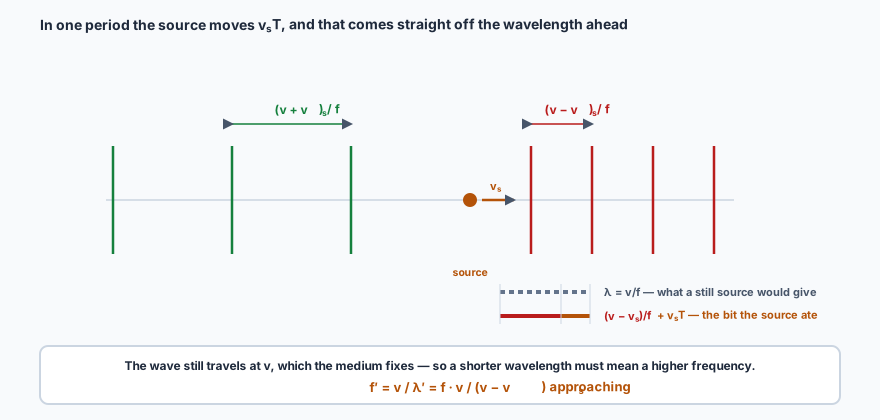
In one period \( T = 1/f \) the source emits one whole wavefront and moves a distance \( v_sT \) in the process. Ahead of it, the next front is emitted from that much closer to the previous one, so the wavelength in the medium is genuinely shortened:
The wave still travels at \( v \), the speed the medium fixes, so the frequency an observer receives is \( f' = v/\lambda' \), which rearranges to the equation you will use:
🕶️A moving observer changes how often the fronts arrive
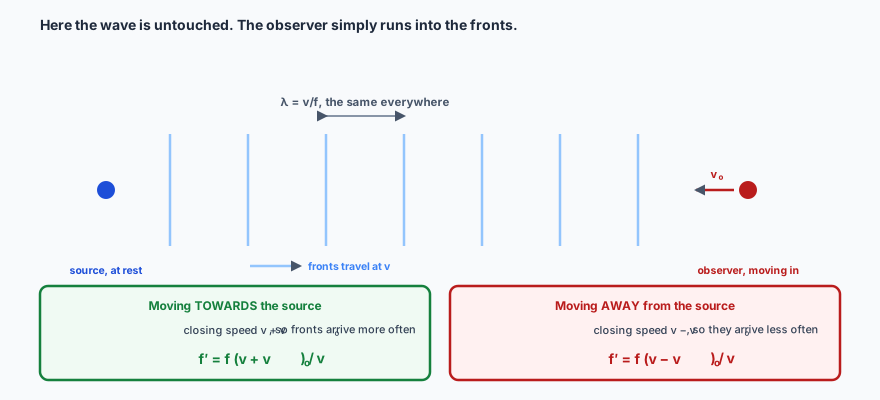
Now hold the source still and move the observer instead. The wavefronts in the medium are completely undisturbed — evenly spaced, wavelength \( \lambda = v/f \) in every direction. An observer running towards them simply meets them more often, because their own motion adds to the closing speed. The relative speed of approach becomes \( v + v_o \) rather than \( v \), and
✏️Worked example 1 — the ambulance
(a) Frequency heard as it approaches. Moving source, approaching, so the wavelength ahead is shortened and the denominator is \( v - v_s \):
(b) Frequency heard after it passes. Now the denominator is \( v + v_s \): \( f' = 780 \times 340/362 = 733 \) Hz. Lower, as receding must be.
(c) The drop the observer hears. \( 834 - 733 = 101 \) Hz, and it happens over the second or so the ambulance takes to pass. That abruptness is the whole reason the effect is so obvious in everyday life: the shift itself is only about 13%, but it arrives all at once.
(d) The same observer now cycles towards a stationary siren at 22 m s\(^{-1}\). Moving observer, approaching: \( f' = 780 \times (340 + 22)/340 = 830 \) Hz.
⚖️The two cases are not the same
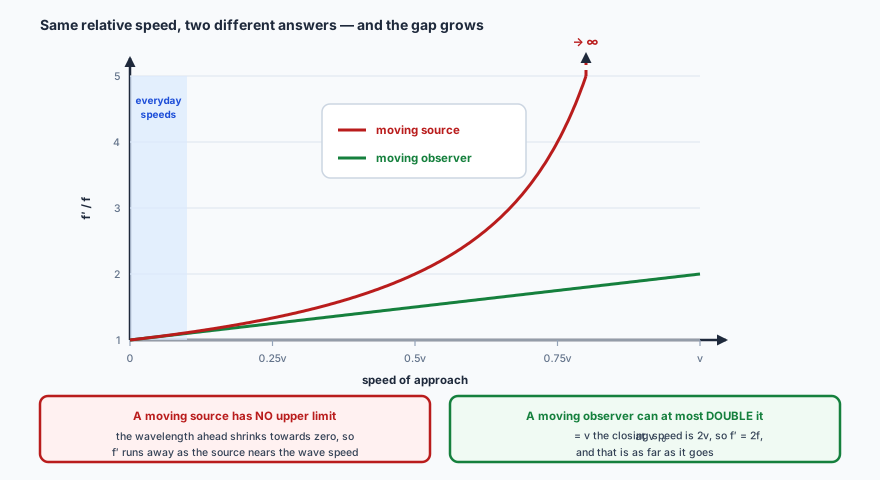
At everyday speeds the two equations agree closely, which is why it is tempting to treat them as one. They are not. A moving source changes the wavelength in the medium; a moving observer does not. The wave that a stationary microphone would record is a different wave in the two cases, and if you froze the medium and measured the crest spacing you could tell them apart immediately.
The disagreement grows as the speed approaches the wave speed. Ratio the two expressions for an approaching motion at speed \( u \) and the moving-source result runs away to infinity as \( u \to v \), while the moving-observer result only ever doubles.
✏️Worked example 2 — where they part company
Both speeds are exactly half the speed of sound.
Moving source: \( f' = 400 \times 340/(340 - 170) = 400 \times 2 = 800 \) Hz. The wavelength ahead has been halved, so the frequency doubles.
Moving observer: \( f' = 400 \times (340 + 170)/340 = 400 \times 1.5 = 600 \) Hz. The wavelength is untouched; the listener meets the fronts one and a half times as often.
➰Getting the sign right, every time
For the moving source the minus sign goes with approaching and the plus with receding; for the moving observer it is the other way round. That is easy to state and easy to misremember under exam pressure, so do not rely on it.
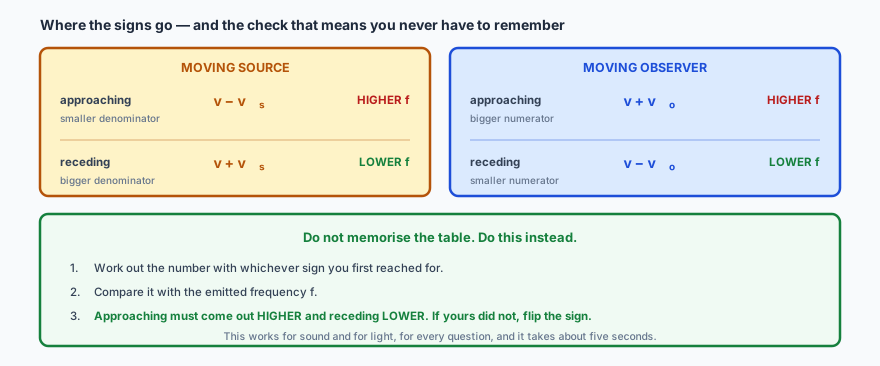
Work out the number, then ask a single question: is the answer on the right side of the emitted frequency? Approaching must give a higher frequency and receding a lower one, in every case, for sound and for light alike. If your answer went the wrong way, you have the sign upside down; flip it and move on.
✈️When the source catches its own waves
Push the source speed up towards \( v \) and the wavefronts ahead have less and less of a head start. At \( v_s = v \) they cannot get away at all: every front emitted since the source reached that speed lies on top of the source, piled into one front of enormous amplitude. The moving-source equation says \( f' \to \infty \), which is the mathematics announcing that the model has broken down.
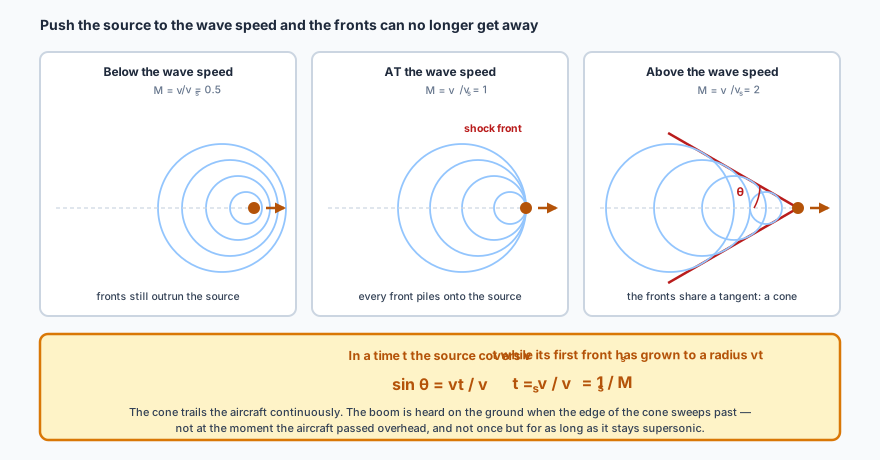
The geometry is worth a line. In a time \( t \) the source travels \( v_st \) while the front it emitted at the start has grown to radius \( vt \). The cone's half-angle therefore satisfies
where \( M = v_s/v \) is the Mach number. A faster aircraft makes a narrower cone.
💡Light: only the relative velocity matters
For light there is no medium. There is nothing for a moving source to compress and nothing for a moving observer to run into, and there is no experiment that could tell you which of the two is "really" moving. So the two cases collapse into one, and the shift depends on the relative velocity alone. When \( v \ll c \) it is well approximated by
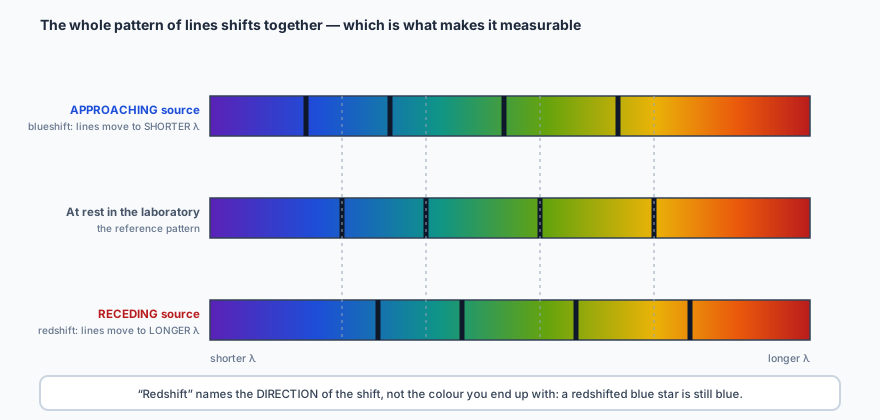
Light from a receding object shifts to longer wavelengths — redshift — and from an approaching object to shorter, blueshift. The names are about the direction of the shift, not about the colour you end up with: a redshifted blue star is still blue.
✏️Worked example 3 — a galaxy's speed from one line
The shift is \( \Delta\lambda = 662.9 - 656.3 = 6.6 \) nm, towards longer wavelengths.
\( v = 1.01\times10^{-2} \times 3.00\times10^{8} = 3.0\times10^{6} \) m s\(^{-1}\), and because the shift is to longer wavelengths it is a redshift, so the galaxy is receding.
🌌Redshift and the expanding universe
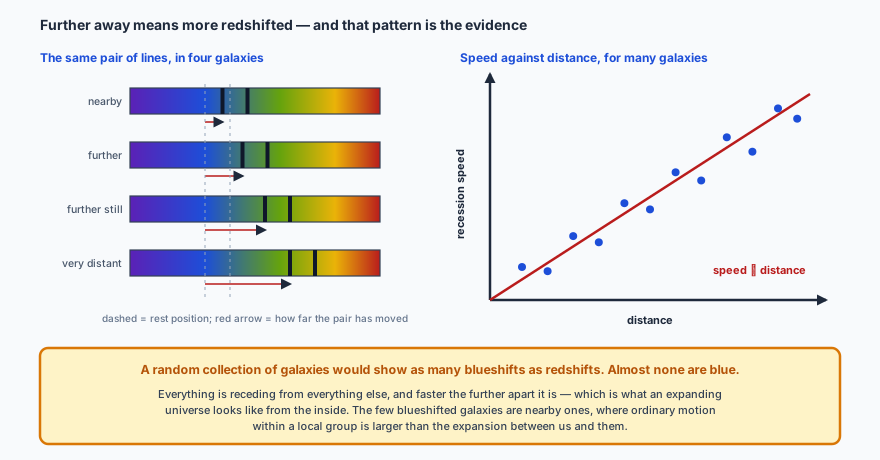
Measure the spectra of many galaxies and two things stand out. Almost every one is redshifted, and the more distant the galaxy the larger its redshift. Nothing about the Doppler effect on its own predicts that pattern — a random collection of galaxies should show as many blueshifts as redshifts — so the pattern itself is the evidence. It says that everything is receding from everything else, which is what an expanding universe looks like from the inside.
📡Reflected waves shift twice
Bounce a wave off a moving object and the Doppler effect happens twice, because the object plays both roles in turn. On the way in it is a moving observer, receiving the transmitted wave at a shifted frequency. It then re-radiates what it received, so on the way back it is a moving source. Both steps shift in the same direction, so the returning signal carries roughly double the single shift.
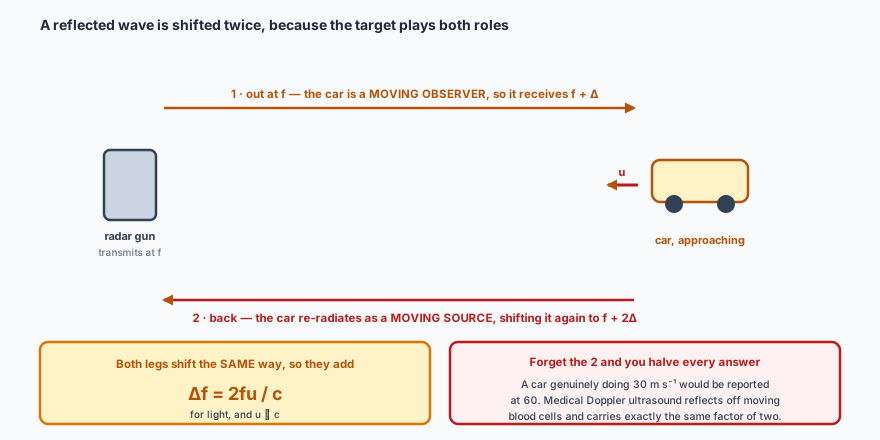
For light and small speeds this gives a beautifully simple result. The single shift is \( fu/c \), so the total shift measured on return is
✏️Worked example 4 — a speed camera
The beat frequency is the total Doppler shift, so \( \Delta f = 4.80\times10^{3} \) Hz. Rearranging \( \Delta f = 2fu/c \):
That is 108 km h\(^{-1}\).
🔭See it happen
PhET, Sound Waves, has a Doppler mode where you can drag the source and watch the wavefronts crowd together in front of it. Push the source speed up to the wave speed and the shock front forms on screen — the sonic boom drawn rather than described. Then set the source moving in a straight line past the listener and watch the received frequency pass smoothly through the emitted value at the moment of closest approach.
📝Practise
Work through these, then reveal the answer. Each question targets a different objective from the list above.
1. A train horn sounds at 500 Hz as the train approaches a stationary observer at 30 m s\(^{-1}\). Take the speed of sound as 340 m s\(^{-1}\). Find the frequency heard.
2. Find the frequency heard by the same observer after the train has passed, and the size of the drop.
3. Now the source is stationary at 500 Hz and the observer cycles towards it at 30 m s\(^{-1}\). Find the frequency heard, and explain why it differs from your answer to question 1.
4. A car drives past you at constant speed along a straight road, sounding its horn continuously. Sketch how the frequency you hear varies with time, and state its value at the moment the car is level with you.
5. Light from a distant galaxy shows \( \Delta\lambda/\lambda = 0.004 \). Find its recession speed.
6. A sodium line with a rest wavelength of 589.0 nm is observed in a star's spectrum at 588.6 nm. Find the star's speed along the line of sight and state whether it is approaching or receding.
7. Explain why the Doppler shift measured by a police speed camera is twice what you might first expect.
8. A bat emits 45.0 kHz and receives the echo from a moth flying directly away from it at 5.0 m s\(^{-1}\). Take the speed of sound as 340 m s\(^{-1}\). Find the frequency of the echo the bat receives.
9. An aircraft flies at Mach 1.5. Find the half-angle of its shock cone, and state what happens to that angle as the aircraft goes faster.
10. State what happens to the wavefronts when a source reaches the speed of the wave in the medium, name the result, and say what the moving-source equation does at that point.
🔗Go deeper — other people’s work
These are external resources, not mine. If one stops working, tell me and everything above it on this page still stands.
- The Physics Classroom — the Doppler effect and shock waves
- The Physics Hypertextbook — the Doppler effect