Forces and momentum
A.1 described motion. A.2 explains it. Everything here comes from three laws and one conserved quantity, and almost every question begins the same way: draw one object, draw every force acting on it, and add them as vectors. Get that diagram right and the physics is usually one line of algebra.
🎯What you need to be able to do
- Describe a force properly — its size, direction, the object it acts on and the object exerting it — and name the common types.
- Add forces as vectors and resolve a force into components, especially on a slope.
- Draw free-body diagrams, and use translational equilibrium (\( \sum F = 0 \)).
- Apply Newton’s three laws, including \( F = ma \) and \( F = \dfrac{\Delta p}{\Delta t} \), and identify third-law pairs correctly.
- Distinguish mass from weight, and use Hooke’s law to measure a force.
- Work with static and dynamic friction, \( F_f \le \mu_s R \) and \( F_f = \mu_d R \).
- Use viscous drag (Stokes’ law) and buoyancy (\( F_b = \rho V g \)), including terminal speed in a fluid.
- Use momentum and impulse, including the area under a force–time graph.
- Apply conservation of momentum to collisions and explosions, and tell elastic from inelastic.
- Treat circular motion as a force problem: \( a = \dfrac{v^{2}}{r} \), and know which real force is doing the job.
🧲What a force is
A force is a push or a pull, measured in newtons, and you can recognise one by what it does: it deforms something, or it changes something’s velocity. That second half matters more than it looks. A change in velocity is an acceleration, so a resultant force causes an acceleration — and no resultant force is needed to keep an object moving at constant velocity.
A force is an interaction between two objects, never a property of one. To describe a force completely you need five things:
- its magnitude and its direction (it is a vector);
- the object it acts on;
- the object exerting it;
- the nature of the force.
So a proper description reads: “a 50 N push, at 20° to the horizontal, acting ON the football FROM the boot”. If you cannot name the object exerting a force, that force does not exist — which is the single most useful test in this whole topic.
The types you will meet. Every one of them is ultimately gravitational or electromagnetic in origin; almost everything in daily life is electromagnetic.
- Normal force, \( F_N \) — the part of the contact force between two surfaces that acts at right angles to them. Between smooth surfaces it is the only contact force there is.
- Surface friction, \( F_f \) — opposes relative motion of the surfaces, and acts along them.
- Tension and the elastic restoring force, \( F_H \) — a stretched spring pulls equally on the objects at both ends, in proportion to its extension (Hooke’s law).
- Viscous drag, \( F_d \) — opposes motion through a fluid, and grows with speed.
- Buoyancy, \( F_b \) — the upward force on anything immersed in a fluid.
- Gravitational force, \( F_g \) — between masses; near the Earth we call it weight.
- Electric, \( F_e \), and magnetic, \( F_m \) — between charges, and between currents or magnets.
One useful split is contact forces (normal, friction, tension, drag, buoyancy) against forces that act at a distance (gravitational, electric, magnetic). The first group needs surfaces touching; the second does not.
📐Forces as vectors, and free-body diagrams
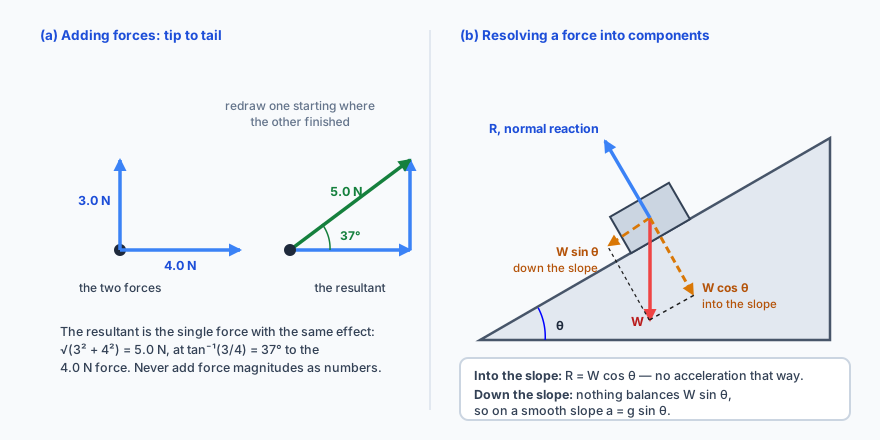
Because forces are vectors, two of them at an angle do not add as numbers. Add them tip to tail, or resolve them into perpendicular components and add each direction separately — whichever makes the geometry easier.
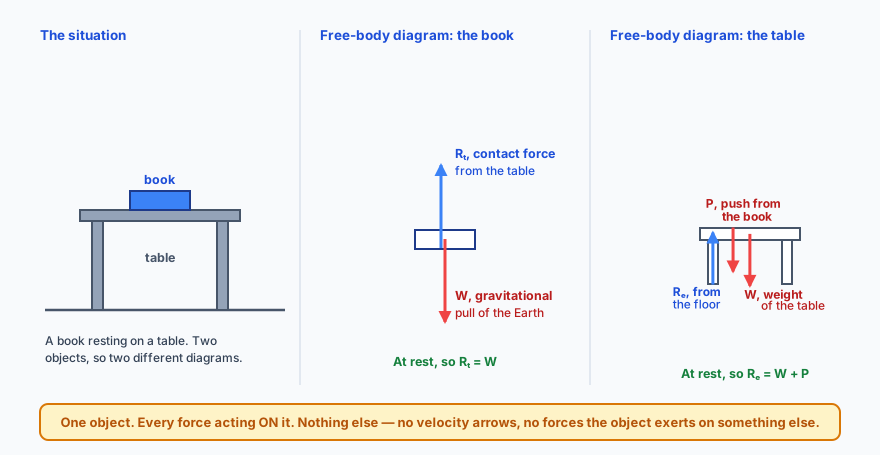
Free-body diagrams are the discipline that makes all of this work. Choose one object, then draw every force acting on that object and nothing else.
⚖️Newton’s first law and equilibrium
An object continues at rest, or moving at constant velocity in a straight line, unless a resultant external force acts on it. Read carefully, that adds nothing to the definition of a force — it simply insists on the converse: no resultant force means no acceleration, and observing no acceleration tells you the forces balance.
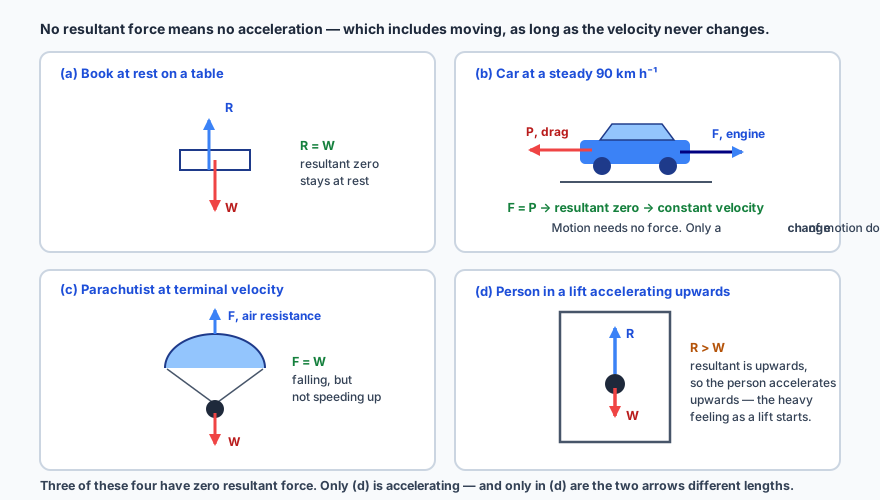
An object with zero resultant force is in translational equilibrium:
Because force is a vector, that means zero resultant in every direction. In two dimensions it is enough to show the forces balance in any two non-parallel directions — usually the two you chose when you resolved them. For a mass hanging on a string and pulled sideways by a force \(P\), equilibrium gives \( T\sin\theta = P \) horizontally and \( T\cos\theta = W \) vertically, and those two equations solve the whole problem.
🧮Newton’s second law
The first law says a resultant force causes acceleration. The second says how much. In its most general form, the resultant force equals the rate of change of momentum:
Four things are worth pinning down. \(F\) is always the resultant force, so work that out first. The mass must be in kilograms for \(F = ma\) to give newtons. The law is experimental — it was not derived from anything. And when the mass changes (a rocket burning fuel, coal landing on a conveyor belt) or the force varies, go back to \( F = \Delta p / \Delta t \), which still holds.
✏️Worked example 1 — a block on a rough slope
Resolve along and perpendicular to the slope. The weight is \( W = 3.0 \times 9.81 = 29.4 \) N, so
Perpendicular to the slope nothing accelerates, so the normal reaction must be \( R = 25.5 \) N — not 29.4 N, which is the mistake waiting to be made here.
Along the slope, the 14.7 N pulling it down exceeds the 8.0 N of friction available, so it does slide. Friction then acts up the slope at its maximum value:
🤝Newton’s third law
When two bodies A and B interact, the force A exerts on B is equal in magnitude and opposite in direction to the force B exerts on A. In symbols, \( F_{AB} = -F_{BA} \). Forces always come in pairs, which makes the third law a checklist: if you have drawn a force, something somewhere is feeling its partner.
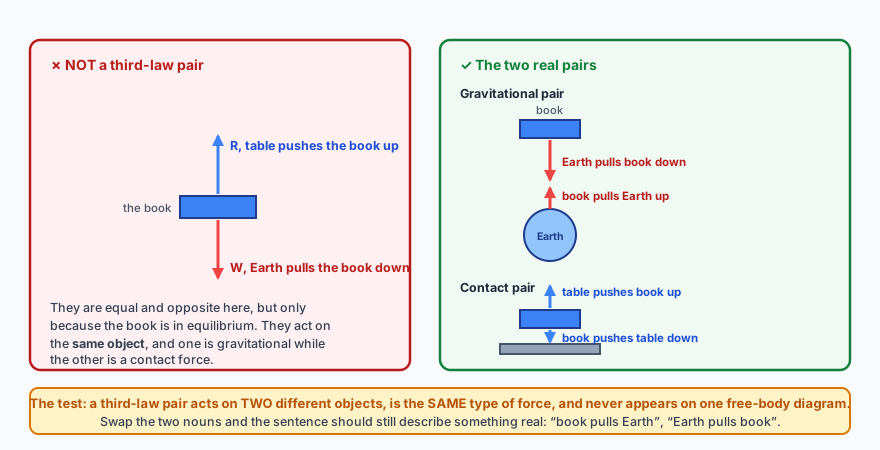
Two properties settle every third-law question. The pair acts on two different objects — so two forces on the same free-body diagram are never a pair. And the pair is the same type of force: if A pulls B gravitationally, then B pulls A gravitationally too.
The law also explains things that look one-sided. Two skaters push apart and feel equal forces, but the lighter one accelerates more, because \( a = F/m \). A person pushing off a wall is accelerated by the wall’s push on them; the wall (attached to the Earth) has far too much mass for its acceleration to be noticed. And a car accelerates because the road pushes it forwards — the engine only turns the wheels, which push backwards on the road.
⚖️Mass, weight and Hooke’s law
Mass is the amount of matter in an object, measured in kilograms, and it does not change when you move the object. Weight is a force, measured in newtons. Take an object to the Moon and its mass is unchanged while its weight falls to about a sixth, because \( g \approx 1.6 \) N kg\(^{-1}\) there against 9.81 N kg\(^{-1}\) here.
The word “weight” is genuinely ambiguous in physics: some people mean the gravitational force \( mg \), others mean the reading on a supporting scale. In equilibrium the two agree, and in an accelerating lift they do not — which is exactly why you feel heavy as a lift starts upwards, while the gravitational force on you has not changed at all. Say “gravitational force” when you mean \( mg \) and the ambiguity disappears.
Hooke’s law turns a spring into a force meter. Up to its elastic limit, the extension \(x\) of a spring is proportional to the force stretching it:
so a graph of force against extension is a straight line through the origin whose gradient is the spring constant. Measure the extension and you have measured the force — a newtonmeter is nothing more than this.
🧱Solid friction
Friction opposes the relative motion of two surfaces, and it arises because no surface is smooth at the microscopic scale. It comes in two varieties, and the difference matters.
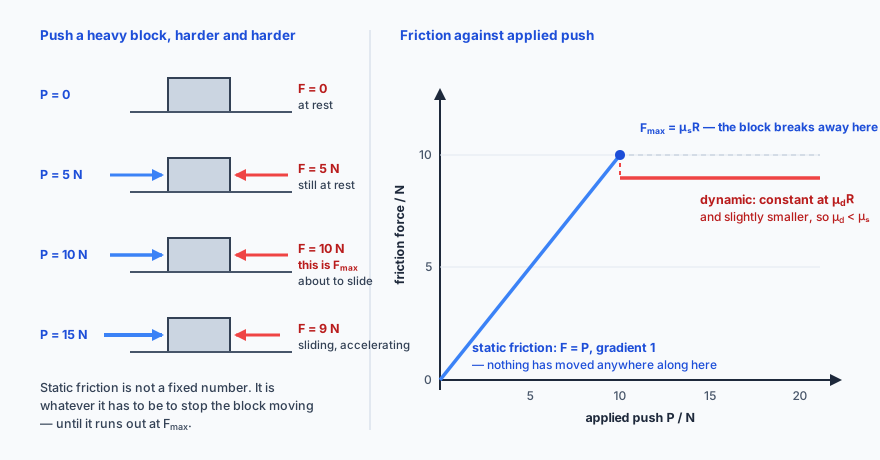
Static friction acts between surfaces that are not sliding, and it takes whatever value is needed to prevent sliding — up to a maximum. Dynamic (or kinetic) friction acts once they are sliding, and is roughly constant:
where \(R\) is the normal reaction. The coefficients are ratios of two forces, so they have no units, and they are usually less than 1. Two consequences surprise people: the maximum friction does not depend on the area of contact when the surfaces are held together by gravity, and friction drops at the moment the object starts to move — which is why a heavy box lurches forward as it finally gives way.
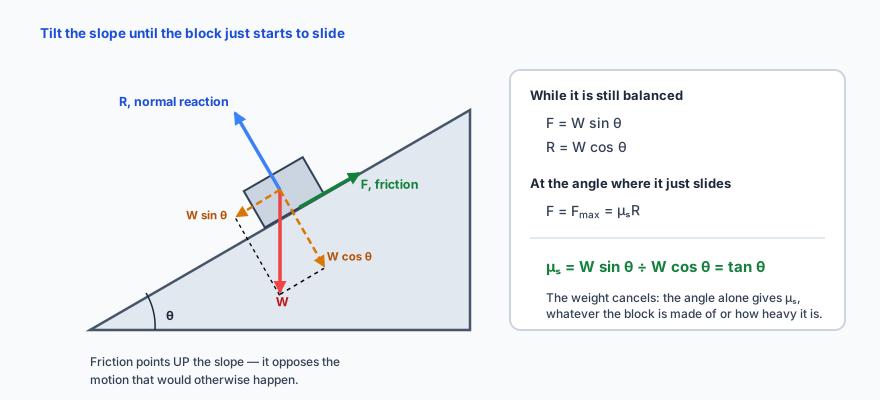
Tilting a slope until an object just slides is the neatest way to measure \( \mu_s \), because everything else cancels.
💧Viscosity, drag and buoyancy
An ideal fluid slides past itself freely. A real fluid does not: its layers rub, and that internal friction is viscosity, \( \eta \). It is defined as the ratio of the tangential stress applied to a fluid to the velocity gradient it produces,
which gives units of Pa s (equivalently N s m\(^{-2}\) or kg m\(^{-1}\) s\(^{-1}\)). Water is about \( 1.0 \times 10^{-3} \) Pa s at room temperature and thick syrup about \( 1.0 \times 10^{2} \) Pa s — five orders of magnitude apart. Viscosity is extremely sensitive to temperature, which is why engine oil is graded for it and why syrup pours so much better warm.
For a sphere moving slowly through a fluid, the drag force is given by Stokes’ law, and an immersed object also feels an upthrust given by Archimedes’ principle.
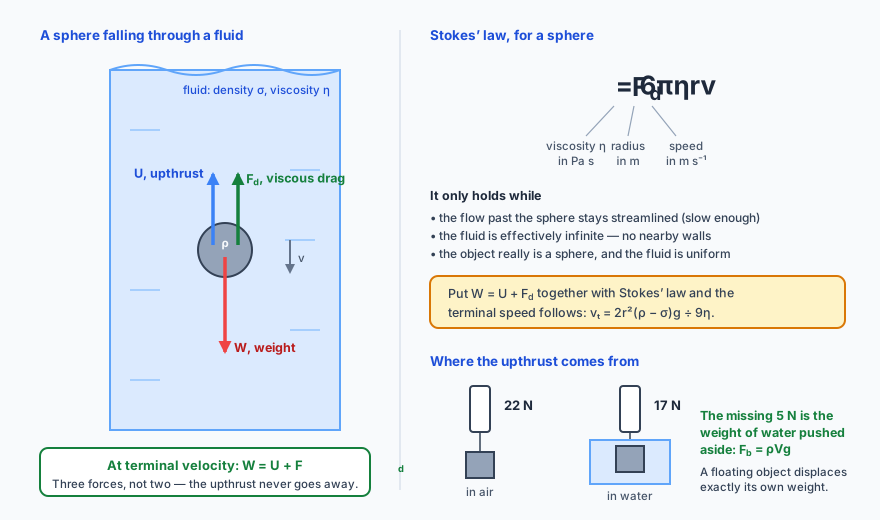
In the buoyancy equation \( \rho \) is the density of the fluid and \(V\) the volume displaced, so the upthrust equals the weight of fluid pushed aside. A floating object displaces exactly its own weight of fluid, which is the whole of why ships float.
Stokes’ law is not universal. It assumes the sphere moves slowly enough for the flow around it to stay streamlined, that the fluid is effectively infinite (no nearby container walls), and that the object really is a sphere. Push any of those and it fails.
✏️Worked example 2 — the size of an oil drop
At terminal velocity the forces balance: weight down, upthrust and drag up. With the gas density neglected the upthrust drops out, leaving weight = drag:
Substituting \( \eta = 14 \times 10^{-6} \) Pa s, \( v = 0.18 \) m s\(^{-1}\), \( \rho = 890 \) kg m\(^{-3}\) and \( g = 9.81 \) m s\(^{-2}\):
🎯Momentum and impulse
Linear momentum is mass times velocity,
and because velocity is a vector, momentum is a vector: signs matter, and you must fix a positive direction before substituting anything. The impulse of a force is the change of momentum it produces,
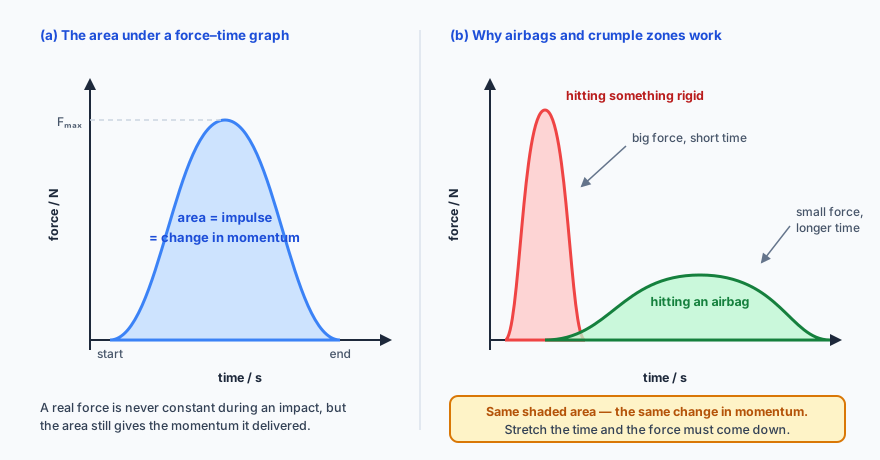
which is just Newton’s second law rearranged. For a force that varies during an impact — and every real impact does — the impulse is the area under the force–time graph.
✏️Worked example 3 — a jet of water on a wall
Work out what arrives in one second. A 50 m length of the jet hits the wall each second, so the volume arriving per second is \( 2.5 \times 10^{-3} \times 50 = 0.125 \) m\(^{3}\), and its mass is \( 0.125 \times 1000 = 125 \) kg.
Then use the momentum form of the second law. That water arrives at 50 m s\(^{-1}\) and stops, so the momentum destroyed each second is
🔒Conservation of momentum
The total momentum of a system of interacting particles is constant provided no resultant external force acts. This is not a new law — it follows from the second and third laws together. When A and B collide, the force on B from A is equal and opposite to the force on A from B, and they act for exactly the same time. So the impulses are equal and opposite, the momentum changes are equal and opposite, and the total is unchanged.
Kinetic energy is a different question entirely, and this is where marks are lost.
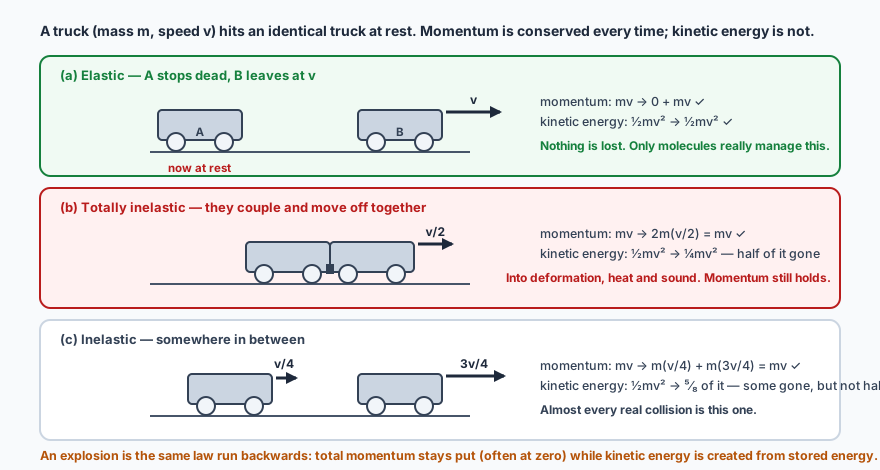
- Elastic: no kinetic energy is lost at all. Real everyday objects never quite manage it — collisions between molecules are the honest example. A useful test: in an elastic collision the relative velocity of approach equals the relative velocity of separation.
- Totally inelastic: the objects stick together, so their relative velocity of separation is zero. This loses the most kinetic energy of any collision with that momentum — to deformation, heat and sound.
- Inelastic: everything in between, which is almost every collision you will ever meet.
- Explosions run the same law backwards: the total momentum stays whatever it was (usually zero), while kinetic energy increases, released from stored chemical or elastic energy.
✏️Worked example 4 — two masses on a pulley
Two free-body diagrams, two equations. Take the direction of motion as positive for each mass: the 6.0 kg falls, the 4.0 kg rises. For the rising mass, \( T - 4.0g = 4.0a \). For the falling mass, \( 6.0g - T = 6.0a \). Adding them eliminates \(T\):
Then substitute back into either equation: \( T = 4.0(9.81 + 1.96) = 47\ \text{N} \).
🎡Uniform circular motion
An object going round a circle at constant speed is accelerating, because its velocity is constantly changing direction. That is the whole idea, and everything else follows from it.
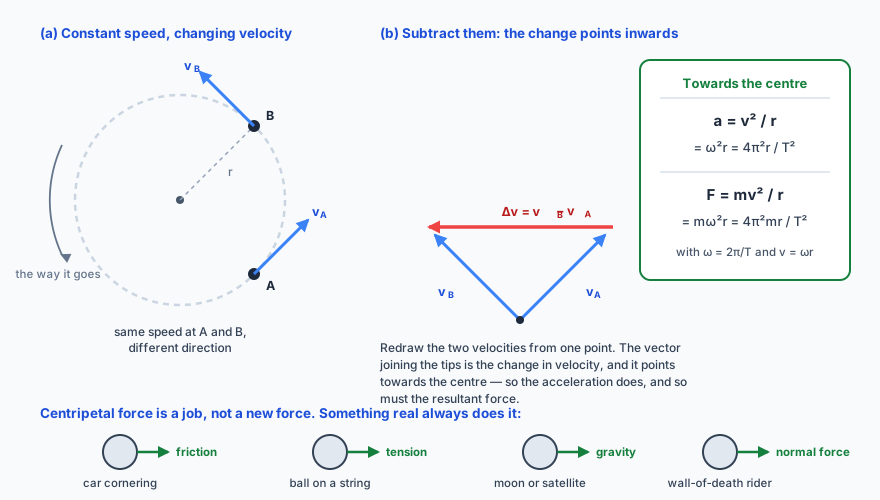
Angles in radians make the algebra work. An angle in radians is the arc length divided by the radius, \( \theta = s/r \), so a full circle is \( 2\pi \) rad. The angular velocity \( \omega \) is the angle turned per second, in rad s\(^{-1}\):
and the centripetal acceleration and force follow, each written three equivalent ways:
Because the centripetal force is always perpendicular to the velocity, it does no work and cannot change the speed. That is why a conical pendulum keeps a steady speed while its direction changes continuously, and why the horizontal component of the normal force on a banked track can turn a car with no help from friction at all.
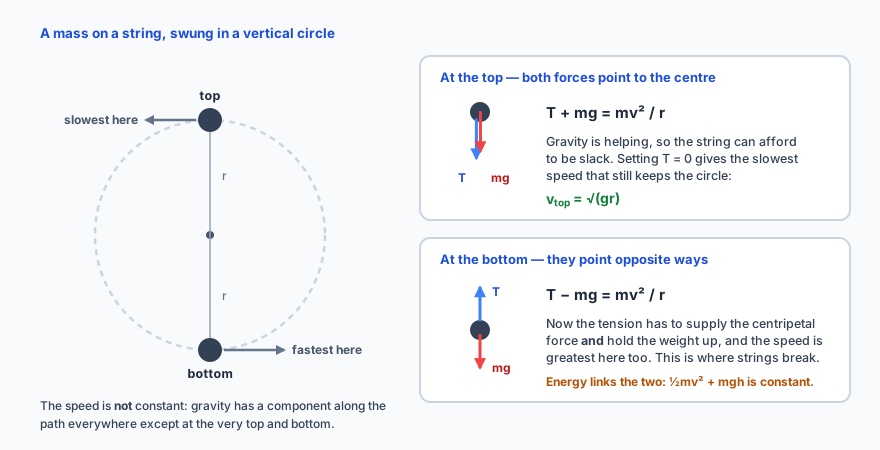
A vertical circle is the interesting case, because now gravity has a component along the path for most of the journey and the speed is no longer constant.
🔭See it happen
PhET, Collision Lab. Set the elasticity slider to 100% and then to 0% with the same starting velocities, and watch the momentum readout stay put while the kinetic energy readout collapses. That single comparison settles the difference between the two conservation statements better than any paragraph.
PhET, Forces and Motion: Basics. Turn on the force arrows and push a crate. The applied-force and friction arrows are drawn to scale, so you can watch friction match your push exactly, then break away and settle at a lower value — the graph on this page, happening live.
📝Practise
Work through these, then reveal the answer. Between them they cover every objective at the top of the page. Take \( g = 9.81 \) m s\(^{-2}\) throughout.
1. A 1.0 kg mass rests on a frictionless surface. A force of 1.0 N acts on it for exactly 1.0 s. How far does it move (a) in the first second, (b) in the first ten seconds?
(a) While the force acts, \( a = F/m = 1.0 \) m s\(^{-2}\), so \( s = \tfrac{1}{2}(1.0)(1.0)^{2} = 0.50 \) m.
(b) After 1.0 s the force is removed and the surface is frictionless, so by Newton’s first law the mass carries on at the speed it had reached, \( v = at = 1.0 \) m s\(^{-1}\). In the remaining 9.0 s it travels a further 9.0 m, giving 9.5 m in total.
The point of the question is part (b): nothing slows it down, so no force is needed to keep it going.
2. An insect of mass 2.8 g jumps vertically from rest, leaving the ground at 3.5 m s\(^{-1}\). Its body is accelerated over a distance of 42 mm during take-off. Calculate (a) the average force the ground exerts on it, and (b) the maximum height it reaches.
(a) During take-off, \( a = \dfrac{v^{2}}{2s} = \dfrac{3.5^{2}}{2(0.042)} = 146 \) m s\(^{-2}\). The ground’s push \(R\) must both accelerate the insect and support its weight: \( R - mg = ma \), so \( R = m(a + g) = 0.0028(146 + 9.81) = 0.44 \) N.
(b) After take-off it is in free fall, so \( h = \dfrac{v^{2}}{2g} = \dfrac{3.5^{2}}{2(9.81)} = 0.62 \) m — more than 200 times its own body length.
Forgetting the weight in part (a) gives 0.41 N, which is the resultant force, not the force from the ground.
3. A 1200 kg car travels at a constant 50 km h\(^{-1}\) and makes a 90° turn on a circular path of radius 22 m, keeping the same speed. Find (a) the time the turn takes, (b) the magnitude of the change in momentum, (c) the minimum coefficient of static friction needed for the car not to skid.
First convert: \( 50 \) km h\(^{-1} = 13.9 \) m s\(^{-1}\).
(a) A quarter of the circumference is \( \tfrac{1}{4}(2\pi \times 22) = 34.6 \) m, so \( t = 34.6/13.9 = 2.5 \) s.
(b) The momentum has the same magnitude before and after, \( p = 1200 \times 13.9 = 1.67 \times 10^{4} \) kg m s\(^{-1}\), but its direction has turned through 90°. The change is the vector difference, so \( |\Delta p| = \sqrt{2}\,p = 2.4 \times 10^{4} \) kg m s\(^{-1}\), directed at 45° to both — not zero, and not \(p\).
(c) The centripetal acceleration is \( a = v^{2}/r = 13.9^{2}/22 = 8.8 \) m s\(^{-2}\), supplied by friction: \( \mu mg \ge ma \), so \( \mu \ge a/g = 8.8/9.81 = 0.90 \). That is a high value — this is a fast turn for that radius.
4. A railway truck of mass 800 kg moving at 3.0 m s\(^{-1}\) collides with a stationary truck of mass 1200 kg. The two couple together. (a) Is the collision elastic? (b) Find their common velocity. (c) Find the impulse received by the 800 kg truck. (d) Estimate the energy lost.
(a) Inelastic — they stick together, so kinetic energy cannot be conserved.
(b) \( 800 \times 3.0 = 2000v \), so \( v = 1.2 \) m s\(^{-1}\).
(c) For the 800 kg truck, \( \Delta p = 800(1.2 - 3.0) = -1.4 \times 10^{3} \) N s: an impulse of 1440 N s opposing its original motion. (The other truck receives \(+1440\) N s — equal and opposite, as the third law requires.)
(d) Before: \( \tfrac{1}{2}(800)(3.0)^{2} = 3600 \) J. After: \( \tfrac{1}{2}(2000)(1.2)^{2} = 1440 \) J. So 2160 J — 60% of it — has gone into deformation, heat and sound.
5. Coal falls vertically onto a horizontal conveyor belt at a rate of 4.5 kg s\(^{-1}\). The belt runs at 2.5 m s\(^{-1}\). (a) Estimate the minimum force needed to keep the belt moving at that speed. (b) Explain why the real force is larger.
(a) Each second, 4.5 kg of coal has to be brought from rest to 2.5 m s\(^{-1}\) horizontally, so \( F = \dfrac{\Delta p}{\Delta t} = 4.5 \times 2.5 = 11 \) N. Note that \( F = ma \) is useless here: the mass on the belt is changing, so the momentum form of the second law is the one that works.
(b) Because the belt also has to overcome friction in its rollers and bearings, and coal that lands and slips before matching the belt’s speed wastes further energy. 11 N is a floor, not a prediction.
6. A block of mass \(M\) rests on a horizontal surface which is slowly tilted. At an angle \(\theta\) the block just begins to slide. (a) Derive an expression for the coefficient of static friction. (b) Once it is moving, does it slide at constant velocity or accelerate?
(a) While it is still at rest, resolving along and perpendicular to the slope gives \( F = Mg\sin\theta \) and \( R = Mg\cos\theta \). At the angle where it just slides, friction is at its maximum, \( F = \mu_s R \). Dividing one by the other, the mass and \(g\) cancel: \( \mu_s = \tan\theta \).
(b) It accelerates. Once sliding starts the friction available drops from \( \mu_s R \) to \( \mu_d R \), and \( \mu_d < \mu_s \), so the component of weight down the slope now exceeds the friction and there is a resultant force. This is why a block that finally gives way tends to lurch rather than creep.
7. A fairground ride is a hollow cylindrical room of radius 2.5 m that spins about its vertical axis. People stand against the wall. When the wall is moving at 9.0 m s\(^{-1}\) the floor is lowered and they stay put. (a) What provides the horizontal force on a person? (b) Estimate the minimum coefficient of friction between a person and the wall.
(a) The normal force from the wall, pushing them horizontally inwards towards the axis. It is the centripetal force — not an extra force, just the wall pushing.
(b) That normal force is \( N = \dfrac{mv^{2}}{r} \). Vertically, friction must hold the person’s whole weight: \( \mu N \ge mg \). Substituting, \( \mu \ge \dfrac{gr}{v^{2}} = \dfrac{9.81 \times 2.5}{9.0^{2}} = 0.30 \). The mass cancels — the ride works the same for everyone, which is just as well.
8. A small mass on a string moves in a vertical circle of radius \(r\) where the gravitational field strength is \(g\). Deduce (a) the minimum speed it must have at the top of the circle, and (b) the minimum speed at the bottom.
(a) At the top, both the tension and the weight point downwards, towards the centre: \( T + mg = \dfrac{mv^{2}}{r} \). The slowest possible pass is when the string goes slack, \( T = 0 \), leaving \( mg = \dfrac{mv^{2}}{r} \), so \( v_{top} = \sqrt{gr} \). Gravity alone is then providing exactly the centripetal force needed.
(b) The string does no work (it is always perpendicular to the velocity), so mechanical energy is conserved between the top and the bottom, a height \(2r\) below: \( \tfrac{1}{2}mv_{bot}^{2} = \tfrac{1}{2}mv_{top}^{2} + mg(2r) \). With \( v_{top}^{2} = gr \) this gives \( v_{bot}^{2} = gr + 4gr = 5gr \), so \( v_{bot} = \sqrt{5gr} \) — more than twice the speed at the top.
9. A book rests on a table. Name the partner of each of the two forces acting on the book, saying what type each is and what it acts on.
The book feels two forces: the Earth’s gravitational pull downwards, and the table’s contact push upwards.
The partner of the gravitational pull is the book’s gravitational pull on the Earth, upwards, and equally large.
The partner of the table’s push is the book’s push down on the table, a contact force.
The two forces on the book are not a third-law pair, even though they happen to be equal here: they act on the same object, and they are different types of force. Tilt the table and they stop being equal, while both third-law pairs stay equal exactly as before.
10. A 2.0 kg gun fires a 4.0 g bullet at 100 m s\(^{-1}\). Find the recoil velocity of the gun, and explain what happens to the kinetic energy.
Total momentum before is zero, and no external horizontal force acts, so it stays zero: \( 0 = (0.0040)(100) + 2.0v \), giving \( v = -0.20 \) m s\(^{-1}\) — 0.20 m s\(^{-1}\) backwards.
Kinetic energy has increased from zero to \( \tfrac{1}{2}(0.0040)(100)^{2} + \tfrac{1}{2}(2.0)(0.20)^{2} = 20.0 + 0.04 = 20 \) J, released by the propellant. That is what an explosion is: momentum conserved, kinetic energy created. Notice how lopsidedly it is shared — the light bullet takes essentially all of it, because for a given momentum the kinetic energy \( p^{2}/2m \) is larger for the smaller mass.
🔗Go deeper — other people’s work
These are external resources, not mine. If one stops working, tell me and everything above it on this page still stands.
- The Physics Classroom — Newton’s Laws, and Momentum and Collisions
- The Physics Classroom — Circular Motion and Satellite Motion
- The Physics Hypertextbook — momentum and impulse
- PhET — Collision Lab, and Forces and Motion: Basics