Theme B · The particulate nature of matter · SL and HL
A gas is the one state of matter where the microscopic and the macroscopic descriptions can be joined by a short piece of algebra. On one side, pressure, volume and temperature — three quantities you can measure with a gauge, a ruler and a thermometer. On the other, \(10^{23}\) molecules bouncing around at random. The kinetic model connects them in a few lines, and the reward is that \( pV = nRT \) stops being a formula to memorise and becomes something you could have predicted.
🎯What you need to be able to do
Use the mole, molar mass and the Avogadro constant, and convert between mass, moles and number of molecules.
Explain gas pressure in terms of the momentum change of molecules colliding with the walls.
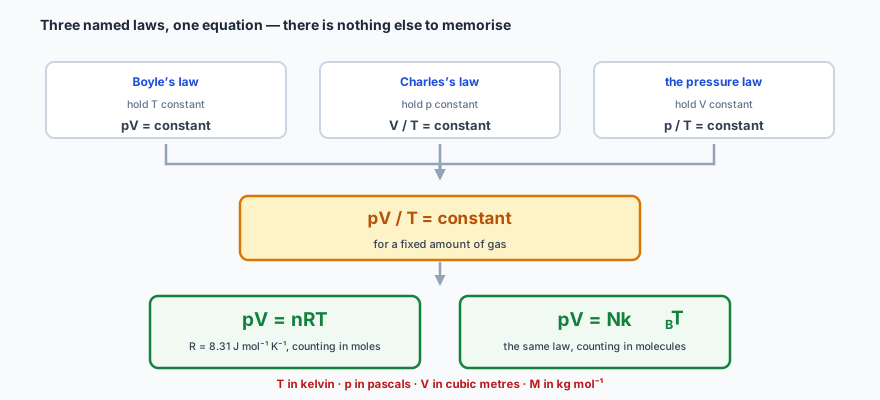
State and use Boyle’s law, Charles’s law and the pressure law, and recognise each as a special case of one equation.
Apply \( pV = nRT \) and \( pV = Nk_{\text{B}}T \), and the combined form \( p_1V_1/T_1 = p_2V_2/T_2 \).
State the assumptions of the kinetic model of an ideal gas.
Use \( pV = \frac{1}{3}Nm\overline{c^{2}} \) and \( \overline{E_{\text{k}}} = \frac{3}{2}k_{\text{B}}T \), and find a root mean square speed.
Use \( U = \frac{3}{2}nRT \) for the internal energy of an ideal monatomic gas.
Say when a real gas stops behaving like an ideal one, and why.
🔢Counting molecules: the mole
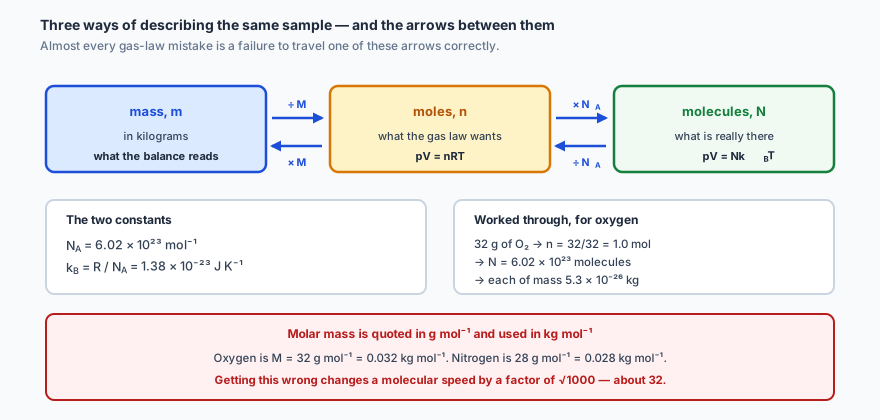
Molecules are far too numerous to count individually, so chemistry and physics both count them in moles. One mole of any substance contains the same number of particles — the Avogadro constant:
Three descriptions of one sample. Almost every gas-law mistake is a failure to move correctly between them — usually a mass in grams pushed into a formula that wants moles.
The molar mass \(M\) is the mass of one mole. It is numerically the relative molecular mass in grams, so oxygen gas (O\(_2\), relative molecular mass 32) has \( M = 32 \) g mol\(^{-1}\) \( = 0.032 \) kg mol\(^{-1}\). Watch that conversion: SI wants kilograms.
💧Where gas pressure comes from
Pressure is force per unit area, \( p = F/A \), measured in pascals. In a gas that force is not applied by anything solid — it is the accumulated effect of molecules bouncing off the wall.
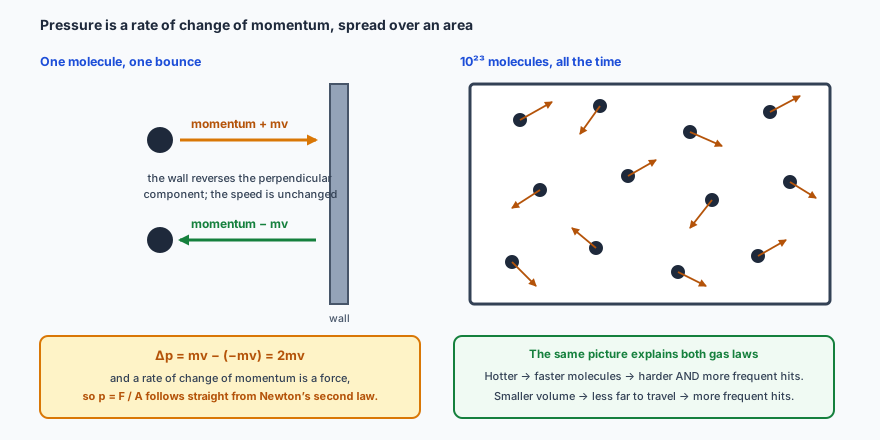
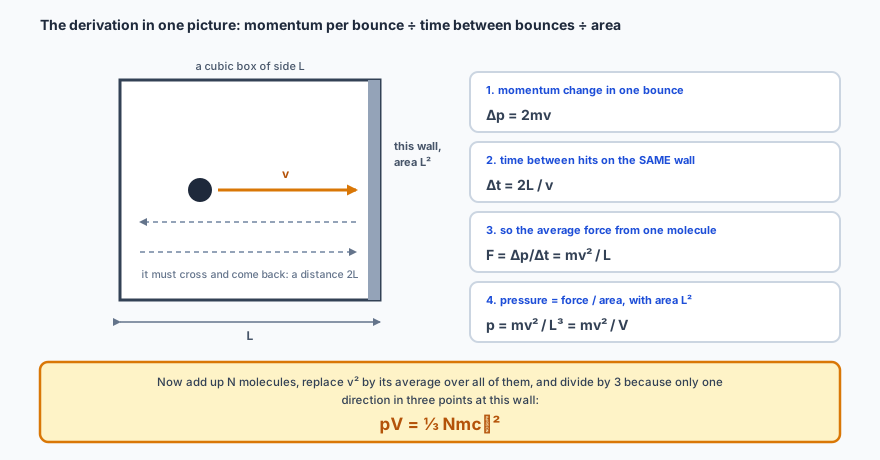
One collision gives a momentum change of \(2mv\); pressure is what an enormous number of them per second, spread over the wall’s area, adds up to.
Each collision reverses the component of the molecule’s momentum perpendicular to the wall, from \( +mv \) to \( -mv \), a change of \( 2mv \). By Newton’s second law a rate of change of momentum is a force, and pressure is that force per unit area, averaged over an enormous number of collisions. That single picture explains both of the gas laws below:
Raise the temperature and the molecules move faster, so each collision transfers more momentum and collisions happen more often. Pressure rises.
Reduce the volume and the molecules have less far to travel between walls, so collisions become more frequent at the same speed. Pressure rises.
📈The three gas laws, and why they are one law
Hold one of the three variables fixed and the other two are related simply. The three named laws are the three ways of doing that.
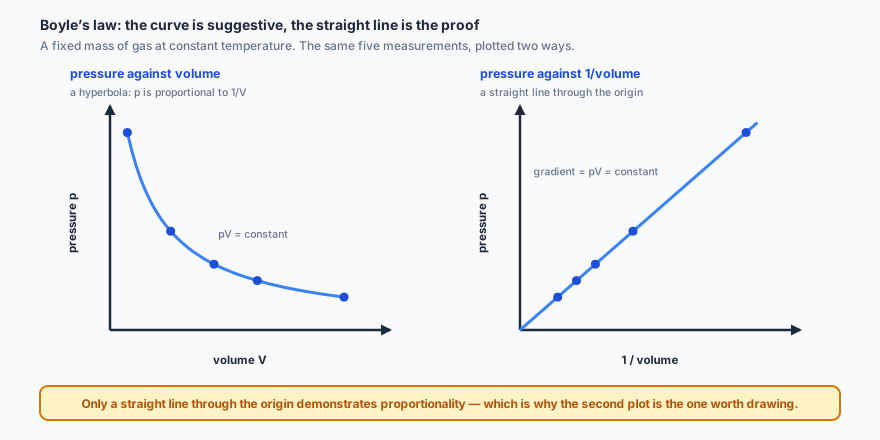
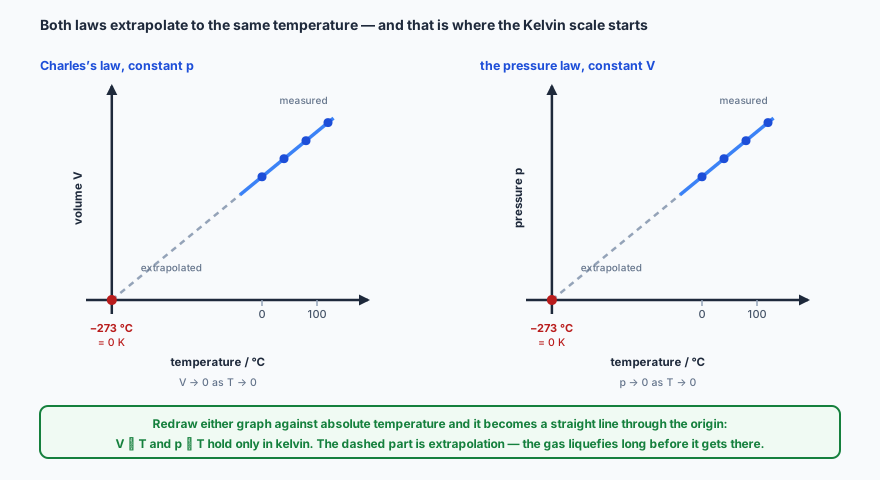
Boyle’s law, at constant temperature. The curve on the left is suggestive; the straight line on the right is the proof, which is why examiners keep asking for the second plot.Charles’s law and the pressure law. Both extrapolate to the same point, and that point is where the Kelvin scale gets its zero — absolute zero is not a separate idea bolted on, it falls out of gas measurements.
They are not three facts. They are one fact looked at from three directions, and the single equation behind all of them is the ideal gas law:
Rearrange \( pV = nRT \) with one variable fixed and each named law drops out. There is nothing to memorise beyond the one equation.
\( pV = nRT \)
\( pV = Nk_{\text{B}}T \)
\( \dfrac{p_1V_1}{T_1} = \dfrac{p_2V_2}{T_2} \)
with \( R = 8.31 \) J mol\(^{-1}\) K\(^{-1}\).
Three unit traps, and they cost more marks than the physics does. Temperature is in kelvin, always, without exception — these are proportionalities, not differences. Volume is in cubic metres, so a 2.0 litre container is \( 2.0\times10^{-3} \) m\(^{3}\). Molar mass is in kg mol\(^{-1}\), so oxygen is 0.032, not 32. The combined form \( p_1V_1/T_1 = p_2V_2/T_2 \) is more forgiving: since it is a ratio, consistent units on both sides will do — but the temperatures still have to be absolute.
✏️Worked example 1 — from grams to molecules
A container holds 64 g of oxygen gas (\( M = 32 \) g mol\(^{-1}\)) at 27 °C in a volume of 0.010 m\(^{3}\). Find the number of moles, the number of molecules, and the pressure.
\[ n = \frac{m}{M} = \frac{64}{32} = 2.0\ \text{mol} \qquad N = nN_{\text{A}} = 2.0 \times 6.02\times10^{23} = 1.2\times10^{24} \]
Now convert the temperature before touching the gas law: \( T = 27 + 273 = 300 \) K.
Is that sensible? Atmospheric pressure is about \( 1.0\times10^{5} \) Pa, so this is about 5 atmospheres — a plausible cylinder pressure. Had the temperature gone in as 27 rather than 300, the answer would have been \( 4.5\times10^{4} \) Pa, below atmospheric, which for a sealed 64 g of oxygen in ten litres should look immediately wrong.
✏️Worked example 2 — a bubble rising
A bubble of volume 1.5 cm\(^{3}\) is released at the bottom of a lake where the pressure is \( 3.0\times10^{5} \) Pa and the temperature is 7 °C. Find its volume just below the surface, where the pressure is \( 1.0\times10^{5} \) Pa and the temperature is 27 °C.
The amount of gas does not change, so use the combined form. Convert both temperatures: 280 K and 300 K.
Two effects, and one of them is small. The pressure drop alone would treble the volume to 4.5 cm\(^{3}\); the warming adds only another 7%. Notice also that the volumes stayed in cm\(^{3}\) throughout — in a ratio equation the units cancel, so only the temperatures had to be converted. That is the one place the combined form is kinder than \( pV = nRT \).
🧪The kinetic model of an ideal gas
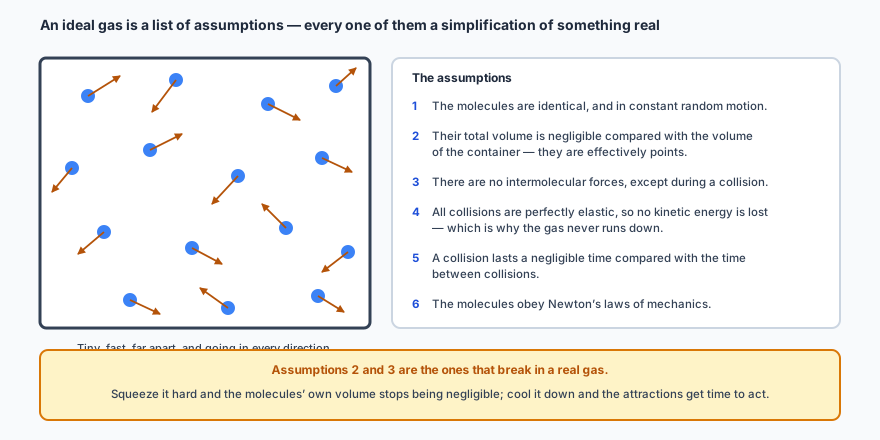
An ideal gas is a model, defined by a short list of assumptions. Everything that follows is a consequence of them.
Every assumption is a simplification of something real, which is why the model eventually fails — and knowing which assumption breaks tells you exactly when.
Following one molecule bouncing between two walls, and then averaging over all of them, gives the central result of the model:
The whole derivation in one picture: momentum change per bounce, divided by the time between bounces, divided by the wall’s area, summed over every molecule.
\[ pV = \tfrac{1}{3}Nm\overline{c^{2}} \]
where \( \overline{c^{2}} \) is the mean square speed of the molecules. Now set that equal to \( pV = Nk_{\text{B}}T \) and the \(N\) and \(p\) and \(V\) all cancel:
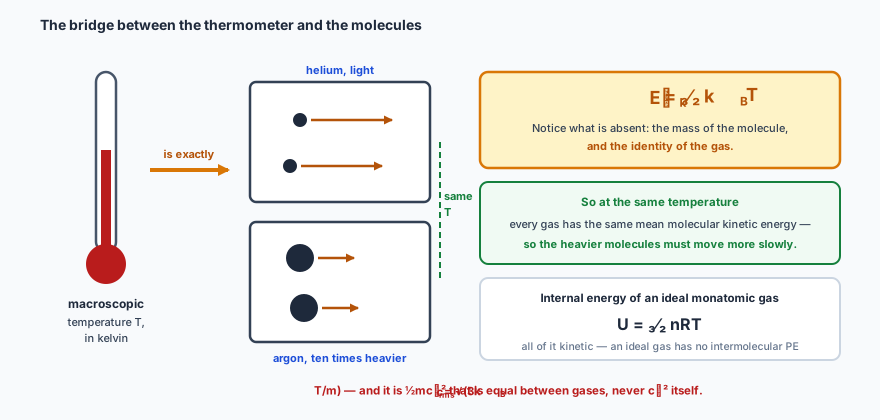
The thermometer on the left and the molecules on the right are the same information. Note what is absent from the equation: the mass of the molecule, and the identity of the gas.
Two consequences worth stating precisely:
At the same temperature, every gas has the same average molecular kinetic energy. Helium and xenon at 300 K are equally energetic per molecule. Since xenon molecules are far heavier, they must be moving far more slowly — \( \frac{1}{2}m\overline{c^{2}} \) is what is equal, not \( \overline{c^{2}} \).
An ideal gas has no intermolecular potential energy, by assumption. So its internal energy is entirely kinetic, and for a monatomic gas
\[ U = N \times \tfrac{3}{2}k_{\text{B}}T = \tfrac{3}{2}nRT \]
The root mean square speed follows by rearranging: \( c_{\text{rms}} = \sqrt{\overline{c^{2}}} = \sqrt{3k_{\text{B}}T/m} \). It is not quite the average speed — squaring first weights the fast molecules more heavily — but it is the speed the model naturally produces.
✏️Worked example 3 — how fast is a nitrogen molecule?
Find the mean kinetic energy and the root mean square speed of a nitrogen molecule at 27 °C. Nitrogen has a molar mass of 28 g mol\(^{-1}\); \( k_{\text{B}} = 1.38\times10^{-23} \) J K\(^{-1}\).
The mass of one molecule comes from the molar mass divided by the Avogadro constant, in kilograms:
\[ m = \frac{0.028}{6.02\times10^{23}} = 4.65\times10^{-26}\ \text{kg} \]
About 520 m s\(^{-1}\) — faster than sound, and it should be. Sound travels through air by molecular collisions, so its speed (340 m s\(^{-1}\)) must be of the same order as, and somewhat less than, the molecular speed. If your answer had come out at 5 m s\(^{-1}\) or 50 km s\(^{-1}\), the molar mass almost certainly went in as 28 rather than 0.028.
⚠️When a real gas stops behaving
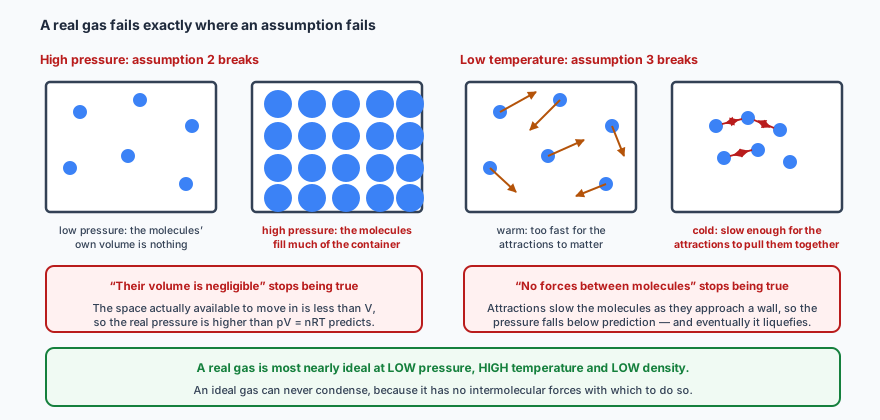
Real gases follow \( pV = nRT \) remarkably well over the everyday range, and then stop. The model fails exactly where its assumptions do.
Each failure is one assumption breaking. That is the useful way to remember them — not as a list of conditions, but as a list of which idealisation gave way.
So a real gas behaves most like an ideal one at low pressure, high temperature and low density — conditions that keep the molecules far apart and fast-moving, which is exactly what the assumptions require. Near liquefaction the model has nothing useful to say at all: an ideal gas, by construction, can never condense, because it has no intermolecular forces to condense it.
🔭See it happen
PhET, Gases Intro. Shrink the container at fixed temperature and watch the
pressure gauge climb while the speed distribution stays put — that is Boyle’s law with
the mechanism visible. Then heat the gas at fixed volume and watch the same gauge climb for a
completely different reason: the molecules are hitting harder, not more often per unit length.
📝Practise
Work through these, then reveal the answer. Each question targets a different objective from the list above.
1. How many molecules are there in 8.0 g of helium? Take \( M = 4.0 \) g mol\(^{-1}\).
\( n = m/M = 8.0/4.0 = 2.0 \) mol, so \( N = nN_{\text{A}} = 2.0 \times 6.02\times10^{23} = 1.2\times10^{24} \) molecules.
2. A gas at \( 1.0\times10^{5} \) Pa occupies 2.0 m\(^{3}\). It is compressed at constant temperature to 0.50 m\(^{3}\). Find the new pressure.
Constant temperature, so \( p_1V_1 = p_2V_2 \): \( p_2 = (1.0\times10^{5} \times 2.0)/0.50 = 4.0\times10^{5} \) Pa. Quarter the volume, four times the pressure — the molecules hit the walls four times as often.
3. Explain, in terms of molecules, why the pressure of a gas rises when it is heated in a sealed rigid container.
Raising the temperature raises the average kinetic energy of the molecules, so they move faster. Each collision with the wall then involves a larger change of momentum, and because they are travelling faster they also strike the wall more frequently. Both effects increase the average rate of change of momentum at the wall, which is the force; the area is unchanged, so the pressure rises.
4. 0.50 mol of an ideal gas is held at 320 K in a container of volume \( 8.0\times10^{-3} \) m\(^{3}\). Find the pressure.
5. A fixed mass of gas at 27 °C and \( 2.0\times10^{5} \) Pa is heated at constant volume to 127 °C. Find the new pressure.
Constant volume, so \( p_1/T_1 = p_2/T_2 \) with \( T \) in kelvin: 300 K and 400 K. \( p_2 = 2.0\times10^{5} \times 400/300 = 2.7\times10^{5} \) Pa. Using 27 and 127 instead would give \( 9.4\times10^{5} \) Pa — wrong by a factor of three and a half.
6. State four assumptions of the kinetic model of an ideal gas.
Any four of: the molecules are identical and in constant random motion; their total volume is negligible compared with the volume of the container; there are no intermolecular forces except during collisions; all collisions are perfectly elastic, so no kinetic energy is lost; the time a collision lasts is negligible compared with the time between collisions; the molecules obey Newton’s laws of mechanics.
7. Find the mean kinetic energy of a molecule in any gas at 500 K.
\( \overline{E_{\text{k}}} = \frac{3}{2}k_{\text{B}}T = 1.5 \times 1.38\times10^{-23} \times 500 = 1.0\times10^{-20} \) J. The question says “any gas” on purpose: the answer does not depend on which gas, because mean kinetic energy depends only on absolute temperature.
8. Helium (\( M = 4.0 \) g mol\(^{-1}\)) and argon (\( M = 40 \) g mol\(^{-1}\)) are at the same temperature. Compare their molecules’ mean kinetic energies and their root mean square speeds.
The mean kinetic energies are equal, since both equal \( \frac{3}{2}k_{\text{B}}T \) and the temperature is the same. For the speeds, \( \frac{1}{2}m\overline{c^{2}} \) is equal, so \( \overline{c^{2}} \propto 1/m \) and \( c_{\text{rms}} \propto 1/\sqrt{m} \). Argon molecules are 10 times heavier, so their rms speed is smaller by a factor of \( \sqrt{10} = 3.2 \).
9. Find the internal energy of 3.0 mol of an ideal monatomic gas at 400 K, and say why the answer would be different for a real gas.
\( U = \frac{3}{2}nRT = 1.5 \times 3.0 \times 8.31 \times 400 = 1.5\times10^{4} \) J. For an ideal gas all the internal energy is kinetic, because the model assumes there are no intermolecular forces and therefore no intermolecular potential energy. A real gas does have such forces, so it also stores potential energy, and its internal energy would be different.
10. Under what conditions does a real gas behave least like an ideal gas, and which assumption fails in each case?
At high pressure (or high density) the molecules are forced close together, so their own volume is no longer negligible compared with the container’s — the point-particle assumption fails. At low temperature the molecules move slowly, so the intermolecular attractions have time to act on them — the no-forces assumption fails, and near the boiling point the gas condenses, which an ideal gas can never do. A real gas is therefore most nearly ideal at low pressure and high temperature.
🔗Go deeper — other people’s work
These are external resources, not mine. If one stops working, tell me and
everything above it on this page still stands.