D.2 gave you the fields. This page is what happens to a charged particle dropped into them —
and the two field types do completely different things to it, which is the whole point.
🎯What you need to be able to do
Use \( F = BIL\sin\theta \) for a current in a magnetic field, and define the tesla from it.
Apply Fleming’s left-hand rule to a current in a field, and know when the right-hand rule is the one you want instead.
Use \( F = qvB\sin\theta \) for a charge moving in a magnetic field, and find its direction — including for a negative charge.
Explain why a magnetic force does no work, and why that forces the path to be a circle.
Use \( r = mv/qB \) and \( T = 2\pi m/qB \), and say what each does and does not depend on.
Describe and analyse the parabolic path of a charge in a uniform electric field.
Analyse crossed fields, derive \( v = E/B \), and explain the velocity selector.
Put the two together to explain how a mass spectrometer works, and how Thomson measured \( e/m_e \).
HLCalculate the field a current makes: \( B = \mu_0 I/2\pi r \) for a straight wire and \( B = \mu_0 nI/L \) for a solenoid.
HLUse \( F/L = \mu_0 I_1I_2/2\pi r \) for two parallel wires, and explain how it defines the ampere.
⚙️The force on a current in a field
A wire carrying a current across a magnetic field feels a force. This is the motor
effect, and it is where every electric motor and every loudspeaker comes from.
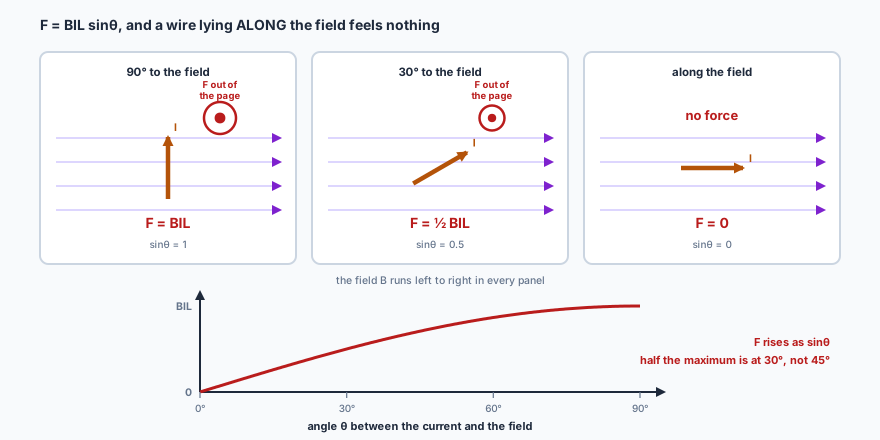
\[ F = BIL\sin\theta \]
where \(\theta\) is the angle between the current and the field. The \(\sin\theta\) is doing
real work: a wire lying along the field feels no force at all.
The force is perpendicular to both the current and the field, so with both drawn in the plane of the page it points out of it. That is also why the rule for its direction needs a hand rather than a diagram.
Rearranged, this equation is what defines magnetic field strength:
\[ B = \frac{F}{IL\sin\theta} \]
The unit is the tesla: 1 T is the field that puts 1 N on a 1 m length of wire
carrying 1 A at right angles to it, so \( 1\ \text{T} = 1\ \text{N A}^{-1}\ \text{m}^{-1} \).
You will also see \(B\) called the magnetic flux density, and its unit written as
Wb m\(^{-2}\) — the same quantity under a name that makes more sense once you reach D.4.
👈Fleming’s rules: which hand, and when
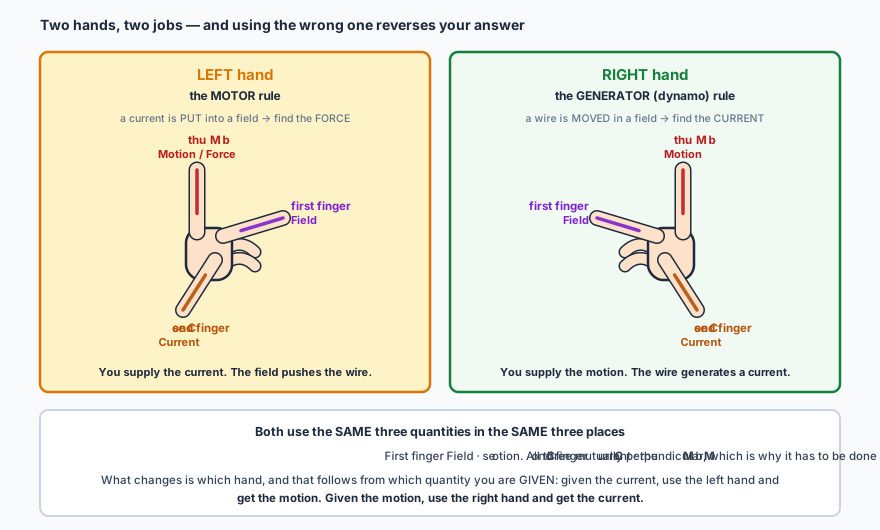
The size of the force comes from \( F = BIL\sin\theta \). Its direction comes
from Fleming’s left-hand rule: hold the thumb, first finger and second finger
of your left hand mutually perpendicular, point the first finger along the
Field and the seCond finger along the Current, and
the thuMb gives the Motion — the direction of the force.
Left for motors, right for generators. The letters are the same in both — first finger Field, seCond finger Current, thuMb Motion — so the only thing to get right is which hand.Which hand? Ask what you are GIVEN. If the current is given and you want the force
— a motor, a wire on rails being pushed by the field, a moving charge being deflected —
it is the left hand. If the motion is given and you want the induced
current — a generator, a magnet pushed into a coil, the rod of D.4 — it is the
right hand. Using the wrong one does not give a nearly-right answer; it gives
exactly the reverse. And do not confuse either with the right-hand grip rule from D.2,
which is a different gesture answering a different question: the shape of the field around a
current.
✏️Worked example 1 — a wire at an angle
A straight wire of length 0.25 m carries a current of 3.0 A in a uniform magnetic field of
0.40 T. Find the force on it when the wire is at 90° to the field, at 30° to it, and
along it.
At 90°: \( F = BIL\sin 90^\circ = 0.40 \times 3.0 \times 0.25 \times 1 = 0.30 \) N.
At 30°: \( F = 0.30 \times \sin 30^\circ = 0.30 \times 0.5 = 0.15 \) N.
Along the field (0°): \( F = 0.30 \times \sin 0^\circ = 0 \). No force at all.
Halving at 30°, not at 45°. The force is half the maximum when
\( \sin\theta = 0.5 \), which is 30° — a favourite trap, because 45° feels like
the halfway angle and actually gives \( 0.707 \times \) the maximum. The third answer is worth
keeping as a sanity check on your geometry: if your wire is parallel to the field and you have
calculated a force, you have used the wrong angle.
⚡The magnetic force needs movement, and it needs it across the field
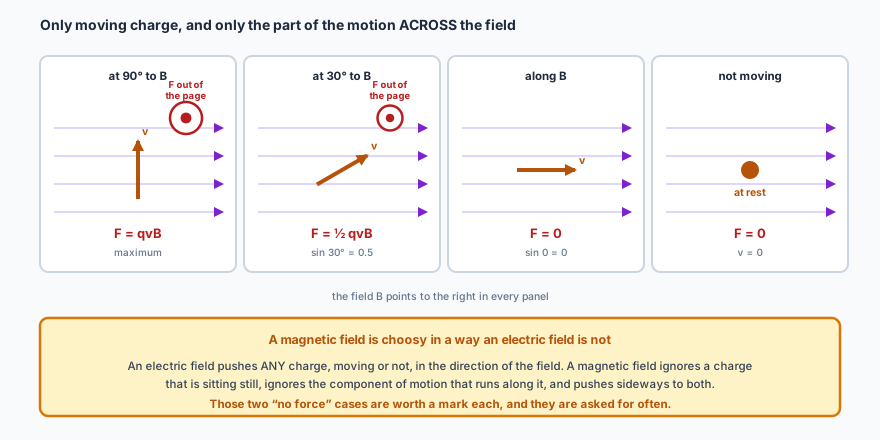
\[ F = qvB\sin\theta \]
with \(\theta\) the angle between the velocity and the field. Two consequences are worth fixing
before anything else, because questions test them directly:
A stationary chargefeels NO magnetic force, however strong the field
A charge moving along the fieldfeels no force either, because \( \sin 0 = 0 \)
A magnetic field is choosy in a way an electric field is not: it acts only on charge that is moving, and only on the component of that motion across the field.
👈Direction — and the reversal that catches everyone
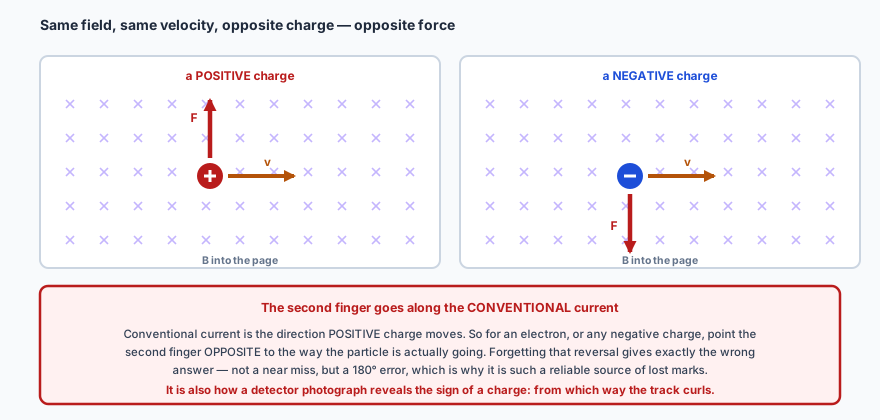
Direction comes from Fleming’s left-hand rule, with the second finger along the
conventional current. Conventional current is the direction positive charge moves.
So for an electron, or any negative charge, point the second finger opposite to the way the
particle is actually going.
Same field, same velocity, opposite charge — opposite force. This is exactly how the sign of a particle’s charge is read off a detector photograph: from which way the track curls.
🚫A magnetic force does no work. Ever.
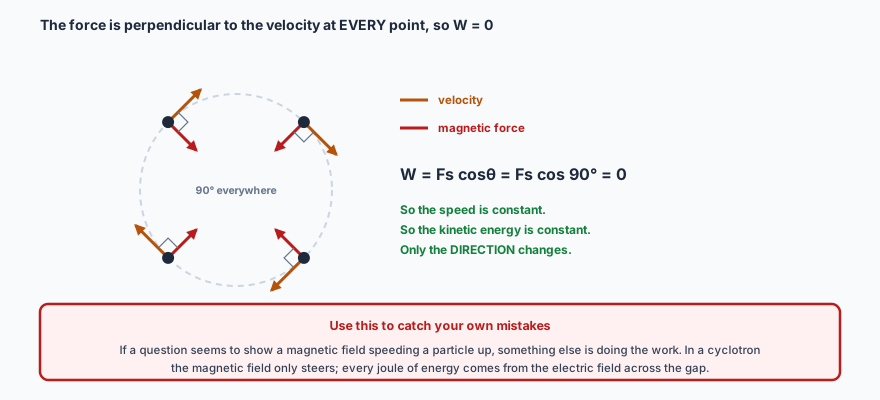
The force is always perpendicular to the velocity, and work is
\( W = Fs\cos\theta \) with \(\theta = 90^\circ\), so \( W = 0 \). The consequence is absolute: a
magnetic field can change a particle’s direction, but never its speed and never its
kinetic energy.
If an exam question has a magnetic field increasing a particle’s kinetic energy, either something else is doing the work or the question means an electric field. This is a reliable way to catch your own mistakes.
⭯So the path is a circle
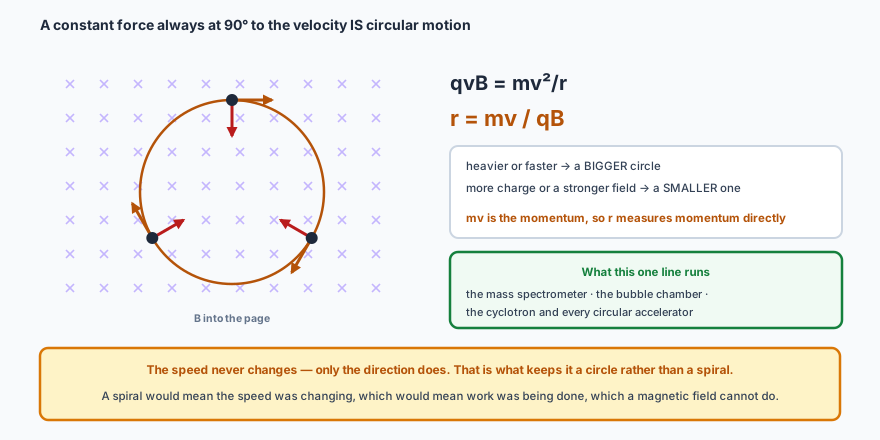
A force of constant magnitude that is always perpendicular to the velocity is precisely the
condition for circular motion. Set the magnetic force equal to the centripetal requirement:
\[ qvB = \frac{mv^{2}}{r} \qquad\Longrightarrow\qquad r = \frac{mv}{qB} \]
\( r = mv/qB \) is the most useful single line on this page. Note that \(mv\) is the momentum, so the radius of a track is a direct measurement of a particle’s momentum — which is what detector photographs are actually for.
✏️Worked example 2 — an electron in a weak field
An electron travels at \( 2.0\times10^{6} \) m s\(^{-1}\) perpendicular to a magnetic field of
0.50 mT. Find the radius of its path and the time for one revolution.
(\( m_e = 9.11\times10^{-31} \) kg, \( e = 1.60\times10^{-19} \) C.)
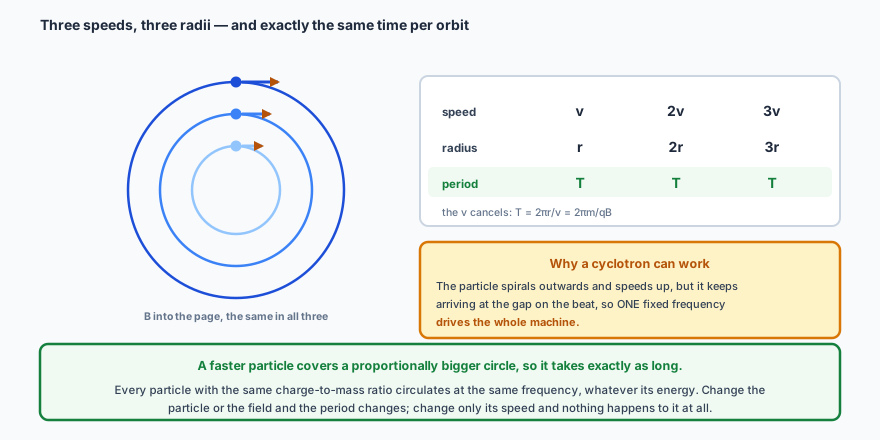
Now double the speed. The radius doubles to 4.6 cm — but \(T\) does not
change at all, because \(v\) does not appear in it. The faster particle goes round a bigger circle
in exactly the same time. That is not a coincidence, it is the whole basis of the next section.
The \(v\) cancels. A fast particle traces a proportionally bigger circle, so it takes exactly as
long to get round. Every particle of the same charge-to-mass ratio circulates at the same frequency
regardless of its energy.
This is why a cyclotron can work at all. The particle speeds up and spirals outwards, but it keeps arriving at the accelerating gap on the beat — so one fixed frequency drives the whole machine.
📈An electric field does something completely different
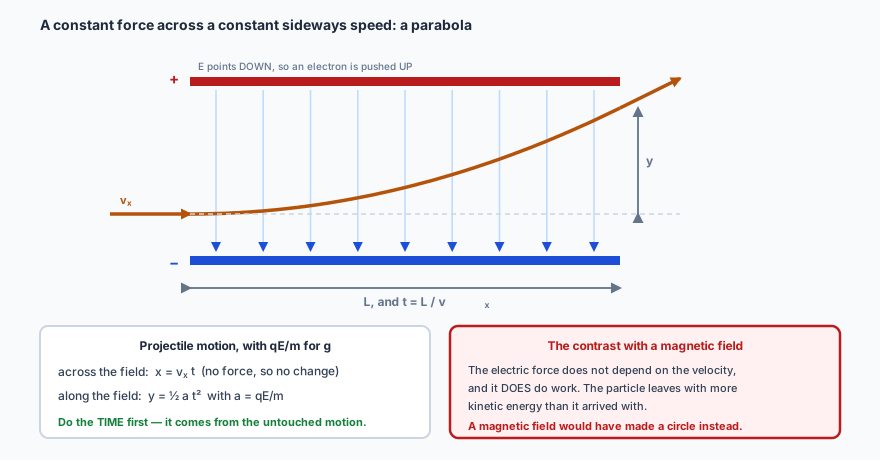
The electric force \( F = qE \) is constant in size and direction and does not
depend on the velocity at all. Fire a charge across a uniform field and it keeps its steady sideways
speed while accelerating uniformly along the field — which is projectile motion, with
\( qE/m \) in place of \(g\). The path is a parabola.
Identical mathematics to a ball thrown horizontally. The one thing to carry over from mechanics: the sideways velocity is untouched, so the time in the field is set entirely by the plate length and the entry speed.
✏️Worked example 3 — deflecting a beam
An electron enters a uniform field of \( 2.0\times10^{4} \) V m\(^{-1}\) at
\( 3.0\times10^{7} \) m s\(^{-1}\), travelling parallel to plates 8.0 cm long. Find its deflection
on leaving.
Time in the field, from the unchanged horizontal motion:
\( t = L/v_x = 0.080 / 3.0\times10^{7} = 2.67\times10^{-9} \) s.
Acceleration across the field:
\( a = qE/m = (1.60\times10^{-19} \times 2.0\times10^{4}) / 9.11\times10^{-31} = 3.5\times10^{15} \)
m s\(^{-2}\).
Do the time first, always. Every part of this hangs off \(t\), and \(t\) comes
from the horizontal motion, which the field never touches. Students who start with the vertical
motion have nothing to work with. Note too that the electron leaves faster than it arrived
(\( v_y = at = 9.4\times10^{6} \) m s\(^{-1}\) has been added sideways) — the electric field
has done work, unlike every magnetic field on this page.
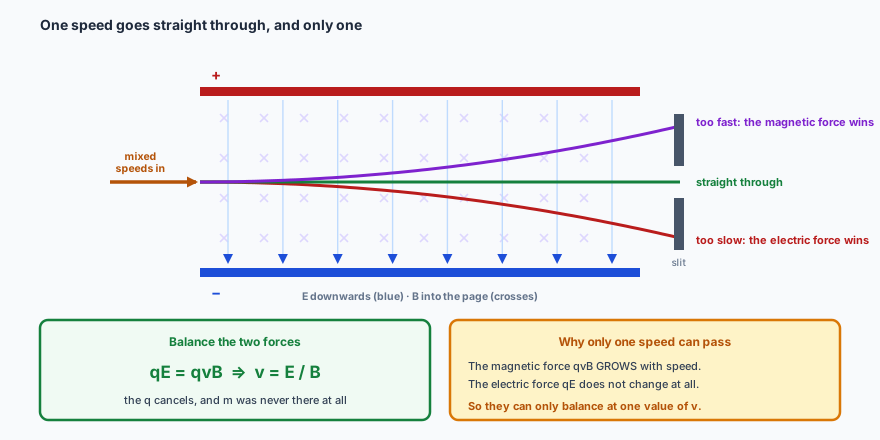
❎Crossed fields: the velocity selector
Put \(E\) and \(B\) perpendicular to each other and both perpendicular to the beam, arranged so
the electric force opposes the magnetic one. A particle goes straight through only if the two
balance:
\[ qE = qvB \qquad\Longrightarrow\qquad v = \frac{E}{B} \]
The magnetic force grows with speed and the electric force does not — which is the whole mechanism. Too slow and the electric force wins; too fast and the magnetic force does; only one speed passes.\( v = E/B \) contains no \(q\) and no \(m\). Both cancelled, so a velocity
selector cannot sort by charge or by mass — it sorts purely by speed, and it selects the same
speed for an electron, a proton and a uranium ion alike. That is not a limitation, it is the point:
it delivers a beam of known, single speed to whatever comes next.
✏️Worked example 4 — the selector
A velocity selector uses an electric field of \( 3.0\times10^{4} \) V m\(^{-1}\) and a magnetic
field of 0.15 T. What speed passes straight through, and what happens to an ion travelling at
\( 1.0\times10^{5} \) m s\(^{-1}\)?
The slower ion, at \( 1.0\times10^{5} \) m s\(^{-1}\), has a magnetic force
\( qvB \) only half as large as it needs, while the electric force \( qE \) is unchanged. The
electric force therefore wins and the ion is deflected in the direction of the electric
force, missing the exit slit.
The reasoning, not the arithmetic, is what earns the marks here. The key sentence
is that \(qvB\) depends on speed and \(qE\) does not, so the balance can only hold at one speed.
Note that the answer would be identical for any charge and any mass.
🔬Where this came from — Thomson and the electron
In 1897 J. J. Thomson used exactly this arrangement to show that “cathode rays” were
moving charged particles, and to measure their charge-to-mass ratio — the discovery of the
electron.
Step 1. With both fields off, the beam goes straight and marks a spot on a
fluorescent screen.
Step 2. Switch on the magnetic field alone. The beam bends into a circular arc,
which shows the rays carry charge, and the direction of the bend gives the sign.
Step 3. Add the electric field and adjust it until the spot returns to its
original place. The two forces now balance, so \( qvB = qE \) and the speed is known:
\( v = E/B \) — the velocity selector again.
Step 4. Turn the electric field off and measure the radius of the magnetic
deflection. From \( r = mv/qB \),
Notice what he could and could not measure. Every quantity on the right is
something you can read off the apparatus, so \( e/m_e \) came out cleanly — but \(e\)
and \(m_e\) separately did not, because they only ever appear as a ratio. It took
Millikan’s oil drops (D.2) to pin down \(e\), and only then could the electron’s
mass be calculated. Two experiments, fifteen years apart, and neither is enough alone.
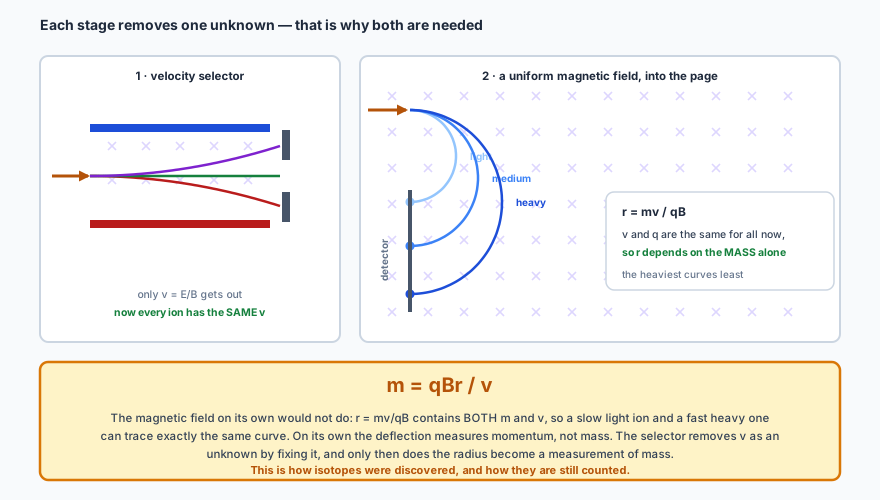
🔬Putting both together: the mass spectrometer
A velocity selector sorts by speed but not by mass; a magnetic field alone bends by \( r = mv/qB \),
which mixes speed and mass together. Chain them and each does the job the other cannot: the selector
guarantees one known speed, so the radius in the second field then depends on mass
alone.
Each stage removes one unknown. After the selector \(v\) is known and identical for every ion, so measuring \(r\) measures \(m\) directly — which is how isotopes were discovered and how they are still counted.
✏️Worked example 5 — identifying an ion
Singly-charged ions leave a velocity selector at \( 2.0\times10^{5} \) m s\(^{-1}\) and enter a
magnetic field of 0.20 T. One species strikes the detector after a semicircle of radius 0.239 m.
Find its mass, in kg and in unified atomic mass units
(\( 1\ \text{u} = 1.661\times10^{-27} \) kg).
A mass of 23 u with a single positive charge is a sodium ion, Na\(^{+}\).
Why the answer is a whole number. Getting 23.0 rather than 22.6 or 23.4 is the
check that the working is right, because atomic masses cluster near integers. If your answer lands
well off an integer, suspect the arithmetic before you suspect the chemistry — and check
whether the ion might be doubly charged, which would halve the mass you calculate.
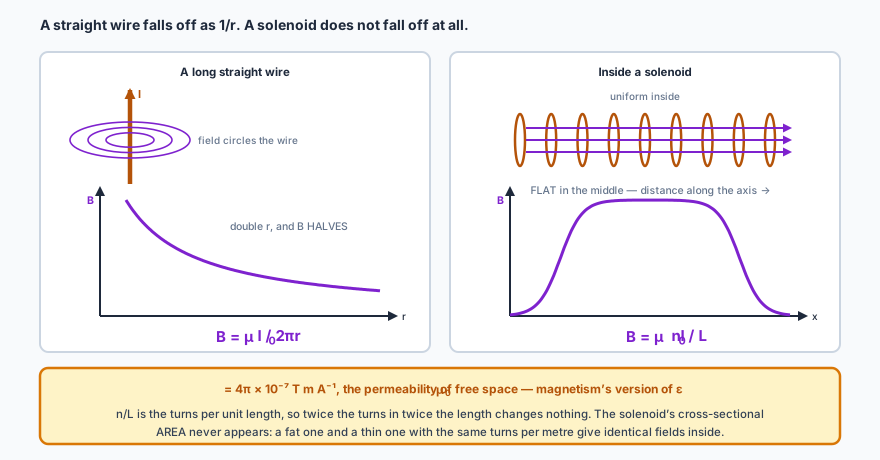
HLThe field a current produces
D.2 showed the shape of the field around a current. Here is its size. Both expressions
contain the permeability of free space,
\( \mu_0 = 4\pi\times10^{-7} \) T m A\(^{-1}\), which plays the role for magnetism that
\( \varepsilon_0 \) played for electricity.
A long straight wire\( B = \dfrac{\mu_0 I}{2\pi r} \)
Inside a solenoid\( B = \dfrac{\mu_0 nI}{L} \)
Note the difference in the fall-off: the field of a straight wire goes as \( 1/r \), not \( 1/r^{2} \). Inside a long solenoid it does not fall off at all — it is genuinely uniform, which is why solenoids are how uniform magnetic fields are made.
Two things about the solenoid are worth noticing. \( n/L \) is the number of turns
per unit length, so a coil with twice the turns in twice the length gives the same field.
And the cross-sectional area does not appear at all — a fat solenoid and a thin one with the
same turns per metre and the same current produce identical fields inside.
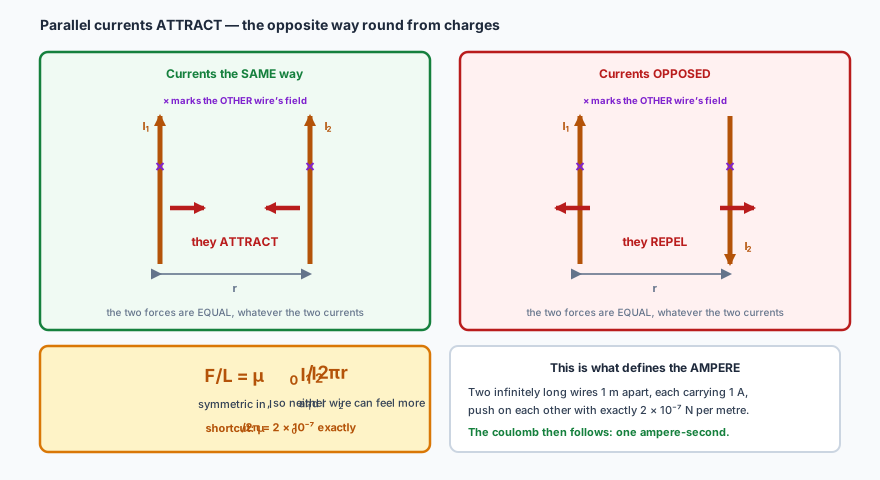
HLTwo parallel wires, and what an ampere is
Each of two parallel current-carrying wires sits in the field the other one makes, so each feels a
force. Combining \( B = \mu_0 I_1/2\pi r \) with \( F = BI_2L \) gives the force per unit
length:
\[ \frac{F}{L} = \frac{\mu_0 I_1 I_2}{2\pi r} \]
Parallel currents attract; opposed currents repel — the opposite way round from charges, which is worth committing to memory because the intuition from electrostatics leads you astray.
The forces on the two wires are equal and opposite however unequal the currents
— a Newton’s third law pair, exactly as in D.1 and D.2. A question that asks which wire
feels the greater force is testing whether you know that, and the answer is neither.
This arrangement is also how the ampere was defined. Two infinitely long parallel
wires 1 m apart, each carrying 1 A, exert on each other a force of exactly
\( 2\times10^{-7} \) N on every metre of length. Infinitely long wires cannot be built, but very
long ones can be, and this is how ammeters are ultimately calibrated. The coulomb then follows as one
ampere-second — current is the more fundamental of the two.
✏️HLWorked example 6 — two conductors
Two long straight conductors 90 mm apart carry currents of 2.0 A and 4.0 A in the same direction.
Find the force on a 0.20 m length of the wire carrying 2.0 A, and state its direction.
(\( \mu_0 = 4\pi\times10^{-7} \) T m A\(^{-1}\).)
\[ F = 1.78\times10^{-5} \times 0.20 = 3.6\times10^{-6}\ \text{N} \]
The currents are in the same direction, so the force is
attractive — towards the other wire.
The 2 A wire and the 4 A wire feel the same force. The expression is symmetric in
\(I_1\) and \(I_2\), so there is no way for one to come out larger — and there could not
be, because they are a third-law pair. A useful shortcut for the arithmetic:
\( \mu_0/2\pi = 2\times10^{-7} \) exactly, so \( F/L = 2\times10^{-7} I_1I_2/r \), which
removes every \(\pi\) from the calculation.
🔭See it happen
PhET, Charges and Fields covers the electric half. For the magnetic half, search
for any cyclotron or mass-spectrometer simulation and do one specific experiment: increase the
particle’s speed and watch the radius grow while the time per orbit stays stubbornly the
same. That single observation is the hardest idea on this page, and it is much more convincing seen
than argued.
📝Practise
Work through these, then reveal the answer. Each question targets a different objective from the list above.
1. A proton travels at \( 5.0\times10^{6} \) m s\(^{-1}\) perpendicular to a 0.30 T field. Find the force on it.
\( F = qvB\sin\theta = 1.60\times10^{-19} \times 5.0\times10^{6} \times 0.30 \times 1 = 2.4\times10^{-13} \) N. It acts perpendicular to both the velocity and the field, so it changes the proton’s direction without changing its speed.
2. A 0.40 m wire carries 2.5 A perpendicular to a 0.20 T field. Find the force on it, state its direction, and give the force if the wire is rotated to lie along the field.
\( F = BIL\sin\theta = 0.20 \times 2.5 \times 0.40 \times \sin 90^\circ = 0.20 \) N. Its direction is perpendicular to both the current and the field, found with Fleming’s left-hand rule: first finger along the field, second finger along the current, and the thumb gives the force. Rotated to lie along the field, \(\theta = 0\), \(\sin\theta = 0\) and the force is zero — a current parallel to a magnetic field feels nothing at all.
3. A charged particle sits at rest in a very strong magnetic field. State the force on it, and explain.
Zero. \( F = qvB\sin\theta \) and \( v = 0 \), so the force is zero however large \(B\) is. A magnetic field acts only on moving charge. The same conclusion applies to a charge moving along the field, where \(\sin\theta = 0\). (An electric field, by contrast, would push the stationary charge immediately.)
4. An electron moves east through a magnetic field directed vertically downwards. Find the direction of the force on it.
Use Fleming’s left hand with the second finger along the conventional current, which for an electron is west — opposite to its motion. First finger down (field), second finger west (conventional current), and the thumb gives the force pointing north. Forgetting to reverse the current direction for a negative charge is the standard slip here, and it gives exactly the wrong answer, south.
5. Find the radius of the path of the proton in question 1.
\( r = \dfrac{mv}{qB} = \dfrac{1.67\times10^{-27} \times 5.0\times10^{6}}{1.60\times10^{-19} \times 0.30} = \dfrac{8.35\times10^{-21}}{4.8\times10^{-20}} = 0.17 \) m. Note that \(mv\) is the momentum: a track’s radius is a direct reading of a particle’s momentum, which is exactly what detector photographs are used for.
6. That proton is now speeded up to \( 1.0\times10^{7} \) m s\(^{-1}\) in the same field. State what happens to the radius and to the period.
The radius doubles to 0.35 m, since \( r \propto v \). The period is unchanged at \( T = 2\pi m/qB = 2.2\times10^{-7} \) s, because \(v\) cancels out of it: the particle covers a circle twice as big at twice the speed, so it takes the same time. This is the fact a cyclotron is built on.
7. A particle enters a uniform magnetic field with kinetic energy \(E_k\). State its kinetic energy on leaving, and justify your answer.
Still \(E_k\) — unchanged. The magnetic force is always perpendicular to the velocity, and \( W = Fs\cos 90^\circ = 0 \), so no work is done on the particle at any point. Its direction changes but its speed cannot. If a question appears to show a magnetic field increasing a particle’s energy, an electric field must be doing the work — as in a cyclotron, where the magnetic field only steers and the gap voltage does all the accelerating.
8. An electron is fired horizontally between two charged plates. Describe and explain the shape of its path, and compare it with the magnetic case.
A parabola. The horizontal velocity is unchanged because there is no horizontal force, while the constant vertical force \(qE\) produces a constant vertical acceleration — the two combine exactly as in projectile motion, with \(qE/m\) in place of \(g\). It differs from the magnetic case in two ways: the electric force does not depend on the velocity, and it does do work, so the electron leaves with more kinetic energy than it entered with. A magnetic field would have curved it into a circle at constant speed instead.
9. A velocity selector has \( E = 1.2\times10^{5} \) V m\(^{-1}\) and \( B = 0.40 \) T. Find the speed selected, and state how the answer changes for a doubly-charged ion.
\( v = E/B = 1.2\times10^{5}/0.40 = 3.0\times10^{5} \) m s\(^{-1}\). For a doubly-charged ion it is exactly the same. Both forces are proportional to \(q\), so \(q\) cancels in \( qE = qvB \) — and so does \(m\), which never appears. The device sorts by speed and by nothing else.
10. Singly-charged ions at \( 2.0\times10^{5} \) m s\(^{-1}\) enter a 0.20 T field and follow a semicircle of radius 0.42 m. Find the mass in u.
\( m = \dfrac{qBr}{v} = \dfrac{1.60\times10^{-19} \times 0.20 \times 0.42}{2.0\times10^{5}} = 6.7\times10^{-26} \) kg. In atomic mass units, \( 6.72\times10^{-26} / 1.661\times10^{-27} = 40 \) u — an argon or calcium ion. The near-integer answer is the sign that the working is sound.
11. Explain why a mass spectrometer needs the velocity selector at all, given that the magnetic field alone already separates the ions.
Because \( r = mv/qB \) contains both \(m\) and \(v\). A slow light ion and a fast heavy one can follow exactly the same radius, so the deflection on its own is ambiguous — it measures momentum, not mass. The selector removes the ambiguity by making \(v\) the same known value for every ion that gets through, after which \( m = qBr/v \) and the radius measures mass alone. Each stage eliminates one unknown; neither would do on its own.
🔗Go deeper — other people’s work
These are external resources, not mine. If one stops working, tell me and
everything above it on this page still stands.
HyperPhysics — magnetic force on a moving charge, cyclotron and mass spectrometer