Electric and magnetic fields
🎯What you need to be able to do
- State that charge comes in two kinds and is always conserved, and distinguish conductors from insulators.
- Apply Coulomb’s law in both its forms, and say what it shares with Newton’s law of gravitation and where it differs.
- Use electric field strength \( E = F/q = kQ/r^{2} \), and sketch the field patterns for one charge and for two.
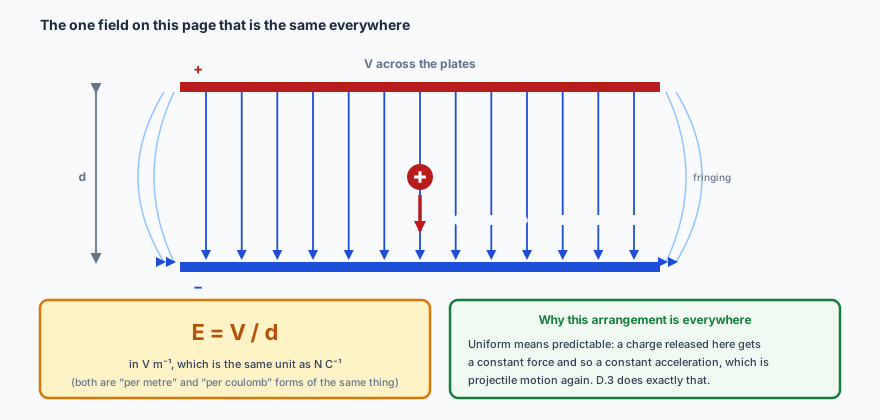
- Use the uniform field between parallel plates, \( E = V/d \).
- Describe Millikan’s experiment and what it established about charge.
- Sketch magnetic field patterns for a bar magnet, a straight wire, a flat coil and a solenoid, and get the directions right using the right-hand grip rule.
- HLUse electric potential and electric potential energy, including the fact that both can be positive, and add potentials as scalars.
- HLUse the potential gradient \( E = -\Delta V_e/\Delta r \), and work in electronvolts.
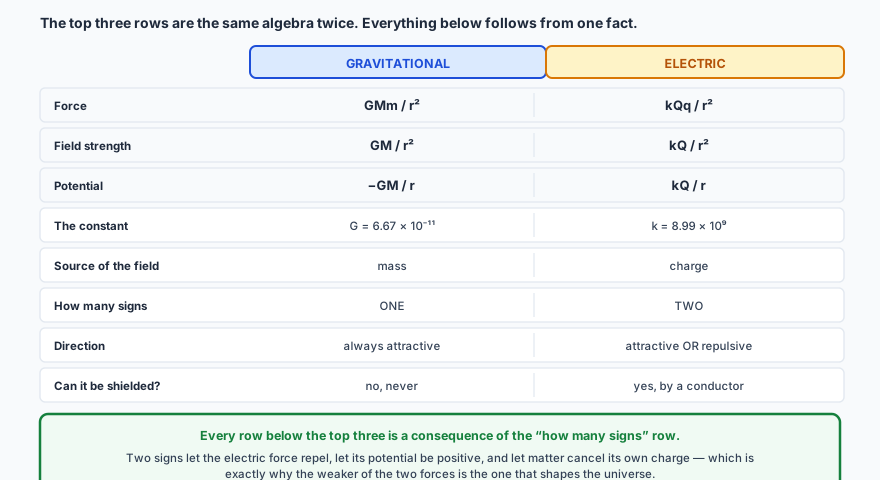
- HLCompare gravitational and electric fields point by point.
⚖️Charge: two kinds, and never created or destroyed
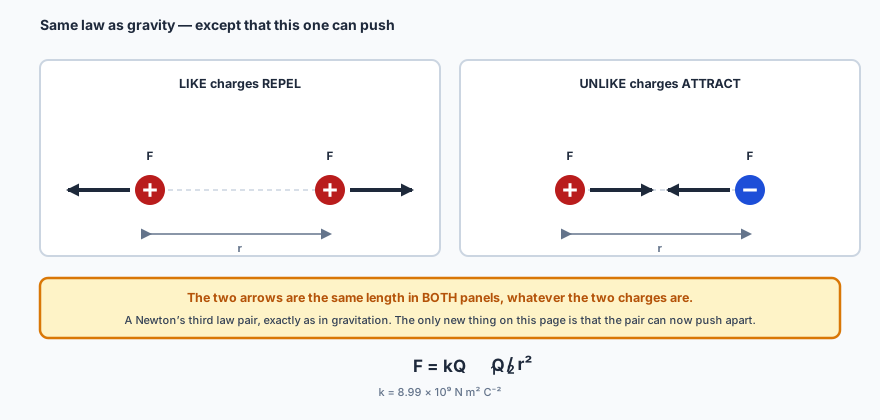
There are exactly two kinds of charge, positive and negative, and equal amounts of them cancel. Matter with equal amounts of each is neutral, which is what almost all matter is. We know charge exists at all only because of the forces between charged objects: like charges repel, unlike charges attract.
The experimental fact underneath everything on this page is that charge is conserved. Rub a comb through your hair and the comb becomes negative while the hair becomes equally positive — no charge was made, electrons were simply moved from one to the other. The total before equals the total after, in every process ever measured.
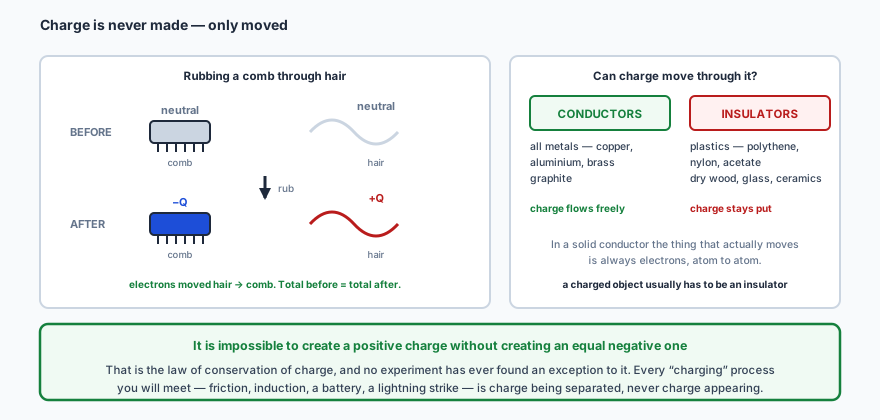
A conductor lets charge flow through it — all metals, and graphite. An insulator does not: plastics, dry wood, glass, ceramics. In a solid conductor the thing that actually moves is always electrons, passing from atom to atom.
⚡Coulomb’s law: Newton’s law with a sign
You will meet the same law written a second way. The Coulomb constant is itself built out of a more fundamental one, the permittivity of free space \( \varepsilon_0 = 8.85\times10^{-12} \) C\(^{2}\) N\(^{-1}\) m\(^{-2}\):
The two forms are identical — check it: \( 1/(4\pi \times 8.85\times10^{-12}) = 8.99\times10^{9} \). Use whichever the question uses. If the charges sit in a material rather than a vacuum, it is \( \varepsilon \) for that material that appears, and the force is smaller.
Structurally this is Newton’s law of gravitation with charge in place of mass: the same inverse square, the same centre-to-centre \(r\), the same equal-and-opposite pair of forces on the two bodies. Everything you learned about handling \(1/r^{2}\) in D.1 transfers unchanged.
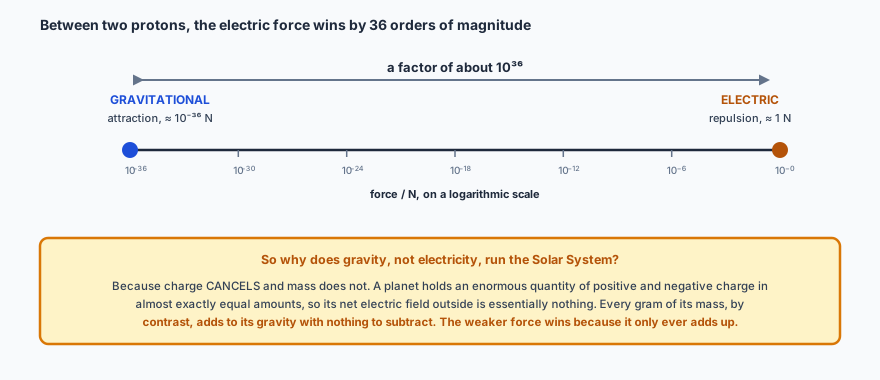
The other difference is scale, and it is not a small one.
✏️Worked example 1 — the two forces side by side
The charges have opposite signs, so the force is attractive. Sub in the masses instead:
🧭Electric field strength and field patterns
Electric field strength \( E = F/q = kQ/r^{2} \) is the force per unit positive charge, measured in N C\(^{-1}\) (or, equivalently, V m\(^{-1}\)). That definition fixes every direction on the page: field lines point away from positive charges and towards negative ones.
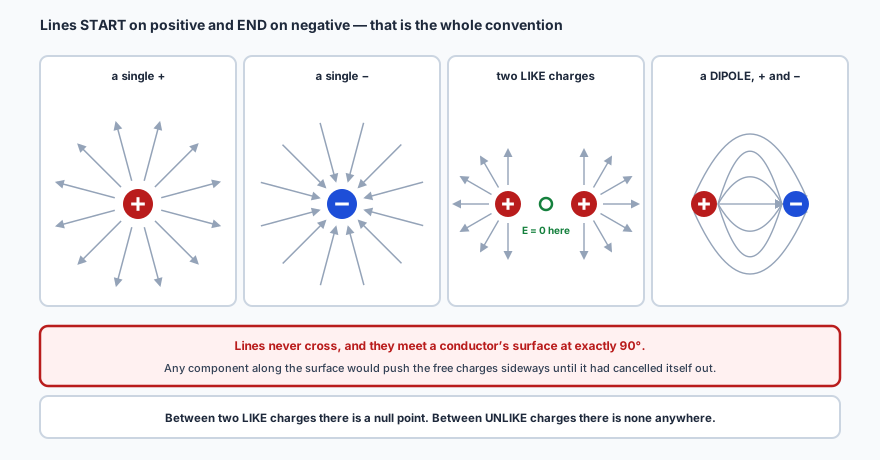
With more than two charges, work out each force separately from Coulomb’s law and then add them as vectors — the same parallelogram you used for forces in Theme A. Electric field strength is a vector too, so fields from several charges add the same way. (Potential, later on this page, is the exception: it is a scalar and simply adds.)
🔢The uniform field between parallel plates
Two parallel plates at a potential difference \(V\), a distance \(d\) apart, make a field that is the same everywhere between them:
✏️Worked example 2 — a uniform field
Field strength. \( E = V/d = 2000/0.050 = 4.0\times10^{4} \) V m\(^{-1}\).
Force. \( F = qE = 1.60\times10^{-19} \times 4.0\times10^{4} = 6.4\times10^{-15} \) N, directed towards the positive plate, because the electron is negative.
Acceleration. \( a = F/m = 6.4\times10^{-15} / 9.11\times10^{-31} = 7.0\times10^{15} \) m s\(^{-2}\).
💧Millikan’s experiment: charge comes in lumps
The uniform field between parallel plates is what let Robert Millikan settle one of the most important questions in physics: is charge continuous, or does it come in a smallest lump?
He sprayed a fine mist of oil into the gap between two horizontal plates and watched single droplets through a microscope. A drop falling freely reaches terminal velocity, which gives its radius and hence its weight. Charge the drop with X-rays, switch on the field, and adjust the voltage until the drop hangs stationary — at which point the electric force exactly balances the weight and the drag has vanished, because nothing is moving.
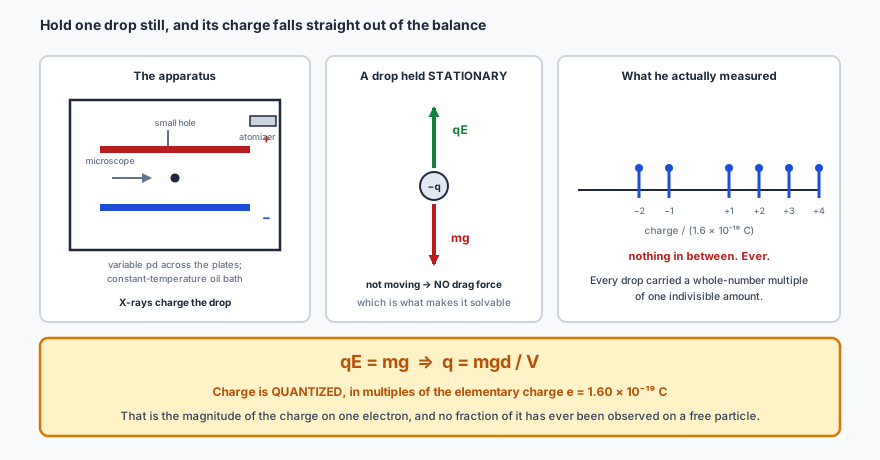
For a stationary drop the forces balance, so
Repeating this for droplet after droplet, Millikan found charges of \( 1.6\times10^{-19} \), \( 3.2\times10^{-19} \), \( 4.8\times10^{-19} \) C — and nothing in between. Charge is quantized: it comes in whole-number multiples of the elementary charge \( e = 1.60\times10^{-19} \) C, which is the magnitude of the charge on a single electron.
✏️Worked example 3 — how many electrons?
Field between the plates. \( E = V/d = 750/0.012 = 6.25\times10^{4} \) V m\(^{-1}\).
Charge, from the balance of forces.
So the drop carries 3 excess electrons.
🧲Magnetic fields are made by moving charge
There are no magnetic monopoles — no isolated N or S pole has ever been found — and one consequence shows up in every diagram you will draw: magnetic field lines always form closed loops. They have no starting point and no end, which is the clearest single difference from electric field lines.
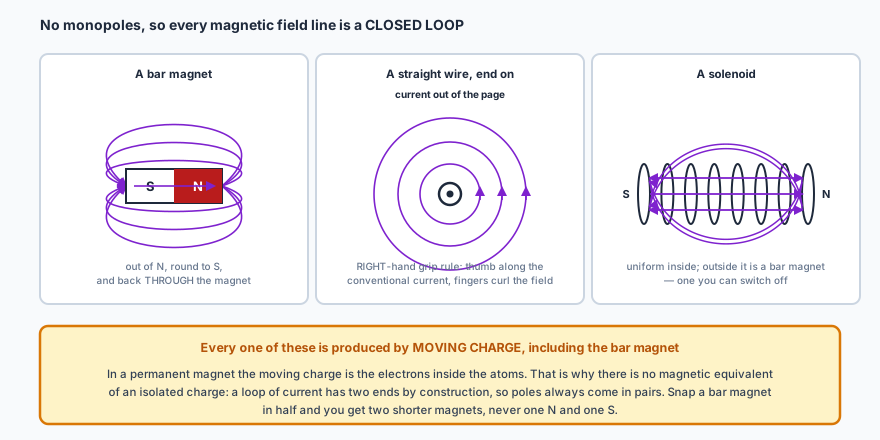
The direction of the field round a current is given by the right-hand grip rule, and it is worth learning as a physical gesture rather than a sentence — it is the rule you will reach for most often in this theme.
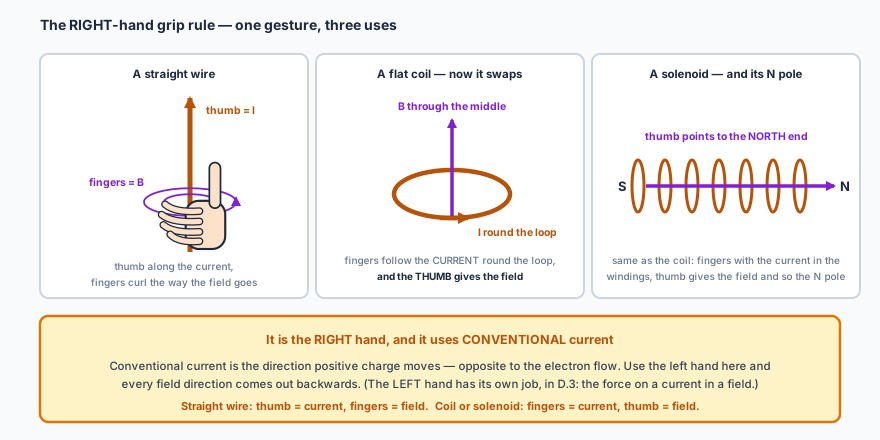
Two more patterns follow from it. A flat circular coil has the circular field of a straight wire wrapped into a ring, so the contributions reinforce through the middle and the field there is strong and nearly straight. A solenoid is many such coils in a row: inside it the field is uniform and parallel, and from outside it is indistinguishable from a bar magnet — one whose poles swap when you reverse the current, and vanish when you switch it off.
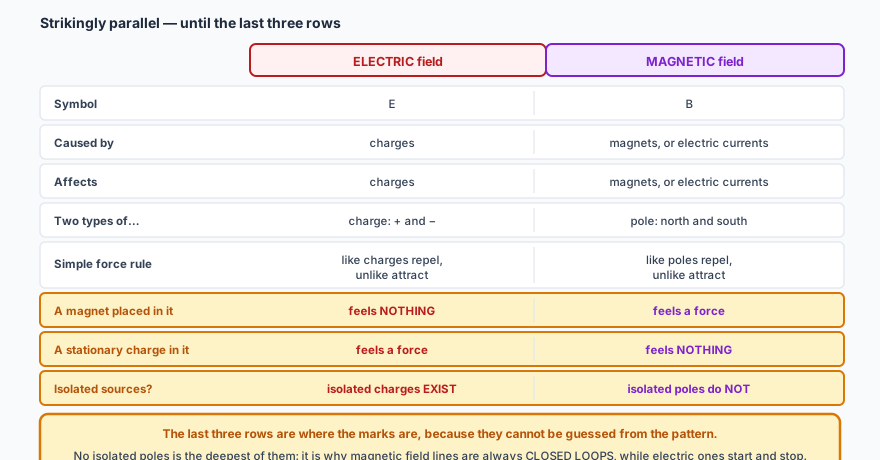
One further pattern is worth knowing because it is where the naming comes from: the Earth has a magnetic field much like a bar magnet’s, and a compass needle lines up along it. The needle’s north pole points towards the geographic North Pole — which means that, magnetically, there is a south pole up there.
➡️What these fields DO to charges and currents
A current-carrying wire placed across a magnetic field feels a force — the motor effect — and so does a single moving charge. Both of those, together with Fleming’s left-hand rule for working out which way that force points, belong to D.3 Motion in electromagnetic fields, and are treated in full there.
The division is worth keeping straight: this page is about the fields themselves — what makes them, what they look like, how strong they are. D.3 is about what happens to something placed in them.
HLElectric potential and potential energy
Both look exactly like their gravitational counterparts, but with one crucial difference: they are not always negative. The sign now follows the charges.
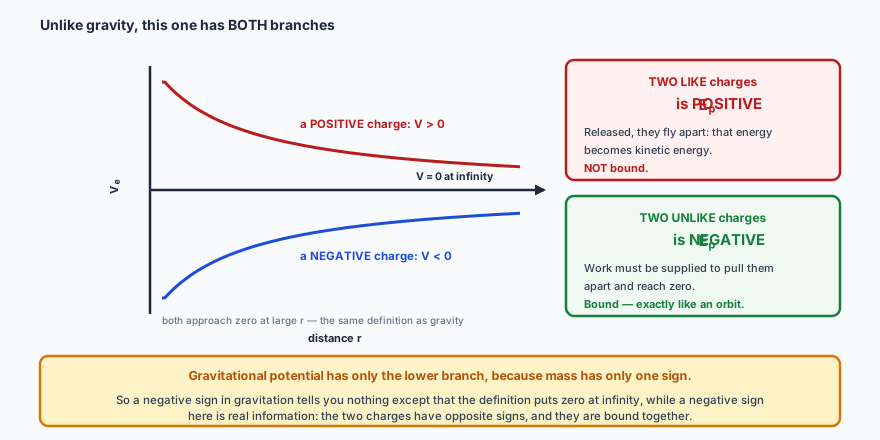
Potential is a scalar, so the potential at a point due to several charges is just the arithmetic sum of the individual contributions — signs included, no angles, no components. Field strength is a vector and must be added as one. This is the same split you met in D.1, and it has the same consequence: a point can have zero field and a large potential, or zero potential and a large field.
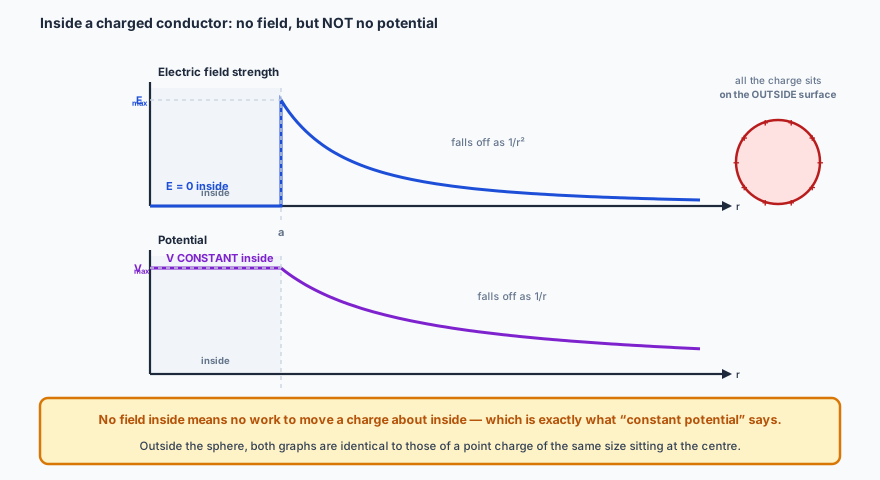
Negative potential energy still means bound, exactly as it did for orbits in D.1 — work must be supplied to separate the pair and reach zero. Positive potential energy means the opposite: released, they fly apart, converting that energy into kinetic energy.
✏️HLWorked example 4 — the work to assemble a pair
At infinity the potential energy is zero, so the work done equals the final potential energy:
So 1.1 J of work must be supplied. Released, the charges repel, and that 1.1 J reappears as kinetic energy — shared between them, so 0.56 J each if their masses are equal.
HLThe potential gradient, and the electronvolt
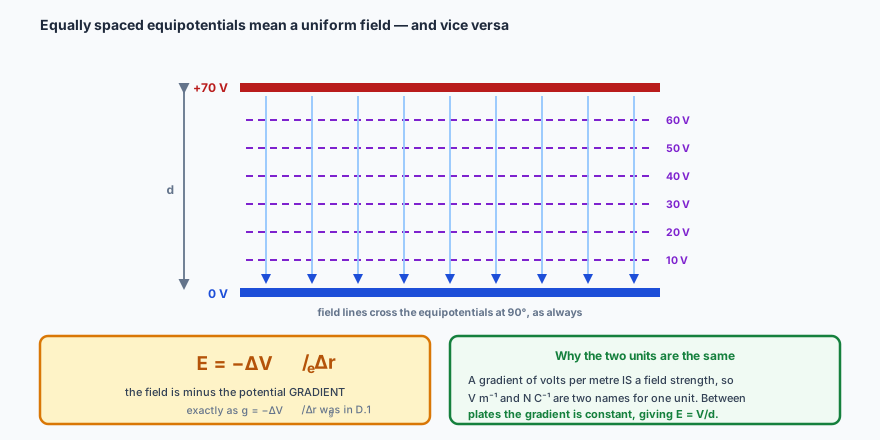
Exactly as in gravitation, the field is minus the rate at which the potential changes with distance:
This is why the two units for electric field strength, N C\(^{-1}\) and V m\(^{-1}\), are the same thing. Between parallel plates the potential falls steadily across the gap, so the gradient is constant at \( V/d \) — which is where \( E = V/d \) came from earlier on this page.
At the scale of a single electron the joule is hopelessly large, so physicists use the electronvolt: the energy gained by a charge of \(e\) moving through a potential difference of 1 V.
The usual prefixes apply — keV, MeV, GeV — and in particle physics they are used far more often than joules.
✏️HLWorked example 5 — accelerating an electron
Energy. A charge of \(e\) through 1000 V gains 1000 eV = 1.00 keV, and \( 1000 \times 1.60\times10^{-19} = 1.60\times10^{-16} \) J.
Speed, from \( \tfrac{1}{2}mv^{2} = qV \):
HLGravitational and electric fields, side by side
Examiners ask for this comparison directly, so it is worth being able to produce it from memory.
🔭See it happen
PhET, Charges and Fields. Drop charges on the canvas and the field vectors appear live; place two like charges and hunt for the null point between them with the field sensor. Then switch on the equipotential tool and confirm that every surface it draws meets the field lines at 90°, which is the D.1 result reappearing unchanged.
📝Practise
Work through these, then reveal the answer. Each question targets a different objective from the list above.
1. Two charges of \( +4.0\ \mu\text{C} \) and \( +4.0\ \mu\text{C} \) are 0.10 m apart. Find the force on each, and state its direction.
2. Find the electric field strength 0.30 m from a point charge of \( +4.0 \) nC.
3. Two parallel plates 2.0 cm apart have a potential difference of 600 V. Find the field between them, and the force on a charge of \( +3.0 \) nC placed anywhere in the gap.
4. In a Millikan-type experiment an oil drop of weight \( 1.6\times10^{-14} \) N hangs stationary between plates 10 mm apart with 500 V across them. Find the charge on the drop and the number of excess electrons.
5. A vertical wire carries a conventional current upwards. Describe the magnetic field around it, and state the direction of the field at a point due north of the wire.
6. Sketch the field pattern for two equal positive charges, and state what is special about the midpoint.
7. HLFind the electric potential 0.20 m from a point charge of \( -6.0 \) nC.
8. HLA charge of \( +3.0 \) nC and one of \( -4.0 \) nC are 0.15 m apart. Find their potential energy, and state whether the pair is bound.
9. HLState three ways in which gravitational and electric fields are the same, and three ways in which they differ.
10. The electric repulsion between two protons is about \( 10^{36} \) times their gravitational attraction. Explain why gravity nonetheless determines the structure of the Solar System.
🔗Go deeper — other people’s work
These are external resources, not mine. If one stops working, tell me and everything above it on this page still stands.
- The Physics Classroom — Static Electricity and Magnetism
- HyperPhysics — electric field, potential and magnetic field concepts