Fusion and stars
🎯What you need to be able to do
- Explain what keeps a main-sequence star stable, and why that equilibrium is self-correcting.
- Describe the proton–proton chain and calculate the energy it releases.
- Distinguish luminosity from apparent brightness, and use \( b = L/4\pi d^2 \).
- Use stellar parallax to find a distance, and state the limits of the method.
- Use Wien’s displacement law and the Stefan–Boltzmann law, and find a star’s radius from them.
- Read a Hertzsprung–Russell diagram and identify the main sequence, red giants and white dwarfs.
- Describe the types of star and what supports each against gravity.
- Outline how a star forms, and describe stellar evolution as a function of mass.
- HLState the Jeans criterion, the CNO cycle, and the Chandrasekhar and Oppenheimer–Volkoff limits.
⚖️What a star actually is
A star is a self-gravitating ball of plasma in hydrostatic equilibrium: at every depth, the inward pull of gravity on a layer is exactly balanced by the outward pressure of the gas and radiation beneath it. That balance is the definition of the main sequence, and a star holds it for about 90% of its life.
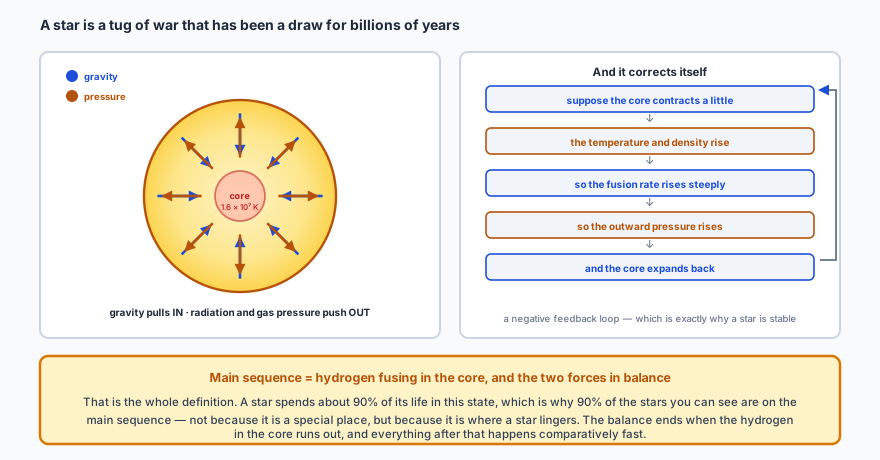
The equilibrium ends when the hydrogen in the core is used up. Everything after that happens comparatively quickly, and what happens is decided almost entirely by the star’s mass.
☀️Where the energy comes from
In a star like the Sun, the energy source is the proton–proton chain: four protons are converted, in three steps, into one helium-4 nucleus.
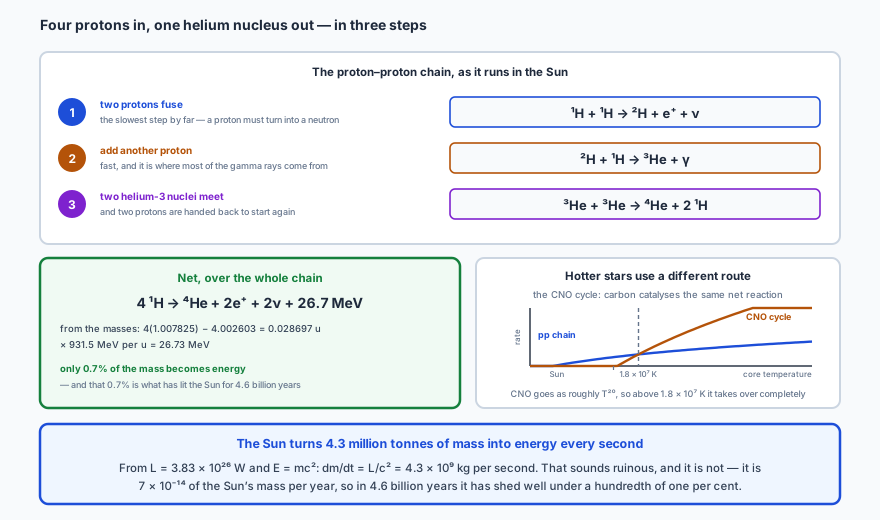
HLHotter stars use a different route to the same product. The CNO cycle uses carbon as a catalyst, and because its rate goes roughly as \(T^{20}\) against the pp chain’s \(T^{4}\), it takes over completely above about \( 1.8 \times 10^{7} \) K. The Sun’s core, at \( 1.57 \times 10^{7} \) K, sits just below the crossover.
✏️Worked example 1 — the energy from one helium nucleus, and what the Sun loses
(a) Mass difference first.
(b) Energy leaving means mass leaving. Rearranging \( E = mc^2 \) as a rate:
💡Luminosity, apparent brightness, and the difference
Two quantities get called “brightness” and they are not the same thing. Luminosity \(L\) is the total power the star radiates, in watts — a property of the star alone. Apparent brightness \(b\) is the power per square metre arriving here, in W m−2 — a property of the star and how far away it is.
The \( 4\pi d^2 \) is the surface area of a sphere of radius \(d\): the star’s output spreads over an ever-larger sphere as it travels, so the power crossing each square metre falls as \( 1/d^2 \).
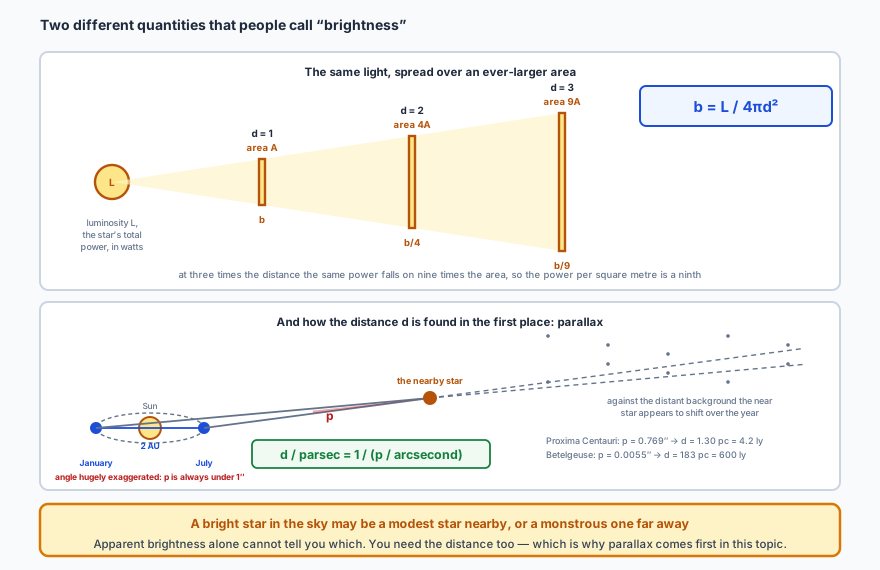
Stellar parallax supplies that distance for nearby stars. As the Earth moves from one side of its orbit to the other, a nearby star appears to shift against the far more distant background. Half of that annual shift is the parallax angle \(p\), and the distance follows from simple geometry:
A parsec is defined as exactly the distance at which \( p = 1'' \); it works out at \( 3.09 \times 10^{16} \) m, or 3.26 light years. The method runs out when \(p\) shrinks below the measurement uncertainty, which for ground-based work is a few hundred parsecs — a tiny neighbourhood by galactic standards.
✏️Worked example 2 — from a parallax angle to a luminosity
Distance from the parallax.
Luminosity from the inverse-square law. Rearranging \( b = L/4\pi d^2 \):
🌈Colour, temperature and size
A star radiates very nearly as a black body, and that single fact is what makes it measurable. Two laws follow from the black-body spectrum, and between them they give the temperature and the radius.
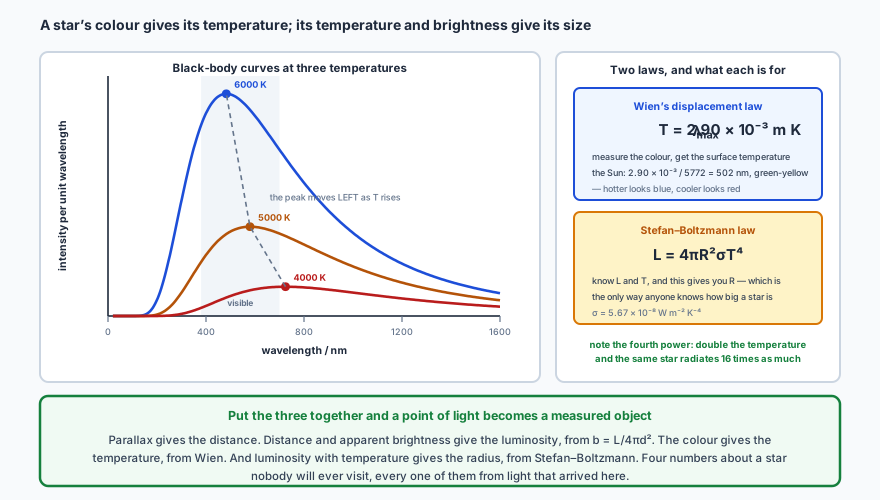
Put the pieces together and a point of light becomes a measured object. Parallax gives the distance; distance with apparent brightness gives the luminosity; the colour gives the temperature; and luminosity with temperature gives the radius. Four numbers about something nobody will ever visit, every one of them extracted from arriving light.
✏️Worked example 3 — how big is it?
Temperature, from Wien.
Radius, from Stefan–Boltzmann. Rearrange \( L = 4\pi R^2\sigma T^4 \):
📊The Hertzsprung–Russell diagram
Plot luminosity against surface temperature for a large sample of stars and they do not scatter evenly: they fall into a few well-defined groups. That plot is the Hertzsprung–Russell diagram, and it is the single most useful chart in astrophysics.
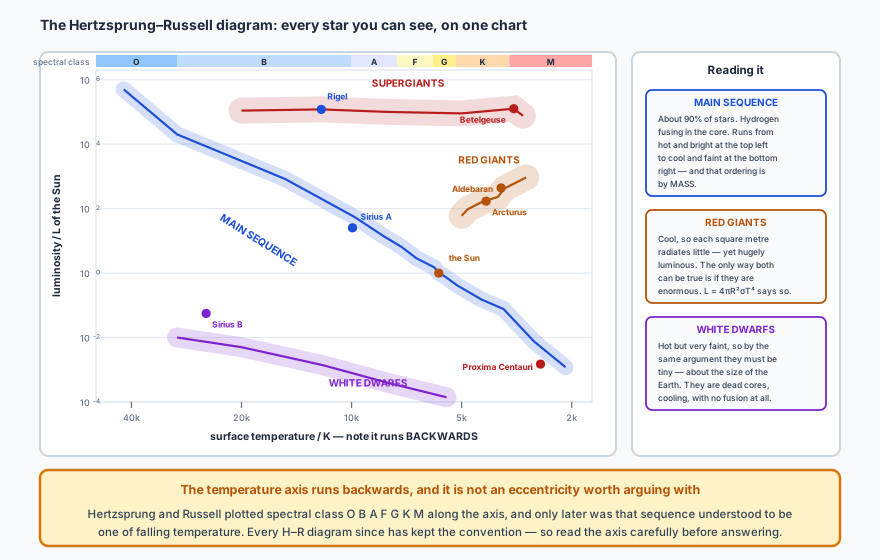
The reasoning behind each region is worth being able to reproduce, because it is Stefan–Boltzmann applied twice:
⭐The kinds of star
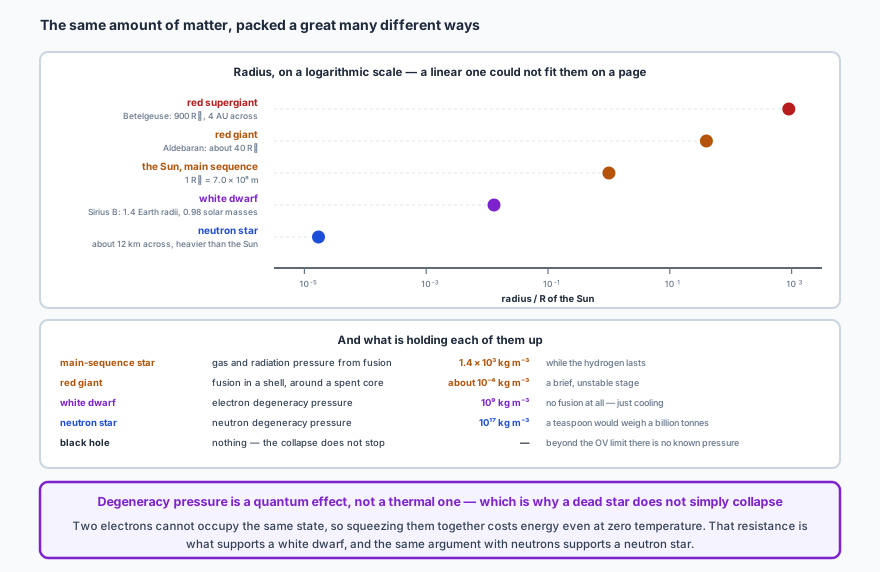
Degeneracy pressure is worth a moment because it is the reason dead stars exist at all. The Pauli exclusion principle forbids two electrons from occupying the same quantum state, so compressing a gas of electrons forces them into higher-momentum states, and that costs energy. The resistance that follows does not go away as the star cools. It is what holds up a white dwarf, and the same argument applied to neutrons holds up a neutron star.
🌌How a star begins
Stars form from cold, thin clouds of molecular gas — typically around 20 K and light years across. Gravity pulls such a cloud inwards; the random thermal motion of its molecules pushes outwards. Which wins is decided by the cloud’s mass.
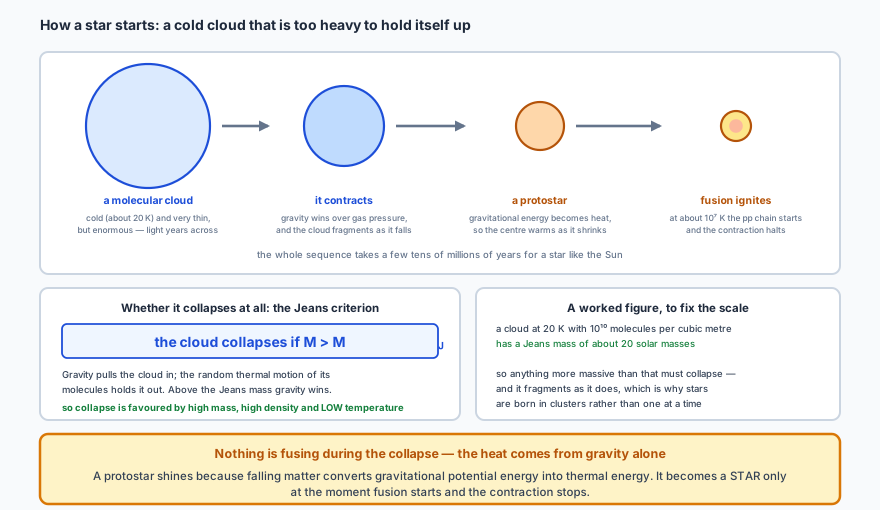
HLThe condition is the Jeans criterion: a cloud collapses if its mass exceeds the Jeans mass \( M_J \). Since gravity grows with mass and density while the opposing pressure grows with temperature, collapse is favoured by high mass, high density and low temperature. A cloud at 20 K holding \( 10^{10} \) molecules per cubic metre has a Jeans mass of roughly 20 solar masses — and since it fragments as it falls, it produces a cluster of stars rather than one.
🕐How long a star lasts, and how it ends
Main-sequence lifetime falls sharply with mass, which is counter-intuitive until you see why: a more massive star has more fuel, but it burns it very much faster. Luminosity goes roughly as \( M^{3.5} \), so the lifetime, which is fuel divided by burn rate, goes as \( M/M^{3.5} = M^{-2.5} \).
✏️Worked example 4 — how long the Sun has
How much fuel, and how much energy it holds.
Divide by the rate it is spent.
What happens after the main sequence is decided by mass, and the branch point is at about eight solar masses.
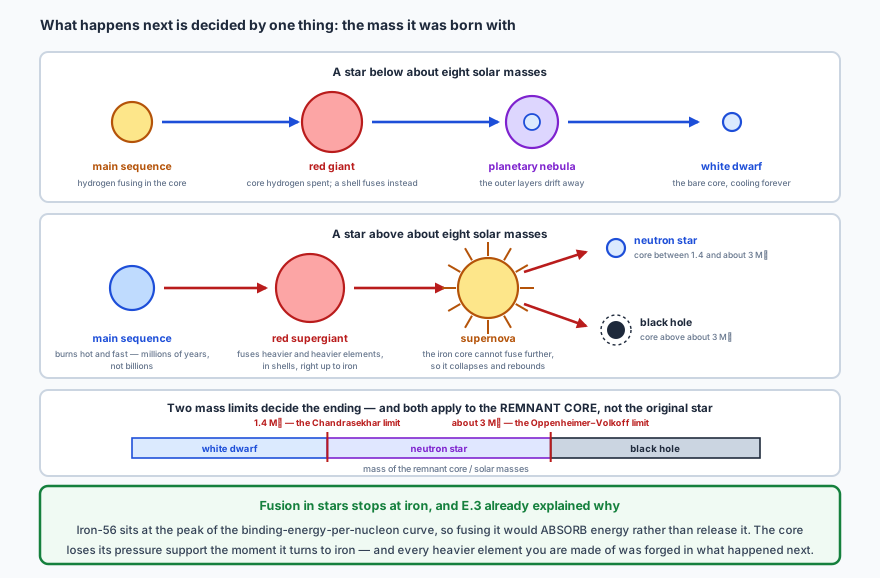
Two mass limits set the ending, and both apply to the remnant core, not to the star it came from — a distinction questions test directly, because a star loses a great deal of mass before it dies:
Below 1.4 solar masses the remnant is a white dwarf; between 1.4 and about 3 it is a neutron star; above that nothing known can halt the collapse and it becomes a black hole. The Sun, at one solar mass and losing more before the end, will finish as a white dwarf — which is also why every element in you heavier than iron had to be made somewhere else: in the supernova of a star far larger than the Sun.
📝Practise
Work through these, then reveal the answer. Each question targets a different objective from the list above.
1. Explain what keeps a main-sequence star in equilibrium, and why that equilibrium is stable rather than precarious.
It is stable because the balance self-corrects. If the core contracts slightly, its temperature and density rise; the fusion rate is very sensitive to temperature, so it rises steeply; the outward pressure therefore rises and pushes the core back out. If the core expands, the reverse happens. That is negative feedback, so a star sits in the balance rather than being perched on it.
2. Write the overall reaction of the proton–proton chain and find the energy released, given atomic masses of 1.007825 u for hydrogen-1 and 4.002603 u for helium-4.
Energy: \( 0.028697 \times 931.5 = 26.7 \) MeV.
Only about 0.7% of the mass involved is converted, which is what makes hydrogen fusion a slow enough process to power a star for billions of years rather than seconds.
3. A star has a parallax angle of \( 0.25'' \) and an apparent brightness of \( 6.4 \times 10^{-9} \) W m−2. Find its distance and its luminosity. Take 1 pc \( = 3.09 \times 10^{16} \) m.
\( L = 4\pi d^{2}b = 4\pi (1.24 \times 10^{17})^{2}(6.4 \times 10^{-9}) = 1.2 \times 10^{27} \) W.
That is about three solar luminosities. Note that the parallax must be converted to a distance in metres before it goes anywhere near the inverse-square law — mixing parsecs and metres is the usual slip here.
4. A star’s spectrum peaks at 580 nm and its luminosity is \( 1.0 \times 10^{30} \) W. Find its surface temperature and radius, and say what kind of star it is.
Stefan–Boltzmann, rearranged: \[ R = \sqrt{\frac{L}{4\pi\sigma T^{4}}} = \sqrt{\frac{1.0 \times 10^{30}}{4\pi(5.67 \times 10^{-8})(5000)^{4}}} = 4.7 \times 10^{10}\ \text{m} \] That is about 68 solar radii. A star cooler than the Sun but 2600 times more luminous, and 68 times its radius, is a red giant — it can only be so luminous at that temperature by being enormous.
5. On an H–R diagram, explain how you can tell that white dwarfs must be very small and red giants very large, without being told either radius.
White dwarfs lie at high temperature but very low luminosity. High \(T\) means each square metre radiates a great deal, so to have a small total \(L\) there must be very little surface area — a small \(R\). They turn out to be roughly Earth-sized.
Red giants lie at low temperature but very high luminosity. Low \(T\) means each square metre radiates little, so to have a huge total \(L\) there must be an enormous surface area — a very large \(R\). They are tens to hundreds of solar radii.
6. Two stars have the same radius, but one has twice the surface temperature of the other. Compare their luminosities, and compare the wavelengths at which they peak.
Peak wavelength: \( \lambda_{\text{max}} \propto 1/T \), so the hotter star peaks at half the wavelength — it looks bluer.
Both results come from the same black-body spectrum: raising the temperature lifts the whole curve steeply and shifts its peak to the left.
7. Explain why a star of 25 solar masses spends far less time on the main sequence than the Sun, even though it starts with far more fuel.
8. Describe what happens to a star of one solar mass after it leaves the main sequence, and name the remnant.
9. State the Chandrasekhar and Oppenheimer–Volkoff limits, and explain what is being weighed in each case.
Oppenheimer–Volkoff limit, about 3 solar masses: the greatest mass that neutron degeneracy pressure can support. Above it, nothing known halts the collapse and a black hole forms.
Both limits apply to the mass of the remnant core, not to the star’s original mass. A star loses a great deal of mass as a red giant or in a supernova, so a star that began with, say, 20 solar masses may still leave a core light enough to become a neutron star.
10. HLState the Jeans criterion and use it to explain why stars form in cold, dense clouds and are born in clusters.
As the cloud collapses its density rises, which lowers the Jeans mass, so sub-regions that were previously stable now exceed their own Jeans mass and begin to collapse independently. The cloud therefore fragments as it falls, and a single cloud of a few thousand solar masses produces a whole cluster of stars rather than one very large one.
🔗Go deeper — other people’s work
These are external resources, not mine. If one stops working, tell me and everything above it on this page still stands.
- HyperPhysics — stellar structure, fusion and the HR diagram
- NASA — stellar evolution and the life cycles of stars