Work, energy and power
Work and energy are the same quantity seen from two sides: work is the transfer, energy is the amount transferred, and both are measured in joules. That single sentence is why this topic is so powerful — it lets you answer questions about the start and the end of a process without knowing anything about the messy middle.
🎯What you need to be able to do
- Say when work is done, and calculate it with \( W = Fs\cos\theta \).
- Read work off a force–displacement graph as an area, including for a spring.
- Use kinetic, gravitational potential and elastic potential energy, and know what “mechanical energy” means.
- Apply conservation of energy to problems where more than one store changes.
- Calculate power, including \( P = Fv \), and calculate efficiency as a ratio or a percentage.
- Interpret and draw Sankey diagrams to scale, and explain what degraded energy is.
- Distinguish energy density from specific energy, and compare energy sources on both.
🔨When work is done
Work is done when a force moves its own point of application in the direction of that force. If the object does not move, or moves at right angles to the force, no work has been done — however much effort it took.
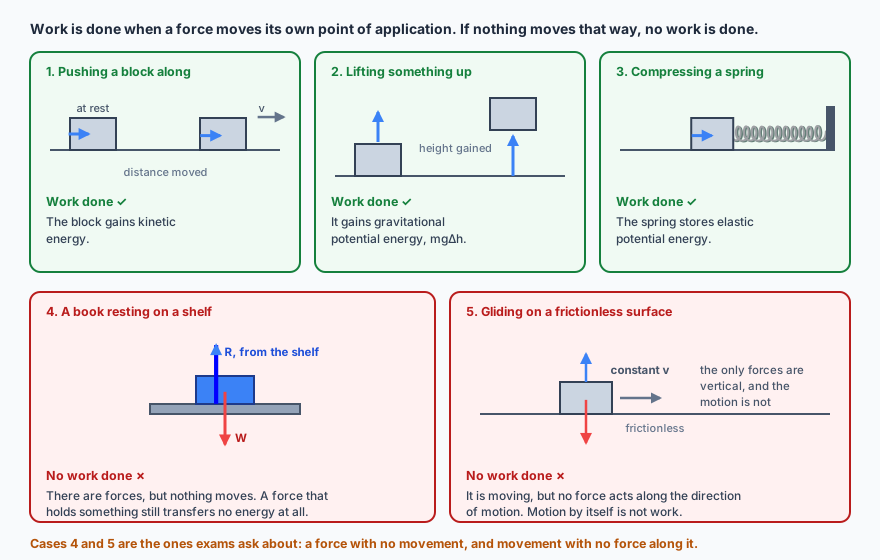
The amount of energy transferred is equal to the work done, so the units must match: work is measured in joules, and 1 J = 1 N m. Work is a scalar, even though it is built from two vectors.
where \(\theta\) is the angle between the force and the displacement. Only the component of the force along the displacement, \( F\cos\theta \), does any work at all.
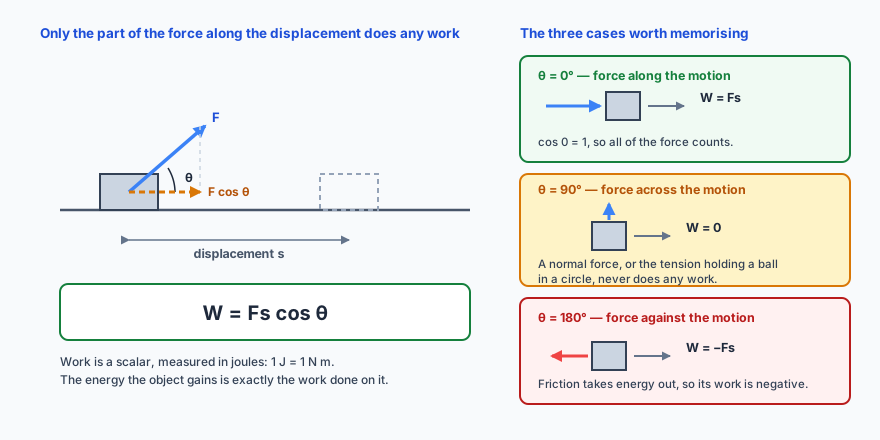
The middle case is the one that earns marks: a force perpendicular to the motion transfers no energy. That is why the normal force does no work on a sliding block, why the tension does no work on a ball whirled in a circle, and why carrying a suitcase along a level corridor does no work on it, however tired your arm gets.
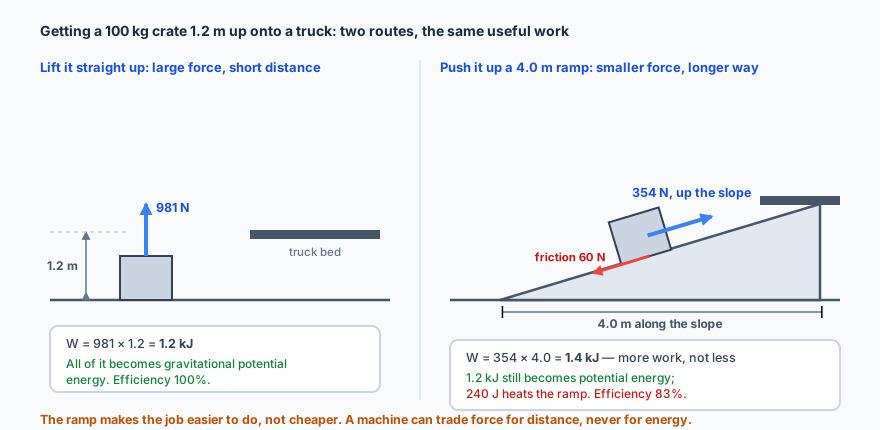
Two routes to the same place make the point about machines. Lifting a crate straight onto a truck needs a large force over a short distance; pushing it up a ramp needs a smaller force over a longer one.
Work from a graph
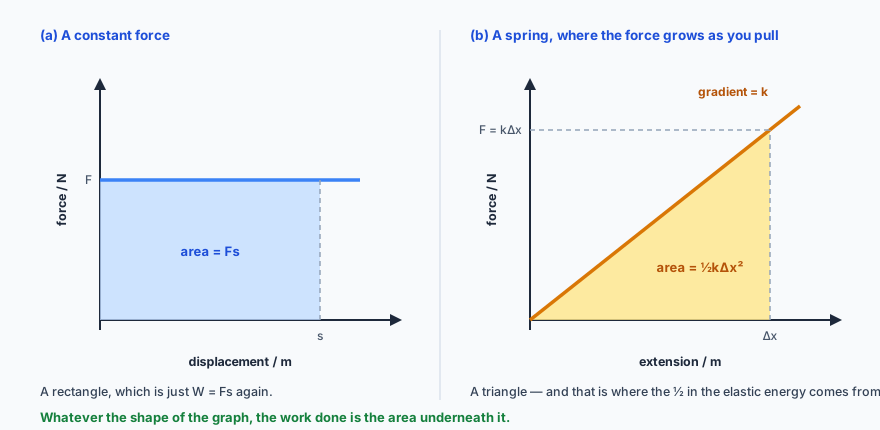
When the force is not constant the formula stops working, and you use the graph instead: the work done is the area under the force–displacement graph.
✏️Worked example 1 — a force at an angle
(a) Constant velocity means zero resultant force. Horizontally, friction balances the horizontal component of the pull:
(b) In 60 s the block moves \( 0.20 \times 60 = 12 \) m, so
(c) The block gains no kinetic energy (constant speed) and no potential energy (level ground), so all 468 J has gone into internal energy: the block and the surface are very slightly warmer. Energy is conserved, it is just no longer useful.
(d) This is the interesting part. The vertical component of the pull was helping to lift the block, so the normal reaction was only
which makes the coefficient of friction \( \mu = 39/95.2 = 0.41 \). Turn the force horizontal and the normal reaction rises to the full \( mg = 117.7 \) N, so the friction available rises to \( 0.41 \times 117.7 = 48 \) N — more than the 45 N now pulling. The block decelerates at \( 3.2/12 = 0.27 \) m s\(^{-2}\), stops after about 7 cm, and stays stopped.
⚡Energy and its stores
Energy is the capacity to do work. It comes in many forms — kinetic, gravitational potential, elastic potential, thermal, chemical, nuclear, electrical, radiant — but three have equations you must be able to use:
Note the square on the speed: doubling the speed quadruples the kinetic energy, which is the whole argument behind speed limits and braking distances. The gravitational form applies near the Earth’s surface, where \( \Delta h \) is the vertical height change — the path taken is irrelevant. In the elastic form, \( \Delta x \) is the extension from the natural length, not the total length.
Mechanical energy is the sum of the kinetic, gravitational potential and elastic potential energies. In the absence of frictional and resistive forces, the total mechanical energy of a system is conserved.
Conservation of energy
In any situation you must be able to account for the changes in energy. If energy is “lost” by one object it must be gained by another. Three ways of saying the same principle:
- the total energy of any closed system is constant;
- energy is never created or destroyed, only changed in form;
- there is no change in the total energy of the Universe.
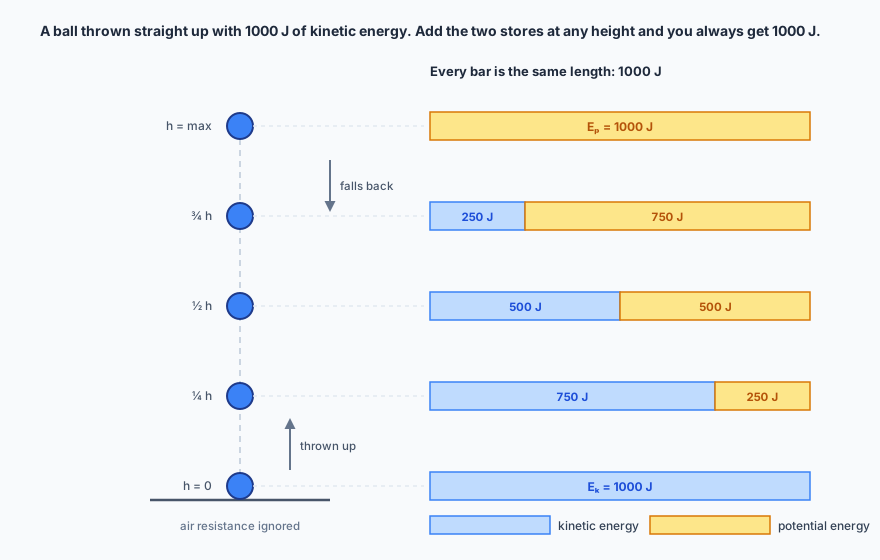
Conservation is powerful because it skips the middle of a problem. A ball rolling down a curved track has a horrible force analysis and a trivial energy one: \( mgh \) at the top becomes \( \tfrac{1}{2}mv^{2} \) at the bottom, so \( v = \sqrt{2gh} \) and the shape of the track never enters the calculation. Add friction and the same statement still works — the missing energy has become internal energy, and you can say exactly how much.
🔋Power and efficiency
Power is the rate at which energy is transferred, which is the same as the rate at which work is done:
There is a second form worth having ready. If something moves at constant velocity \(v\) against a constant resistive force \(F\), then in each second it travels \(v\) metres and does \(Fv\) joules of work:
Reach for that one whenever a question mentions a vehicle at steady speed: at constant speed the driving force equals the resistive force, so the engine’s useful power output is simply resistance × speed.
Efficiency is the ratio of useful energy out to total energy in. Because it is a ratio, it has no units, and it can never exceed 1:
Whether energy counts as “useful” depends on what you wanted. In a filament lamp the light is useful and the thermal energy is waste; in an electric heater the thermal energy is the whole point, and such a heater is essentially 100% efficient.
✏️Worked example 2 — a grasshopper
(a) Once it leaves the ground the only store that grows is gravitational potential energy, so all the kinetic energy at take-off becomes potential energy at the top:
The mass cancels, which is worth noticing: the take-off speed needed for a given height is the same for a grasshopper and an elephant.
(b) The energy transferred during the push is the energy it ends up with, \( mg\Delta h = 0.0080 \times 9.81 \times 1.8 = 0.141 \) J, delivered in 0.10 s:
📈Sankey diagrams
Almost all of the world’s electrical power is generated the same way: a fuel releases thermal energy, the thermal energy boils water, the steam turns a turbine, and the turbine turns a generator.
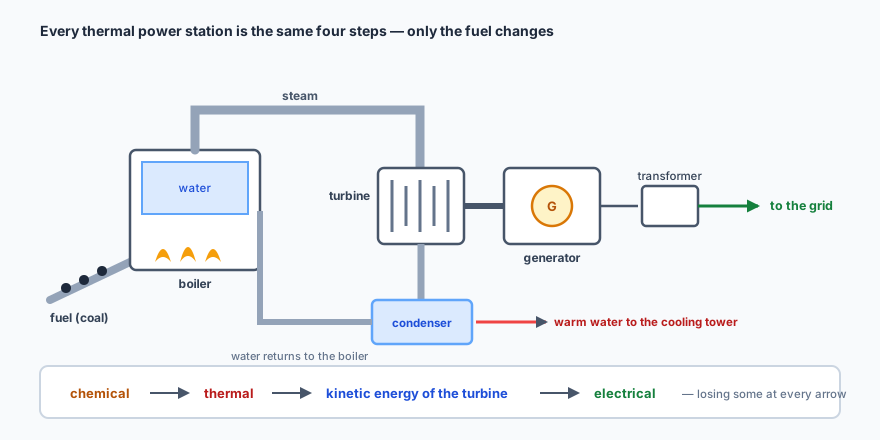
Any cyclical process must dump some energy into the surroundings where it can no longer do useful work. That is the second law of thermodynamics talking, and it is why no power station is anywhere near 100% efficient. A Sankey diagram shows exactly where the energy went: an arrow drawn left to right, with the width of every branch proportional to the energy or power it carries, and losses branching off up or down.
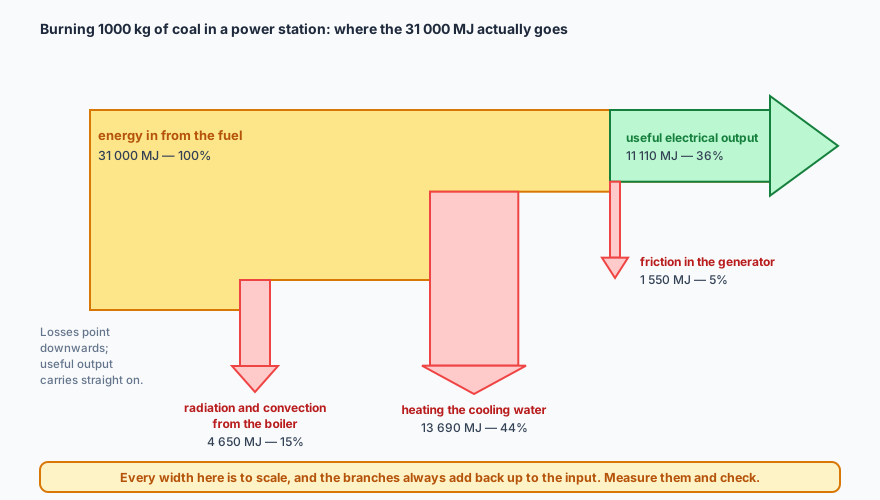
✏️Worked example 3 — reading a power station
Start from the fuel. 1000 kg at 31 MJ kg\(^{-1}\) releases \( 3.1 \times 10^{4} \) MJ. The three losses total
so the useful electrical output is \( 31\,000 - 19\,890 = 1.11 \times 10^{4} \) MJ, and
⛰Energy density and specific energy
Two similar-sounding quantities, and questions do test the difference:
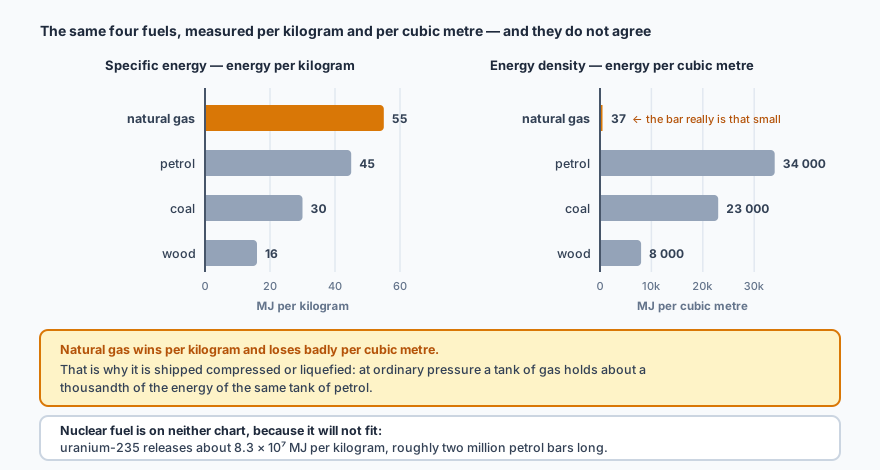
- Specific energy is the energy liberated per unit mass of fuel consumed, in J kg\(^{-1}\). It is what matters when you have to carry the fuel — aircraft, rockets, your own body.
- Energy density is the energy liberated per unit volume of fuel consumed, in J m\(^{-3}\). It is what matters when you have to store the fuel in a tank of fixed size.
Comparing energy sources
No source is best on every measure, and the IB expects you to be able to argue the trade-offs rather than recite a list.
- Fossil fuels — coal, oil, gas. High specific energy and energy density, cheap, easy to transport, and a station can be built almost anywhere. Against: they are non-renewable, their combustion products include greenhouse gases and the pollutants that cause acid rain, and extracting them damages the environment.
- Solar, wind, wave. No chemical by-products, renewable, and the energy itself is free. Against: the supply is unreliable and depends on weather, location and time of day, the initial cost is high, and a very large area is needed for a significant output.
- Hydroelectric and tidal. Clean and renewable, and hydro is reliable in a way that wind is not. Against: they need particular geography, and building a dam floods land. Pumped storage belongs here but is not a source at all — it is one of the few large-scale ways of storing energy, filling in when demand peaks.
- Geothermal. Clean, renewable and steady, but only usable where the geology allows it.
- Nuclear fission. An enormous energy density and no carbon dioxide during operation. Against: the waste stays radioactive for a very long time, decommissioning is expensive, and public acceptance is hard to win. Fusion is a different prospect again — effectively unlimited fuel and far less radioactive waste — but the engineering of confining a plasma at scale is still unsolved.
✏️Worked example 4 — how much force is a car fighting?
Work out the fuel mass first. 8.0 litres is \( 8.0 \times 10^{-3} \) m\(^{3}\), so the mass burned per 100 km is \( 8.0 \times 10^{-3} \times 750 = 6.0 \) kg, releasing
Only a fifth of that reaches the wheels: useful work \( = 0.20 \times 270 = 54 \) MJ. At constant velocity the car gains no kinetic energy and (on level ground) no potential energy, so all of that useful work goes into overcoming resistance over \( 1.0 \times 10^{5} \) m:
🔭See it happen
PhET, Energy Skate Park. Turn on the bar-graph display and drop the skater from the top of the track. The kinetic and potential bars trade against each other exactly as in the figure above while the total stays fixed — then add friction and watch a third bar, thermal energy, start eating the other two. Nothing explains degraded energy faster.
PhET, Energy Forms and Changes. Follow the chain from a burning block to a boiling kettle and watch the energy symbols move. It is the power-station diagram on this page, at kitchen scale.
📝Practise
Work through these, then reveal the answer. Between them they cover every objective at the top of the page. Take \( g = 9.81 \) m s\(^{-2}\) throughout.
1. A tennis ball of mass 50 g is dropped from 3.0 m onto a hard floor and bounces back to 2.2 m. Find (a) its speed just before it lands, (b) its speed just after it leaves the floor, (c) the energy lost in the bounce. (d) If energy has been lost, how is energy still conserved?
(a) \( v = \sqrt{2gh} = \sqrt{2 \times 9.81 \times 3.0} = 7.7 \) m s\(^{-1}\).
(b) Coming back up, the same relation with 2.2 m: \( v = \sqrt{2 \times 9.81 \times 2.2} = 6.6 \) m s\(^{-1}\).
(c) The quickest route is the height difference: \( \Delta E = mg\Delta h = 0.050 \times 9.81 \times 0.80 = 0.39 \) J. (Doing it through kinetic energies gives the same 0.39 J.)
(d) It is not lost from the Universe, only from the ball’s mechanical energy. It went into internal energy in the ball and the floor, which are now fractionally warmer, and into the sound of the bounce.
2. A spring of natural length 20.0 cm has a spring constant of 1.25 N cm\(^{-1}\). It lies horizontally with one end fixed and a 500 g mass on the other, on a frictionless surface. The mass is pulled 4.0 cm to the right and held. Find (a) the force on the mass, (b) the elastic energy stored, (c) the speed of the mass as it passes back through the natural-length position.
First convert the spring constant: \( 1.25 \) N cm\(^{-1}\) = 125 N m\(^{-1}\).
(a) \( F = k\Delta x = 125 \times 0.040 = 5.0 \) N, pulling the mass back towards the fixed end.
(b) \( E_H = \tfrac{1}{2}k\Delta x^{2} = \tfrac{1}{2}(125)(0.040)^{2} = 0.10 \) J.
(c) At the natural length the spring stores nothing, so all 0.10 J is kinetic: \( v = \sqrt{2E_k/m} = \sqrt{2(0.10)/0.50} = 0.63 \) m s\(^{-1}\).
3. The same spring is now hung vertically from a rigid support with the same 500 g mass on the bottom, at rest in its equilibrium position. (a) Find the extension and the elastic energy stored. (b) The mass is pulled down a further 4.0 cm and released. Find the elastic energy now stored, the gain in gravitational potential energy as it rises back to the equilibrium position, and its speed there. (c) Compare that speed with your answer to question 2(c).
(a) At equilibrium the spring force balances the weight: \( k\Delta x = mg \), so \( \Delta x = \dfrac{0.50 \times 9.81}{125} = 0.039 \) m = 3.9 cm. Then \( E_H = \tfrac{1}{2}(125)(0.0392)^{2} = 0.096 \) J.
(b) Total extension is now \( 3.9 + 4.0 = 7.9 \) cm, storing \( \tfrac{1}{2}(125)(0.0792)^{2} = 0.39 \) J. Rising 4.0 cm back to equilibrium releases \( 0.39 - 0.096 = 0.296 \) J of elastic energy, of which \( mg\Delta h = 0.50 \times 9.81 \times 0.040 = 0.196 \) J is spent climbing. What is left is kinetic: \( 0.296 - 0.196 = 0.100 \) J, so \( v = \sqrt{2(0.100)/0.50} = 0.63 \) m s\(^{-1}\).
(c) Identical, to two significant figures — and it is exact, not a coincidence. Hanging the spring vertically shifts the rest position but changes nothing about the motion around it: the extra elastic energy stored at any displacement is exactly the gravitational energy needed to climb back. That is why a mass on a vertical spring and one on a horizontal spring oscillate in precisely the same way.
4. A crane lifts a 500 kg load through 12 m in 20 s at a steady speed. (a) Find the useful power output. (b) The crane’s motor draws 4.0 kW while doing it. Find its efficiency and state where the rest of the energy goes.
(a) \( W = mgh = 500 \times 9.81 \times 12 = 5.9 \times 10^{4} \) J, so \( P = W/t = 58\,860/20 = 2.9 \times 10^{3} \) W.
(b) \( \eta = \dfrac{2943}{4000} = 0.74 \), or 74%. The missing 1.1 kW goes into friction in the gears, cable and pulleys, electrical heating in the motor windings, and sound.
5. A car travels at a constant 25 m s\(^{-1}\) against a total resistive force of 600 N. (a) Find the useful power output of the engine. (b) If the engine is 25% efficient, at what rate is chemical energy being released in the fuel?
(a) At constant speed the driving force equals the resistance, so \( P = Fv = 600 \times 25 = 1.5 \times 10^{4} \) W = 15 kW.
(b) \( P_{\text{input}} = P_{\text{output}}/\eta = 15/0.25 = 60 \) kW. Three-quarters of that — 45 kW — is leaving as thermal energy through the radiator and the exhaust.
6. A suitcase is pulled 30 m along a level floor by a 60 N force acting at 40° above the horizontal. (a) Find the work done by that force. (b) Explain why the vertical component does no work, and what it does do.
(a) \( W = Fs\cos\theta = 60 \times 30 \times \cos 40^\circ = 1.4 \times 10^{3} \) J.
(b) The suitcase never moves vertically, so the vertical component moves through zero distance in its own direction and does no work. It is not useless, though: it reduces the normal reaction, which reduces the friction, which is why pulling a case by its handle is easier than pushing it along at floor level.
7. A 0.25 kg ball is thrown vertically upwards at 12 m s\(^{-1}\). (a) Find the maximum height it would reach with no air resistance. (b) It actually reaches 6.5 m. How much energy was transferred to the air?
(a) \( \tfrac{1}{2}mv^{2} = mg h \), so \( h = \dfrac{v^{2}}{2g} = \dfrac{144}{19.62} = 7.3 \) m.
(b) It started with \( \tfrac{1}{2}(0.25)(12)^{2} = 18.0 \) J and arrived at the top with \( mgh = 0.25 \times 9.81 \times 6.5 = 15.9 \) J of potential energy and no kinetic energy. So 2.1 J went into internal energy of the air and the ball.
8. A filament lamp is rated at 60 W and is 10% efficient. (a) How much energy does it waste in one hour? (b) Describe the Sankey diagram you would draw for it.
(a) The wasted power is 90% of 60 W = 54 W, so in one hour \( E = 54 \times 3600 = 1.9 \times 10^{5} \) J, about 194 kJ.
(b) An input arrow of 60 W wide, one thin branch continuing to the right for the 6 W of light — a tenth of the width — and one thick branch turning downwards for the 54 W of thermal energy, nine times wider than the useful one. The two output widths must add to the input width.
9. Show that 1 kWh is 3.6 MJ. A power station generates \( 7.8 \times 10^{9} \) kWh in a year, burning coal that yields 11 110 MJ of electrical energy per 1000 kg. (a) Estimate the mass of coal burned in the year. (b) If it supplies 500 000 homes, estimate the coal burned per household per day.
1 kWh is a power of 1 kW maintained for one hour: \( 1000 \times 3600 = 3.6 \times 10^{6} \) J = 3.6 MJ.
(a) The annual output is \( 7.8 \times 10^{9} \times 3.6 = 2.8 \times 10^{10} \) MJ. Each 1000 kg of coal yields 11 110 MJ, so the mass needed is \( \dfrac{2.8 \times 10^{10}}{11\,110} \times 1000 = 2.5 \times 10^{9} \) kg — about 2.5 million tonnes.
(b) \( \dfrac{2.5 \times 10^{9}}{500\,000 \times 365} = 14 \) kg of coal per household per day. Quoting it that way is what makes the number mean something.
10. Natural gas has a higher specific energy than petrol but a far lower energy density at atmospheric pressure. (a) Explain the difference between the two quantities. (b) Explain what this means for a vehicle designed to run on natural gas.
(a) Specific energy is energy per unit mass (J kg\(^{-1}\)); energy density is energy per unit volume (J m\(^{-3}\)). A gas has very little mass in a given volume, so it can be excellent per kilogram and poor per cubic metre at the same time.
(b) A tank of gas at ordinary pressure holds roughly a thousandth of the energy of the same tank of petrol, so the range would be hopeless. The fuel therefore has to be compressed to a few hundred atmospheres, or liquefied by cooling, which buys back the energy density at the cost of a heavy pressure vessel or a refrigeration system — and the mass of that vessel eats into the specific-energy advantage the gas started with.
🔗Go deeper — other people’s work
These are external resources, not mine. If one stops working, tell me and everything above it on this page still stands.
- The Physics Classroom — Work, Energy and Power
- The Physics Hypertextbook — energy, and power
- PhET — Energy Skate Park, and Energy Forms and Changes