Rigid body mechanics
Everything you learned about moving points now grows a rotational twin. A force becomes a torque, mass becomes moment of inertia, momentum becomes angular momentum, and the equations of motion reappear almost unchanged with angles in place of distances. Learn the pairs and this whole topic collapses into one idea used many times.
🎯What you need to be able to do
- Treat the motion of a rigid body as translation of its centre of mass plus rotation about that centre.
- Use the rotational quantities \(\theta\), \(\omega\) and \(\alpha\), and relate them to their linear partners with \( s = r\theta \), \( v = r\omega \) and \( a_t = r\alpha \).
- Solve problems with the equations of motion for constant angular acceleration.
- Calculate torque with \( \tau = Fr\sin\theta \), recognise a couple, and find a resultant torque.
- Apply both conditions for equilibrium of an extended body: \( \sum F = 0 \) and \( \sum \tau = 0 \).
- Use moment of inertia \( I = \sum mr^{2} \) and Newton’s second law for rotation, \( \tau = I\alpha \).
- Use \( W = \tau\theta \) and \( E_k = \tfrac{1}{2}I\omega^{2} \), including for a body that rolls without slipping.
- Use angular momentum \( L = I\omega \), angular impulse \( \Delta L = \tau\Delta t \), and conservation of angular momentum.
🔄Translation and rotation together
The messy-looking motion of a real object is always two simple motions added: the translation of its centre of mass, and the rotation about an axis through that centre. Study them separately and rejoin them at the end.
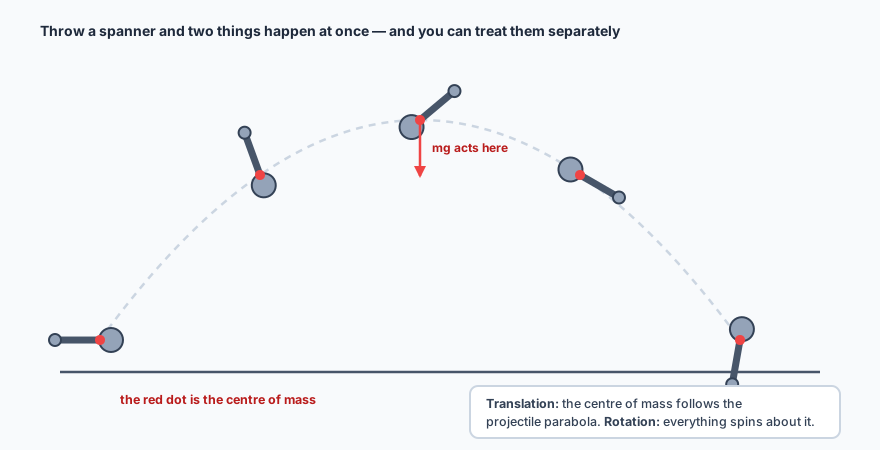
Translational quantities describe the centre of mass and are the same for every particle in the body. Rotational quantities describe turning about the chosen axis, and they are the same for every particle:
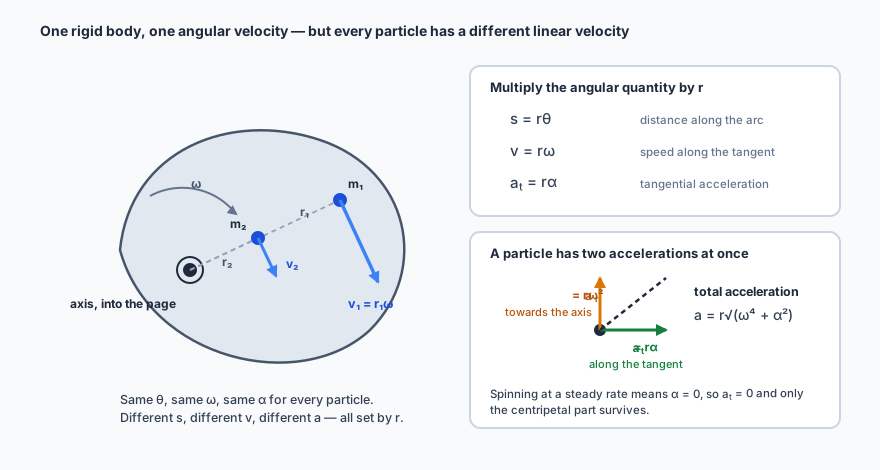
A particle in a rotating body has two accelerations at once. The centripetal (or radial) one, \( a_r = r\omega^{2} \), points at the axis and is there whenever the body turns at all. The tangential one, \( a_t = r\alpha \), appears only if the rotation rate is changing. Add them as perpendicular vectors:
Rolling: the two motions at the same time
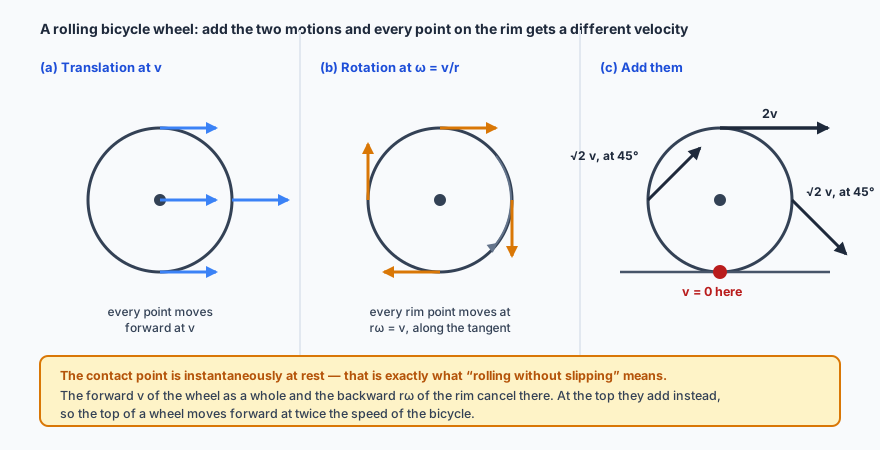
A wheel rolling along the ground is the cleanest example. Every point on the rim carries the forward velocity \(v\) of the axle and a tangential velocity \( r\omega \) from the spin, and for rolling without slipping those two have the same size.
🧮The equations of rotational motion
Because the definitions of \(\omega\) and \(\alpha\) mirror those of \(v\) and \(a\) exactly, the algebra that produced the suvat equations produces an angular set with no new work at all. This correspondence is the single most useful thing to have in your head for this topic:
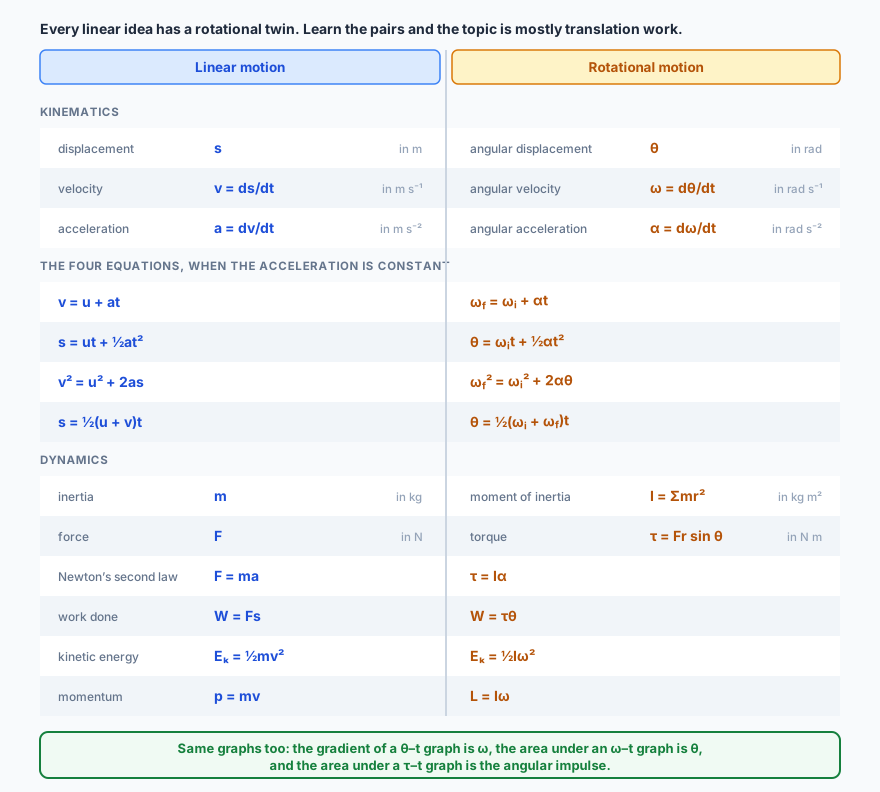
The graphs translate too. The gradient of an angular displacement–time graph is \(\omega\); the gradient of an \(\omega\)–\(t\) graph is \(\alpha\) and the area under it is \(\theta\); and the area under a torque–time graph is the angular impulse, exactly as the area under a force–time graph was the linear impulse in A.2.
⚖️Torque, couples and equilibrium
A force applied to an extended body does two things: it accelerates the centre of mass, and it can turn the body. The turning effect about a given axis is the moment of the force, or the torque \(\tau\).
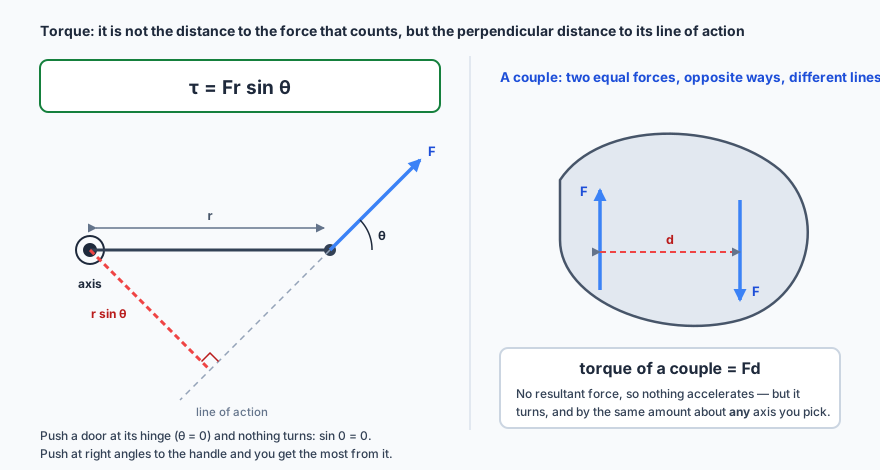
Torque is measured in N m. That is dimensionally the same as the joule, but a torque is not an energy and should never be written in joules. Its direction is described as clockwise or anticlockwise about the axis you have chosen.
A couple is a pair of equal, antiparallel forces acting along different lines. It has no resultant force, so it produces no acceleration of the centre of mass at all — only rotation. Its torque is \( Fd \), where \(d\) is the perpendicular separation of the two lines, and remarkably that value is the same about every axis you could choose.
The two conditions for equilibrium
An extended body is in static equilibrium when it is neither accelerating nor angularly accelerating, which needs both of:
translational equilibrium
rotational equilibrium
In a two-dimensional problem it is enough to show the forces balance in two different directions, and that there is no resultant torque about any one axis. You may choose that axis freely — and choosing it at the line of action of an unknown force makes that unknown vanish from the equation, which is the whole trick.
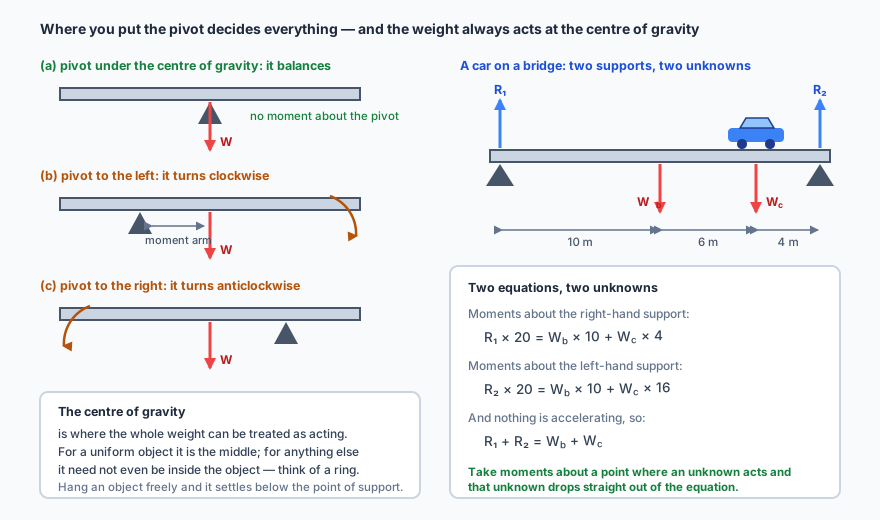
✏️Worked example 1 — the ladder against a smooth wall
(a) The wall is smooth, so its reaction \(R_w\) is horizontal. The ladder’s weight is vertical. Those two lines meet at one point, so — by the three-force rule above — the force from the ground must pass through that same point too. That line is not vertical, so the ground’s force must have a horizontal component: friction. Without it there is nothing to stop the base sliding out.
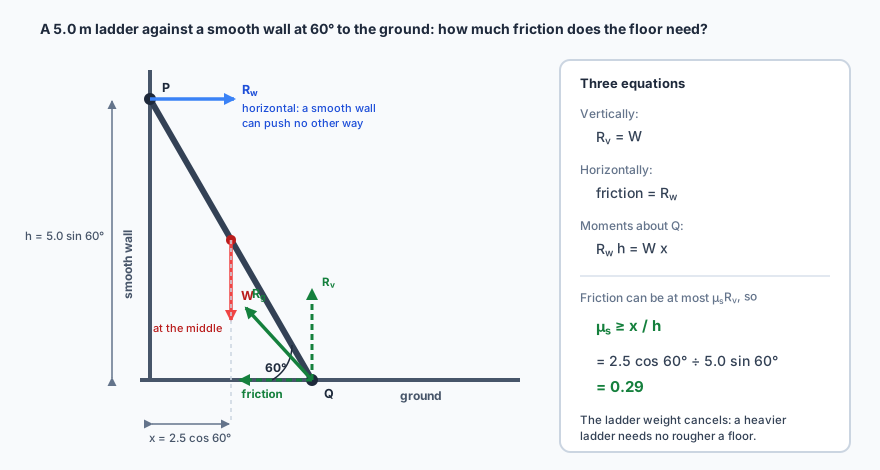
(b) Three equations. Vertically \( R_v = W \). Horizontally \( F_f = R_w \). Taking moments about the base (which removes both ground forces at a stroke),
Friction cannot exceed \( \mu_s R_v = \mu_s W \), and it must equal \(R_w\), so
🎡Moment of inertia
Apply Newton’s second law to one particle of a rotating body. The tangential component of the force gives \( F = ma_t = mr\alpha \), and multiplying by \(r\) turns that into a torque: \( \tau = mr^{2}\alpha \). Sum over every particle — the internal torques cancel in third-law pairs, leaving only external ones — and
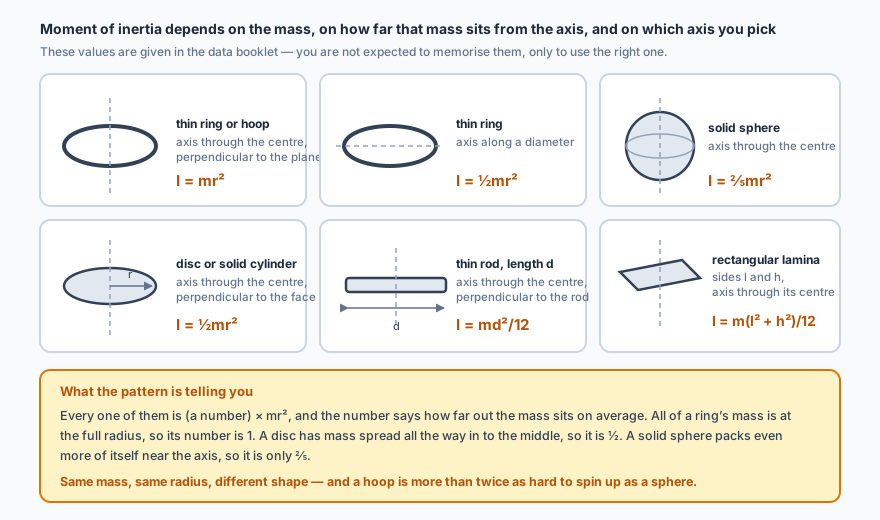
\(I\) is the moment of inertia: the rotational equivalent of mass, measured in kg m\(^{2}\). It is a scalar, and it depends on three things — how much mass there is, how that mass is distributed, and which axis you are rotating about. The same object has different moments of inertia about different axes.
⚡Rotational dynamics: energy and momentum
When a torque turns a body through an angle \(\theta\), the force moves through an arc \( r\theta \), so the work done is
and in the absence of resistive torques that work is stored as rotational kinetic energy. Substituting \( \omega_f^{2} = \omega_i^{2} + 2\alpha\theta \) into \( W = I\alpha\theta \) gives it directly:
Angular momentum completes the dictionary. For one particle it is the moment of the linear momentum about the axis, \( L = (mv)r = mr^{2}\omega \); summing over the body gives
and the angular version of impulse follows the linear one exactly: angular impulse \( \Delta L = \tau\Delta t \), which for a varying torque is the area under the torque–time graph.
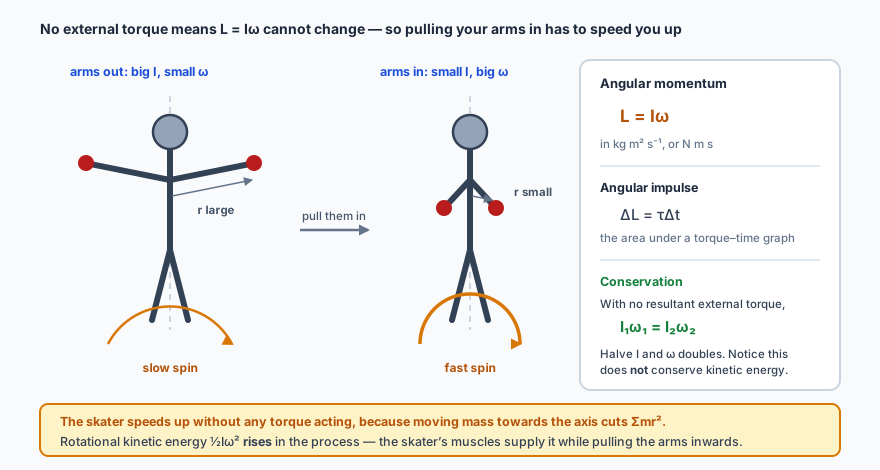
Conservation of angular momentum: the total angular momentum of a system stays constant provided no resultant external torque acts. It is a genuinely separate conservation law — a system can conserve angular momentum while its kinetic energy changes, as the skater’s does.
✏️Worked example 2 — two flywheels coupled together
(a) No external torque acts about the axis, so angular momentum is conserved. This is the rotational twin of a totally inelastic collision:
(b) Compare the kinetic energies before and after:
so 30 J has been lost, to friction and heating in the coupling.
✏️Worked example 3 — a sphere rolling down a slope
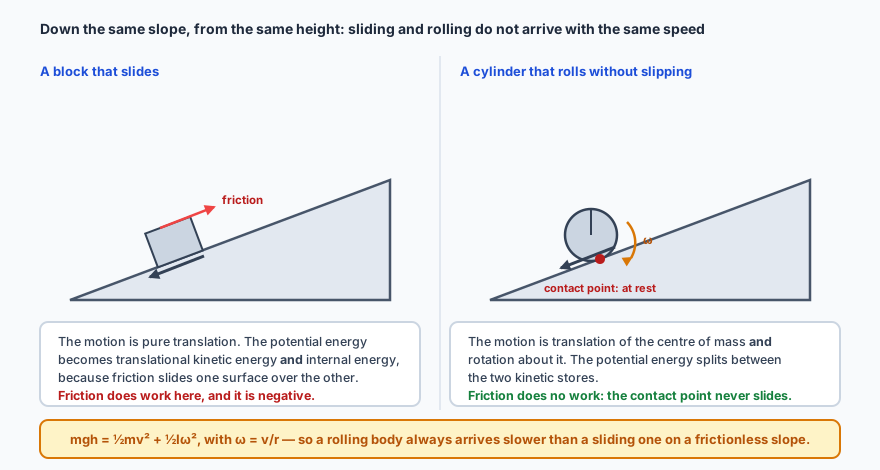
Energy is the quick route. Friction does no work here, because the contact point never slides, so all the potential energy becomes kinetic — but it has to be shared between the two stores:
Rolling links the two. Without slipping, \( \omega = v/r \), so the rotational term becomes
The \(r\) cancels completely. Collecting terms, \( mgh = \tfrac{1}{2}mv^{2} + \tfrac{1}{5}mv^{2} = \tfrac{7}{10}mv^{2} \), and the mass cancels too:
🔭See it happen
PhET, Torque (or Ladybug Revolution). Put a mass on the platform, apply a torque and watch \(\alpha\) respond; then slide the mass outwards and apply the same torque again. Nothing about the mass changed, only its \(r\) — and the angular acceleration collapses. That is \( I = \sum mr^{2} \) in one experiment.
A hoop and a disc down a ramp. Race any two round objects of different shape down the same slope. The one with the smaller number in front of its \(mr^{2}\) always wins, regardless of mass or size — a race you can run with a tin of soup and an empty tin.
📝Practise
Work through these, then reveal the answer. Between them they cover every objective at the top of the page. Take \( g = 9.81 \) m s\(^{-2}\), and keep the calculator in radians.
1. A flywheel of moment of inertia 0.75 kg m\(^{2}\) is accelerated uniformly from rest to 8.2 rad s\(^{-1}\) in 6.5 s. Find (a) the resultant torque, (b) its rotational kinetic energy at 8.2 rad s\(^{-1}\). (c) The flywheel has radius 15 cm. A braking force applied at the rim brings it to rest in exactly 2 revolutions. Find that force.
(a) \( \alpha = \dfrac{8.2 - 0}{6.5} = 1.26 \) rad s\(^{-2}\), so \( \tau = I\alpha = 0.75 \times 1.26 = 0.95 \) N m.
(b) \( E_k = \tfrac{1}{2}I\omega^{2} = \tfrac{1}{2}(0.75)(8.2)^{2} = 25 \) J.
(c) Two revolutions is \( \theta = 4\pi = 12.6 \) rad. From \( \omega_f^{2} = \omega_i^{2} + 2\alpha\theta \) with \( \omega_f = 0 \): \( \alpha = -\dfrac{8.2^{2}}{2(12.6)} = -2.68 \) rad s\(^{-2}\). Then \( \tau = I\alpha = 2.01 \) N m, and since the force acts at the rim, \( F = \tau/r = 2.01/0.15 = 13 \) N.
2. The angular speed of a car engine increases uniformly from 120 rad s\(^{-1}\) to 400 rad s\(^{-1}\) in 14 s. Find (a) the angular acceleration and (b) the angular displacement during that time.
(a) \( \alpha = \dfrac{400 - 120}{14} = 20 \) rad s\(^{-2}\).
(b) Use the angular equation with no \(\alpha\) in it: \( \theta = \tfrac{1}{2}(\omega_i + \omega_f)t = \tfrac{1}{2}(520)(14) = 3.6 \times 10^{3} \) rad — about 580 revolutions.
3. A car has wheels of radius 0.35 m and travels in a straight line at 31 m s\(^{-1}\). (a) Find the angular speed of the wheels. (b) Describe how the velocity of a point on the rim varies. (c) The car brakes to rest while the wheels complete 40 revolutions. Find the angular acceleration and the distance covered.
(a) \( \omega = v/r = 31/0.35 = 89 \) rad s\(^{-1}\).
(b) It changes continuously between 0 at the bottom, where the tyre touches the road and is instantaneously at rest, and \(2v = 62\) m s\(^{-1}\) at the top. At the sides it is \( \sqrt{2}\,v = 44 \) m s\(^{-1}\) at 45° to the horizontal. The path traced out by such a point is a cycloid.
(c) \( \theta = 40 \times 2\pi = 251 \) rad. From \( \omega_f^{2} = \omega_i^{2} + 2\alpha\theta \): \( \alpha = -\dfrac{88.6^{2}}{2(251)} = -16 \) rad s\(^{-2}\). The distance is \( s = r\theta = 0.35 \times 251 = 88 \) m.
4. A solid disc of mass 80 kg and radius 0.50 m is rotating at 200 rad s\(^{-1}\) when a frictional torque of 12 N m starts to act on its axle. For a solid disc \( I = \tfrac{1}{2}mr^{2} \). Find (a) how long it takes to stop and (b) the angular displacement during the slowing.
First the moment of inertia: \( I = \tfrac{1}{2}(80)(0.50)^{2} = 10 \) kg m\(^{2}\).
(a) \( \alpha = \tau/I = 12/10 = 1.2 \) rad s\(^{-2}\) (a deceleration), so \( t = \dfrac{200}{1.2} = 1.7 \times 10^{2} \) s — nearly three minutes.
(b) \( \theta = \tfrac{1}{2}(200 + 0)t = \tfrac{1}{2}(200)(166.7) = 1.7 \times 10^{4} \) rad, about 2650 revolutions. A flywheel with little friction stores its energy for a long time, which is the point of one.
5. An engine shaft rotating at 400 rad s\(^{-1}\) transmits 25 kW. Find the torque on the shaft.
6. A wheel of mass 10 kg and radius 45 cm has all its mass at the rim. Its angular speed is increased from 40 rad s\(^{-1}\) to 100 rad s\(^{-1}\) in 5.0 s. Find (a) the work done by the torque and (b) the average power delivered.
All the mass at the rim means \( I = mr^{2} = 10 \times 0.45^{2} = 2.03 \) kg m\(^{2}\).
(a) The work done is the change in rotational kinetic energy: \( W = \tfrac{1}{2}I(\omega_f^{2} - \omega_i^{2}) = \tfrac{1}{2}(2.03)(100^{2} - 40^{2}) = 8.5 \times 10^{3} \) J.
(b) \( P = W/t = 8505/5.0 = 1.7 \times 10^{3} \) W.
7. A horizontal disc rotates freely about a vertical axis through its centre at 1.0 revolution per second. A 8.0 g lump of putty is dropped onto it and sticks 50 mm from the centre. The rate falls to 0.80 revolutions per second. Find the moment of inertia of the disc.
No external torque acts about the axis, so \( I\omega_1 = (I + mr^{2})\omega_2 \). Because only the ratio of the rates matters, revolutions per second can be used directly.
The putty contributes \( mr^{2} = 0.0080 \times (0.050)^{2} = 2.0 \times 10^{-5} \) kg m\(^{2}\). So \( I(1.0) = (I + 2.0\times10^{-5})(0.80) \), giving \( 0.20I = 1.6 \times 10^{-5} \) and
\( I = 8.0 \times 10^{-5} \) kg m\(^{2}\). A very light disc — which is why so little putty slowed it so much.
8. A torque of 30 N m acts on a wheel of moment of inertia 600 kg m\(^{2}\), starting from rest. (a) Find the angular acceleration. (b) The wheel has mass 200 kg. Estimate the speed of a point on its rim after one minute, stating your assumption.
(a) \( \alpha = \tau/I = 30/600 = 0.050 \) rad s\(^{-2}\).
(b) After 60 s, \( \omega = \alpha t = 3.0 \) rad s\(^{-1}\). To get from \(\omega\) to a rim speed you need the radius, and for that you must assume a shape. Treating it as a solid disc, \( I = \tfrac{1}{2}mr^{2} \) gives \( r = \sqrt{2I/m} = \sqrt{6.0} = 2.4 \) m, so \( v = \omega r = 7.3 \) m s\(^{-1}\).
Say the assumption out loud: with all the mass at the rim instead, \( I = mr^{2} \) would give \( r = 1.7 \) m and \( v = 5.2 \) m s\(^{-1}\). The moment of inertia alone does not fix the size of an object.
9. Tidal friction between the oceans and the sea bed produces a torque that slowly reduces the rate of the Earth’s spin on its own axis. Deduce the effect on (a) the Earth’s angular momentum about its axis, (b) the total angular momentum of the Earth–Moon system, (c) the Moon’s angular momentum about the Earth, (d) the Earth–Moon separation.
(a) It decreases. The torque opposes the spin, and \( \Delta L = \tau\Delta t \).
(b) It is unchanged. The tidal torques are internal to the Earth–Moon system, and no resultant external torque acts on it.
(c) It must increase, by exactly as much as the Earth’s spin angular momentum decreased, since the total is fixed.
(d) The separation increases: a larger orbital angular momentum means a larger orbit. The Moon is in fact receding at about 3.8 cm per year, which laser ranging off the Apollo reflectors can measure directly.
10. A uniform beam of weight 200 N and length 4.0 m rests on two supports, one at the left-hand end and one 1.0 m from the right-hand end. A 500 N load sits 0.50 m from the left-hand end. Find the force on each support.
Take moments about the left-hand support, so its own reaction has no moment. The right-hand support is 3.0 m away, the beam’s weight acts at its centre 2.0 m away, and the load is 0.50 m away:
\( R_2 \times 3.0 = 200 \times 2.0 + 500 \times 0.50 = 650 \), so \( R_2 = 217 \) N.
Vertically, \( R_1 + R_2 = 200 + 500 = 700 \) N, so \( R_1 = 483 \) N.
Check by taking moments about the right-hand support instead: \( R_1 \times 3.0 = 200 \times 1.0 + 500 \times 2.5 = 1450 \), giving \( R_1 = 483 \) N. Agreement between two independent axes is the standard way to catch an error here.
🔗Go deeper — other people’s work
These are external resources, not mine. If one stops working, tell me and everything above it on this page still stands.
- The Physics Classroom — Rotation and Balance
- The Physics Hypertextbook — rotational dynamics, and rotational equilibrium
- PhET — Torque, and Ladybug Revolution