Galilean and special relativity
Every result in this topic follows from two short sentences: the laws of physics look the same to every inertial observer, and the speed of light in a vacuum is one of them — the same number, however fast the source or the observer is moving. Nothing else is assumed. Simultaneity breaking, clocks running slow, rulers running short: all of it is just bookkeeping, once those two sentences are taken literally.
🎯What you need to be able to do
- Use Galilean transformations and Galilean velocity addition, and explain why they fail for light.
- State the two postulates of special relativity and explain what forces you to accept them.
- Explain the relativity of simultaneity with a concrete example.
- Use the Lorentz factor and the full Lorentz transformation equations, in either direction.
- Use the relativistic velocity addition equation, and compare it with the Galilean one.
- Identify proper time, proper length and rest mass correctly, and use the invariant spacetime interval.
- Calculate time dilation and length contraction, and use muon decay as evidence for both.
- Read and draw spacetime diagrams, including a worldline’s elapsed proper time.
- Explain the twin paradox and resolve it without contradiction.
📍Reference frames and Galilean relativity
A frame of reference is just a coordinate system plus a clock: something that lets you assign a position and a time to every event. Whether an object counts as moving or at rest is a question that only has an answer once you have said relative to which frame. A passenger sitting still in a chair is at rest relative to the plane, in motion relative to the ground, and moving at tens of kilometres per second relative to the Sun. None of those statements is more correct than the others — motion is a relationship between an object and a frame, not a property of the object alone.
An inertial frame is one in which Newton’s first law holds: a frame that is either at rest or moving at constant velocity. Everything in this section assumes the frames involved are inertial — an accelerating frame is a different, harder problem that this topic does not ask you to solve.
Take two inertial frames, S and S′, moving at relative velocity \(v\) along their shared x-axis, and synchronise their clocks so that their origins coincide at \(t = t' = 0\). The Galilean transformation converts the coordinates of an event from one frame to the other:
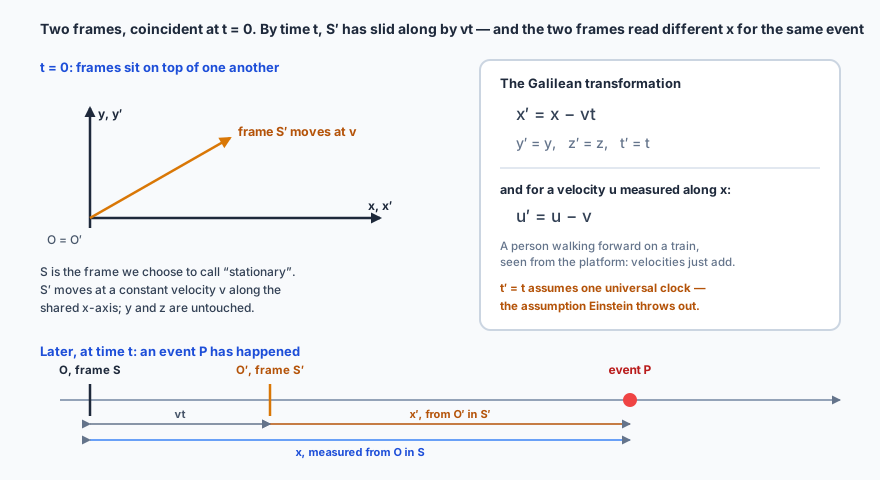
and differentiating the first equation with respect to time gives the familiar rule for combining velocities, \( u' = u - v \). Walk forward at 2 m s\(^{-1}\) inside a train doing 30 m s\(^{-1}\) and the platform sees 32 m s\(^{-1}\): velocities just add. This is not an approximation at everyday speeds — it is exactly what experiment shows, to a precision far beyond what any passenger could detect. The equation quietly sitting in the middle of that transformation, \( t' = t \), is the one that eventually breaks: it assumes every observer shares one universal clock, ticking at the same rate regardless of how anyone is moving.
💣The postulates of special relativity
In 1864 Maxwell unified electricity and magnetism into one set of equations, and those equations make a striking prediction: an electromagnetic wave in a vacuum must travel at a speed fixed by two constants of nature, \( c = 1/\sqrt{\varepsilon_0\mu_0} \). Nowhere does that formula mention the speed of whatever emitted the wave. Maxwell’s equations say the speed of light is simply independent of the motion of the source.
That is incompatible with Galilean addition. Chase a light beam at half its speed and Galilean relativity insists it must recede from you at half speed; ride a bicycle towards someone shining a torch at you and the light should arrive faster than \(c\). Every experiment ever performed says otherwise — most strikingly a 1964 CERN measurement of gamma-ray photons emitted by particles travelling at nearly \(c\) itself: the photons were still measured moving at exactly \(c\), not at \(2c\).
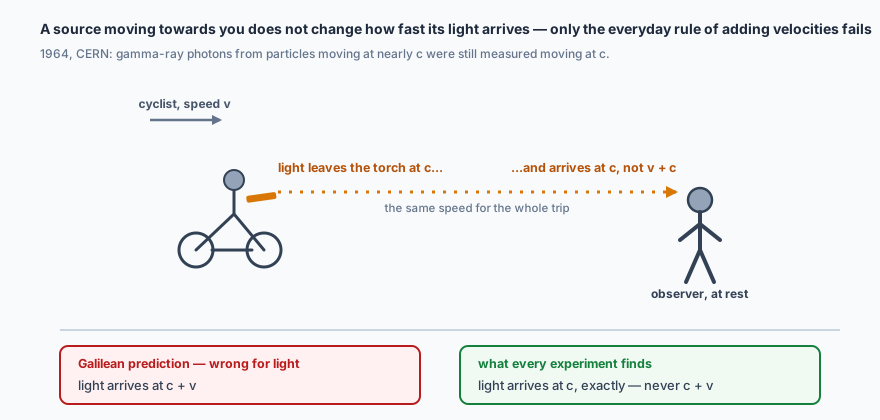
Einstein took this seriously rather than treating it as a puzzle to explain away, and built special relativity on two postulates:
- The speed of light in a vacuum has the same value for all inertial observers, regardless of the motion of the source or the observer.
- The laws of physics are the same in all inertial reference frames.
The second postulate sounds almost too obvious to state — Newtonian mechanics already respects it, since \(F=ma\) does not care whether you are “really” at rest or moving at constant velocity. The first is the one doing all the work. Accept both, and the universal clock hidden inside \( t' = t \) cannot survive: something has to give, and what gives is the idea that time and space are the same for everyone.
⏳The relativity of simultaneity
Two events are simultaneous if they happen at the same time. The uncomfortable discovery of special relativity is that this is not something all observers need to agree on.
Picture a passenger sitting exactly in the middle of a moving carriage. She sends a flash of light towards each end, where mirrors are mounted. Because she is equidistant from both mirrors, and light travels at \(c\) whichever way you measure it, she sees both pulses hit their mirror at the same instant, and both return to her at the same instant.
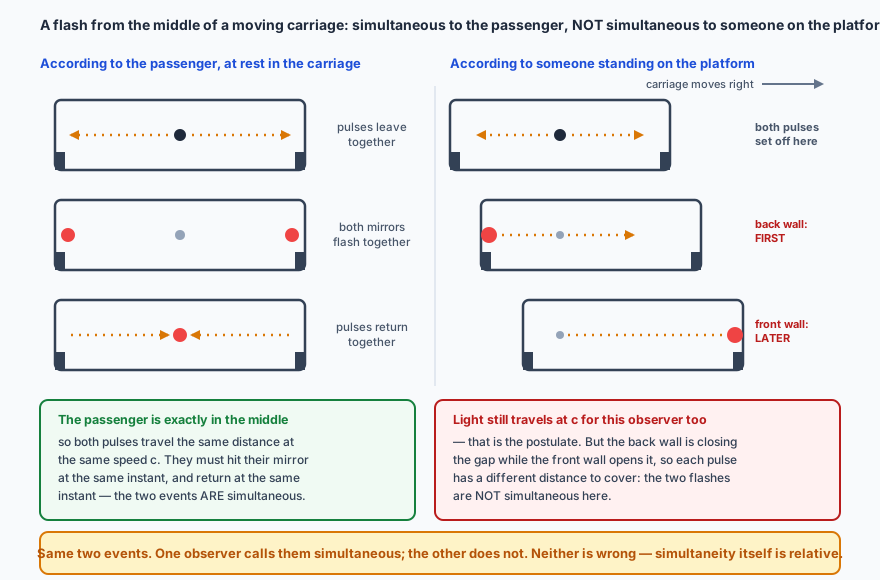
Now watch the same experiment from the platform. Light still travels at \(c\) for this observer too — that is the first postulate, not a matter of opinion. But from the platform, the back of the carriage is moving towards the point where its pulse started, so it meets its pulse sooner; the front of the carriage is moving away from its pulse, so it takes longer to be reached. The platform observer therefore sees the back wall flash first. The two events that the passenger calls simultaneous are not simultaneous on the platform.
📊The Lorentz transformations
Every formula from here on carries the same factor, the Lorentz factor:
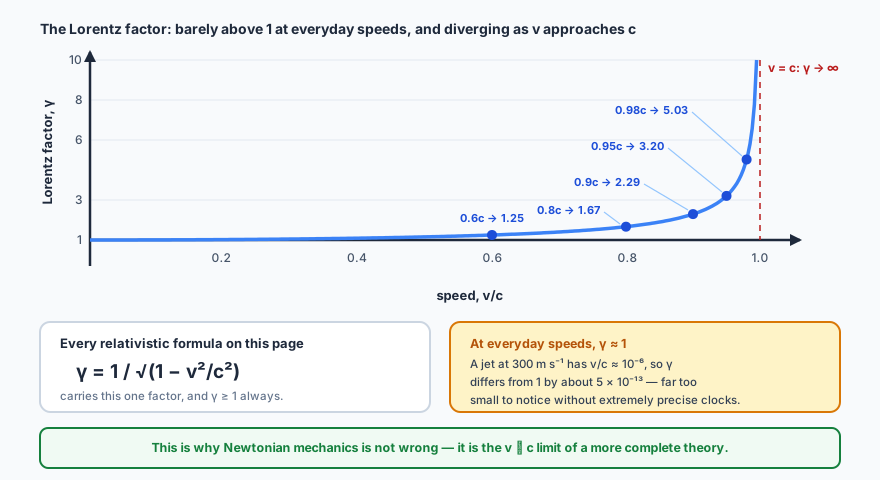
With \(\gamma\) defined, the full Lorentz transformation replaces the Galilean one for an event with coordinates \((x,t)\) in frame S and \((x',t')\) in frame S′, moving at velocity \(v\) relative to S along their shared x-axis:
and the reverse transformation, from S′ back to S, is the same equations with \(v\) replaced by \(-v\):
You are not required to derive these, only to use them. Notice what has changed from the Galilean version: \(t'\) now depends on \(x\) as well as \(t\). That cross-term, \(vx/c^{2}\), is simultaneity-breaking written as algebra — it is precisely why two events with the same \(t\) but different \(x\) in one frame get different \(t'\) in the other, exactly as the carriage experiment showed.
✏️Worked example 1 — using the full transformation
First, \(\gamma\). At \(v = 0.60c\), \( \gamma = 1/\sqrt{1-0.60^{2}} = 1/0.80 = 1.25 \).
Transform event B (event A, at the common origin, transforms to itself):
Check with the invariant interval. In S, \( (c\Delta t)^{2} - (\Delta x)^{2} = (300)^{2} - (450)^{2} = -1.125\times10^{5}\ \text{m}^{2} \). In S′, \( (c\Delta t')^{2} - (\Delta x')^{2} = (37.5)^{2} - (337.5)^{2} = -1.125\times10^{5}\ \text{m}^{2} \).
➕Velocity addition
Differentiating the Lorentz transformation the way you differentiated the Galilean one gives the relativistic rule for combining velocities. For an object moving at velocity \(u\) along the x-axis of frame S, its velocity \(u'\) in frame S′ (itself moving at \(v\) relative to S) is
which reduces to the familiar \( u' = u - v \) whenever \(uv/c^{2}\) is negligible — the Galilean formula is not wrong, it is just this equation's low-speed limit. At high speed the denominator is what saves the day. Two particles flying apart at \(0.75c\) each, as measured in the lab, do not separate at \(1.5c\) in either particle’s own frame:
Close to \(c\), but never reaching or passing it. However close \(u\) and \(v\) individually get to \(c\), the combination formula guarantees \(u'\) stays below \(c\) too — the speed limit is built into the algebra, not imposed on it afterwards.
🔒Invariant quantities
If two observers disagree about positions and times, is there anything left they agree on? Combine the two Lorentz equations and the answer is yes — for two events separated by \(\Delta x\) and \(\Delta t\) in one frame, and by \(\Delta x'\) and \(\Delta t'\) in another,
This quantity is the spacetime interval, and it is invariant: every inertial observer computes the same value, however much they disagree about \(\Delta x\) and \(\Delta t\) individually. It plays the same role in relativity that ordinary distance, \( \sqrt{x^2+y^2+z^2} \), plays in everyday geometry — a quantity that survives a change of viewpoint. The full three-dimensional version is \( (c\Delta t)^{2} - \Delta x^{2} - \Delta y^{2} - \Delta z^{2} \).
Three further quantities are invariant, and each is defined by pinning down which frame gets to measure it:
- Proper time, \(\Delta t_0\) — the time between two events as measured in the frame where both events happen at the same place. It is the shortest time interval any observer will measure between those two events.
- Proper length, \(L_0\) — the length of an object as measured in the frame where the object is at rest. It is the longest length any observer will measure for that object.
- Rest mass, \(m_0\) — the mass of an object as measured in the frame where the object is at rest.
⌛Time dilation
A clock built from a single photon bouncing between two mirrors a distance \(l\) apart makes the point as simply as possible. At rest, one tick — the round trip — takes \( \Delta t_0 = 2l/c \), and because both bounces happen at the same place, this is the proper time for the tick.
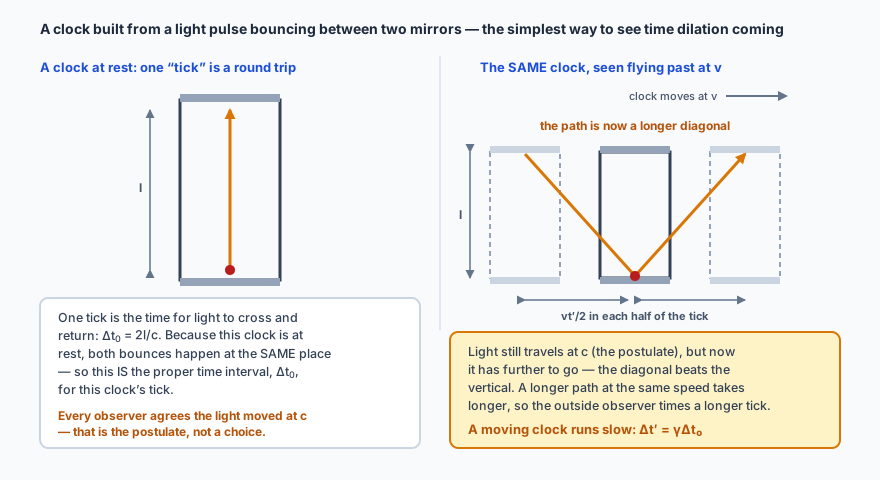
Watch the same clock fly past at speed \(v\) and the photon's path is no longer a straight up-and-down line: the mirrors have moved sideways between bounces, so the photon traces a diagonal. Light still travels at \(c\) — the postulate insists on it — but the diagonal is longer than the vertical, so covering it takes longer. Working through the geometry (Pythagoras on the triangle formed by \(l\), half the sideways shift, and the diagonal) gives:
A moving clock runs slow, by exactly the Lorentz factor. This is not particular to light clocks — it applies to every clock, including biological ones, because if it did not, you could build a light clock and a mechanical clock side by side, watch them drift apart, and use that drift to detect absolute motion. The whole point of the postulates is that no such experiment exists.
📏Length contraction and the evidence
Time is not the only casualty. An object's length, measured along its direction of motion, is also frame-dependent:
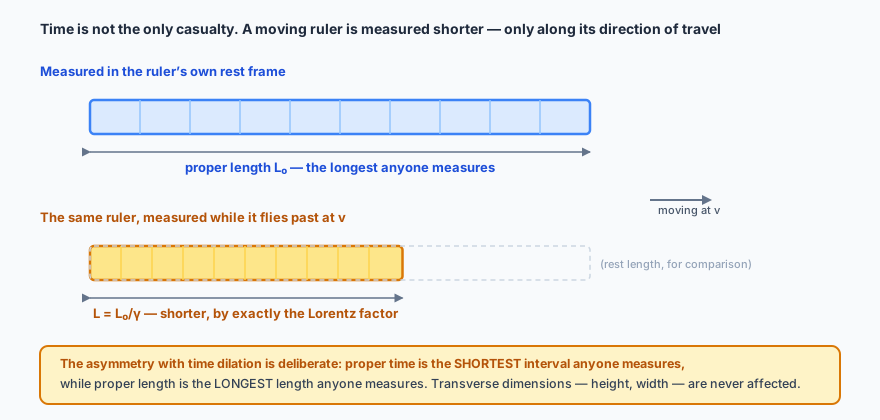
Notice the deliberate asymmetry with time dilation: proper time is the shortest interval anyone measures, while proper length is the longest length anyone measures. Every other observer measures a longer time and a shorter length. Getting that pair the right way round is worth more marks than the formulas themselves.
✏️Worked example 2 — a journey to a nearby star
\(\gamma = 1.25\) at \(0.60c\), as before.
(a) In the Earth frame, distance over speed: \( t = 12/0.60 = 20 \) years.
(b) The crew are present at both departure and arrival, at the same place — on their own ship — so they measure the proper time: \( \Delta t_0 = 20/1.25 = 16 \) years.
(c) In the crew's frame the 12 ly Earth–star distance is a moving length, contracted: \( L = 12/1.25 = 9.6 \) light-years.
The classic real evidence for both effects together is the muon. Muons produced by cosmic rays high in the atmosphere have a proper lifetime of only 2.2 µs, and even travelling at \(0.99c\) that is only enough time to cover a few hundred metres — nowhere near the roughly 10 km to the ground. Large numbers of them are detected at sea level anyway.
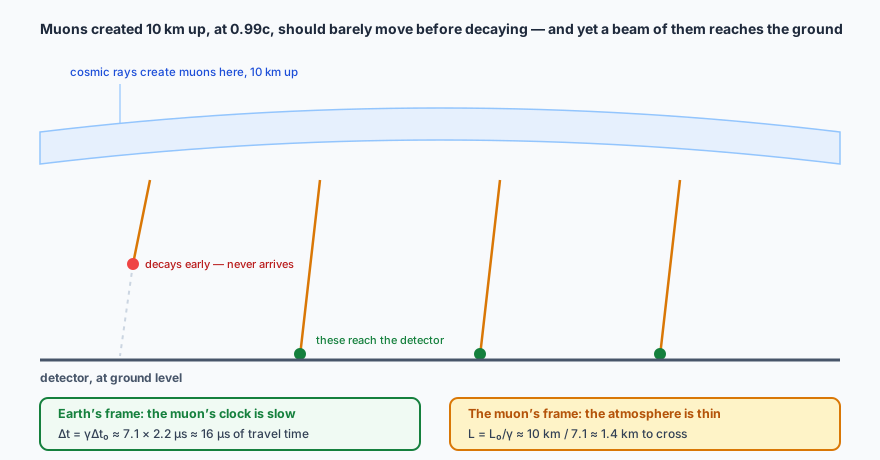
From Earth's frame, the muon's internal clock is time-dilated: at \(0.99c\), \(\gamma \approx 7.1\), so its 2.2 µs proper lifetime becomes roughly 16 µs as measured on the ground, comfortably enough to cross 10 km at nearly \(c\). From the muon's own frame, its lifetime is perfectly ordinary — time dilation cannot be the explanation there, because the muon's clock is its own clock. Instead, the 10 km of atmosphere is a length rushing past it at \(0.99c\), and that length is contracted to about 1.4 km, easily covered within an ordinary lifetime. Both descriptions are different stories told in different frames; both predict the same count of muons reaching the detector, which is exactly what a correct theory has to do.
✏️Worked example 3 — an unstable particle
\(\gamma\) at \(0.96c\): \( \gamma = 1/\sqrt{1-0.96^{2}} = 1/\sqrt{0.0784} = 3.57 \).
(a) The particle's own clock reads the proper time, so the lab measures a longer, dilated time: \( \Delta t = \gamma\Delta t_0 = 3.57 \times 5.0\times10^{-8} = 1.79\times10^{-7} \) s.
(b) In the lab frame, distance is speed times the lab-frame time: \( d = vc\,\Delta t = 0.96(3.0\times10^{8})(1.79\times10^{-7}) = 51.4 \) m.
(c) In the particle's own frame that same 51.4 m stretch of lab is a moving length, contracted: \( d' = d/\gamma = 51.4/3.57 = 14.4 \) m.
🗺️Spacetime diagrams
A spacetime diagram plots an object's position against time, usually with \(c \times \text{time}\) on the vertical axis so that both axes share the same units of length. Every object — moving or not — is a line on this diagram, its worldline, and reading a few worldlines correctly is most of what this section asks for.
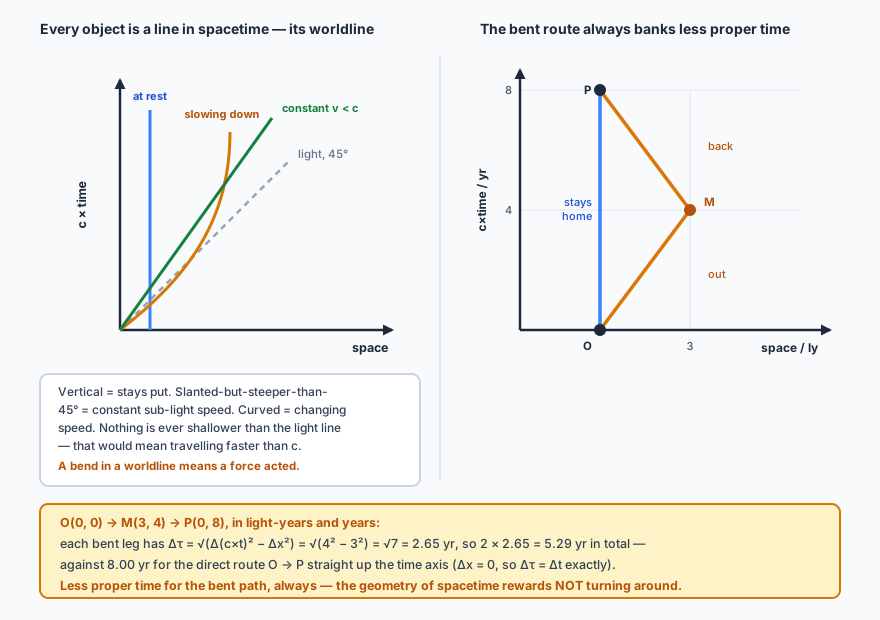
Along any worldline, the elapsed proper time between two points is the invariant interval between them, converted into a time by dividing by \(c\):
which is real and positive only when \( |\Delta x| < c\,\Delta t \) — that is, only for a worldline no shallower than the light lines, exactly the constraint already built into the diagram. A curved (bent) worldline can be broken into short straight segments and its proper time added up segment by segment, which is exactly the technique behind the twin paradox.
✏️Worked example 4 — a direct route beats a detour
Direct route. \( \Delta x = 0 \), so \( \Delta\tau = \sqrt{8.0^{2} - 0^{2}} = 8.0 \) yr — the coordinate time and the proper time coincide exactly, because this observer never moves.
Bent route, leg by leg. O→M has \( \Delta x = 3.0 \) ly, \( \Delta t = 4.0 \) yr, so \( \Delta\tau = \sqrt{4.0^{2}-3.0^{2}} = \sqrt{7} = 2.65 \) yr. M→P has the same \( |\Delta x| \) and \( \Delta t \), so it also contributes \( \sqrt{7} = 2.65 \) yr. Total: \( 5.29 \) yr.
👶The twin paradox
One twin stays on Earth. The other accelerates away at high speed, travels to a distant star, turns around, and comes home. Each twin, naively applying “moving clocks run slow” to the other, expects the other to be younger on reunion. Both cannot be right — hence paradox.
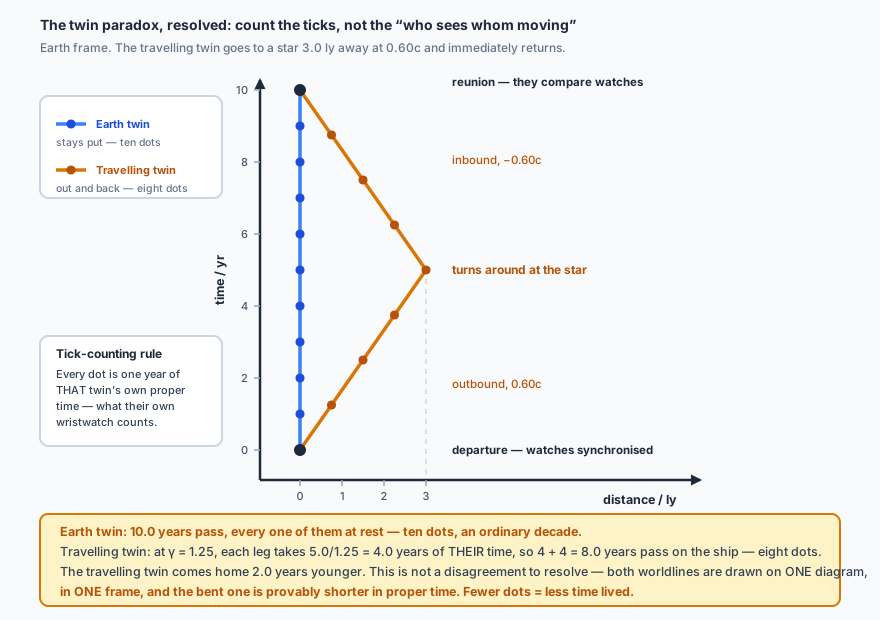
The resolution is that the situation is not symmetric. The Earth twin stays in a single inertial frame throughout. The travelling twin does not: turning around means decelerating, stopping, and accelerating back — leaving one inertial frame and joining another. That acceleration is physically detectable (the travelling twin could feel it, with an accelerometer, without looking outside), so there is a real, frame-independent fact about which twin's worldline is bent. And Worked example 4 already showed what a bent worldline costs: less elapsed proper time than the direct route between the same two events, always.
For a distance \(d\) (Earth frame) at constant speed \(v\) each way, the Earth twin ages \( \Delta t = 2d/v \), while the travelling twin ages the proper time along the bent path, \( \Delta\tau = \Delta t/\gamma \). At \(v = 0.60c\) and \(d = 3.0\) ly, \(\gamma = 1.25\): the Earth twin ages \(10.0\) years, the traveller ages \(8.0\) years, and the traveller returns 2.0 years younger — matching the tick count in the figure exactly.
🔭See it happen
PhET, Relativity (and Twin Paradox simulations). Watch a light clock's diagonal path lengthen as its speed increases, or run the twin-paradox simulation directly with an adjustable turnaround speed and distance — the ages on return match \( \Delta\tau = \Delta t/\gamma \) exactly, for any numbers you choose.
📝Practise
Work through these, then reveal the answer. Between them they cover every objective at the top of the page.
1. Calculate the Lorentz factor for a speed of \(0.90c\).
2. An unstable particle has a proper lifetime of \(2.60 \times 10^{-8}\) s and moves at \(0.995c\). (a) Estimate the distance it could travel using its proper lifetime directly, with no relativity. (b) Find the distance it actually travels, on average, in the lab frame. (c) By what factor does relativity extend its reach?
(a) \( d_0 = vc\,\Delta t_0 = 0.995(3.0\times10^{8})(2.60\times10^{-8}) = 7.76 \) m.
(b) At \(0.995c\), \( \gamma = 1/\sqrt{1-0.995^{2}} = 10.0 \). The lab-frame lifetime is \( \gamma\Delta t_0 = 2.60\times10^{-7} \) s, so \( d = vc \times \gamma\Delta t_0 = 77.6 \) m.
(c) \( 77.6/7.76 = 10.0 \) — exactly \(\gamma\). Relativity does not add a separate correction; it multiplies the naive answer by the Lorentz factor, every time.
3. A spacecraft has a proper length of 80 m and travels at \(0.92c\). Find its length as measured by an observer it passes.
4. Two fragments fly apart from a fission event, measured in the lab at \(0.90c\) and \(0.85c\) in opposite directions. Find the speed of one fragment relative to the other.
5. Two events are separated by \( \Delta x = 6.0 \times 10^{8} \) m and \( \Delta t = 2.5 \) s in one frame. Calculate the invariant spacetime interval \( (c\Delta t)^{2} - (\Delta x)^{2} \), and state what a different inertial observer would calculate for the same two events.
6. Explain why the Galilean velocity-addition equation fails for light, and identify precisely which postulate is responsible.
7. State the condition under which two observers in relative motion will always agree that two events are simultaneous, and explain why.
8. Event A occurs at \(x = 2.0\) ly, \(ct = 3.0\) ly. Event B occurs at \(x = 5.0\) ly, \(ct = 6.0\) ly. Calculate the spacetime interval between them and state what kind of worldline — if any — could connect the two events.
9. A different pair of twins repeats the experiment with the travelling twin going to a star 4.0 ly away (Earth frame) at \(0.80c\) and immediately returning. Find the age of each twin when the traveller gets home, if both were 20 years old at departure.
10. A rod of proper length 2.0 m moves past you at \(0.80c\), oriented along its direction of travel. (a) Find its length as you measure it. (b) Find how long, by your own clock, it takes to pass a fixed point next to you.
(a) \( \gamma = 1/\sqrt{1-0.80^{2}} = 1.667 \). \( L = 2.0/1.667 = 1.2 \) m.
(b) The contracted 1.2 m rod passes a fixed point at its own speed: \( t = L/v = 1.2/(0.80 \times 3.0\times10^{8}) = 5.0 \times 10^{-9} \) s.
🔗Go deeper — other people’s work
These are external resources, not mine. If one stops working, tell me and everything above it on this page still stands.
- The Physics Hypertextbook — special relativity
- HyperPhysics — relativity, time dilation and the muon experiment
- PhET — Relativity simulations