Theme B · The particulate nature of matter · HL only
Two laws, and they do very different jobs. The first says energy is conserved when a gas is heated or compressed — it tells you what is possible. The second says that some of those possible things never happen anyway, no matter how carefully you engineer them — it tells you what is allowed. Everything on this page, including the reason no engine can ever be perfectly efficient, comes from holding those two apart.
🎯What you need to be able to do
State and apply the first law, \( Q = \Delta U + W \), with the sign conventions correct.
Calculate the work done by an expanding gas, \( W = p\Delta V \), and recognise it as the area under a \(p\)–\(V\) curve.
Describe isobaric, isovolumetric, isothermal and adiabatic changes, and sketch each on \(p\)–\(V\) axes.
Use \( pV^{5/3} = \) constant for an adiabatic change in a monatomic ideal gas.
Find the net work done in a cycle from the area it encloses.
Define entropy and use \( \Delta S = \Delta Q / T \).
State the second law in words, and explain what it forbids.
Calculate the efficiency of a heat engine and compare it with the Carnot limit \( \eta_{\text{C}} = 1 - T_{\text{C}}/T_{\text{H}} \).
⚖️The first law: conservation of energy, written for a gas
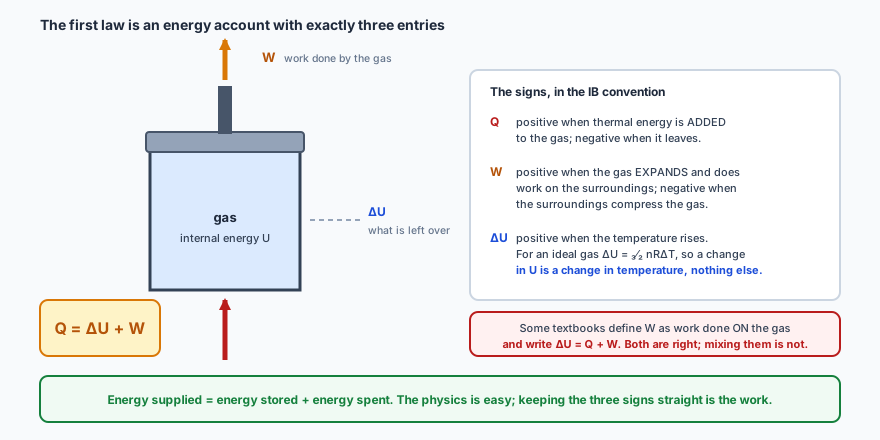
Thermal energy can enter a gas, the gas can do work on its surroundings, and its internal energy can change. The first law says those three are one accounting statement:
\[ Q = \Delta U + W \]
Energy in equals energy stored plus energy out. The whole difficulty of the first law is not the physics, it is keeping three signs straight.
\(Q\)thermal energy added to the gas
\(W\)work done by the gas
\( \Delta U \)change in the gas’s internal energy
For an ideal monatomic gas, internal energy is entirely kinetic, so from B.3:
\[ U = \tfrac{3}{2}nRT \qquad\text{so}\qquad \Delta U = \tfrac{3}{2}nR\,\Delta T \]
which gives a rule worth memorising in this exact form: a change in internal energy is a change in temperature, and nothing else. If the temperature is unchanged, \( \Delta U = 0 \), whatever else is happening.
The sign of \(W\) is the one that catches people. In the IB convention \(W\) is the work done by the gas, so an expanding gas has \( W > 0 \) and a compressed gas has \( W < 0 \). Some textbooks define \(W\) as the work done on the gas and write the law as \( \Delta U = Q + W \). Both are correct; mixing them is not. Check which convention a question is using by asking whether the gas is expanding, and whether that should help or hinder its internal energy.
🔧Work done by an expanding gas
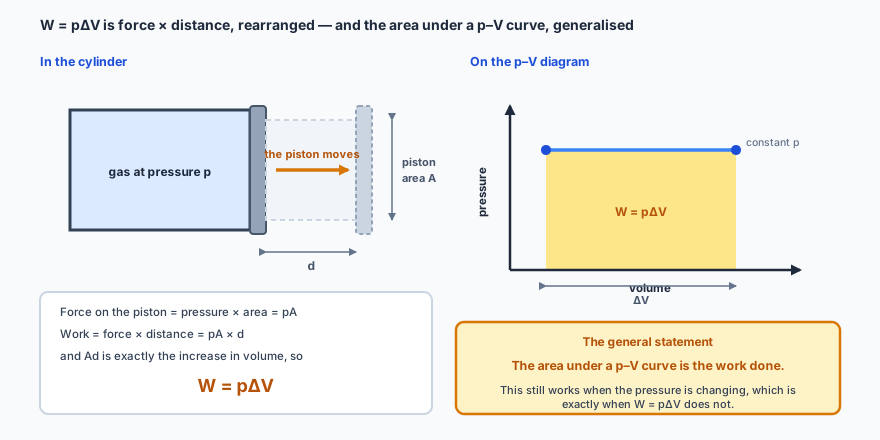
When a gas expands it pushes the piston out, and pushing something through a distance is work. If the pressure stays constant while the volume changes by \( \Delta V \):
\[ W = p\,\Delta V \]
\( W = p\Delta V \) is just \( \text{force} \times \text{distance} \) rearranged. The general statement is the one on the right: the area under a \(p\)–\(V\) curve is the work done.
That second statement is the more useful one, because it still works when the pressure is changing — and it is what makes \(p\)–\(V\) diagrams worth drawing at all.
📊The four processes on a \(p\)–\(V\) diagram
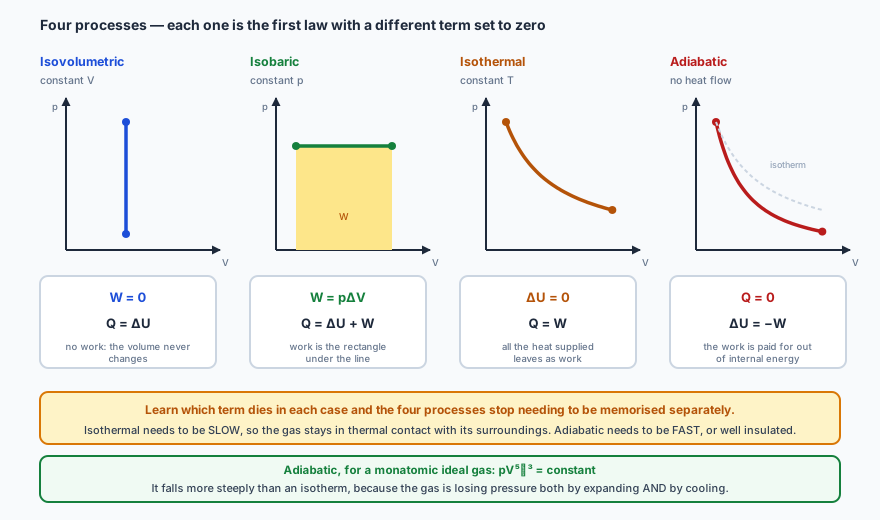
Four special changes appear over and over. Each is defined by one thing being held fixed, and each has a characteristic shape.
Each column is the first law with one term deliberately set to zero. Learn which term dies in each case and the four processes stop needing to be memorised separately.
isovolumetric\( \Delta V = 0 \Rightarrow W = 0 \), so \( Q = \Delta U \)
isobaric\( p \) constant, \( W = p\Delta V \)
isothermal\( \Delta T = 0 \Rightarrow \Delta U = 0 \), so \( Q = W \)
adiabatic\( Q = 0 \), so \( \Delta U = -W \)
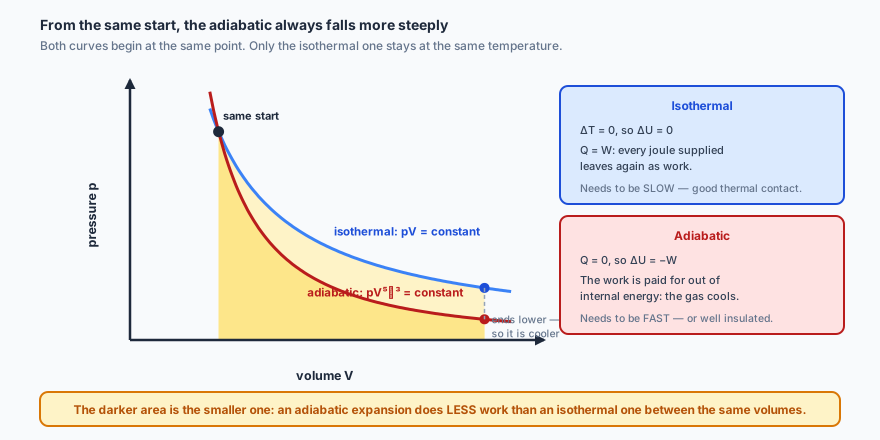
The last two are worth reading again, because they are opposites. In an isothermal expansion every joule of heat supplied comes straight out again as work, and the gas neither warms nor cools — which requires the change to be slow enough for the gas to stay in thermal contact with its surroundings. In an adiabatic expansion no heat enters at all, so the work has to be paid for out of the internal energy, and the gas cools as it expands. That requires the change to be fast, or the gas to be well insulated.
From the same start, the adiabatic always falls more steeply: the gas is losing pressure both because the volume is growing and because it is cooling.
(a) A gas absorbs 500 J of thermal energy and does 200 J of work on its surroundings. Find the change in its internal energy.
(b) An ideal gas at a constant pressure of \( 2.0\times10^{5} \) Pa expands from \( 1.0\times10^{-3} \) m\(^{3}\) to \( 3.0\times10^{-3} \) m\(^{3}\) while 800 J of thermal energy is supplied. Find the work done and the change in internal energy.
(a) Straight substitution, with both signs positive because energy went in and the gas did work:
\[ \Delta U = Q - W = 500 - 200 = +300\ \text{J} \]
(b) Constant pressure, so the work is the rectangle:
\[ W = p\Delta V = 2.0\times10^{5} \times (3.0 - 1.0)\times10^{-3} = 400\ \text{J} \]
\[ \Delta U = Q - W = 800 - 400 = +400\ \text{J} \]
Both answers are positive, and both should be. In each case more energy was supplied than the gas spent on work, so the surplus went into internal energy — and since \( \Delta U = \frac{3}{2}nR\Delta T \), that means the gas got hotter. Had the gas been compressed instead, \(W\) would have been negative and \( \Delta U \) larger than \(Q\).
🔄Cycles: where the useful work comes from
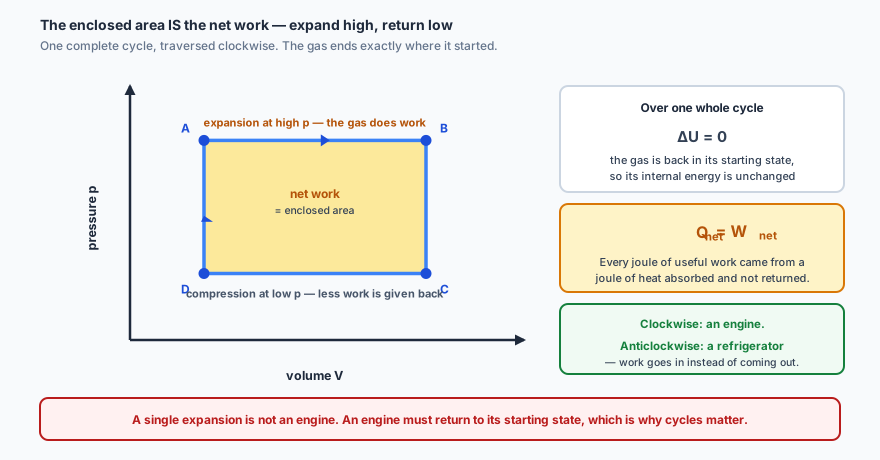
A single expansion is not an engine. An engine has to return to its starting state so it can do it again, which on a \(p\)–\(V\) diagram means going round a closed loop.
Expand at high pressure, return at low pressure, and the difference is yours. The enclosed area is the net work — go round clockwise and the engine does work, anticlockwise and it consumes it (a refrigerator).
Because the gas ends where it began, its internal energy is unchanged over one complete cycle: \( \Delta U = 0 \), so \( Q_{\text{net}} = W_{\text{net}} \). Every joule of useful work came from a joule of thermal energy that was absorbed and not given back.
🚫The second law: what conservation of energy allows but nature forbids
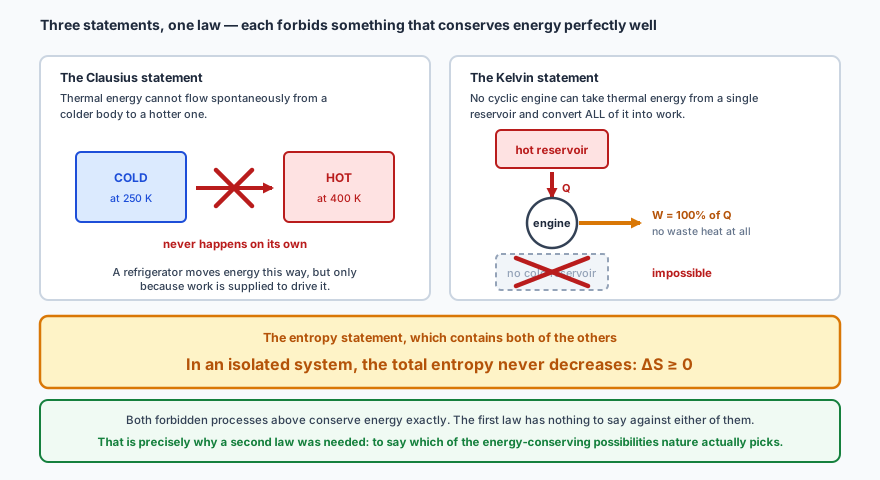
Drop a hot block into cold water and the two reach a common temperature. Nothing in the first law forbids the reverse — the water spontaneously cooling and the block spontaneously heating conserves energy perfectly. It simply never happens. The second law is the statement of what direction things go.
Three statements, one law. Each forbids something that conserves energy perfectly well — which is exactly why a second law was needed at all.
Entropy is the quantity that makes this precise. For thermal energy \( \Delta Q \) transferred at absolute temperature \(T\):
\[ \Delta S = \frac{\Delta Q}{T} \qquad \text{J K}^{-1} \]
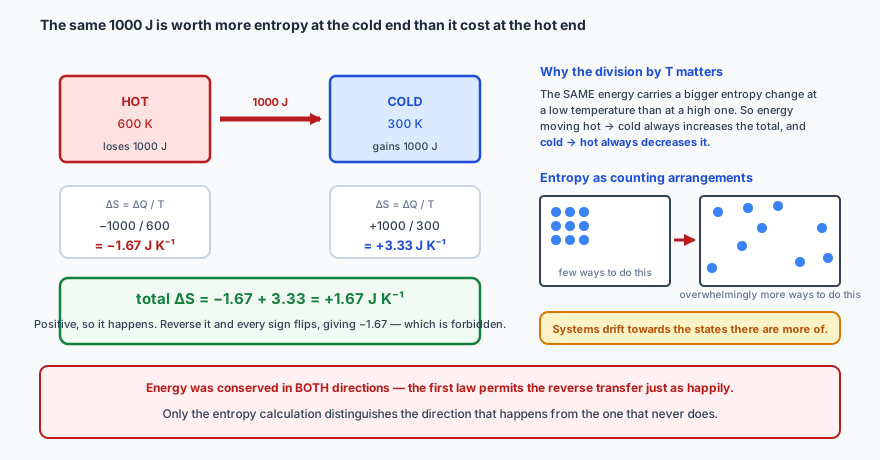
The same 1000 J is worth more entropy at the cold end than it cost at the hot end, because entropy is energy divided by temperature. That asymmetry is the whole of the second law in one line of arithmetic.
Notice what the division by \(T\) does: the same energy carries a bigger entropy change at a low temperature than at a high one. So energy moving from hot to cold always increases the total, and energy moving from cold to hot always decreases it — which is precisely the process nobody has ever seen.
✏️Worked example 2 — which way will it go?
1000 J of thermal energy passes from a reservoir at 600 K to one at 300 K. Find the total entropy change, and say what it tells you.
Positive, so it happens. Reverse the transfer and every sign flips: \( \Delta S_{\text{total}} = -1.67 \) J K\(^{-1}\), which the second law forbids in an isolated system. Note that energy was conserved in both directions — the first law had nothing to say about which one nature picks. That is what the second law is for.
⚙️Heat engines and the efficiency limit
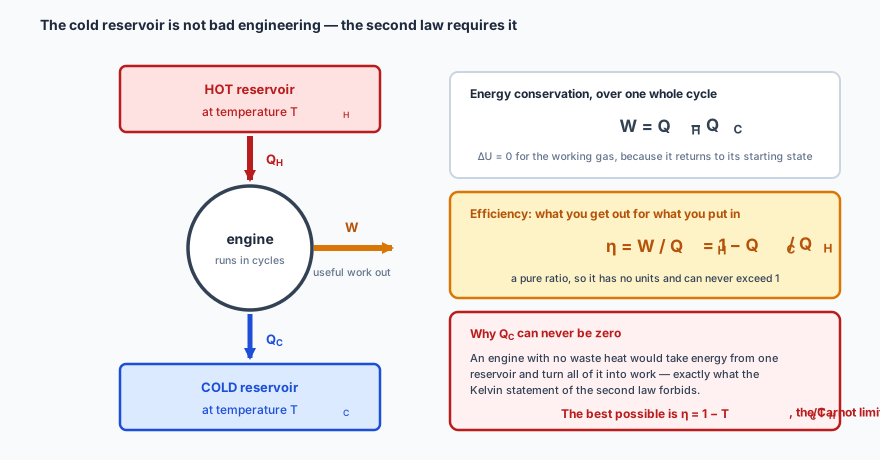
A heat engine takes thermal energy from a hot reservoir, converts part of it to work, and dumps the rest into a cold reservoir. The dumping is not sloppy engineering — the second law requires it.
The cold reservoir is not optional. An engine with no \( Q_{\text{C}} \) would be exactly what the Kelvin statement forbids, and its efficiency would be 1.
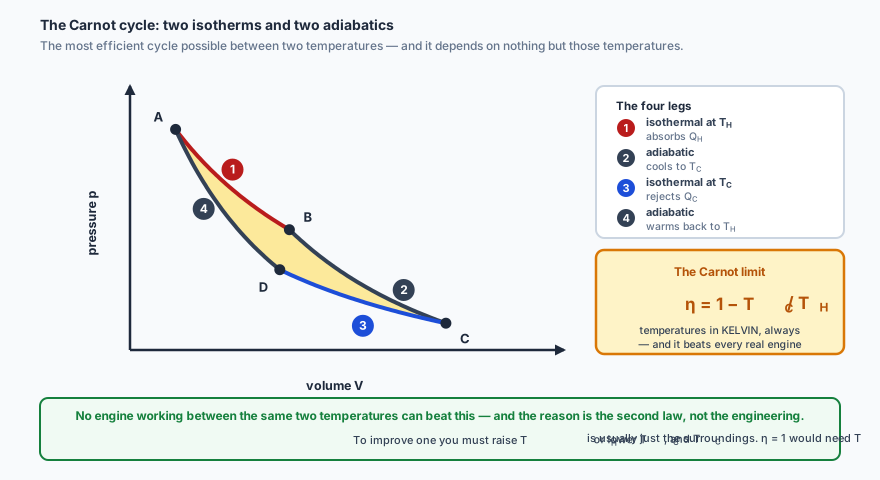
Two isotherms and two adiabatics. No engine working between the same two temperatures can beat it, and the reason is the second law rather than any detail of the machinery.
The Carnot efficiency depends only on the two absolute temperatures. That has a blunt practical consequence: to make an engine more efficient you must either raise the hot temperature or lower the cold one, and the cold one is usually the surroundings, which you cannot change. It also shows why \( \eta = 1 \) requires \( T_{\text{C}} = 0 \) — a cold reservoir at absolute zero, which is unattainable.
✏️Worked example 3 — a real engine against its limit
An engine takes 1000 J per cycle from a reservoir at 600 K and rejects 700 J to a reservoir at 300 K. Find its work output, its efficiency, and the maximum efficiency possible between those temperatures.
0.30 against a ceiling of 0.50 — the engine achieves 60% of what is thermodynamically possible. That is a realistic figure for a good engine. If a question ever gives you an efficiency above the Carnot value, the numbers are wrong, and saying so is worth a mark. Note also that both temperatures went in as kelvin: with 327 °C and 27 °C the answer would have been 0.92, which is impossible.
📉Degradation: why energy runs downhill
Energy is always conserved, so the familiar phrase “wasting energy” needs unpacking. Nothing is lost. What happens is that energy becomes degraded: it ends up spread thinly, at low temperature, among the random motions of a great many molecules, and in that form there is no way to gather it back up and do work with it.
That is the second law expressed as a practical statement. A joule at 1000 K can drive an engine; the same joule at 300 K, dispersed into the surroundings, cannot. Every real process increases total entropy, and every increase in entropy is a loss of the usefulness of energy, never of the energy itself.
🔭See it happen
PhET, Reversible Reactions and the gas simulations from B.3 both show entropy as
a counting statement: start every molecule in one corner and it never returns there, not because
it is forbidden, but because there are overwhelmingly more ways to be spread out than to be
tidy. That is what \( \Delta S \geq 0 \) means at the molecular level.
📝Practise
Work through these, then reveal the answer. Each question targets a different objective from the list above.
1. 250 J of thermal energy is supplied to a gas, which expands and does 100 J of work. Find the change in internal energy.
\( \Delta U = Q - W = 250 - 100 = +150 \) J. Positive, so the internal energy has risen and, since \( \Delta U = \frac{3}{2}nR\Delta T \) for an ideal gas, so has the temperature.
2. A gas is compressed, 300 J of work being done on it, while 500 J of thermal energy leaves it. Find \( \Delta U \).
Both signs are negative in the IB convention: \( Q = -500 \) J (energy left the gas) and \( W = -300 \) J (the surroundings did the work, not the gas). So \( \Delta U = Q - W = -500 - (-300) = -200 \) J. The gas cooled.
3. An ideal gas expands at a constant pressure of \( 1.5\times10^{5} \) Pa from \( 2.0\times10^{-3} \) m\(^{3}\) to \( 5.0\times10^{-3} \) m\(^{3}\). Find the work done by the gas.
\( W = p\Delta V = 1.5\times10^{5} \times 3.0\times10^{-3} = 4.5\times10^{2} \) J. This is the rectangular area under the horizontal line on a \(p\)–\(V\) diagram.
4. Explain why the temperature of an ideal gas falls when it expands adiabatically.
Adiabatic means \( Q = 0 \), so the first law gives \( \Delta U = -W \). The expanding gas does positive work on its surroundings, so \(W\) is positive and \( \Delta U \) is negative. Since \( U = \frac{3}{2}nRT \) for an ideal gas, a fall in internal energy is a fall in temperature. The energy to do the work had to come from somewhere, and with no heat supplied the only source was the gas’s own internal energy.
5. State what is true of \(Q\), \(W\) and \( \Delta U \) in (a) an isothermal change and (b) an isovolumetric change.
(a) Isothermal: \( \Delta T = 0 \), so \( \Delta U = 0 \) and therefore \( Q = W \) — every joule supplied leaves again as work. (b) Isovolumetric: \( \Delta V = 0 \), so \( W = 0 \) and therefore \( Q = \Delta U \) — every joule supplied goes into internal energy and raises the temperature.
6. A cycle on a \(p\)–\(V\) diagram encloses an area of 250 J and is traversed clockwise. State the net work done by the gas per cycle and the net thermal energy absorbed.
Clockwise means the gas does net work on its surroundings, so \( W_{\text{net}} = +250 \) J. The gas returns to its starting state, so \( \Delta U = 0 \) over the cycle, and the first law gives \( Q_{\text{net}} = W_{\text{net}} = 250 \) J absorbed.
7. 600 J of thermal energy flows from a body at 400 K to one at 250 K. Find the total entropy change and say whether the process is allowed.
\( \Delta S = -600/400 + 600/250 = -1.50 + 2.40 = +0.90 \) J K\(^{-1}\). It is positive, so the second law permits it — and indeed this is the direction thermal energy always flows on its own.
8. An engine absorbs 2000 J per cycle and rejects 1400 J. Find its efficiency. If its reservoirs are at 500 K and 300 K, is this engine possible?
\( W = 2000 - 1400 = 600 \) J, so \( \eta = 600/2000 = 0.30 \). The Carnot limit is \( 1 - 300/500 = 0.40 \). Since \( 0.30 < 0.40 \), the engine is possible — it reaches 75% of the theoretical maximum.
9. Explain why no heat engine can have an efficiency of 100%.
The Kelvin statement of the second law says no cyclic engine can take thermal energy from a single reservoir and convert all of it into work; some must always be rejected to a colder reservoir. Quantitatively, \( \eta = 1 - T_{\text{C}}/T_{\text{H}} \) reaches 1 only if \( T_{\text{C}} = 0 \) K, and absolute zero is unattainable. Equivalently: an engine with no waste heat would leave the total entropy unchanged or decreasing, which is forbidden.
10. A car engine and its exhaust gases together conserve energy exactly. Explain what is meant by saying that energy has nevertheless been “degraded”.
None of the energy has been destroyed — it has been transferred to the exhaust gases, the engine block and eventually the atmosphere. But it is now spread among an enormous number of molecules at a temperature close to that of the surroundings, and an engine can only extract work from energy that flows between a hot and a cold reservoir. With no temperature difference left to exploit, that energy can no longer do useful work. Degradation is a loss of usefulness, measured by the increase in entropy, not a loss of energy.
🔗Go deeper — other people’s work
These are external resources, not mine. If one stops working, tell me and
everything above it on this page still stands.
HyperPhysics — the laws of thermodynamics and the Carnot cycle