SHM now opens the wave theme rather than sitting inside it, and it carries more weight than it did. That ordering is a hint: a wave is what you get when a whole line of oscillators are coupled together, so every idea on this page reappears in C.2 with a distance axis added. The whole topic rests on one sentence — the acceleration is proportional to the displacement and points the other way — and everything else is a consequence.
🎯What you need to be able to do
Define displacement, amplitude, period, frequency and phase difference for an oscillation.
State the defining condition for simple harmonic motion and recognise it from a force or acceleration equation.
Use \( a = -\omega^{2}x \) and \( \omega = 2\pi/T \), and explain why the period does not depend on the amplitude.
Sketch and interpret displacement, velocity and acceleration against time, and state the phase relationships between them.
Describe the interchange of kinetic and potential energy, and sketch energy against displacement and against time.
Apply \( T = 2\pi\sqrt{m/k} \) and \( T = 2\pi\sqrt{l/g} \), and state the conditions under which each holds.
HL Use \( x = x_0\sin\omega t \) and \( x = x_0\cos\omega t \) with their velocity and acceleration equations, and handle a phase angle.
HL Use \( v = \pm\omega\sqrt{x_0^{2} - x^{2}} \) and the energy equations \( E_{\text{K}} = \frac{1}{2}m\omega^{2}(x_0^{2}-x^{2}) \), \( E_{\text{P}} = \frac{1}{2}m\omega^{2}x^{2} \).
🔄Oscillations: the vocabulary
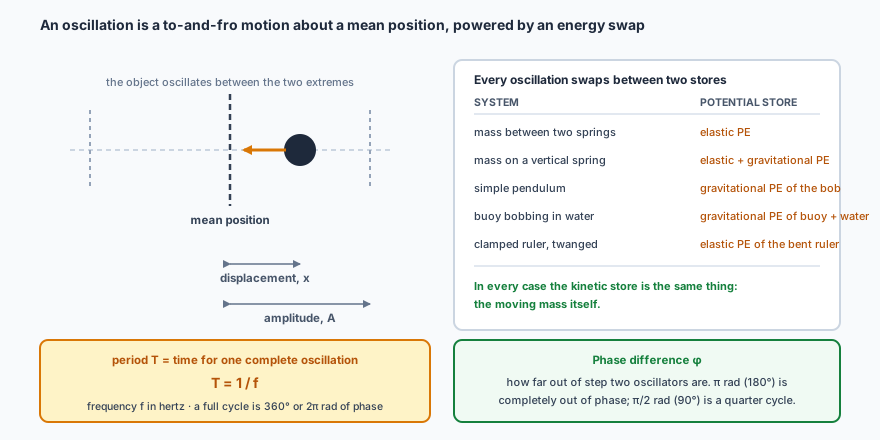
An oscillation is any motion in which an object moves to and fro about a fixed average point — the mean position — retracing the same path and taking a fixed time between repeats. What makes it keep going is a continual interchange of energy between a kinetic store and a potential store.
Different systems, one pattern: energy sloshes between a kinetic store and a potential store, twice per cycle each way.
displacement \(x\)distance from the mean position, in a stated direction
amplitude \(A\)the maximum displacement
period \(T\)time for one complete oscillation
frequency \(f\)oscillations per second, in hertz
\( T = \dfrac{1}{f} \)
Phase difference \( \phi \) measures how far out of step two oscillating particles are. One complete cycle is 360° or \( 2\pi \) rad, so a phase difference of 180° (\( \pi \) rad) means exactly half a cycle apart — completely out of phase — and 90° (\( \pi/2 \) rad) is a quarter of a cycle.
🎯What makes an oscillation simple harmonic
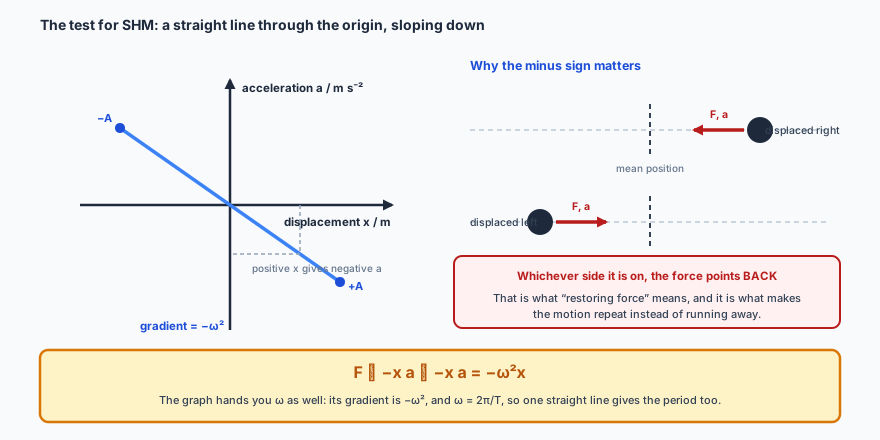
Not every oscillation is SHM. Simple harmonic motion is motion in which the acceleration is always directed towards a fixed point and is proportional to the displacement from that point. The acceleration is caused by a restoring force that always points back towards the mean position:
\( F \propto -x \)
\( a \propto -x \)
\( a = -\omega^{2}x \)
The test for SHM is this graph: a straight line through the origin with a negative gradient. The gradient is \( -\omega^{2} \), so the graph hands you the angular frequency as well.
The minus sign is doing real work: it says the acceleration always points back towards the mean position, which is what stops the object escaping and makes the motion repeat.
The constant of proportionality is written as \( \omega^{2} \) because that makes everything downstream tidy. \( \omega \) is the angular frequency, in rad s\(^{-1}\):
\( \omega = \dfrac{2\pi}{T} \)
\( \omega = 2\pi f \)
\( T = \dfrac{2\pi}{\omega} \)
The period of SHM does not depend on the amplitude. Pull a pendulum twice as far back and it still takes the same time to swing — the motion is isochronous. That is genuinely surprising, and it is why pendulums make good clocks. The reason is that a bigger amplitude means a bigger restoring force and therefore a bigger acceleration, and the two effects cancel exactly. Nothing in \( T = 2\pi\sqrt{m/k} \) or \( T = 2\pi\sqrt{l/g} \) mentions the amplitude, and that is not an accident.
📑Identifying SHM in an unfamiliar system
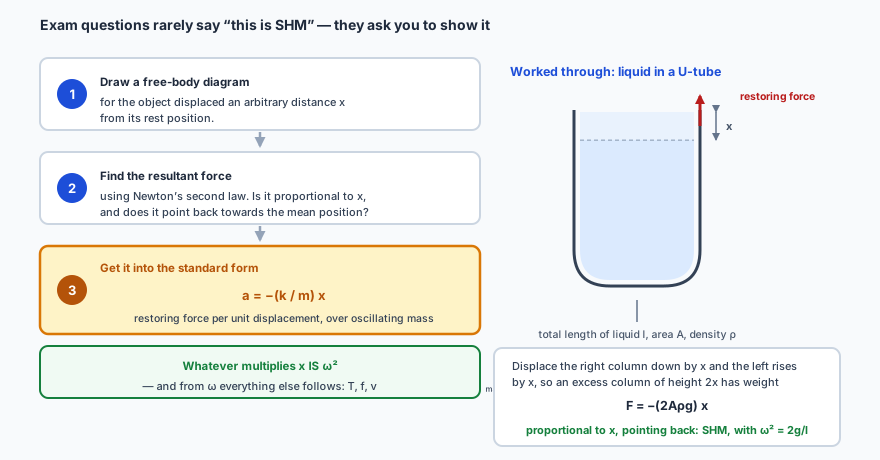
Exam questions rarely say “this is SHM”. They give you a system and ask you to show it. The procedure is always the same three steps.
Step 3 is the payoff: once the equation is in the form \( a = -(\text{something})\,x \), that something is \( \omega^{2} \), and every quantitative result follows.
\[ a = -\left(\frac{\text{restoring force per unit displacement}}{\text{oscillating mass}}\right)x \qquad\Rightarrow\qquad \omega^{2} = \frac{k}{m} \]
📏The two standard systems
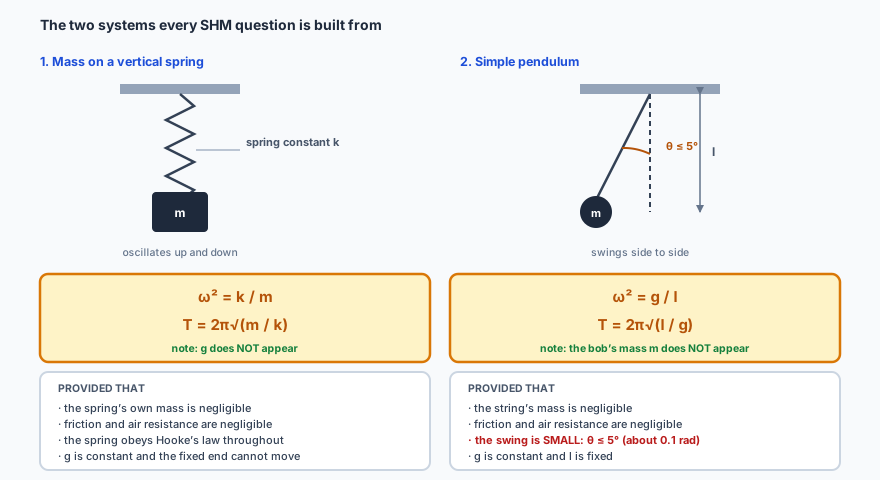
Note what is missing from each: the amplitude, from both, and the mass of the bob, from the pendulum. A heavy pendulum and a light one of the same length keep the same time.
mass on a spring\( \omega^{2} = \dfrac{k}{m} \), \( T = 2\pi\sqrt{\dfrac{m}{k}} \)
✏️Worked example 1 — showing that a mass on a spring performs SHM
A 600 g mass is attached to a light spring of spring constant 30 N m\(^{-1}\). (a) Show that the mass moves with SHM. (b) Calculate the frequency of its oscillation.
(a) At rest, the weight \( mg = 6.0 \) N is balanced by the spring's tension. Displace the mass a further distance \(x\) downwards and the spring stretches by an extra \(x\), so the extra upward force is \( kx \). That is the resultant force, and it points back towards the rest position:
\[ F = -kx \qquad\Rightarrow\qquad a = -\frac{k}{m}x \]
The acceleration is proportional to the displacement and directed towards the mean position, so the motion is simple harmonic, with \( \omega^{2} = k/m \).
(b) Now the numbers, with the mass in kilograms:
\[ T = 2\pi\sqrt{\frac{m}{k}} = 2\pi\sqrt{\frac{0.600}{30}} = 0.889\ \text{s} \qquad f = \frac{1}{T} = \frac{1}{0.889} = 1.1\ \text{Hz} \]
Notice that the weight cancelled out. Hanging the spring vertically shifts the mean position downwards but changes nothing else: the extra force for an extra displacement \(x\) is still \(kx\). That is why the same \( T = 2\pi\sqrt{m/k} \) works for a vertical spring and a horizontal one.
📊The graphs, and the phase relationships
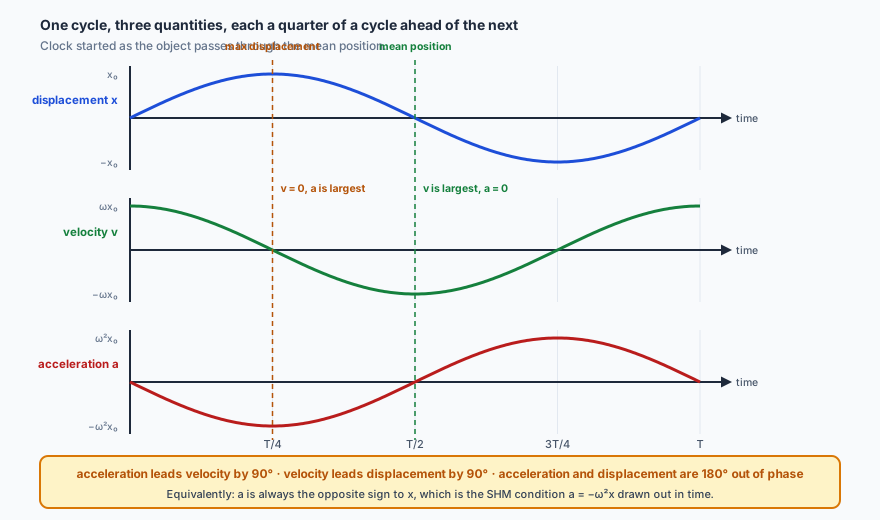
Start the clock as the object passes through the mean position and the three quantities trace out sine and cosine curves a quarter of a cycle apart.
Read it at the extremes: at maximum displacement the object is momentarily stationary but has its largest acceleration; at the mean position it is moving fastest with zero acceleration.
acceleration leads velocity by 90°
velocity leads displacement by 90°
acceleration and displacement are 180° out of phase
⚡Energy in SHM
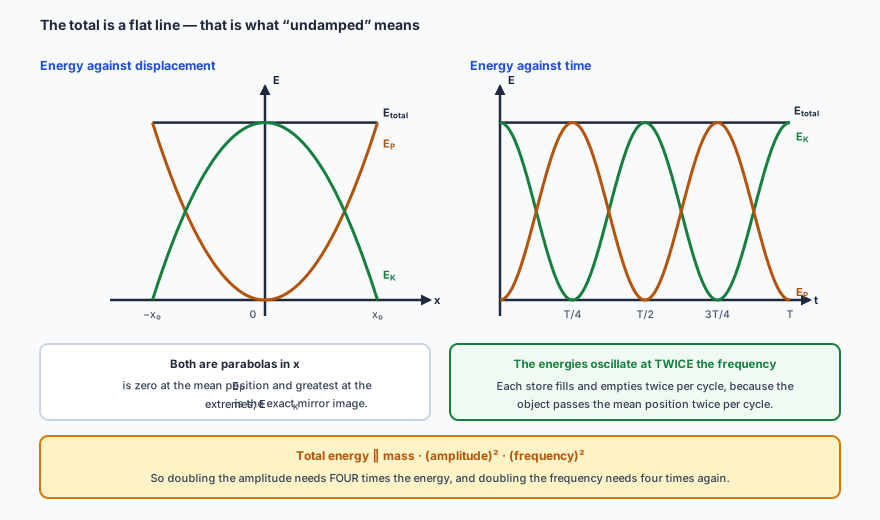
Provided nothing dissipates energy — the oscillation is undamped — the total is constant and simply moves back and forth between the two stores.
Two things to take from the second graph: the energies oscillate at twice the frequency of the displacement, and the total is a flat line — which is what “undamped” means.
The total energy in an oscillation is proportional to the mass, to the square of the amplitude, and to the square of the frequency. Double the amplitude and you need four times the energy.
✏️Worked example 2 — reading a period and an amplitude
A body of mass 500 g oscillates with SHM with a period of 0.50 s and an amplitude of 1.0 cm. Find (a) the frequency, (b) the angular frequency, (c) the spring constant, (d) the maximum acceleration.
Both unit conversions matter and both are easy to miss. The mass went in as 0.500 kg, not 500, and the amplitude as 0.010 m, not 1.0. Using centimetres would have given an acceleration of 158 m s\(^{-2}\), sixteen times gravity, for a body moving one centimetre — which should look wrong immediately.
✏️Worked example 3 — a mass between two springs
A 50 g mass is held between two identical horizontal springs, each of spring constant 1.0 N m\(^{-1}\), and displaced 0.20 m towards the right-hand spring. Find (a) the maximum stored elastic potential energy, (b) the maximum speed, (c) the maximum acceleration, (d) the displacement at which the potential and kinetic energies are equal.
Displace the mass to the right and the right-hand spring pushes it back while the left-hand spring pulls it back — both forces act the same way, so the effective spring constant is the sum, \( k = 2.0 \) N m\(^{-1}\).
For (d), the potential energy equals the kinetic when each is half the total, so \( \frac{1}{2}kx^{2} = \frac{1}{2}\left(\frac{1}{2}kx_0^{2}\right) \):
\[ x = \frac{x_0}{\sqrt{2}} = \frac{0.20}{\sqrt{2}} = 0.14\ \text{m} \]
Check the energy both ways. \( \frac{1}{2}mv_{\max}^{2} = 0.5 \times 0.050 \times 1.26^{2} = 0.040 \) J, matching the elastic energy we started from. Note also that the answer to (d) is not half the amplitude — energy goes as \(x^{2}\), so half the energy is at \( x_0/\sqrt{2} \), about 71% of the way out.
🔢HL The equations of motion
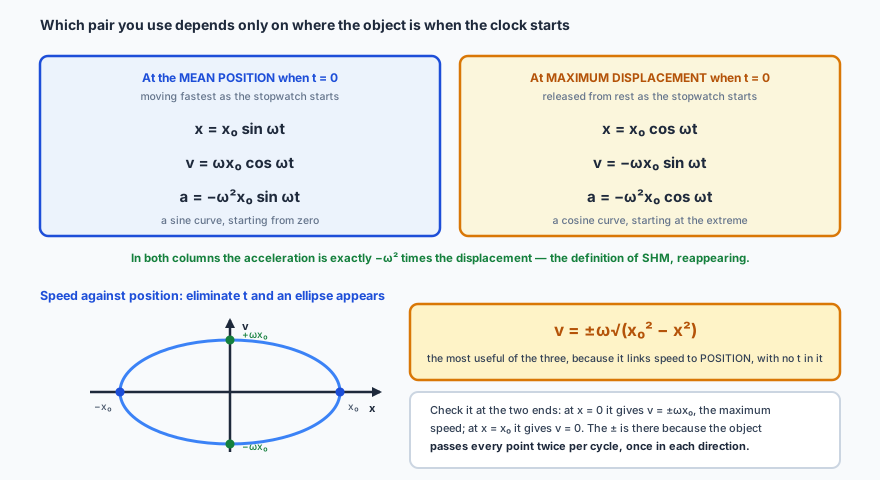
Which pair of equations you use depends only on where the object is when the clock starts.
In both columns the acceleration equation is just \( -\omega^{2} \) times the displacement equation — which is the definition of SHM reappearing, as it must.
at the mean position when \(t=0\)\( x = x_0\sin\omega t \)
at maximum displacement when \(t=0\)\( x = x_0\cos\omega t \)
Eliminating time between the displacement and velocity equations gives a relation that is often more useful than either, because it connects speed directly to position:
\[ v = \pm\omega\sqrt{x_0^{2} - x^{2}} \]
Check it at the two ends: at \( x = 0 \) it gives \( v = \pm\omega x_0 \), the maximum speed, and at \( x = x_0 \) it gives \( v = 0 \). The \( \pm \) is there because the object passes each point twice per cycle, once in each direction.
🕐HL Phase angle
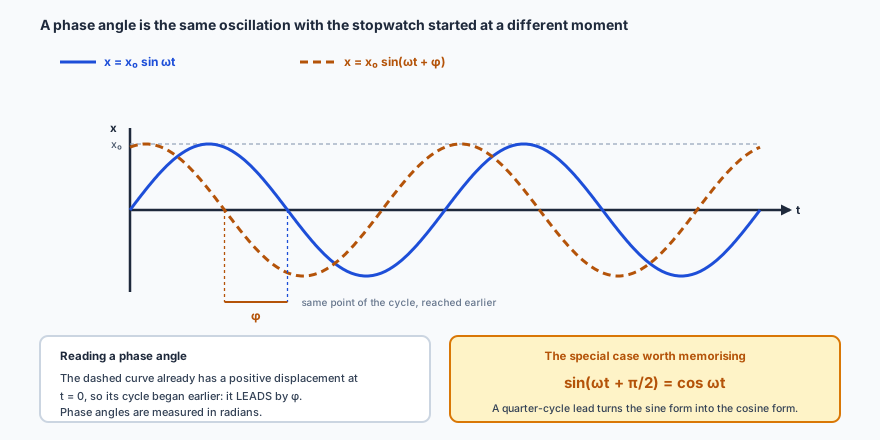
If the clock starts at neither of those two convenient instants, the curve is simply shifted along the time axis, and that shift is written as a phase angle \( \phi \), measured in radians:
\( x = x_0\sin(\omega t + \phi) \)
\( v = \omega x_0\cos(\omega t + \phi) \)
A phase angle is not new physics — it is the same oscillation with the stopwatch started at a different moment. Setting \( \phi = \pi/2 \) turns the sine form into the cosine form.
⚡HL The energy equations
Substituting \( v = \pm\omega\sqrt{x_0^{2}-x^{2}} \) into \( E_{\text{K}} = \frac{1}{2}mv^{2} \) turns the energy graphs above into algebra:
Add the first two and the \( x^{2} \) terms cancel, leaving a total that does not depend on \(x\) at all — which is the flat line on the energy graph, proved. And since \( \omega = 2\pi f \), the total energy is proportional to \(m\), to \(x_0^{2}\) and to \(f^{2}\), exactly as stated above.
✏️Worked example 4 —HL reading an equation of motion
A particle undergoes SHM with displacement, in centimetres from the mean position, given by \( x = 3.5\sin\left(\omega t + \frac{\pi}{2}\right) \), where \( \omega = 3\pi \) rad s\(^{-1}\). Find (a) the period, (b) the maximum speed, (c) the maximum acceleration, (d) the first time after \(t = 0\) at which the velocity is zero.
Read the amplitude and angular frequency straight off: \( x_0 = 3.5 \) cm and \( \omega = 3\pi \) rad s\(^{-1}\).
\[ T = \frac{2\pi}{\omega} = \frac{2\pi}{3\pi} = 0.67\ \text{s} \]
For (d), start by reading what the phase angle means. Since \( \sin(\theta + \pi/2) = \cos\theta \), the equation is really \( x = 3.5\cos\omega t \): the particle begins at maximum displacement, momentarily at rest. So the velocity is already zero at \(t = 0\), and we want the next time it happens.
\[ v = \omega x_0\cos\!\left(\omega t + \tfrac{\pi}{2}\right) = 0 \quad\Rightarrow\quad \omega t = n\pi \quad\Rightarrow\quad t = \frac{n}{3}\ \text{s} \]
Taking \( n = 1 \) gives \( t = 0.33 \) s — which is exactly \( T/2 \), the particle arriving at the opposite extreme.
The tempting wrong answer is 0.17 s, and it is worth seeing why. That is \( T/4 \), the moment the particle passes through the mean position — where the speed is at its maximum, not zero. If you solve \( \omega t + \pi/2 = \pi \) without thinking, that is what you get. Reading the phase angle first — “\( \phi = \pi/2 \) means it starts at the extreme” — tells you immediately that the answer must be half a period, because the stationary points are the two extremes.
🔭See it happen
PhET, Masses and Springs and Pendulum Lab. In the pendulum lab, set two
pendulums to the same length but different bob masses and start them together — they stay in
step, which is the “\(m\) is not in the equation” result made visible. Then change the amplitude
of one and watch that the period still does not budge.
📝Practise
Work through these, then reveal the answer. Each question targets a different objective from the list above.
1. An object of mass \(M\) is subject to a varying force \(F\) and has a varying displacement \(x\) from its starting position. Outline the conditions necessary for the object to be moving with SHM.
The resultant force must be a restoring force: it must always be directed towards a fixed point (the mean position), and its magnitude must be proportional to the displacement from that point, \( F \propto -x \). Since \( F = Ma \), the acceleration is then also proportional to the displacement and directed towards the mean position, \( a = -\omega^{2}x \). The constant of proportionality must itself be constant — the mass and the restoring force per unit displacement must not change during the motion.
2. Explain why the time period of a simple pendulum does not depend on the amplitude of its swing.
A larger amplitude means a larger displacement, and in SHM the restoring force — and therefore the acceleration — is proportional to the displacement. So the object has further to travel but is accelerated proportionally harder throughout, and the two effects cancel exactly. The motion is described as isochronous. Formally, the amplitude appears nowhere in \( T = 2\pi\sqrt{l/g} \). (This holds only for small angles, up to about 5°, where the restoring force really is proportional to displacement.)
3. A body of mass 500 g on a spring oscillates with a period of 0.50 s. Find the period if (a) two identical springs are used in parallel, (b) two identical springs are used in series.
The original spring has \( k = m\omega^{2} = 0.500\times(2\pi/0.50)^{2} = 79 \) N m\(^{-1}\). (a) Two springs in parallel both stretch by \(x\) and both pull, so the effective constant doubles to 158 N m\(^{-1}\); since \( T \propto 1/\sqrt{k} \), the period falls by \( \sqrt{2} \) to \( 0.50/\sqrt{2} = 0.35 \) s. (b) Two in series share the extension, so the effective constant halves to 39.5 N m\(^{-1}\) and the period rises by \( \sqrt{2} \) to 0.71 s.
4. A pendulum with a period of 0.50 s on Earth is taken to the Moon, where the gravitational field strength is one sixth of the Earth's. Find its new period.
\( T = 2\pi\sqrt{l/g} \), and only \(g\) changes. Dividing \(g\) by 6 multiplies \(T\) by \( \sqrt{6} = 2.45 \), so \( T = 0.50 \times 2.45 = 1.2 \) s. The pendulum runs slower on the Moon — a pendulum clock taken there would lose time badly. Note that a mass-on-a-spring clock would be unaffected, because \(g\) does not appear in \( T = 2\pi\sqrt{m/k} \).
5. A pendulum is oscillating inside a lift. Describe what happens to its period if (a) the lift moves upwards at a steady speed, (b) the lift accelerates upwards, (c) the lift cable breaks.
What matters is the effective gravitational field strength felt inside the lift. (a) At a steady speed there is no acceleration, so the effective \(g\) is unchanged and the period is unchanged. (b) Accelerating upwards increases the effective \(g\) to \(g + a\), so \(T\) decreases — the pendulum swings faster. (c) In free fall the effective \(g\) is zero, so \( T \to \infty \): there is no restoring force at all and the pendulum simply stops oscillating and floats.
6. The tip of a tuning fork undergoes SHM at 512 Hz with a maximum speed of 3.5 m s\(^{-1}\). Determine the amplitude of its oscillation.
\( v_{\max} = \omega x_0 \), and \( \omega = 2\pi f = 2\pi \times 512 = 3217 \) rad s\(^{-1}\). So \( x_0 = v_{\max}/\omega = 3.5/3217 = 1.1\times10^{-3} \) m, about a millimetre. A tuning fork's tips move a surprisingly small distance very quickly.
7. Sketch, on the same time axis, the displacement, velocity and acceleration of an object in SHM, and state the phase relationship between each pair.
With the clock started at the mean position: displacement is a sine curve, velocity a cosine curve, acceleration an inverted sine curve. Velocity leads displacement by 90° (\(\pi/2\) rad); acceleration leads velocity by 90°; acceleration and displacement are 180° (\(\pi\) rad) out of phase. Checks: at maximum displacement the velocity is zero and the acceleration is maximum and opposite in sign; at the mean position the velocity is maximum and the acceleration is zero.
8. An object oscillates with amplitude 0.20 m. At what displacement is its kinetic energy equal to its potential energy?
Both must be half the total. \( E_{\text{P}} = \frac{1}{2}kx^{2} \) and \( E_{\text{total}} = \frac{1}{2}kx_0^{2} \), so \( x^{2} = \frac{1}{2}x_0^{2} \) and \( x = x_0/\sqrt{2} = 0.14 \) m. Not half the amplitude — energy depends on \(x^{2}\), so the halfway point in energy is at 71% of the amplitude.
9. HL A particle in SHM has \( x = 3.5\sin(3\pi t) \) cm. Find its period, maximum speed and maximum acceleration.
\( x_0 = 3.5 \) cm and \( \omega = 3\pi \) rad s\(^{-1}\). \( T = 2\pi/\omega = 0.67 \) s. \( v_{\max} = \omega x_0 = 3\pi \times 3.5 = 33 \) cm s\(^{-1}\). \( a_{\max} = \omega^{2}x_0 = 9\pi^{2}\times3.5 = 3.1\times10^{2} \) cm s\(^{-2}\). The units stay in centimetres throughout because the amplitude was given in centimetres — just be consistent, and convert at the end if the question wants SI.
10. HL An object of mass \(m\) has \( x = x_0\sin\omega t \). Derive expressions for its kinetic and potential energies at time \(t\), and use them to show that the total energy is constant.
Differentiating, \( v = \omega x_0\cos\omega t \), so \( E_{\text{K}} = \frac{1}{2}mv^{2} = \frac{1}{2}m\omega^{2}x_0^{2}\cos^{2}\omega t \). The potential energy is \( E_{\text{P}} = \frac{1}{2}m\omega^{2}x^{2} = \frac{1}{2}m\omega^{2}x_0^{2}\sin^{2}\omega t \). Adding them, \( E = \frac{1}{2}m\omega^{2}x_0^{2}(\cos^{2}\omega t + \sin^{2}\omega t) = \frac{1}{2}m\omega^{2}x_0^{2} \), since \( \sin^{2} + \cos^{2} = 1 \). There is no \(t\) left in the expression, so the total energy is constant — which is the flat line on the energy–time graph.
🔗Go deeper — other people’s work
These are external resources, not mine. If one stops working, tell me and
everything above it on this page still stands.
HyperPhysics — simple harmonic motion and the pendulum
The Physics Hypertextbook — simple harmonic motion