A wave is what happens when a whole line of oscillators is coupled together: each one drives its neighbour, so the pattern travels even though the matter does not. Everything in C.1 reappears here with a distance axis added — which is exactly why the two graphs on this page look identical and mean completely different things.
🎯What you need to be able to do
Explain what a wave transfers, and what it does not.
Distinguish transverse from longitudinal waves and give examples of each.
Describe a sound wave in terms of compressions and rarefactions, and relate displacement to pressure.
Use wavelength, frequency, period, amplitude and wave speed, and apply \( v = f\lambda \).
Read both displacement–distance and displacement–time graphs, and say which quantity each one gives.
Use wavefronts and rays, and state how they are related.
Relate intensity to amplitude, \( I \propto A^{2} \).
Place the parts of the electromagnetic spectrum in order and state what they have in common.
🌊What a wave actually carries
Light, sound and ripples on a pond look nothing alike, but they share three properties, and those three are the definition:
They transfer energy from one place to another.
They do so without any net motion of the medium — a floating cork bobs up and down as the ripple passes and ends up where it started.
They involve oscillations, and for the ideal case those oscillations are the SHM of C.1.
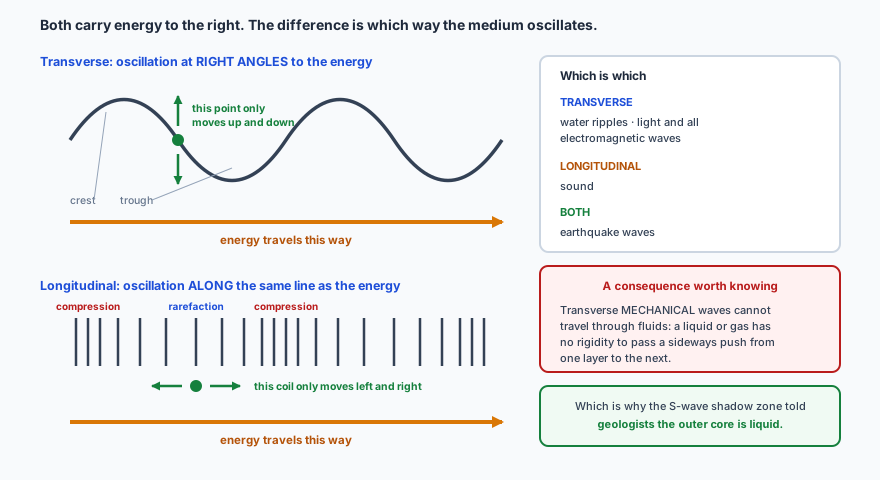
A continuous wave is a succession of oscillations; a wave pulse is a single one. The important split is by direction: in a transverse wave the oscillations are at right angles to the direction of energy transfer, and in a longitudinal wave they are parallel to it.
Both carry energy to the right. The difference is the direction in which the medium’s particles happen to oscillate — and that is the only difference.
transversewater ripples · light and all EM waves
longitudinalsound
bothearthquake waves
One consequence worth remembering: transverse mechanical waves cannot travel through fluids. A liquid or a gas has no rigidity to transmit a sideways displacement from one layer to the next — which is why sound in air is longitudinal and why the shadow zone of S-waves told geologists that the Earth’s outer core is liquid.
📡Wavefronts and rays: two ways to draw the same wave
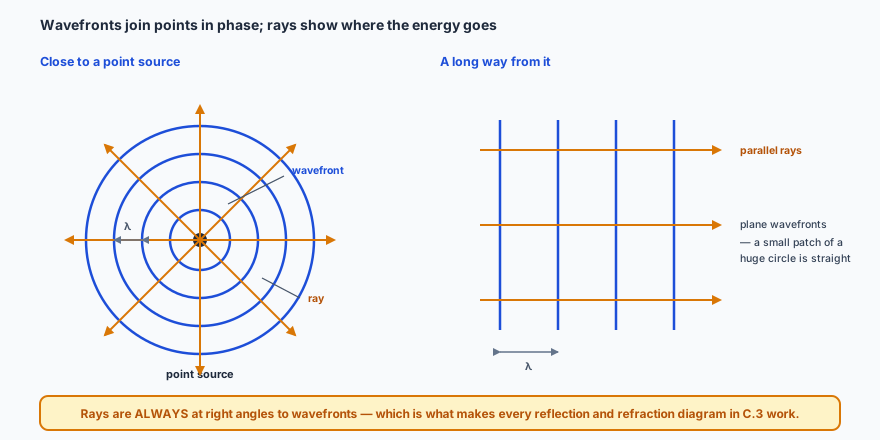
A wavefront joins points oscillating in phase; a ray shows where the energy goes. Rays are always at right angles to wavefronts — and that fact is what makes C.3’s reflection and refraction diagrams work.
Wavefronts are drawn one wavelength apart, so the spacing between them is the wavelength. Close to a point source they are circles (spheres in three dimensions); a long way away, a small patch of a huge circle is indistinguishable from a straight line, which is why distant sources give plane wavefronts with parallel rays.
🔊Sound: the longitudinal case in detail
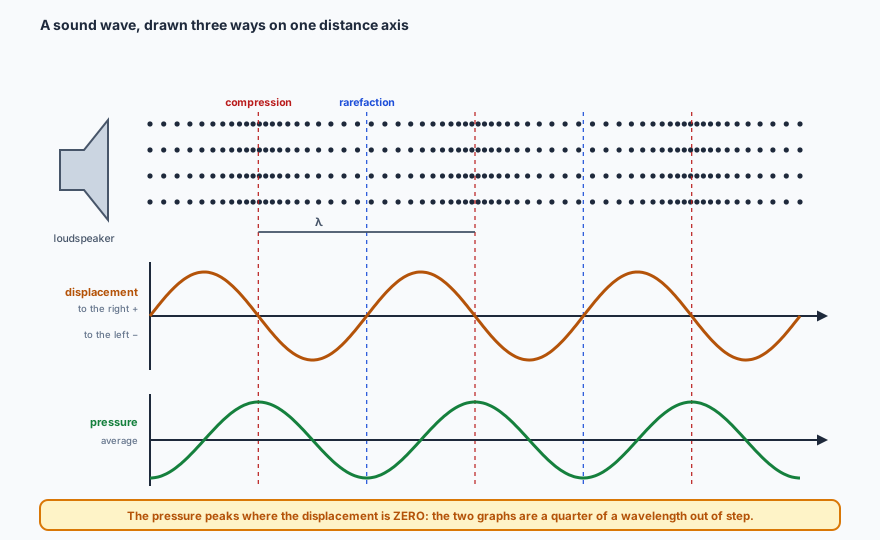
A loudspeaker cone pushes forward and the air just in front of it is squashed — a compression, a region of higher-than-average pressure. It then pulls back, leaving the air stretched — a rarefaction, at lower-than-average pressure. Those regions travel outwards; the air molecules themselves just oscillate back and forth about fixed positions.
The subtlety worth noticing: the pressure maxima sit where the displacement is zero. Molecules on either side of a compression are moving towards it, so the crowding is greatest exactly where nothing has been displaced.
📏The quantities, and the two graphs
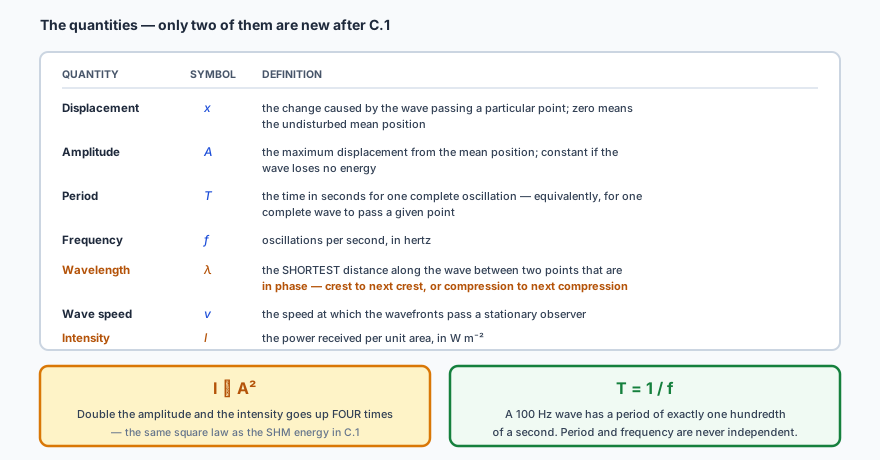
Only two of these are new after C.1: wavelength, which needs a distance axis, and intensity, which is what a detector actually measures.
\( T = \dfrac{1}{f} \)
\( I \propto A^{2} \)
intensity in W m\(^{-2}\)
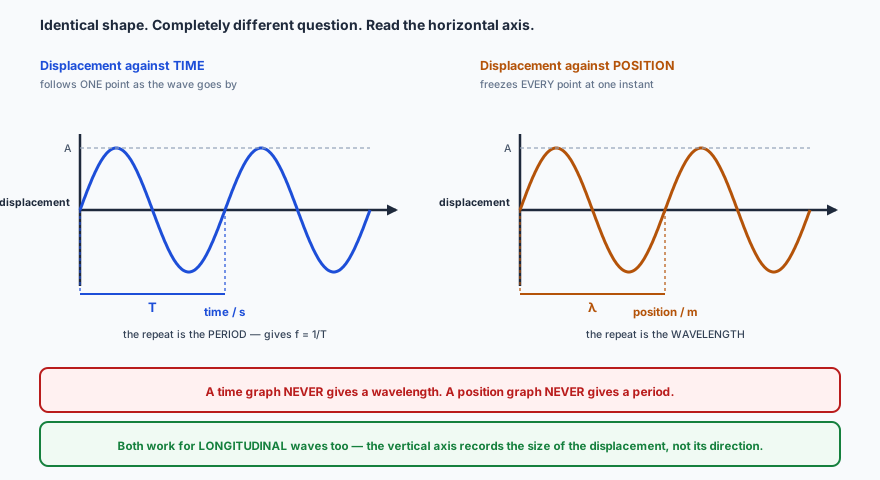
Now the pair of graphs that cause more lost marks than anything else in this topic. They look identical. Read the horizontal axis.
Same shape, different question. The time graph follows one point as the wave goes by; the position graph freezes every point at one instant.
Two traps here, and both are avoidable by reading the axis first. A displacement–time graph gives you the period, never the wavelength; a displacement–position graph gives you the wavelength, never the period. And because the vertical axis records only the size of the displacement, not its direction, both graphs work perfectly well for a longitudinal wave — a sine-shaped graph does not mean the wave is transverse.
🔄The wave equation
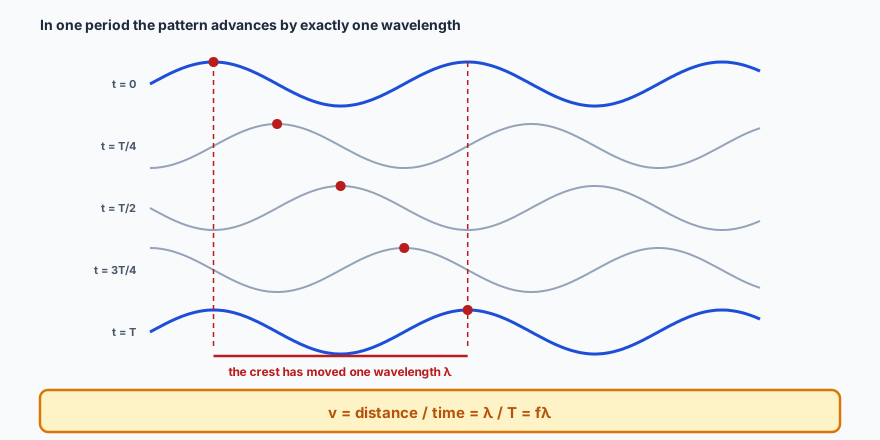
In one period the wave pattern moves forward by exactly one wavelength. That is the whole derivation:
Follow the marked crest: after one period it has moved one wavelength, and the wave looks exactly as it did at the start.
\[ v = \frac{\text{distance}}{\text{time}} = \frac{\lambda}{T} = f\lambda \]
It applies to every wave — sound, light, water, anything. And note which quantity is usually fixed: the speed is set by the medium, so when a wave crosses into a new material and slows down, its frequency is unchanged (it is set by the source) and its wavelength is what shrinks. That is the fact C.3 builds refraction on.
✏️Worked example 1 — thunder and lightning
Sound travels in air at about \( 3.3 \times 10^{2} \) m s\(^{-1}\) and light at \( 3.0 \times 10^{8} \) m s\(^{-1}\). (a) Find the wavelength of a 120 Hz sound. (b) Find the frequency of light of wavelength 500 nm. (c) An observer sees a lightning flash and hears the thunder 2.5 s later. Estimate the distance to the strike.
Was it fair to ignore the light’s travel time? Yes, and it is worth showing why: the light covers 825 m in \( 825/(3.0\times10^{8}) = 2.8 \) µs, which is about a millionth of the 2.5 s measured. Note also the scale of the two answers in (a) and (b): a sound wavelength is a few metres, a light wavelength is a fraction of a micrometre. That factor of ten million is why sound diffracts round a doorway and light does not.
✏️Worked example 2 — reading a displacement–time graph
A stone is dropped into still water. A cork floating 1.0 m from the impact point first starts to move at \( t = 1.4 \) s, and then oscillates with an amplitude of 2.0 cm and a period of 0.40 s. Find (a) the wave speed, (b) the frequency, (c) the wavelength.
The wave took 1.4 s to cover the 1.0 m from the impact point to the cork:
Notice where each number came from. The speed came from the delay before the cork moved — a distance divided by a time, not from the graph’s shape at all. The frequency came from the graph, because it is a displacement–time graph and its repeat is the period. The wavelength could not be read off the graph and had to be calculated: a time graph never shows a wavelength. And the amplitude, 2.0 cm, played no part in any of it — amplitude and speed are independent.
🌈The electromagnetic spectrum
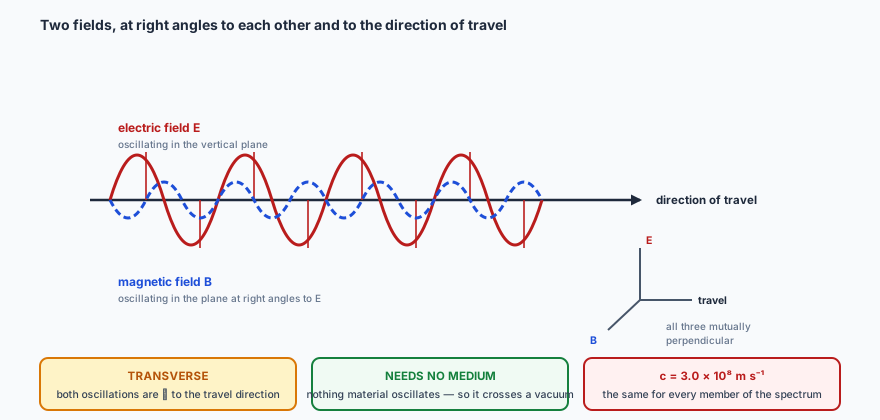
An accelerating electric charge produces a changing electric field, which produces a changing magnetic field, which produces a changing electric field — and the pair propagate outwards together as an electromagnetic wave.
Two fields, at right angles to each other and to the direction of travel. Since nothing material has to oscillate, an EM wave needs no medium — which is why sunlight crosses empty space.
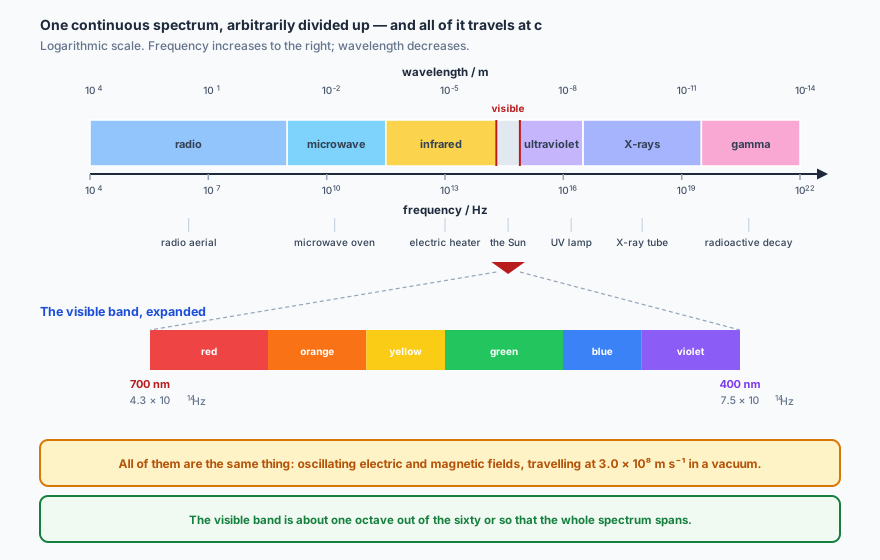
All electromagnetic waves are identical in nature and travel at the same speed in a vacuum, \( c = 3.0 \times 10^{8} \) m s\(^{-1}\). What differs is the frequency — and because the range of frequencies is enormous, so is the range of behaviour.
One continuous spectrum, arbitrarily divided up. The visible band is a tiny slice of it — roughly one octave out of about sixty.
Two boundaries worth knowing by heart, because questions use them as a sanity check: visible light runs from about 400 nm (violet) to 700 nm (red), which is \( 7.5\times10^{14} \) Hz down to \( 4.3\times10^{14} \) Hz.
🔭See it happen
PhET, Wave on a String for the transverse case — switch on the reference line
and watch one point move purely up and down while the pattern travels sideways. Then
PhET, Sound Waves for the longitudinal one, where you can display the pressure and the
particle motion at the same time and see the quarter-wavelength offset between them.
📝Practise
Work through these, then reveal the answer. Each question targets a different objective from the list above.
1. Outline the nature of (a) sound waves and (b) electromagnetic waves.
(a) Sound is a longitudinal mechanical wave: the air molecules oscillate back and forth parallel to the direction of energy transfer, producing compressions (high pressure) and rarefactions (low pressure). It needs a medium and cannot travel through a vacuum. (b) Electromagnetic waves are transverse: oscillating electric and magnetic fields, at right angles to each other and to the direction of travel. They need no medium, and all travel at \( 3.0\times10^{8} \) m s\(^{-1}\) in a vacuum.
2. A wave has a frequency of 250 Hz and a wavelength of 1.4 m. Find its speed and its period.
\( v = f\lambda = 250 \times 1.4 = 3.5\times10^{2} \) m s\(^{-1}\), and \( T = 1/f = 1/250 = 4.0\times10^{-3} \) s. The speed is close to the speed of sound in air, which is a hint that this is a sound wave.
3. Explain how a wave transfers energy without transferring matter.
Each particle of the medium oscillates about its own fixed mean position and returns there every cycle — it has no net displacement. But each particle is coupled to its neighbours, so as it oscillates it does work on the next particle along, passing energy forward. What travels is the pattern of displacement and the energy it carries, not the matter. A floating cork on a ripple demonstrates this: it bobs up and down and stays put horizontally.
4. Distinguish between a wavefront and a ray, and state how they are related.
A wavefront is a surface joining neighbouring points that are oscillating in phase — in two dimensions it is a line, and successive wavefronts are one wavelength apart. A ray is a line showing the direction in which the wave energy travels. They are always at right angles to one another.
5. A displacement–time graph and a displacement–position graph for the same wave look identical. State what each one tells you.
The displacement–time graph shows the oscillation of a single point as the wave passes, so its repeat along the axis is the period \(T\) (and hence the frequency). The displacement–position graph is a snapshot of every point along the wave at one instant, so its repeat is the wavelength \( \lambda \). Both give the amplitude. Neither, on its own, gives the wave speed — you need both, via \( v = f\lambda \).
6. A sound wave of frequency 512 Hz travels from air (\( v = 330 \) m s\(^{-1}\)) into water (\( v = 1500 \) m s\(^{-1}\)). Find its wavelength in each, and state what happens to the frequency.
In air: \( \lambda = 330/512 = 0.64 \) m. In water: \( \lambda = 1500/512 = 2.9 \) m. The frequency does not change — it is set by the source, and the boundary cannot create or destroy oscillations. The speed is set by the medium, so it is the wavelength that adjusts.
7. The amplitude of a wave is doubled. What happens to the intensity it delivers?
Intensity is proportional to the square of the amplitude, \( I \propto A^{2} \), so doubling the amplitude gives \( 2^{2} = 4 \) times the intensity. This is the same square relationship that appears in the SHM energy of C.1, and for the same reason: energy goes as amplitude squared.
8. Place these in order of increasing wavelength: X-rays, radio waves, green light, infrared, ultraviolet.
X-rays, ultraviolet, green light, infrared, radio waves. Equivalently, that is order of decreasing frequency, since \( c = f\lambda \) with \(c\) fixed. Rough values: X-rays \( \sim10^{-10} \) m, UV \( \sim10^{-8} \) m, green light \( 5\times10^{-7} \) m, infrared \( \sim10^{-5} \) m, radio \( \sim10^{2} \) m and up.
9. In a sound wave, where are the pressure maxima relative to the displacement maxima?
They are a quarter of a wavelength apart — the pressure is greatest where the displacement is zero. At the centre of a compression, molecules on the left have been pushed right and molecules on the right have been pushed left, so they crowd together there while the molecules at that exact point have not moved at all. The displacement graph and the pressure graph are 90° out of phase.
10. Discuss the similarities and differences between transverse and longitudinal waves.
Similarities: both transfer energy without net transfer of matter; both involve particles (or fields) oscillating about fixed mean positions; both obey \( v = f\lambda \); both can reflect, refract, diffract and interfere; both can be represented by the same two displacement graphs. Differences: in a transverse wave the oscillation is perpendicular to the direction of energy transfer, in a longitudinal wave it is parallel. Transverse waves have crests and troughs; longitudinal waves have compressions and rarefactions. Transverse mechanical waves cannot pass through fluids, whereas longitudinal ones can. Only transverse waves can be polarised.
🔗Go deeper — other people’s work
These are external resources, not mine. If one stops working, tell me and
everything above it on this page still stands.