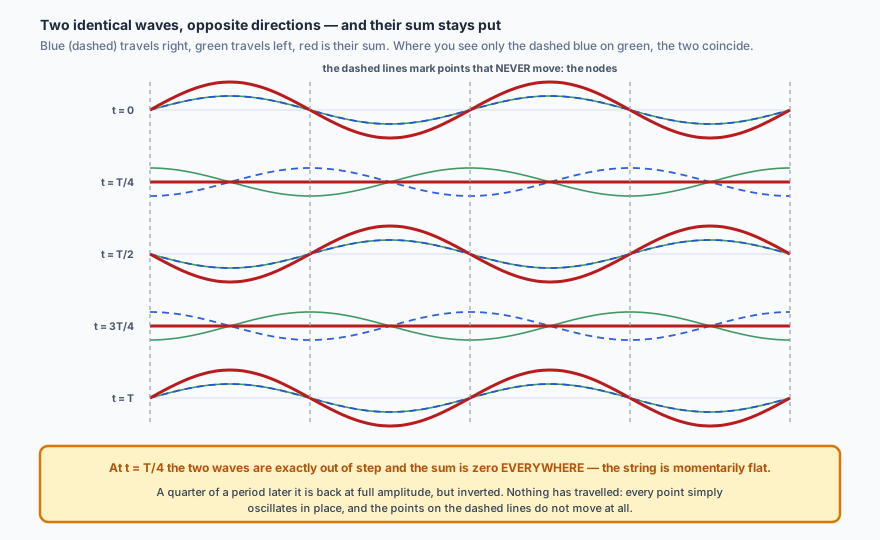
A standing wave is not a new kind of wave. It is what superposition does when a travelling wave meets its own reflection: the two run through each other in opposite directions, and the pattern that results stays put. Every musical instrument works this way, and so does every disaster in which a bridge is driven at the wrong frequency.
🎯What you need to be able to do
Explain how a standing wave forms, and contrast it with a travelling wave.
Identify nodes and antinodes, and use the fact that adjacent nodes are \( \lambda/2 \) apart.
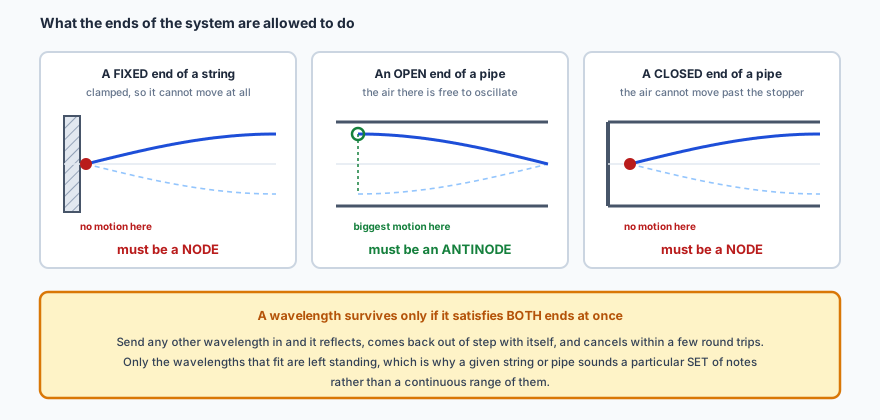
Apply the boundary conditions: a fixed end is a node, a free end is an antinode.
Find the harmonics of a string fixed at both ends, and use \( f_n = \dfrac{nv}{2L} \).
Find the harmonics of an open pipe and of a pipe closed at one end, and explain why a closed pipe has only odd harmonics.
Define natural frequency, forced oscillation and resonance.
Describe light, critical and heavy damping, and their effect on a resonance curve.
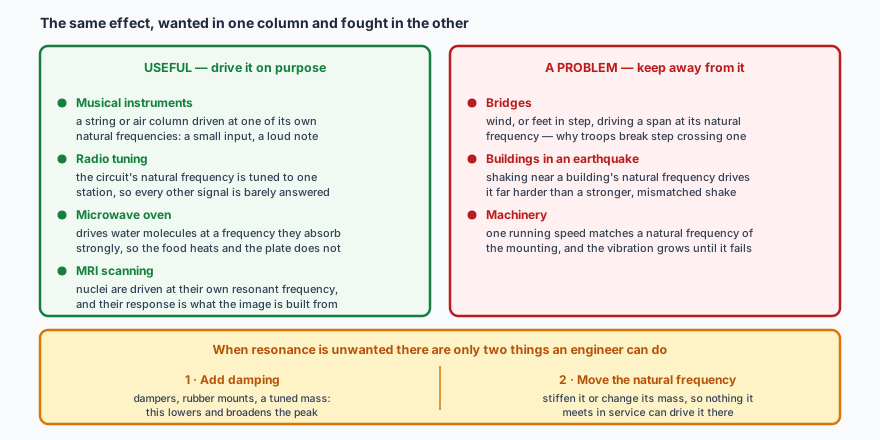
Give examples of resonance being useful and of resonance being a nuisance.
🎵How a standing wave forms
Send a wave along a string towards a fixed end. It reflects, and the reflected wave travels back through the incoming one. Now apply the principle of superposition from C.3: at every point, add the two displacements.
Nothing is travelling in the sum. Some points never move, and every other point oscillates in place — which is exactly what a “standing” wave means.
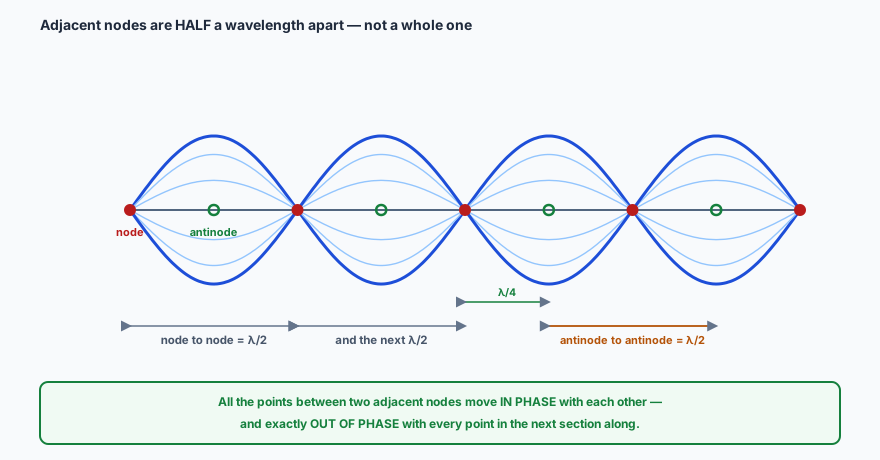
The points that never move are nodes; the points that swing furthest are antinodes. They alternate, and the geometry that follows from the picture is the most useful fact on this page:
Adjacent nodes are \( \lambda/2 \) apart, not \( \lambda \). Nearly every wrong answer in this topic comes from forgetting the factor of two.
node to next node\( \lambda/2 \)
antinode to next antinode\( \lambda/2 \)
node to nearest antinode\( \lambda/4 \)
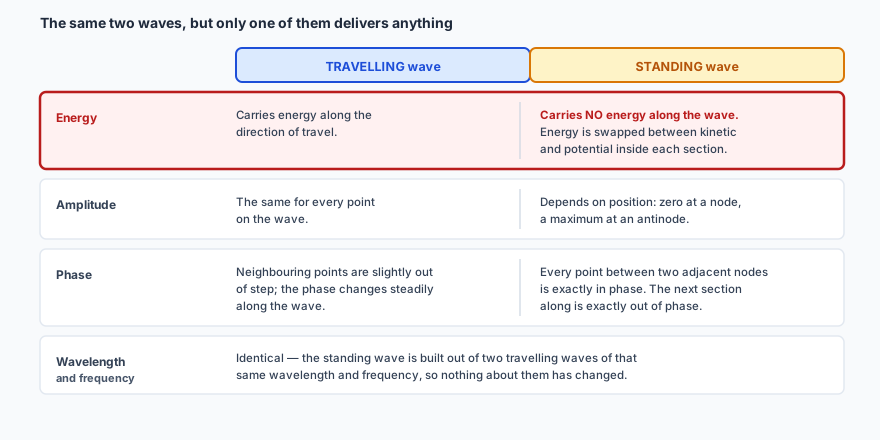
The row that matters most is the first: a standing wave transports no energy. It is a pattern of oscillation, not a delivery mechanism.
📏Boundary conditions decide everything
Which standing waves a system can support is settled entirely by what happens at its ends.
Only wavelengths that satisfy both ends survive. Everything else interferes destructively with itself after a few reflections and dies away.
🎻Strings fixed at both ends
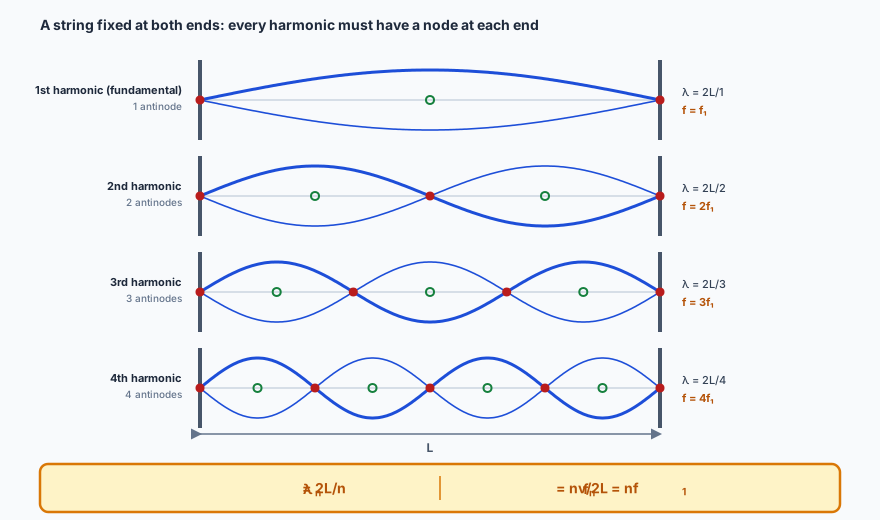
Both ends must be nodes. The longest wave that fits has a single antinode in the middle, and that is the fundamental, or first harmonic. Adding one more node at a time gives the rest.
The \(n\)th harmonic has \(n\) antinodes and \(n+1\) nodes. Counting the antinodes is the quickest way to identify one in an exam diagram.
\( \lambda_n = \dfrac{2L}{n} \)
\( f_n = \dfrac{nv}{2L} = nf_1 \)
\( n = 1, 2, 3, \ldots \)
Because every harmonic is a whole-number multiple of the fundamental, a plucked string sounds a definite note: the fundamental sets the pitch and the mixture of higher harmonics sets the timbre, which is why a violin and a flute playing the same note sound completely different.
✏️Worked example 1 — a string
A string of length 0.80 m is fixed at both ends and vibrates in its fundamental mode at 256 Hz. Find (a) the wavelength of the fundamental, (b) the speed of waves on the string, (c) the frequency of the third harmonic.
In the fundamental the string holds half a wavelength, so:
The speed did not change for part (c), and that is the key idea. The wave speed on a string is set by its tension and its mass per unit length — not by which harmonic is playing. So going up a harmonic halves-and-thirds the wavelength and multiplies the frequency to match. If you found yourself recalculating \(v\) for the third harmonic, that is the misconception to fix.
🎺Pipes: open and closed
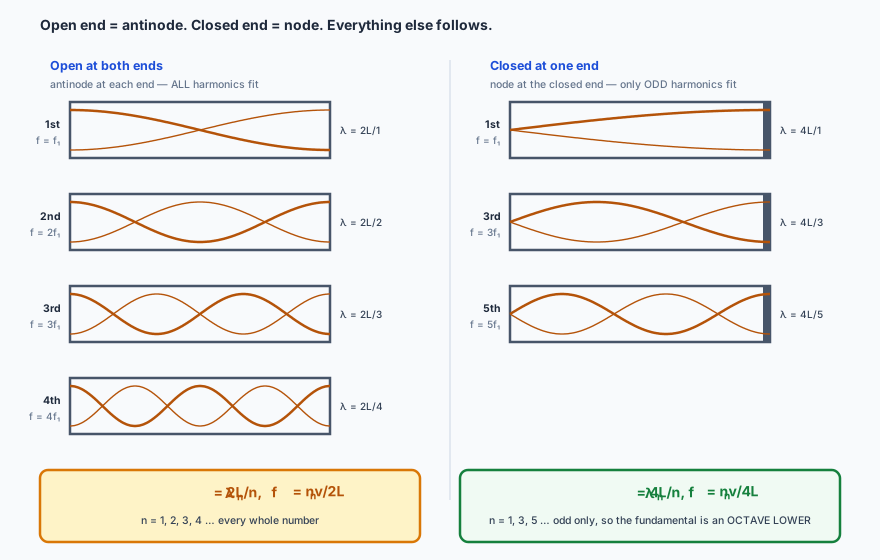
A pipe holds a standing sound wave — a longitudinal one — but the same boundary rules apply. An open end is an antinode (the air is free to oscillate); a closed end is a node (it cannot).
A closed pipe of a given length sounds an octave lower than an open one, and is missing all its even harmonics — which is why a stopped organ pipe has such a distinctive, hollow tone.
open both ends\( \lambda_n = \dfrac{2L}{n} \), \( f_n = \dfrac{nv}{2L} \), all \(n\)
closed one end\( \lambda_n = \dfrac{4L}{n} \), \( f_n = \dfrac{nv}{4L} \), odd \(n\) only
Two factors of two, and they are easy to mix up. A node-to-node distance is \( \lambda/2 \); a node-to-antinode distance is \( \lambda/4 \). A closed pipe holds a quarter of a wavelength in its fundamental because it runs from a node at one end to an antinode at the other; an open pipe holds a half, because it runs antinode to antinode. Sketching the pattern and counting quarter-wavelengths takes ten seconds and removes the guesswork entirely.
✏️Worked example 2 — a pipe closed at one end
A pipe closed at one end resonates at its fundamental frequency of 512 Hz. Taking the speed of sound as 340 m s\(^{-1}\), find (a) the length of the pipe, (b) the next frequency at which it will resonate, (c) the fundamental frequency of an open pipe of the same length.
1024 is exactly twice 512, and it had to be. The open pipe fits half a wavelength where the closed pipe fits a quarter, so its fundamental wavelength is half as long and its frequency twice as high — one octave up. Getting a factor other than exactly 2 means one of the two pipes was given the wrong fraction of a wavelength.
📢Natural frequency, forced oscillation and resonance
Every system that can oscillate has one or more natural frequencies — the frequencies at which it oscillates when displaced and released. Drive that system with a periodic external force and it performs a forced oscillation at the driving frequency, not its own.
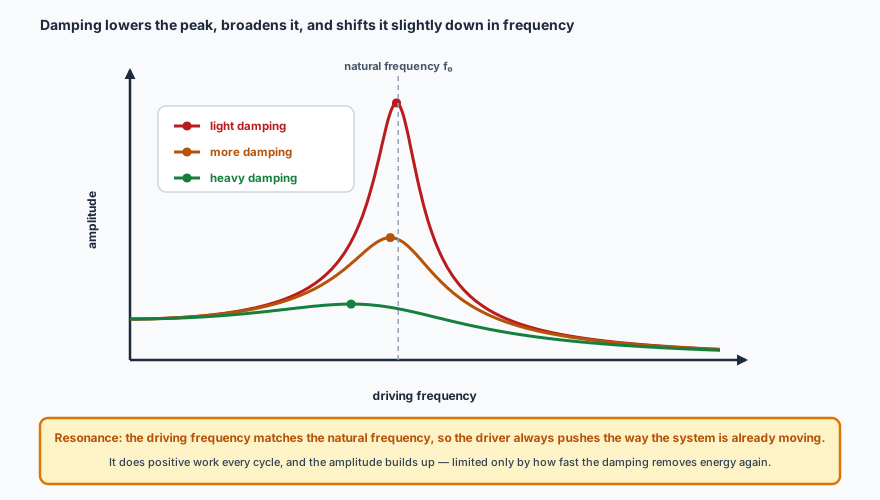
Resonance is what happens when the two coincide: the driving force is always pushing in the direction the system is already moving, so it does positive work on every cycle and the amplitude builds up dramatically.
Damping does three things at once: it lowers the peak, broadens it, and shifts it slightly below the natural frequency.
📉Damping
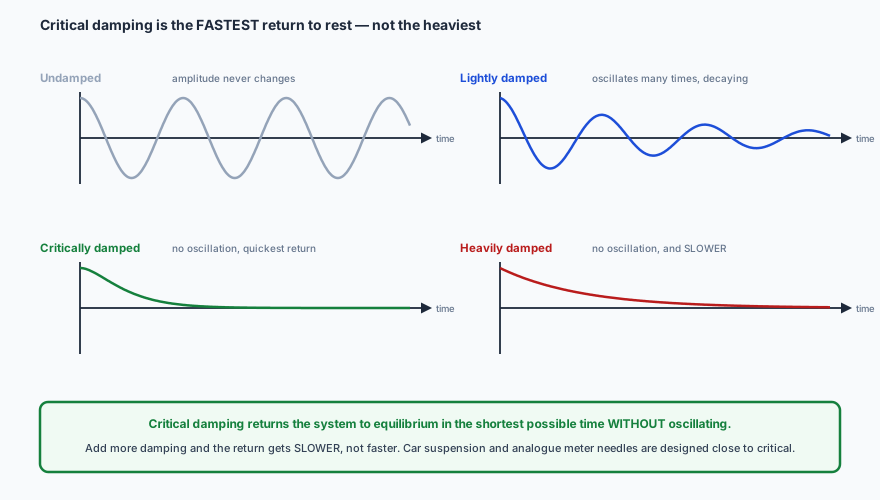
Damping is any process that removes energy from an oscillation. Three regimes are worth distinguishing, and the distinction is about how quickly the system returns to rest.
Critical damping is the fastest return to rest without overshooting. It is not the heaviest damping — heavier damping is slower, which is the point most often missed.
⚖️Resonance: wanted and unwanted
The engineering response is always one of two things: add damping, or move the natural frequency away from whatever is likely to drive it.
🔭See it happen
PhET, Wave on a String. Set the end to “fixed”, switch to oscillate, and sweep
the frequency slowly: at most settings the string thrashes about incoherently, and then at
particular frequencies a clean standing wave snaps into place. That is resonance and the harmonic
series in one experiment. Adding damping visibly blunts the effect.
📝Practise
Work through these, then reveal the answer. Each question targets a different objective from the list above.
1. Explain how a standing wave is formed on a string fixed at both ends.
A wave travels along the string and reflects at the fixed end, so two waves of the same frequency, wavelength and amplitude travel through each other in opposite directions. By the principle of superposition their displacements add at every point. At certain points the two are always exactly out of phase and cancel, giving nodes of permanently zero displacement; halfway between, they are always in phase and reinforce, giving antinodes of maximum amplitude. The resulting pattern does not travel along the string.
2. On a standing wave the distance between adjacent nodes is 0.30 m. Find the wavelength.
Adjacent nodes are half a wavelength apart, so \( \lambda = 2 \times 0.30 = 0.60 \) m. Answering 0.30 m is the single commonest error in this topic.
3. State three differences between a travelling wave and a standing wave.
(1) A travelling wave transfers energy along its direction of travel; a standing wave transfers none. (2) In a travelling wave every point has the same amplitude; in a standing wave the amplitude depends on position, from zero at a node to a maximum at an antinode. (3) In a travelling wave the phase varies continuously along the wave; in a standing wave all points between adjacent nodes are exactly in phase, and adjacent sections are exactly out of phase. (Wavelength and frequency are the same for both — that is not a difference.)
4. A string 2.0 m long is fixed at both ends. Waves travel along it at 40 m s\(^{-1}\). Find the frequencies of the first three harmonics.
\( f_1 = v/2L = 40/(2\times2.0) = 10 \) Hz. The harmonics are whole-number multiples: \( f_2 = 20 \) Hz and \( f_3 = 30 \) Hz. Equivalently \( \lambda_1 = 4.0 \) m, \( \lambda_2 = 2.0 \) m, \( \lambda_3 = 1.33 \) m.
5. Explain why a pipe closed at one end produces only odd harmonics.
The closed end must be a node and the open end an antinode. The shortest pattern that satisfies both is a quarter of a wavelength, and every additional pattern that fits must add a whole half-wavelength to that — giving lengths of \( \lambda/4, 3\lambda/4, 5\lambda/4 \dots \), which is \( L = n\lambda/4 \) for odd \(n\) only. An even harmonic would require either two nodes or two antinodes at the ends, which the boundary conditions forbid.
6. A pipe closed at one end has a length of 0.25 m. Taking the speed of sound as 340 m s\(^{-1}\), find its fundamental frequency and the next frequency at which it resonates.
\( \lambda_1 = 4L = 1.0 \) m, so \( f_1 = v/\lambda_1 = 340/1.0 = 340 \) Hz. The next resonance is the third harmonic (odd harmonics only): \( f_3 = 3 \times 340 = 1020 \) Hz. An open pipe of the same length would have \( f_1 = 340/(2\times0.25) = 680 \) Hz, twice as high.
7. Distinguish between the natural frequency of a system and the frequency of a forced oscillation.
The natural frequency is the frequency at which a system oscillates when it is displaced and released with no further external driving; it is a property of the system itself. In a forced oscillation the system is driven by a periodic external force and oscillates at the driving frequency, whatever that is. Resonance occurs when the driving frequency equals the natural frequency, and the amplitude then becomes large.
8. Describe the effect of increasing the damping on the resonance curve of a system.
Increasing the damping (1) reduces the maximum amplitude at resonance, (2) broadens the peak, so the system responds appreciably over a wider band of driving frequencies, and (3) shifts the peak to a slightly lower frequency than the undamped natural frequency. With very heavy damping there is scarcely a peak at all.
9. Explain what is meant by critical damping and give one example of where it is wanted.
Critical damping is the amount of damping that returns a displaced system to its equilibrium position in the shortest possible time without oscillating. More damping than this is heavy damping, and the return is slower, not faster. Examples: car suspension, which should absorb a bump without leaving the car bouncing; the needle of an analogue meter, which should settle on its reading at once; and door closers.
10. Give one example of resonance being useful and one of it being a problem, and state how engineers deal with the latter.
Useful: a musical instrument, where an air column or string is driven at one of its natural frequencies to produce a loud, definite note; or a radio receiver, tuned so that its natural frequency matches one station. A problem: a bridge or a tall building driven at its natural frequency by wind, traffic, marching feet or an earthquake, where the amplitude can build until the structure fails. Engineers respond either by adding damping (tuned mass dampers, shock absorbers) or by shifting the natural frequency away from the frequencies the structure is likely to meet.
🔗Go deeper — other people’s work
These are external resources, not mine. If one stops working, tell me and
everything above it on this page still stands.
HyperPhysics — standing waves, strings and air columns
The Physics Hypertextbook — standing waves and resonance