Gravitational fields
🎯What you need to be able to do
- State Kepler’s three laws and say what each one is about.
- Apply Newton’s law of gravitation, including the fact that the two forces are equal and opposite however unequal the masses are.
- Use gravitational field strength, and sketch field lines around one mass and around two.
- Analyse circular orbits by setting gravity equal to the centripetal force, and derive Kepler’s third law from it.
- Explain why a higher orbit is a slower one, and why an astronaut in one appears weightless.
- Describe the uniform field close to a planet’s surface, and say when the uniform approximation is safe.
- HLUse gravitational potential and gravitational potential energy, including their signs.
- HLAdd potentials as scalars, and use \( W = m\Delta V_g \) for the work done moving a mass.
- HLUse the potential gradient \( g = -\Delta V_g/\Delta r \), and interpret equipotential surfaces.
- HLCalculate escape speed and the total energy of an orbit.
🪐Kepler’s laws: what was known before anyone knew why
Copernicus proposed in 1543 that the Sun, not the Earth, is at the centre of the Solar System. In the 1590s Tycho Brahe spent years making planetary observations far more accurate than anyone had managed before. By 1618 Johannes Kepler had squeezed three laws out of Brahe’s numbers.
They are experimental laws. Kepler had no idea why they were true, and nor did anyone else for more than 250 years, until Newton produced a single hypothesis from which all three follow. That gap is the point of this section: the laws describe, Newton’s law explains. They apply to anything orbiting a much more massive body, not just planets round the Sun.
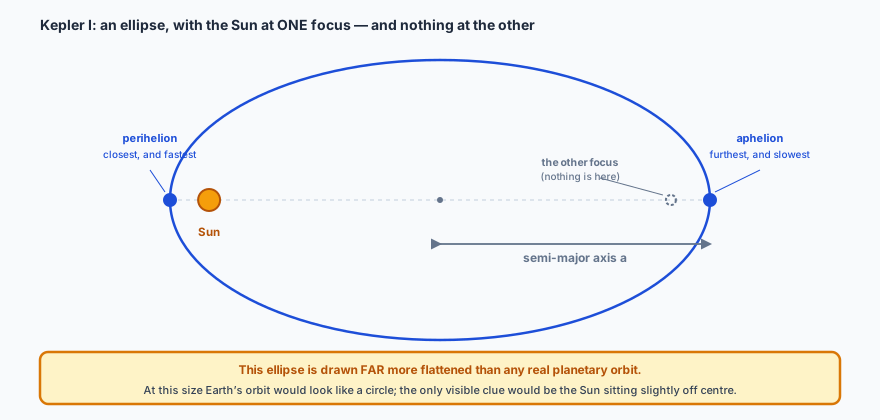
First law — the orbits are ellipses, with the Sun at one focus. An ellipse is a flattened circle with two focal points; the Sun sits at one of them and there is nothing at all at the other.
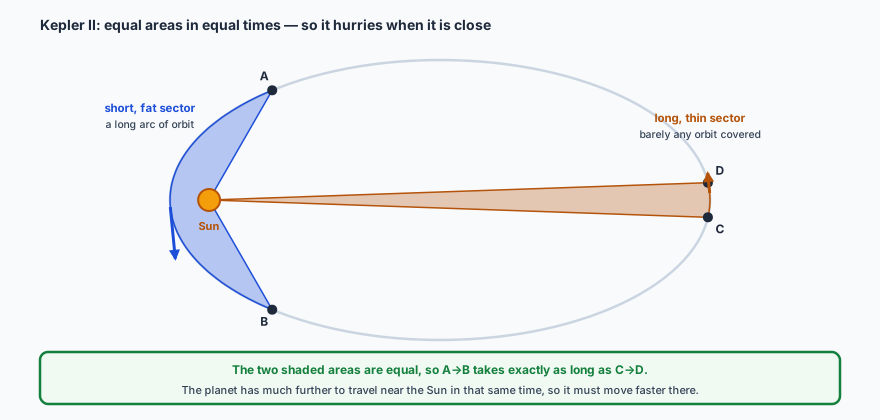
Second law — the line from the Sun to the planet sweeps out equal areas in equal times. A planet close in has a short line to sweep with, so it must travel further along its orbit in a given time to sweep the same area: it moves fastest when it is closest to the Sun and slowest when furthest away.
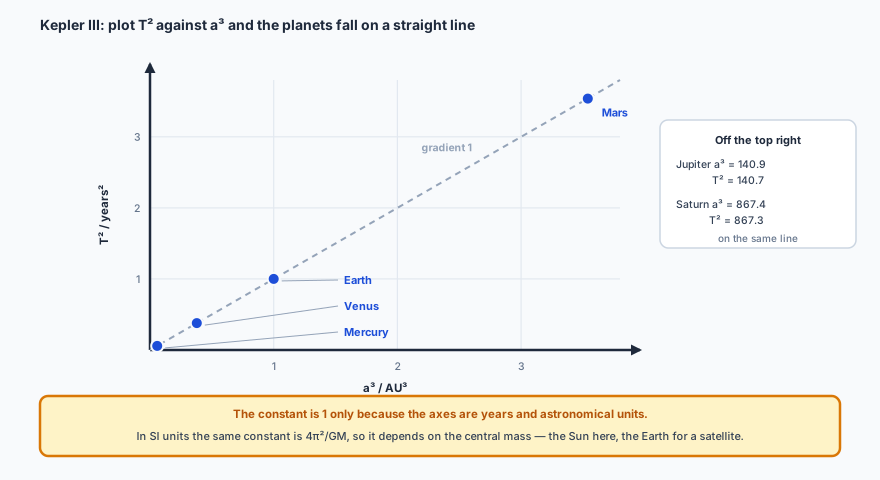
Third law — the ratio \( (\text{orbital period})^{2} / (\text{semi-major axis})^{3} \) is the same for every body orbiting the same central mass. For a circular orbit of radius \(r\) and period \(T\) that is
🍎Newton’s law of universal gravitation
If you trip over, you fall towards the ground. Newton’s claim was that the same thing that does that to you holds the Moon in its orbit — that every mass in the Universe attracts every other one. That is what “universal” means here, and it is a much bigger claim than it looks.
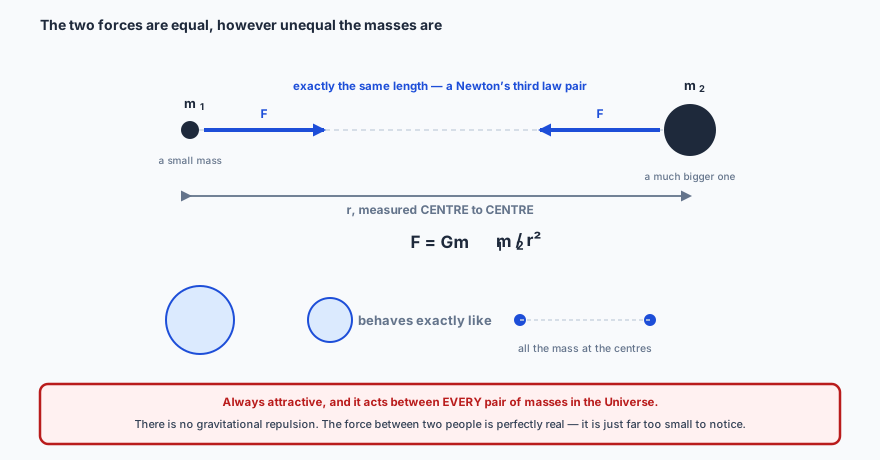
Five things about this law are worth having ready, because questions test them directly.
🧮Gravitational field strength
A field is a region where a mass feels a force, and gravitational field strength is the force per unit mass:
It is a vector, pointing towards the mass, measured in N kg\(^{-1}\) — which is the same thing as m s\(^{-2}\). Notice what is not in that expression: the mass you place in the field. This is exactly why every object falls with the same acceleration, a fact that puzzled people for two thousand years and then dropped out of one line of algebra.
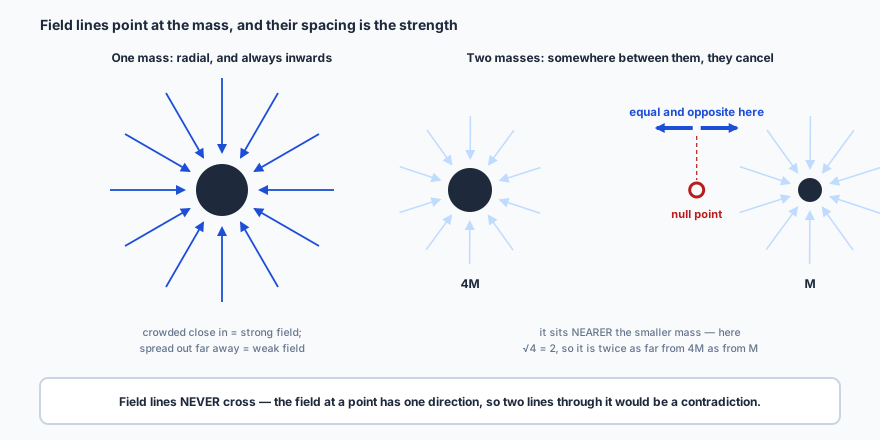
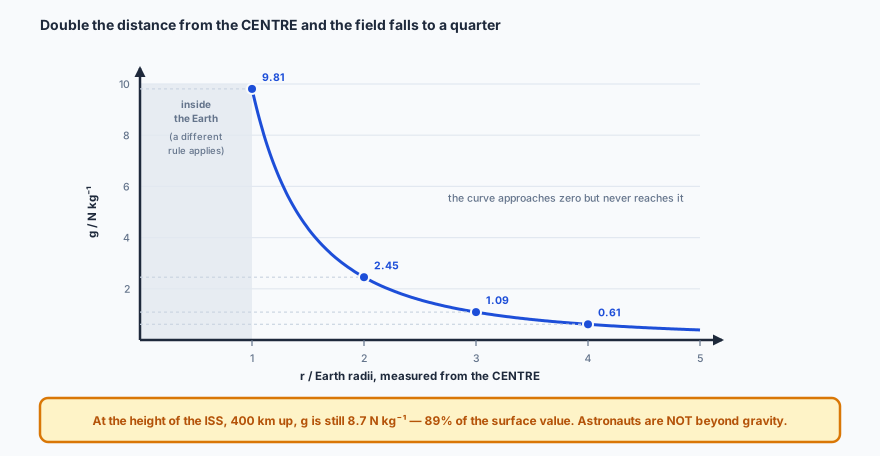
Outside a spherical mass the field falls off as \(1/r^{2}\) from the centre, so the surface value is not a special case of anything — it is just \(g\) evaluated at \(r = R\).
🌍Close to the surface, the field looks uniform
Stand on the ground and the field lines around you are, to any accuracy you could measure, parallel and evenly spaced, all pointing straight down. Nothing has changed about the physics — the field is still radial and still \( GM/r^{2} \) — but you are looking at such a tiny patch of a very large sphere that the convergence is invisible.
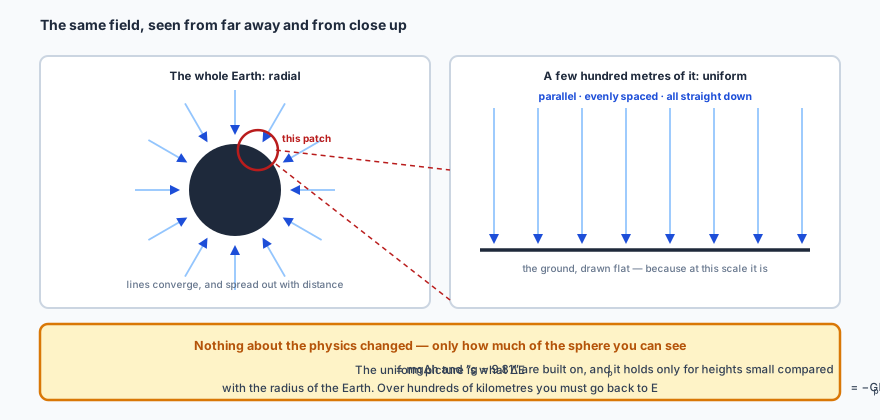
This is why two different formulas for gravitational potential energy coexist, and it fixes when each is allowed. Over a cliff, a building or a laboratory bench, \(g\) is constant and \( \Delta E_p = mg\Delta h \) is exact enough. Over hundreds of kilometres it is not, and you must go back to \( E_p = -GMm/r \).
🛰️Circular orbits: gravity is the centripetal force
An orbiting satellite is not balanced between two forces. There is only one force on it — gravity — and that force is what makes it go round. Setting gravity equal to the centripetal force is the single move that opens almost every orbit question:
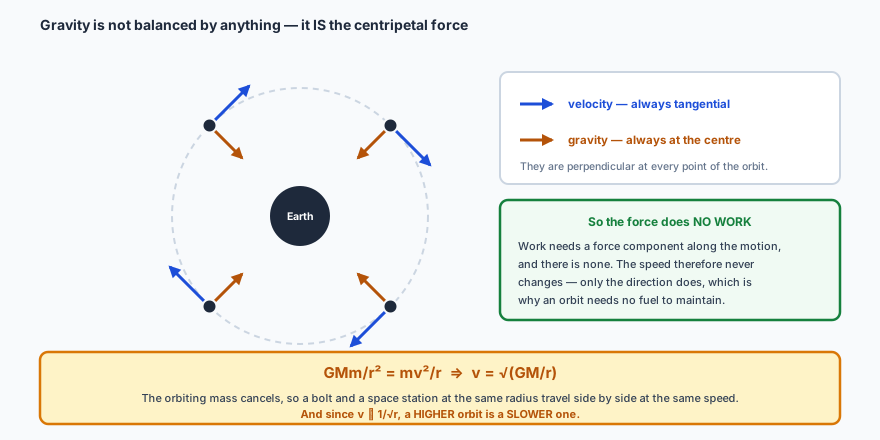
Two things fall straight out. The satellite’s mass \(m\) cancels, so the orbit does not depend on what is orbiting — a bolt and a space station at the same radius travel at the same speed side by side. And because \(v \propto 1/\sqrt{r}\), a higher orbit is a slower one, which is the opposite of what most people guess.
🧑🚀Weightlessness is free fall, not the absence of gravity
What a bathroom scale reads is not your weight — it is the contact force the scale pushes back with. Those are equal only when you are not accelerating vertically. Put the scale in a lift and the reading changes with the lift’s acceleration; cut the cable, so that lift, scale and passenger all accelerate downwards at \(g\) together, and the reading falls to zero.
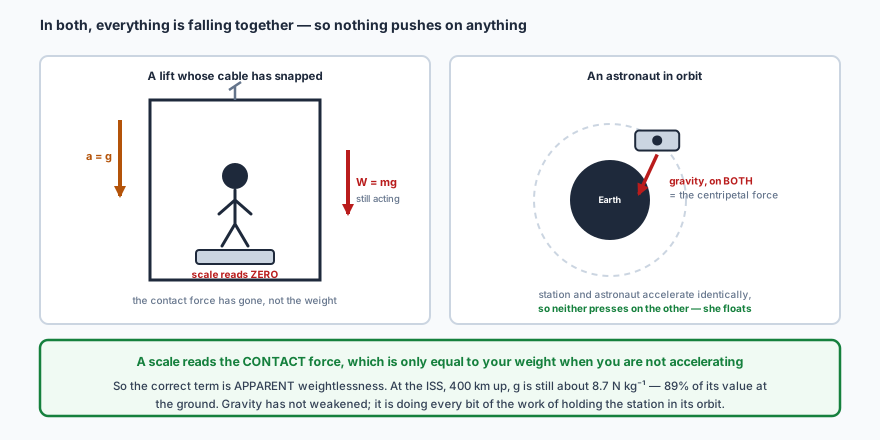
An orbiting astronaut is in exactly that state permanently. Gravity is still pulling on the astronaut and on the station, and that pull is precisely the centripetal force keeping each of them in orbit. Because the two accelerate identically there is no contact force between them, and the astronaut floats. The correct term is apparent weightlessness: what has vanished is the contact force we normally feel, not the gravitational field, which at the ISS is still about 89% of its surface value.
✏️Worked example 1 — a satellite in low orbit
Get \(r\) right first. \( r = 6.37 \times 10^{6} + 0.80 \times 10^{6} = 7.17 \times 10^{6} \) m. Using the altitude alone here is the error that wrecks the whole question.
(a) Orbital speed. \( v = \sqrt{GM/r} = \sqrt{(6.67 \times 10^{-11} \times 5.97 \times 10^{24})/(7.17 \times 10^{6})} = \sqrt{5.55 \times 10^{5}} = 7.45 \times 10^{3} \) m s\(^{-1}\), about 7.5 km s\(^{-1}\).
(b) Period. \( T = 2\pi r/v = (2\pi \times 7.17 \times 10^{6})/(7.45 \times 10^{3}) = 6045 \) s, about 101 minutes — a plausible low-Earth-orbit period, which is a useful sanity check.
(c) Field strength at that height. \( g = GM/r^{2} = 3.98 \times 10^{14} / (7.17 \times 10^{6})^{2} = 7.75 \) N kg\(^{-1}\) — still 79% of the surface value.
(d) HLEscape speed from that altitude. \( v_{\text{esc}} = \sqrt{2} \times v_{\text{orbit}} = 1.414 \times 7.45 = 10.5 \) km s\(^{-1}\).
✏️Worked example 2 — Kepler’s second law with numbers
Sweeping equal areas in equal times means the quantity \( rv \) is the same at both ends of the orbit (each is twice the rate at which area is swept). So
\( v_a = 2.93 \times 10^{4} \) m s\(^{-1} = 29.29 \) km s\(^{-1}\).
✏️Worked example 3 — where the fields cancel
Let the point be a distance \(x\) from the Earth’s centre, so it is \( d - x \) from the Moon’s. The two field strengths must be equal in magnitude:
So \( x = 9.01(d - x) \), giving \( x = 9.01d/10.01 = 0.900d = 3.46 \times 10^{8} \) m from the Earth’s centre.
🔄Kepler’s third law, derived rather than asserted
Substituting \( v = 2\pi r/T \) into \( v = \sqrt{GM/r} \) and squaring gives
That is Kepler’s third law, and the constant is now identified: it depends only on the central mass. Three centuries of astronomy in two lines of algebra, which is roughly why Newton’s law was taken seriously.
It also runs backwards, which is how the Solar System was weighed. Measure a moon’s period and orbital radius and you can solve for the mass of the planet it goes round — the only way we have of finding the mass of anything we cannot put on a balance.
A geostationary satellite is just the case \( T = 24 \) hours. That fixes \( r \approx 4.2 \times 10^{7} \) m from the Earth’s centre, about 36 000 km up. It must also orbit over the equator and in the direction of the Earth’s rotation, or it will not stay above one point.
HLGravitational potential and potential energy
Gravitational potential \( V_g = -GM/r \) is the work done per unit mass in bringing a small mass from infinity to that point; gravitational potential energy is \( E_p = mV_g = -GMm/r \).
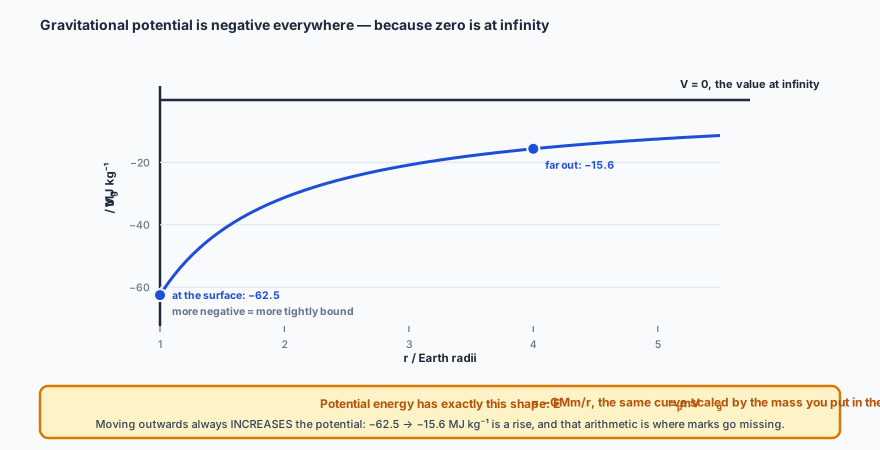
A more negative value means more tightly bound. Moving outwards always increases the potential — from −60 to −30 MJ kg\(^{-1}\) is an increase, and the arithmetic of negative numbers is where marks are quietly lost here.
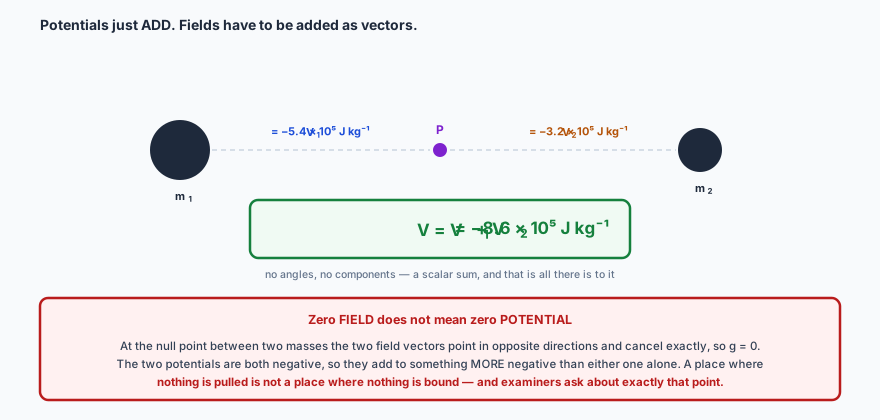
That last point is worth pausing on, because it is a favourite of examiners. At the null point of Worked example 3 the two fields cancel exactly, so \( g = 0 \). The two potentials do not cancel — both are negative, so they add to something more negative than either. A place where nothing is pulled is not a place where nothing is bound.
Once you can find the potential anywhere, the work needed to move a mass between two points is immediate:
and because potential depends only on position, that work is independent of the path taken. Fields with this property are called conservative; gravitational and electric fields both are, and friction is the standard example of a force that is not.
✏️HLWorked example 5 — lifting a satellite, using potential alone
Potential at each place. \( V_g(R_E) = -GM/R_E = -6.25\times10^{7} \) J kg\(^{-1}\), and \( V_g(2R_E) = -3.13\times10^{7} \) J kg\(^{-1}\).
HLEscape speed
To escape means to reach infinity, where the potential energy is zero, with nothing left over. So the kinetic energy at launch must be at least enough to cancel the negative potential energy:
The escaping mass cancels again, so escape speed is the same for a pebble and a spacecraft — 11.2 km s\(^{-1}\) from the Earth’s surface, and only 2.4 km s\(^{-1}\) from the Moon’s, which is why the Moon has no atmosphere: its gas molecules reach that speed and leave.
HLThe potential gradient
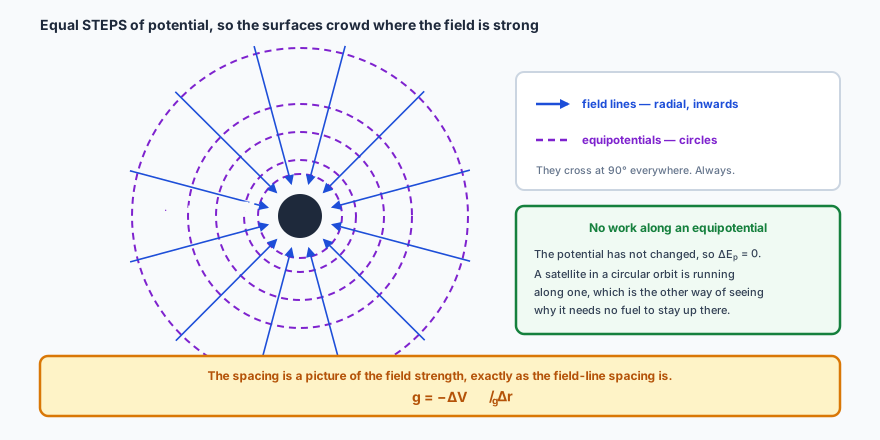
Field strength and potential are not two independent ideas: the field is the rate at which the potential changes with distance.
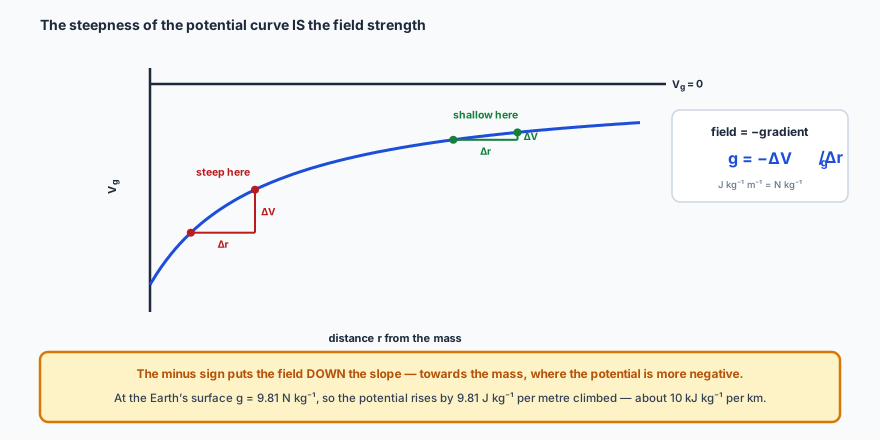
The minus sign says the field points down the potential slope — towards the mass, where the potential is more negative — while the work you do to climb is done up it. The units, J kg\(^{-1}\) m\(^{-1}\), are the same as N kg\(^{-1}\), as they must be.
A quick way to feel the size of it: at the Earth’s surface \( g = 9.81 \) N kg\(^{-1}\), so the potential rises by 9.81 J kg\(^{-1}\) for every metre you go up — about 10 kJ kg\(^{-1}\) per kilometre. Equipotential surfaces drawn at equal steps of potential are therefore evenly spaced near the ground, which is the uniform-field picture from earlier arriving by a different route.
HLThe total energy of an orbit
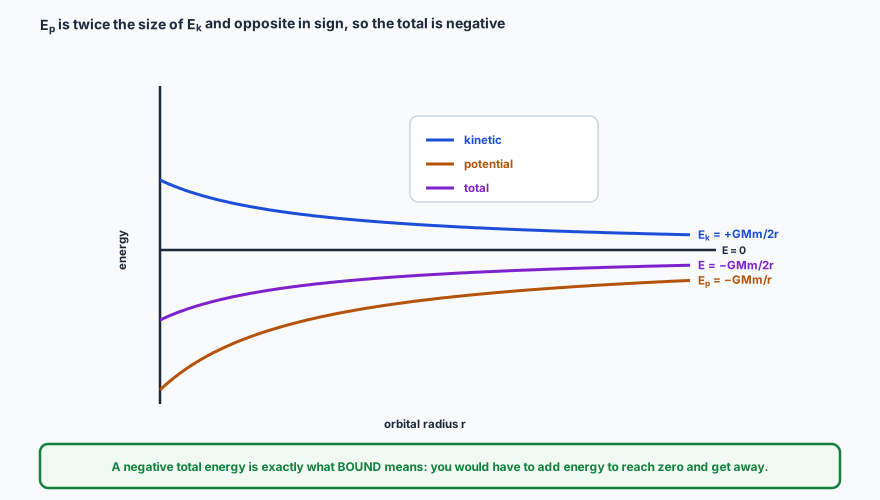
For a circular orbit, \( \tfrac{1}{2}mv^{2} = GMm/2r \), so the kinetic energy is exactly half the size of the potential energy and opposite in sign:
✏️HLWorked example 4 — the cost of a higher orbit
Use the total energy at each radius and take the difference.
\( \Delta E = E_2 - E_1 = -5.66\times10^{9} - (-3.33\times10^{10}) = 2.77 \times 10^{10} \) J, about 28 GJ.
HLEquipotential surfaces
An equipotential is a surface on which the potential is the same everywhere. Around a point mass they are spheres, drawn as circles, and they are always perpendicular to the field lines. No work is done moving along one, because the potential has not changed — which is why a satellite in a circular orbit needs no fuel: it is running along an equipotential.
🔭See it happen
PhET, Gravity and Orbits. Turn on the velocity and force vectors and watch gravity point permanently at the centre while the velocity stays tangential. Then reduce the orbital speed slightly and watch the orbit decay inwards — and the satellite speed up as it falls. Turning gravity off mid-orbit is also worth doing once: the satellite leaves along the tangent in a straight line, which is the clearest possible demonstration that the force is what bends the path.
📝Practise
Work through these, then reveal the answer. Each question targets a different objective from the list above.
1. Find the gravitational field strength at the surface of Mars, given \( M = 6.42 \times 10^{23} \) kg and \( R = 3.39 \times 10^{6} \) m.
2. A minor planet orbits the Sun with a semi-major axis of 4.0 AU. Find its orbital period in years, without using \(G\) or the mass of the Sun.
3. Find the orbital radius of a geostationary satellite. Take \( M_E = 5.97 \times 10^{24} \) kg and \( T = 24 \) hours.
4. Find the orbital speed of that geostationary satellite, and compare it with the 7.5 km s\(^{-1}\) of the 800 km satellite.
5. A comet on a long elliptical orbit is 30 times further from the Sun at aphelion than at perihelion. Find the ratio of its speeds at the two points, and name the law you used.
6. Find the escape speed from the surface of the Moon, given \( M = 7.35 \times 10^{22} \) kg and \( R = 1.74 \times 10^{6} \) m.
7. Two spheres of mass 60 kg and 6.0 kg are 0.50 m apart, centre to centre. Find the force on each, and state which is larger.
8. Explain why astronauts on the International Space Station, about 400 km up, appear weightless, given that \(g\) there is still about 8.7 N kg\(^{-1}\).
9. HLFind the gravitational potential at the Earth’s surface, taking \( GM = 3.98 \times 10^{14} \) and \( R = 6.37 \times 10^{6} \) m, and explain the sign.
10. HLA satellite of mass \(m\) is moved from a circular orbit of radius \(r\) to one of radius \(2r\). Find the energy required, in terms of \(G\), \(M\), \(m\) and \(r\), and state what happens to its speed.
🔗Go deeper — other people’s work
These are external resources, not mine. If one stops working, tell me and everything above it on this page still stands.
- The Physics Classroom — Circular Motion and Satellite Motion
- HyperPhysics — gravity, orbits and gravitational potential