The whole of this topic is additional higher level. It is also where classical
physics finally runs out: two experiments here cannot be explained by any wave model of light, and
a third shows that matter has the same problem in reverse.
🎯What you need to be able to do
State the four experimental observations of the photoelectric effect, and explain why a wave model cannot account for them.
Use Einstein’s photon model: \( E_{\max} = hf - \phi \), and define the work function and the threshold frequency.
Describe the stopping-potential experiment and use \( E_{\max} = V_se \).
Interpret a graph of stopping potential against frequency, and obtain \(h\) and \(\phi\) from it.
Explain wave–particle duality, and use the de Broglie relation \( \lambda = h/p \).
Describe the electron-diffraction experiment and say what it demonstrates.
Describe the Compton effect and use \( \Delta\lambda = \dfrac{h}{m_ec}(1 - \cos\theta) \).
⚡The photoelectric effect: four awkward facts
Shine ultraviolet light on a clean metal surface such as zinc and electrons are emitted from it.
That much is unremarkable — light carries energy, the energy frees electrons. The details are
what caused the trouble.
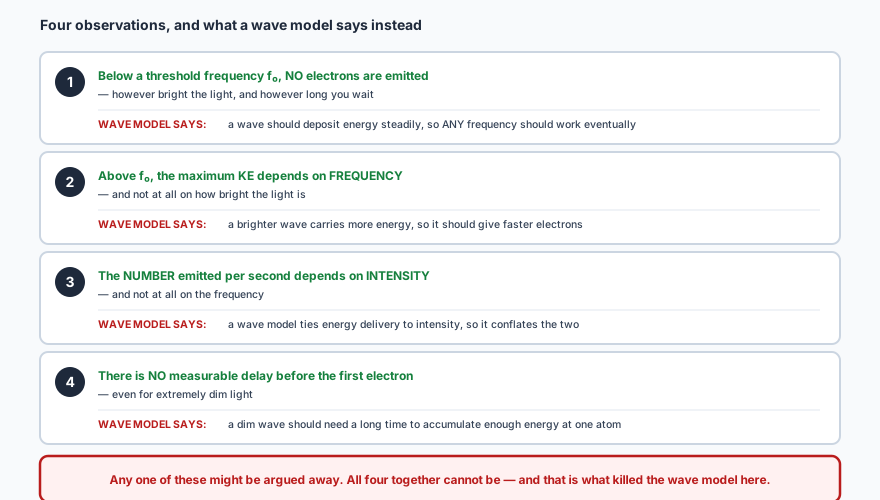
Each of the four observations is paired with what a wave model predicts instead. It is the combination that is fatal — any one of them alone might be explained away.
Why a wave model cannot survive this. On a wave picture, energy arrives spread
across the whole surface and accumulates steadily. A dim light of any frequency should therefore
eventually deliver enough energy to free an electron — you would just have to wait. A brighter
light should deliver energy faster and so make the electrons come out with more energy. Both
predictions are flatly wrong: below the threshold frequency you can wait all day and get nothing, and
brightness changes only how many electrons come out, never how fast.
💡Einstein’s photon model
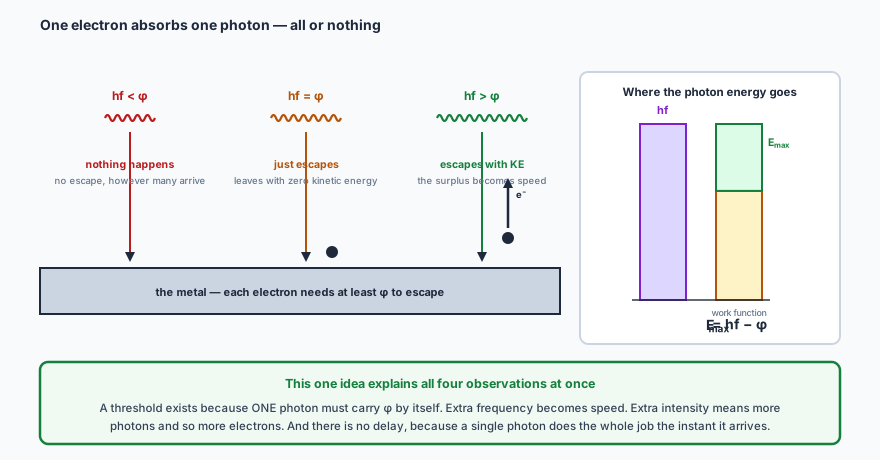
Einstein’s resolution was to treat light as arriving in discrete packets —
photons — each carrying \( E = hf \), with the number arriving per
second fixed by the intensity. One electron absorbs one photon, all or nothing.
Each electron needs a certain minimum energy to escape the surface, called the work
function \(\phi\). Anything left over becomes kinetic energy:
The model explains all four observations at once. A threshold exists because one photon must carry \(\phi\) on its own; extra frequency becomes speed; extra intensity becomes more electrons; and there is no delay because a single photon does the job instantly.Brighter light gives MORE electrons, never FASTER ones. Intensity sets how many
photons arrive per second, and frequency sets how much energy each one carries. Doubling the
brightness doubles the current and leaves \( E_{\max} \) exactly where it was. This is the single
most-tested idea on the page, and the wave intuition — more energy in, more energy out
— is precisely what it contradicts.
\( E_{\max} \) is a MAXIMUM. Only electrons right at the surface escape having
spent exactly \(\phi\); electrons from deeper down lose more on the way out and emerge with less.
So the equation gives the fastest electrons, not the typical ones, and the emitted electrons have a
whole spread of energies below that ceiling.
🔌Measuring it: the stopping potential
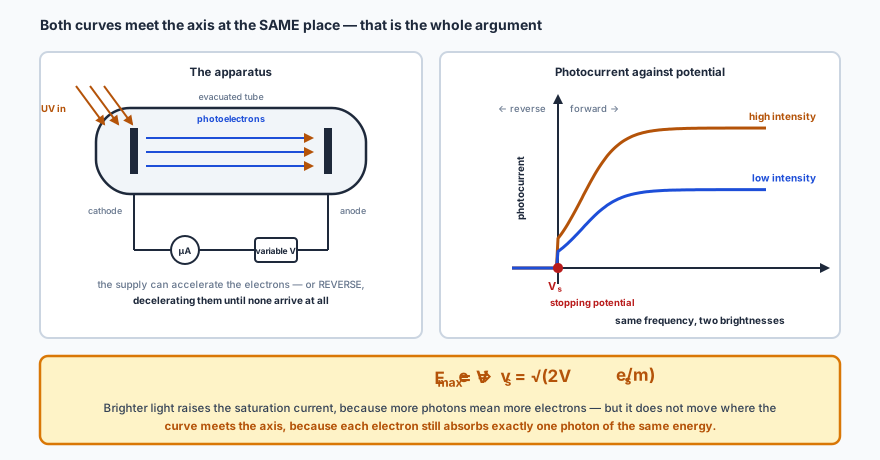
Photoelectrons are emitted from a cathode and collected at an anode, giving a small
photocurrent. Now reverse the potential difference so the electrons are
decelerated. Increase that reverse voltage and fewer and fewer electrons make it across,
until at the stopping potential \(V_s\) even the fastest ones are turned back and
the current falls to zero.
The two curves meet the axis at the same point. That is the whole argument in one picture: intensity changes how many electrons there are, not how energetic the fastest one is.
At that point the work done against the field has used up all the kinetic energy the fastest
electron had:
Find the maximum speed of electrons emitted from a zinc surface (\( \phi = 4.2 \) eV) illuminated
by radiation of wavelength 200 nm. (\( m_e = 9.11\times10^{-31} \) kg.)
Work function in joules.
\( \phi = 4.2 \times 1.60\times10^{-19} = 6.72\times10^{-19} \) J.
Check the threshold before you start. Zinc’s threshold is
\( f_0 = \phi/h = 1.0\times10^{15} \) Hz, which is a wavelength of 296 nm. Our 200 nm light is
shorter, so it is above threshold and electrons do come out. Had the question offered
400 nm light, the answer would have been “none at all, whatever the intensity” —
and that is a real exam question, not a trick.
📈The graph that measures Planck’s constant
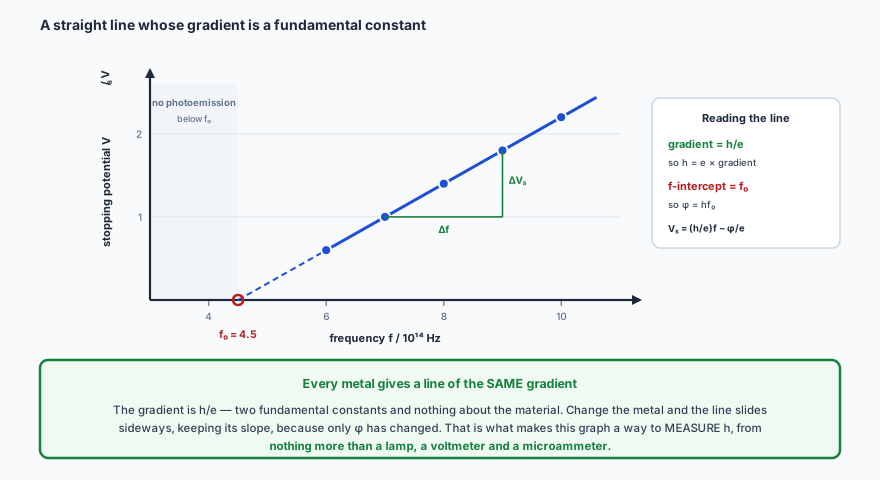
\( V_s = (h/e)f - \phi/e \) is \( y = mx + c \). Plot the stopping potential against frequency and
you get a straight line whose gradient is \( h/e \) and whose intercept on the
frequency axis is the threshold frequency.
Every metal gives a line of the same gradient — it contains only \(h\) and \(e\). Changing the metal slides the line sideways, because only \(\phi\) has changed.
✏️Worked example 2 — getting \(h\) out of data
An experiment gives stopping potentials of 0.6, 1.0, 1.4, 1.8 and 2.2 V for frequencies of 6.0,
7.0, 8.0, 9.0 and \( 10.0 \times 10^{14} \) Hz. Find the threshold frequency, Planck’s
constant and the work function.
Gradient. The points are evenly spaced, so take the ends:
\( 6.4\times10^{-34} \) against the true \( 6.63\times10^{-34} \) — 3.5% low, and
that is fine. This is real experimental data, not an algebra exercise, and a 3.5%
discrepancy from a five-point graph is a good result. What matters is that the method recovers a
fundamental constant of nature from a voltmeter and a lamp. Do not “correct” your
gradient towards the book value — report what the data gives and comment on it.
⚛️Wave–particle duality
Two questions follow, and the answer to both is yes.
Is light a wave or a particle? Light reflects, refracts, diffracts and interferes
— all wave behaviour, all of Theme C. It also produces the photoelectric effect and, as we will
see, bounces off electrons like a ball — particle behaviour. The honest answer is that light is
neither: it is light. We model it as a wave when that predicts what happens and as a particle when
that does, and no single classical picture covers both. This is wave–particle
duality.
If waves can behave as particles, can particles behave as waves? Yes — and
that is de Broglie’s hypothesis.
📏The de Broglie hypothesis
Every moving particle has a wave associated with it, of wavelength
\[ \lambda = \frac{h}{p} \qquad\text{and for a photon}\qquad \lambda = \frac{hc}{E} \]
The square of that wave’s amplitude at a point is a measure of the probability of
finding the particle there — which is the wavefunction picture that replaced Bohr’s
orbits.
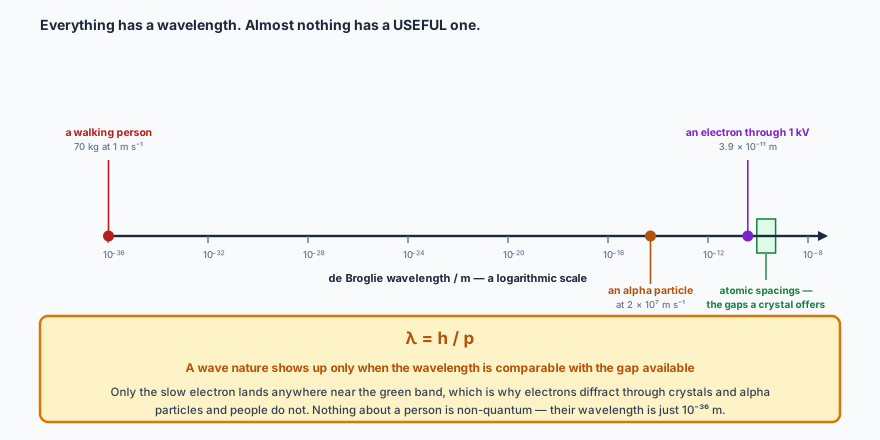
Nothing about a walking person is non-quantum in principle — the wavelength is simply \( 10^{-36} \) m, twenty orders of magnitude smaller than a nucleus, so no gap exists that could ever diffract them.
✏️Worked example 3 — three de Broglie wavelengths
Estimate the de Broglie wavelength of (a) an electron accelerated through 1.0 kV, (b) an alpha
particle of mass \( 6.6\times10^{-27} \) kg moving at \( 2.0\times10^{7} \) m s\(^{-1}\), and
(c) a 70 kg person walking at 1.0 m s\(^{-1}\).
(a) The electron gains \( E_k = eV = 1.6\times10^{-16} \) J. Since
\( E_k = p^{2}/2m \), \( p = \sqrt{2mE_k} = 1.7\times10^{-23} \) kg m s\(^{-1}\), so
(b) \( p = mv = 6.6\times10^{-27} \times 2.0\times10^{7} = 1.3\times10^{-19} \)
kg m s\(^{-1}\), giving \( \lambda = 5.0\times10^{-15} \) m.
(c) \( p = 70 \times 1.0 = 70 \) kg m s\(^{-1}\), giving
\( \lambda = 9.5\times10^{-36} \) m.
Only (a) is observable. Atomic spacings in a crystal are around
\( 10^{-10} \) m, so the electron’s \( 3.9\times10^{-11} \) m is the right order of
magnitude to be diffracted by one — and it is. The alpha particle’s wavelength is
smaller than a nucleus, and the person’s is smaller than anything whatsoever. Note the
route in (a): the momentum comes from the kinetic energy via \( E_k = p^{2}/2m \), not from
\( v \) — that is the step most often missed.
🔬Electron diffraction: seeing the wave
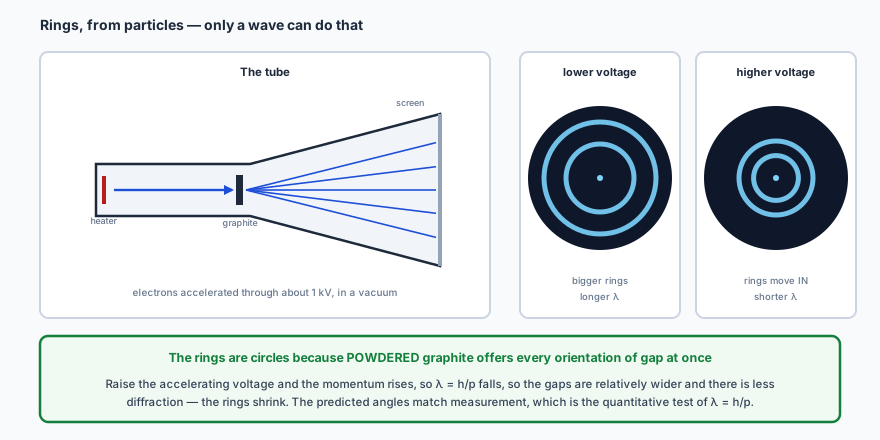
To diffract, a wave needs a gap comparable with its wavelength. Nothing manufactured is
\( 10^{-11} \) m across — but the spacing between atoms in a crystal is. Fire a beam of
electrons at a thin layer of powdered graphite and they emerge in a pattern of
concentric rings on a fluorescent screen.
The rings are the point: only a wave produces constructive interference at particular angles. That electrons do it is the direct evidence that matter has a wave nature.
Turn up the accelerating voltage and the rings shrink. That is the de Broglie relation being
tested quantitatively: more voltage gives more momentum, \( \lambda = h/p \) gives a shorter
wavelength, the gaps are relatively bigger, and there is less diffraction. The predicted angles match
measurement.
💥The Compton effect
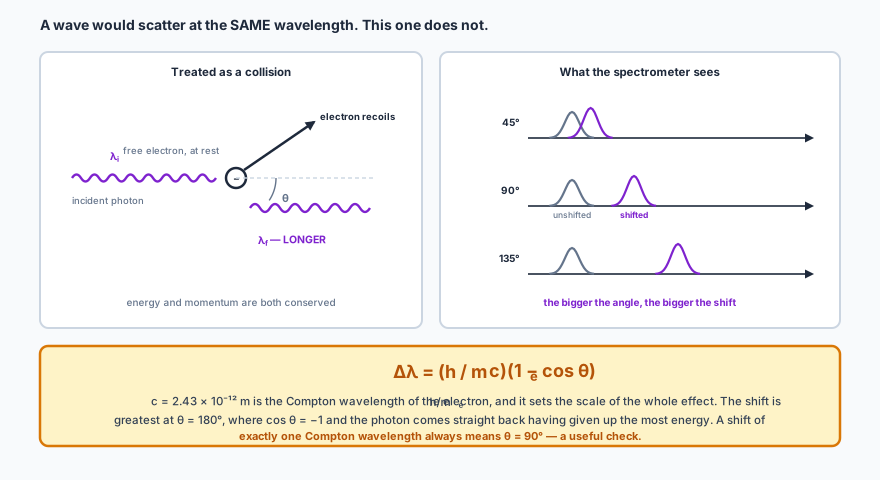
Fire high-energy X-rays at a target such as graphite and examine the scattered radiation. Some of
it has the original wavelength — but some has a longer one, and how much longer
depends on the angle you look at.
A wave scattering off a charge would re-radiate at the same frequency. A shift in wavelength means the X-ray gave some of its energy away — which is what a particle does in a collision, and what a wave cannot do.
Treat it as an elastic collision between a photon and a free electron, apply conservation of energy
and of momentum, and the shift comes out as
The quantity \( h/m_ec = 2.43\times10^{-12} \) m is the Compton wavelength of the
electron and sets the scale of the whole effect. The shift is greatest when \( \cos\theta = -1 \),
that is at \( \theta = 180^\circ \), where the photon comes straight back and gives up the most
energy.
✏️Worked example 4 — a Compton shift
An X-ray of wavelength \( 7.1000\times10^{-11} \) m strikes a target and is scattered through
30°. Find the wavelength of the scattered X-ray.
Note how many figures the question gives you. The shift is 0.5% of the original
wavelength, so quoting \( \lambda_i \) as “7.1” would lose the entire effect to
rounding — hence 7.1000. Whenever a question hands you unusually many significant figures,
it is telling you that a small difference is the answer. And check the sign: the scattered photon
always has the longer wavelength, because it has given energy to the electron.
🔭See it happen
PhET, Photoelectric Effect. Set the light below the threshold and turn the
intensity to maximum — nothing happens, which is the whole topic in one observation. Then
raise the frequency past the threshold and watch electrons appear the instant you do. The
simulation plots current against intensity, current against frequency and electron energy against
frequency, which are exactly the three graphs this topic asks you to interpret.
📝Practise
Work through these, then reveal the answer. Each question targets a different objective from the list above.
1. Describe what is meant by the photoelectric effect, and state the four experimental observations that a wave model cannot explain.
The photoelectric effect is the emission of electrons from a metal surface when electromagnetic radiation (typically ultraviolet) is shone on it.
The four observations: (i) below a threshold frequency no electrons are emitted at all, however long you wait and however intense the light; (ii) above it, the maximum kinetic energy of the electrons depends on the frequency, not the intensity; (iii) the number emitted per second depends on the intensity, not the frequency; (iv) there is no measurable delay between the light arriving and the first electrons appearing, even in very dim light.
A wave model predicts the opposite on every count: energy should accumulate until any frequency works, brighter light should give faster electrons, and dim light should show a delay while the energy builds up.
2. Explain what is meant by the stopping potential, and why it does not change when the light is made brighter.
The stopping potential \(V_s\) is the reverse potential difference just large enough to reduce the photocurrent to zero — the voltage at which even the fastest photoelectron is turned back before reaching the anode. It therefore measures the maximum kinetic energy: \( E_{\max} = V_se \).
It does not change with intensity because intensity controls only how many photons arrive per second, and therefore how many electrons are emitted. Each electron still absorbs exactly one photon of the same energy \(hf\), so \( E_{\max} = hf - \phi \) is unchanged. On the current–voltage graph, brighter light raises the saturation current but the curve meets the axis at the same place.
3. Light of wavelength 250 nm falls on a metal of work function 3.0 eV. Find the maximum kinetic energy of the emitted electrons, in joules and in eV.
Photon energy \( E = hc/\lambda = (6.63\times10^{-34} \times 3.00\times10^{8})/(250\times10^{-9}) = 7.96\times10^{-19} \) J.
Work function \( \phi = 3.0 \times 1.60\times10^{-19} = 4.80\times10^{-19} \) J.
\( E_{\max} = 7.96\times10^{-19} - 4.80\times10^{-19} = 3.2\times10^{-19} \) J, which is \( 3.16\times10^{-19}/1.60\times10^{-19} = \mathbf{2.0} \) eV.
A quicker route in eV throughout: the photon carries \( 1240/250 = 4.96 \) eV (using \(hc = 1240\) eV nm), so \( E_{\max} = 4.96 - 3.0 = 2.0 \) eV.
4. A graph of stopping potential against frequency has gradient \( 4.1\times10^{-15} \) V s and crosses the frequency axis at \( 5.0\times10^{14} \) Hz. Find Planck’s constant and the work function.
The gradient is \( h/e \), so \( h = e \times 4.1\times10^{-15} = 1.60\times10^{-19} \times 4.1\times10^{-15} = 6.6\times10^{-34} \) J s.
The intercept on the frequency axis is the threshold frequency \(f_0\), so \( \phi = hf_0 = 6.6\times10^{-34} \times 5.0\times10^{14} = 3.3\times10^{-19} \) J \( = 2.1 \) eV.
Note that the gradient contains only \(h\) and \(e\), so every metal gives the same gradient; changing the metal shifts the line sideways and changes only the intercept.
5. Outline what is meant by wave–particle duality.
That neither the wave model nor the particle model alone accounts for the behaviour of light or of matter, and that both are needed. Light reflects, refracts, diffracts and interferes like a wave, yet delivers its energy in discrete quanta in the photoelectric effect and carries momentum in a collision in the Compton effect. Matter, conversely, behaves as localised particles in most circumstances yet diffracts through crystal lattices like a wave. Which model is appropriate depends on the experiment; neither is the whole truth, and the two never contradict each other in any single observation.
6. Calculate the de Broglie wavelength of an electron moving at half the speed of light, \( 0.5c \). (Ignore relativistic corrections.)
\( p = mv = 9.11\times10^{-31} \times 1.5\times10^{8} = 1.37\times10^{-22} \) kg m s\(^{-1}\), so
\[ \lambda = \frac{h}{p} = \frac{6.63\times10^{-34}}{1.37\times10^{-22}} = 4.9\times10^{-12}\ \text{m} \]
This is about a fiftieth of an atomic spacing, so such an electron would diffract only very weakly from a crystal — and note that at \(0.5c\) the non-relativistic \(p = mv\) is already about 15% low, which is why the question says to ignore it.
7. Describe the electron-diffraction experiment and state what it shows. Explain what happens to the pattern if the accelerating voltage is increased.
Electrons from a heated filament are accelerated through about 1 kV in an evacuated tube and pass through a thin target of powdered graphite, striking a fluorescent screen where they produce concentric bright rings. The rings are circles because the powder presents every possible orientation of the atomic planes, so every azimuthal direction is equally represented.
What it shows: rings are an interference pattern, and only waves interfere — so electrons have a wave nature. The atomic spacing (\(\approx 10^{-10}\) m) is comparable with the electrons’ de Broglie wavelength, which is what makes the diffraction observable at all.
Higher voltage: greater kinetic energy, so greater momentum, so a shorter de Broglie wavelength \( \lambda = h/p \). The gaps are then relatively larger compared with the wavelength, so there is less diffraction and the rings move inwards to smaller angles.
8. Outline the Compton effect and explain how it supports the particle model of light.
High-energy X-rays or gamma rays of a single known wavelength are scattered from a target such as graphite. The scattered radiation contains two wavelengths: one equal to the original, and one longer, with the increase depending on the scattering angle.
Why it supports the particle model: a wave scattering from a charge would set it oscillating at the wave’s own frequency and be re-radiated at that same frequency, so a wave model predicts no shift at all. A longer wavelength means lower energy, so the radiation must have given energy away — and the shifted component is exactly what you get by treating the event as an elastic collision between a particle-like photon carrying energy and momentum and a free outer electron, conserving both. The recoiling electron carries off the missing energy.
9. A photon of wavelength \( 6.00\times10^{-12} \) m collides with a stationary electron and its wavelength changes by \( 2.43\times10^{-12} \) m. Deduce the angle through which the photon was scattered.
\[ \Delta\lambda = \frac{h}{m_ec}(1-\cos\theta) \quad\text{with}\quad \frac{h}{m_ec} = 2.43\times10^{-12}\ \text{m} \]
So \( 2.43\times10^{-12} = 2.43\times10^{-12}(1 - \cos\theta) \), giving \( 1 - \cos\theta = 1 \), so \( \cos\theta = 0 \) and \( \theta = \mathbf{90^\circ} \).
A shift of exactly one Compton wavelength always means 90°, which is worth remembering as a check. The scattered photon has \( \lambda_f = 8.43\times10^{-12} \) m.
10. For the collision in question 9, determine the kinetic energy given to the electron.
The electron gets whatever energy the photon lost.
Before: \( E_i = hc/\lambda_i = (6.63\times10^{-34} \times 3.00\times10^{8})/(6.00\times10^{-12}) = 3.315\times10^{-14} \) J.
After: \( E_f = (6.63\times10^{-34} \times 3.00\times10^{8})/(8.43\times10^{-12}) = 2.360\times10^{-14} \) J.
\[ E_k = E_i - E_f = 3.315\times10^{-14} - 2.360\times10^{-14} = 9.6\times10^{-15}\ \text{J} \]
which is about 60 keV. Keep plenty of significant figures in \(E_i\) and \(E_f\): you are subtracting two similar numbers, so rounding them early destroys the answer — the same hazard as in the worked example.
🔗Go deeper — other people’s work
These are external resources, not mine. If one stops working, tell me and
everything above it on this page still stands.
HyperPhysics — photoelectric effect and de Broglie wavelengths