Fission
🎯What you need to be able to do
- Describe induced fission, and write a balanced fission equation.
- Explain the chain reaction in terms of the multiplication factor \(k\), and what critical mass means.
- Explain why the neutrons must be slowed, and what the moderator does about it.
- State the job of each part of a reactor: fuel, moderator, control rods, coolant, heat exchanger, containment.
- Explain why uranium must be enriched, and what that has to do with weapons.
- Explain why fission products are radioactive, and discuss the waste that follows.
- Evaluate nuclear power against the alternatives, with both halves of the argument.
- Outline nuclear fusion as a power source, the conditions it needs, and why it is not yet working.
⚛️Induced fission
A uranium-235 nucleus that absorbs a neutron becomes uranium-236, and uranium-236 is so unstable that it deforms and splits within about \( 10^{-14} \) s. That is induced fission: not something the nucleus does on its own, but something a neutron makes it do.
The split is not always into barium and krypton — a nucleus this size can come apart in hundreds of different ways, and the fragments are usually unequal, with nucleon numbers around 95 and 140. What is always true is that two or three neutrons come out, and that the two balances hold: \( 235 + 1 = 141 + 92 + 3 \), and \( 92 + 0 = 56 + 36 + 0 \).
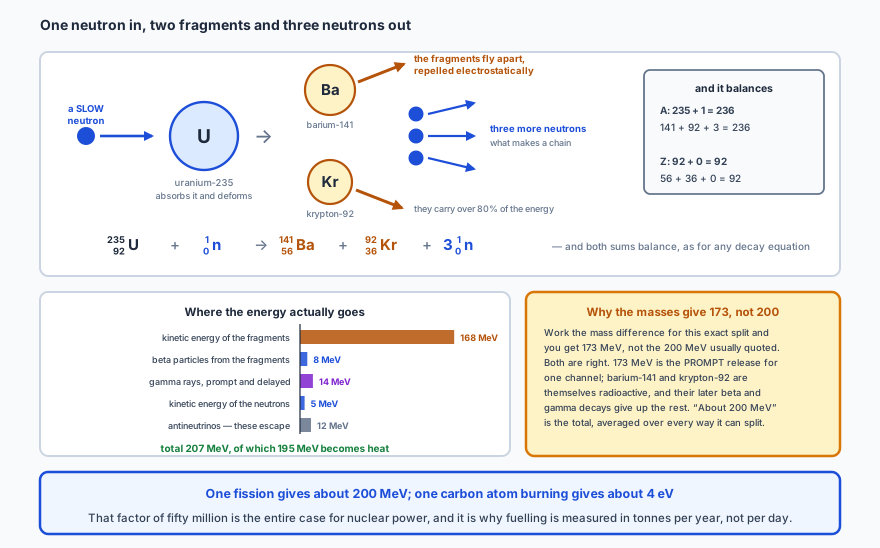
Two details in that figure repay attention. First, the neutron that starts it must be slow — the next section explains why. Second, if you work out the energy released from the mass difference for this particular split you get 173 MeV, not the 200 MeV usually quoted. Both figures are right: 173 MeV is the prompt release for one channel, and the fission fragments are themselves radioactive, so their subsequent beta and gamma decays give up the rest over the following hours and years.
✏️Worked example 1 — completing a fission equation
Balance the nucleon numbers. The left-hand side has \( 235 + 1 = 236 \). The right has \( 94 + A + 2 \), so \( A = 140 \).
Balance the proton numbers. Strontium is \( Z = 38 \). The left has \( 92 + 0 = 92 \), so \( Z = 92 - 38 = 54 \), which is xenon.
Energy, from the binding-energy curve. Total binding energy before, for the 236 nucleons in the compound nucleus:
And after, for the two fragments (the free neutrons have no binding energy):
🔗The chain reaction, and one number that decides everything
Each fission produces two or three neutrons, so each fission can in principle cause more than one more. Whether it actually does is the whole question, and it is captured in a single number: the multiplication factor \(k\), the average number of neutrons from one fission that go on to cause another.
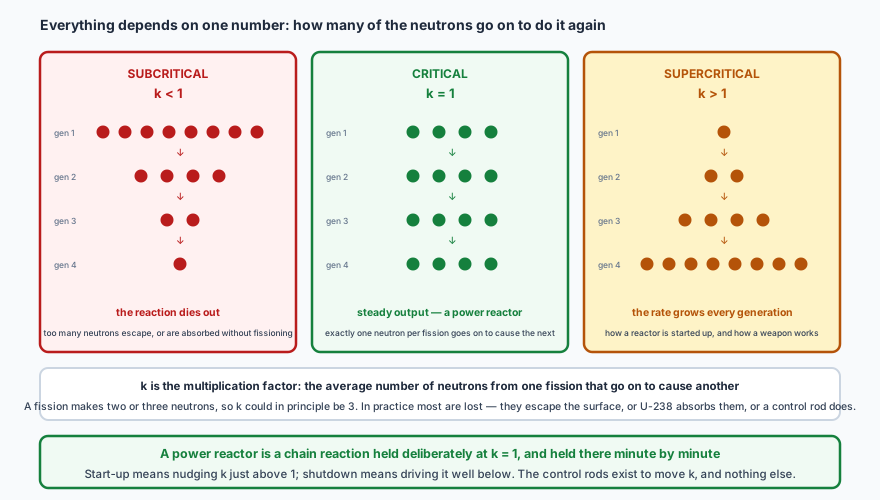
A fission makes two or three neutrons, so why is \(k\) not simply 2 or 3? Because most neutrons never cause a fission. Some escape through the surface of the fuel. Some are absorbed by uranium-238, which is over 99% of natural uranium and which mostly captures neutrons without fissioning. Some are absorbed by the moderator, the coolant, or the structure. And in a working reactor, some are absorbed deliberately, by the control rods.
⚖️Critical mass
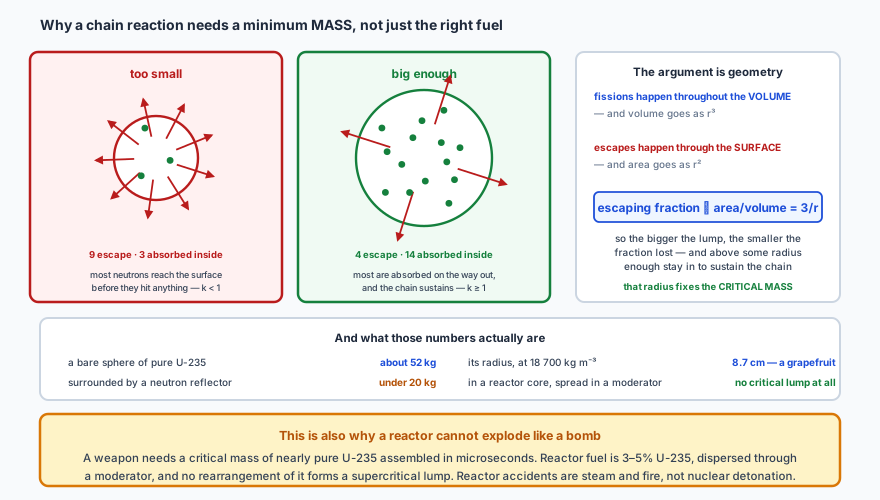
Because escape through the surface is one of the loss routes, the size of the lump of fuel matters directly. Fissions happen throughout the volume, which goes as \( r^3 \); escapes happen through the surface, which goes as \( r^2 \). So the fraction lost scales as
Double the radius and you halve the fraction escaping. Above some radius, enough neutrons stay in that the chain sustains itself, and the mass at that radius is the critical mass.
🎸Why the neutrons have to be slowed down
Here is the awkwardness at the centre of reactor design. Fission produces neutrons with kinetic energies around 2 MeV — fast neutrons. But uranium-235 is hundreds of times more likely to absorb a slow one. A neutron in thermal equilibrium with matter at room temperature has an energy of about \( kT = 0.025 \) eV, and at that energy U-235 fissions readily; at 2 MeV it mostly does not.
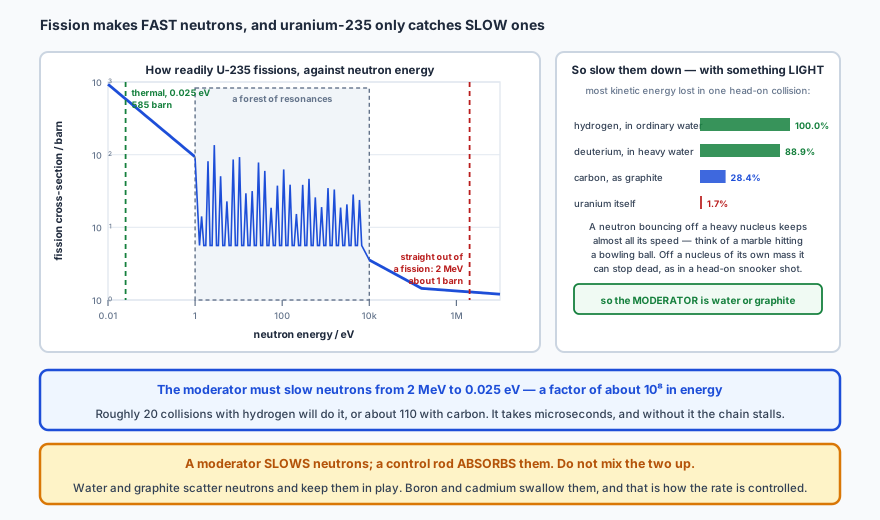
So the neutrons must be slowed, from 2 MeV to 0.025 eV — a factor of about \( 10^{8} \) in energy. That is the moderator's job, and it does it by elastic collisions. The physics of those collisions decides what the moderator can be made of: in a head-on elastic collision, a light particle transfers most of its kinetic energy only to a target of similar mass. A neutron bouncing off a uranium nucleus loses under 2% of its energy; off a hydrogen nucleus, of almost exactly its own mass, it can lose all of it.
Hence water or graphite. Around twenty collisions with hydrogen will thermalise a fission neutron; carbon needs about a hundred. In a pressurised water reactor the moderator and the coolant are the same water, which turns out to be a useful safety property: lose the water and the chain reaction stops, because there is nothing left to slow the neutrons.
🏭Inside a reactor
A pressurised water reactor is the commonest design in the world, and every part of it has exactly one job. Exam questions almost always ask for the job, not the name.
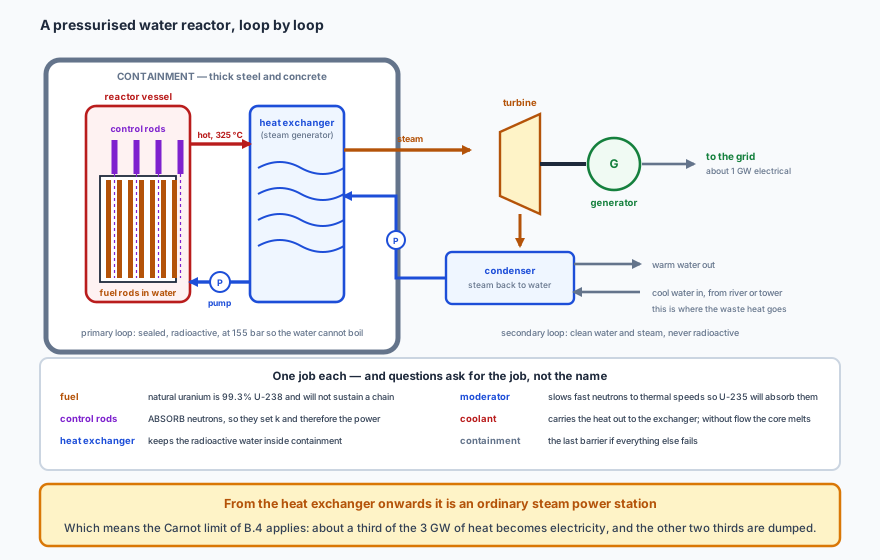
The pressure is worth a sentence of its own. The primary water is held at about 155 times atmospheric pressure so that it stays liquid at 325 °C. Water that hot at ordinary pressure would flash to steam, and steam is a far worse coolant — and a far worse moderator.
⚛️Enrichment, and what it has to do with weapons
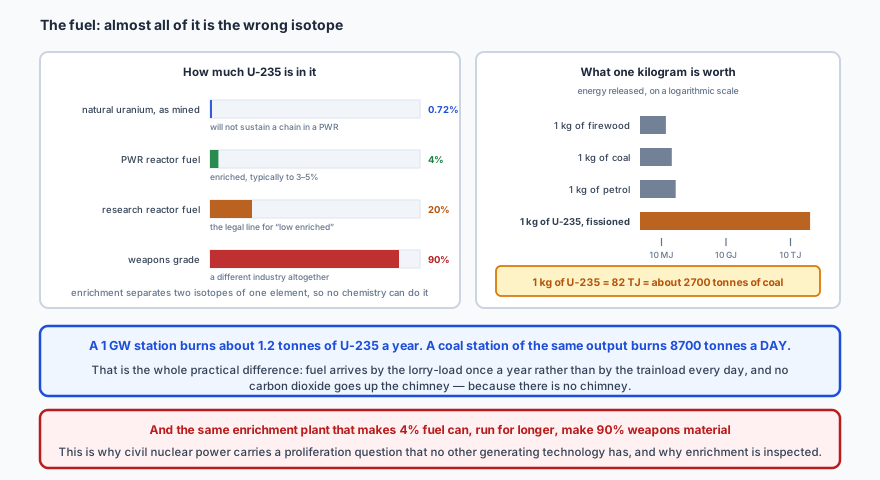
Natural uranium is 99.27% uranium-238 and only 0.72% uranium-235. Uranium-238 does not fission with slow neutrons; it absorbs them. So natural uranium in a PWR cannot sustain a chain reaction, and the fuel must be enriched to a few per cent U-235.
Enrichment is difficult in a specific way: U-235 and U-238 are the same element, so no chemical process can separate them. It has to be done on the mass difference alone — about 1% — by gas centrifuges running in long cascades.
✏️Worked example 2 — how much fuel a power station actually uses
(a) Work back to thermal power first. The 1.0 GW is what comes out; the reactor must produce three times as much heat:
One fission gives \( 200 \times 10^{6} \times 1.60 \times 10^{-19} = 3.2 \times 10^{-11} \) J, so
(b) Turn a number of nuclei into a mass. In one day there are \( 9.5 \times 10^{19} \times 86400 = 8.2 \times 10^{24} \) fissions, and each consumes one U-235 nucleus. One mole is 235 g and contains \( N_A \) nuclei, so
☢️The waste, and why there is any
Fission fragments are radioactive, and the reason is worth deriving rather than remembering. A nucleus with 92 protons needs about 1.6 neutrons per proton to sit in the stability band of E.3. A fragment with 50 protons needs only about 1.4. But the fragment inherits its neutrons from the uranium, so it arrives with far too many for its new proton number — it lands well above the band. Every fission fragment is therefore a beta-minus emitter, usually through a chain of several decays.
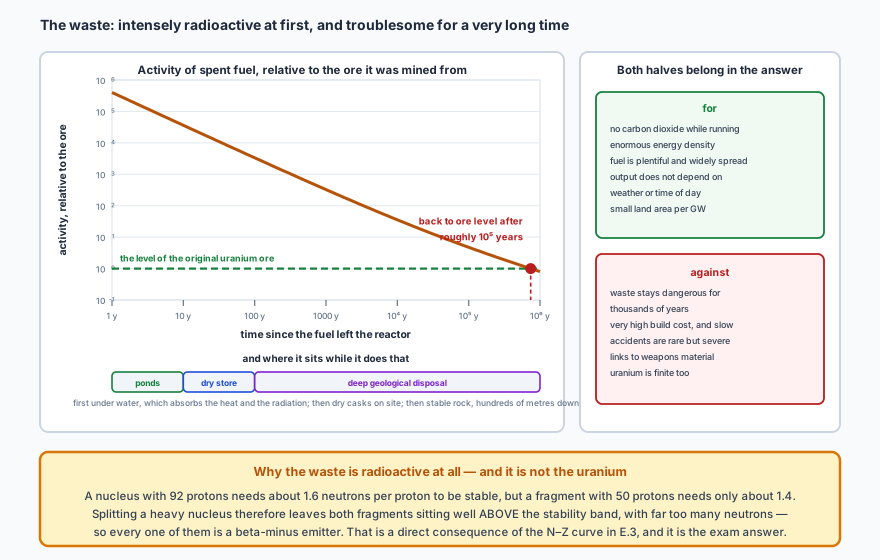
The practical consequence is a fuel assembly that comes out of the reactor generating several kilowatts of heat purely from its own decay, and that stays hazardous long after any institution now in existence can be expected to look after it. It is handled in three stages: years in cooling ponds, where water absorbs both the heat and the radiation; decades in dry casks on site; and then, in principle, deep geological disposal in stable rock. The qualification matters — as of now only a handful of countries have a repository actually built.
⚖️Weighing it up
“Discuss the advantages and disadvantages” is a standard question, and it is marked on whether both sides are actually argued rather than listed. The strongest points on each side:
Two things are worth saying plainly because they are often got wrong. First, a reactor cannot detonate like a bomb. A weapon needs a critical mass of nearly pure U-235 assembled in microseconds; reactor fuel is a few per cent U-235 dispersed through a moderator, and no rearrangement of it forms a supercritical lump. Reactor accidents are steam explosions, chemical fires and melting, which are quite bad enough, but they are not nuclear detonations. Second, uranium is finite too — nuclear fission is a low-carbon source, but it is not a renewable one.
☀️Fusion: the other way up the curve
The binding-energy curve has two downhill directions, and fission uses only one of them. Fusing light nuclei climbs the same curve from the left, and climbs it far more steeply: fusing deuterium with tritium releases 17.6 MeV from five nucleons, or 3.5 MeV per nucleon, against fission's 0.85.
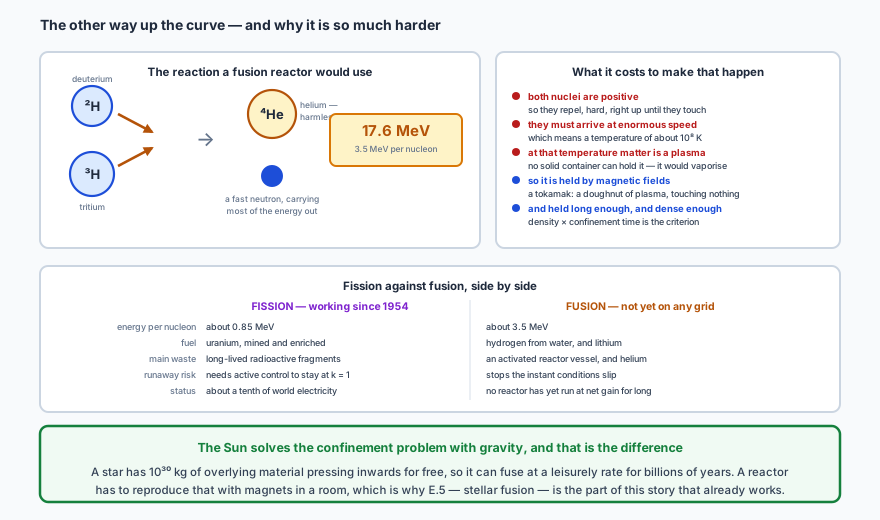
Both nuclei are positively charged, so they repel until they are close enough for the strong force to take over — about \( 10^{-15} \) m. Getting there needs kinetic energies corresponding to temperatures around \( 10^{8} \) K. At those temperatures matter is a fully ionised plasma, and no material container can hold it: contact would both vaporise the wall and quench the plasma. So it is confined by magnetic fields instead, in a torus — a tokamak — where the charged particles spiral along field lines and never touch anything (the physics of D.3).
The remaining condition is that the plasma must be held long enough and densely enough for the reactions to release more energy than went into heating it. Density and confinement time trade off against each other, and no device has yet run at sustained net gain. Which is the honest status of fusion power: the physics is settled, the engineering is not.
Stars, of course, solve the confinement problem for free. A star has \( 10^{30} \) kg of overlying material pressing inwards under gravity, so it can hold a plasma at fusion conditions for billions of years without any magnets at all — which is where E.5 picks the story up.
📝Practise
Work through these, then reveal the answer. Each question targets a different objective from the list above.
1. A uranium-235 nucleus absorbs a neutron and splits, giving barium-144, three neutrons and one other fragment. Identify it, and write the complete equation.
Proton number: \( 92 + 0 = 92 \) on the left. Barium is \( Z = 56 \), so \( Z = 92 - 56 = 36 \), which is krypton. \[ ^{235}_{\ 92}\text{U} + ^{1}_{0}\text{n} \rightarrow\ ^{144}_{\ 56}\text{Ba} + ^{89}_{36}\text{Kr} + 3\,^{1}_{0}\text{n} \] Check both sums: \( 144 + 89 + 3 = 236 \) and \( 56 + 36 = 92 \).
2. Explain why the neutrons produced by fission must be slowed down before they can sustain a chain reaction, and name a suitable material for doing it.
3. Define critical mass, and explain why a critical mass exists at all.
4. State the function of the moderator and of the control rods in a reactor, and explain why they must be made of different materials.
The control rods absorb neutrons and remove them from the chain, so raising and lowering them sets \(k\) and therefore the power. They must be made of a strong neutron absorber — boron or cadmium.
The two jobs are opposite, which is why the materials must be different: a moderator that absorbed neutrons would stop the reaction it exists to sustain.
5. A compound nucleus of 236 nucleons with a binding energy per nucleon of 7.6 MeV splits into two fragments with 234 nucleons between them, at 8.4 MeV per nucleon. Estimate the energy released.
Binding energy after: \( 234 \times 8.4 = 1966 \) MeV (the two free neutrons have no binding energy).
Energy released: \( 1966 - 1794 = 172 \approx 1.7 \times 10^{2} \) MeV.
The binding energy has increased, and that increase is what is released — the products are more tightly bound than the parent, which is exactly what moving up the binding-energy curve means.
6. A reactor delivers 500 MW of electrical power at an efficiency of 35%. Each fission releases 200 MeV. Find the number of fissions per second and the mass of U-235 used per year.
Energy per fission: \( 200 \times 10^{6} \times 1.60 \times 10^{-19} = 3.2 \times 10^{-11} \) J.
Rate: \( (1.43 \times 10^{9})/(3.2 \times 10^{-11}) = 4.5 \times 10^{19} \) fissions per second.
In a year (\( 3.16 \times 10^{7} \) s) that is \( 1.4 \times 10^{27} \) fissions, so \[ m = \frac{1.4 \times 10^{27}}{6.02 \times 10^{23}} \times 235 \approx 5.5 \times 10^{5}\ \text{g} = 5.5 \times 10^{2}\ \text{kg} \] About half a tonne of U-235 a year. Watch the efficiency: forgetting to divide by 0.35 understates the fuel by a factor of three.
7. Explain why the fragments produced by fission are radioactive, and state which type of decay they undergo.
8. A student claims that a nuclear power station could explode like a nuclear weapon. Explain why this is not possible.
9. State two conditions that must be met for nuclear fusion to occur in a reactor, and explain why each is necessary.
Sufficient density, maintained for long enough: fusion is a two-body collision process, so the reaction rate depends on how many nuclei are packed together and how long they are held there. The product of density and confinement time must exceed a threshold, or the energy released never exceeds the energy spent heating the plasma.
A third point worth adding: at those temperatures the fuel is a plasma that no material can contain, so it must be confined by magnetic fields — in a tokamak — or, in a star, by gravity.
10. Compare the energy released per nucleon in the fusion reaction \( ^{2}_{1}\text{H} + ^{3}_{1}\text{H} \rightarrow\ ^{4}_{2}\text{He} + ^{1}_{0}\text{n} \), which releases 17.6 MeV, with that of a fission releasing 200 MeV from 236 nucleons. Comment on the result.
Fission: \( 200/236 = 0.85 \) MeV per nucleon.
Fusion releases about four times as much energy per nucleon. This follows directly from the binding-energy-per-nucleon curve: the climb from hydrogen to helium is enormously steeper than the shallow descent from uranium down towards the middle of the curve. So although one fission event releases far more energy than one fusion event, fusion is much the better use of a given mass of fuel — and its fuel is deuterium from ordinary water rather than mined and enriched uranium.
🔗Go deeper — other people’s work
These are external resources, not mine. If one stops working, tell me and everything above it on this page still stands.
- HyperPhysics — nuclear binding energy and fission
- The Physics Hypertextbook — nuclear energy