Electrochemistry
🎯What you need to be able to do
- Predict the products of electrolysis from the state of the electrolyte, electrode potentials and concentration.
- Use F = Le and Q = It to calculate charge, and the mass or volume of substance liberated; describe how electrolysis can determine the Avogadro constant.
- Define standard electrode potential and standard cell potential, and describe the standard hydrogen electrode.
- Describe how to measure E⦵ for a metal or non-metal and its ions, and for ions of the same element in two oxidation states.
- Calculate E⦵cell, deduce electrode polarity and electron flow, predict feasibility, rank oxidising and reducing agents, and build redox equations from half-equations.
- Predict, qualitatively and with the Nernst equation, how E changes with concentration.
- Use ΔG⦵ = −nE⦵cellF.
📚The chemistry
24.1 Electrolysis
In electrolysis, an electric current drives a non-spontaneous redox reaction. Positive ions (cations) move to the cathode (negative electrode) and are reduced; negative ions (anions) move to the anode (positive electrode) and are oxidised.
Predicting the products
Molten compounds contain only their own ions, so the metal forms at the cathode and the non-metal at the anode: molten PbBr2 gives lead and bromine.
Aqueous solutions also contain water, which can be reduced to hydrogen or oxidised to oxygen instead. Which species reacts depends on electrode potentials and concentration:
- At the cathode: the species most easily reduced — the one with the most positive E⦵ — is reduced. Ions of metals below hydrogen (Cu2+, +0.34 V; Ag+, +0.80 V) are reduced to the metal. Ions of reactive metals (Na+, −2.71 V; Mg2+; Al3+) are not; water is reduced instead, giving hydrogen: 2H2O + 2e− → H2 + 2OH−.
- At the anode (inert electrodes): sulfate and nitrate are not oxidised, so water is, giving oxygen: 2H2O → O2 + 4H+ + 4e−. Halide ions are oxidised to the halogen when they are reasonably concentrated.
- Concentration can change the outcome. Concentrated aqueous NaCl gives chlorine at the anode; very dilute NaCl gives mostly oxygen. The Cl2/Cl− (+1.36 V) and O2/H2O (+1.23 V) potentials are close, so a high [Cl−] tips the balance towards chlorine.
Quantities: Q = It and F = Le
Q is charge in coulombs, I current in amps, t time in seconds. The Faraday constant, F = 9.65 × 10⁴ C mol−1, is the charge on one mole of electrons, which is why it equals the Avogadro constant times the charge on one electron.
To find the amount of product: charge → moles of electrons (÷ F) → moles of product (÷ electrons in the half-equation) → mass or volume. Cu2+ + 2e− → Cu needs 2 mol of electrons per mole of copper; Ag+ + e− → Ag needs 1; the oxygen half-equation needs 4 per mole of O2.
Determining the Avogadro constant
Electrolyse copper(II) sulfate solution using copper electrodes, with a variable resistor and an ammeter in series. Weigh the cathode (clean, dry) before and after, pass a constant, measured current for a measured time, and reweigh.
- Charge passed: Q = It.
- Number of electrons: Q ÷ e (charge on one electron, 1.60 × 10⁻¹⁹ C).
- Moles of electrons: 2 × (mass gained ÷ 63.5).
- L = number of electrons ÷ moles of electrons.
The anode loses copper as the cathode gains it; either mass change can be used, and the cathode gain is usually more reliable (the anode can shed loose copper).
24.2 Electrode potentials
Definitions and the hydrogen electrode
A metal dipped in a solution of its ions sets up an equilibrium, and a potential difference, that cannot be measured on its own. So every half-cell is measured against a reference: the standard hydrogen electrode, defined as 0.00 V.
- Standard hydrogen electrode: hydrogen gas at 101 kPa bubbling over a platinum electrode (coated with platinum black, which catalyses the equilibrium) in a solution with [H+] = 1.00 mol dm−3, at 298 K. 2H+(aq) + 2e− ⇌ H2(g).
- Standard electrode (reduction) potential, E⦵: the potential of a half-cell relative to the standard hydrogen electrode, under standard conditions (298 K, 101 kPa, all ion concentrations 1.00 mol dm−3). Always written as a reduction.
- Standard cell potential, E⦵cell: the potential difference between two half-cells under standard conditions.
Measuring E⦵
- A metal and its ions: the metal dipped in a 1.00 mol dm−3 solution of its ions, e.g. Cu in Cu2+(aq).
- A non-metal and its ions: the gas bubbled over a platinum electrode in a 1.00 mol dm−3 solution of the ions, e.g. Cl2 over Pt in Cl−(aq) — like the hydrogen electrode.
- Ions of one element in two oxidation states: a platinum electrode in a solution containing both ions at 1.00 mol dm−3, e.g. Fe3+ and Fe2+. Platinum is inert and simply conducts electrons.
Connect the half-cell to a standard hydrogen electrode with a salt bridge (filter paper soaked in saturated KNO3, which completes the circuit by allowing ions to move without the solutions mixing) and a high-resistance voltmeter (so that almost no current flows and the concentrations do not change during the measurement).
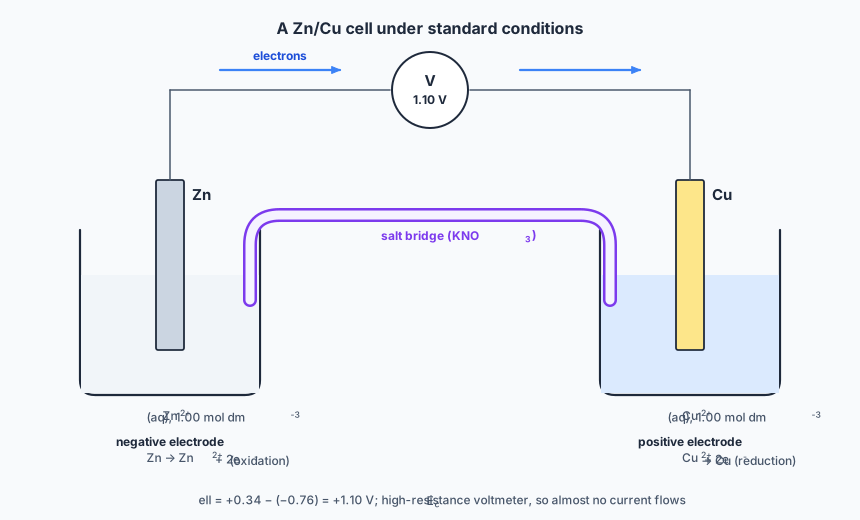
Using E⦵ values
The more positive E⦵, the more readily the species on the left of the half-equation is reduced: the stronger an oxidising agent it is. The more negative, the more readily the species on the right is oxidised: the stronger a reducing agent. F2 (+2.87 V) is the strongest oxidising agent in the data section; Li (−3.04 V) the strongest reducing agent.
- Polarity: the half-cell with the more positive E⦵ is the positive electrode, where reduction happens. Electrons flow in the external circuit from the negative electrode to the positive one.
- Feasibility: a redox reaction is feasible under standard conditions if E⦵cell for it is positive — that is, if the species being reduced has the more positive E⦵. A feasible reaction may still be too slow to observe (high activation energy), and non-standard concentrations can change the answer.
- Building the equation: write the half-equation with the more positive E⦵ as a reduction, reverse the other, multiply so the electrons cancel, and add. Never multiply the E⦵ values.
Concentration and the Nernst equation
Qualitatively, apply Le Chatelier to the reduction equilibrium: increasing the concentration of the oxidised species (the left side, e.g. Cu2+) shifts it to the right, making E more positive; decreasing it makes E more negative.
Quantitatively, the Nernst equation (at 298 K):
z is the number of electrons in the half-equation. For a metal/ion half-cell, the reduced species is the solid metal, whose “concentration” is taken as 1, so for Cu2+ + 2e− ⇌ Cu: E = 0.34 + (0.059/2) log[Cu2+]. For Fe3+ + e− ⇌ Fe2+, both ions appear: E = 0.77 + 0.059 log([Fe3+]/[Fe2+]).
Linking to free energy
n is the number of moles of electrons transferred in the balanced equation. A positive E⦵cell gives a negative ΔG⦵ — the same feasibility test as in topic 23, reached a different way. The answer comes out in J mol−1; divide by 1000 for kJ.
✏️Worked example
(a)
Copper has the more positive E⦵, so the copper electrode is positive. Electrons flow through the external wire from zinc to copper.
(b) Cu2+ is reduced; Zn is oxidised:
(c)
Diluting the Cu2+ makes the copper electrode less positive, so the cell potential falls, as Le Chatelier predicts.
(d)
📝Practise
Work through these, then reveal the answer. Each question targets a different objective from the list above.
1. Predict the products at each electrode when these are electrolysed with inert electrodes: (a) molten sodium chloride; (b) concentrated aqueous sodium chloride; (c) aqueous copper(II) sulfate.
2. In an experiment to determine the Avogadro constant, a current of 0.200 A was passed for 40.0 minutes and the copper cathode gained 0.158 g. Calculate L. [e = 1.60 × 10⁻¹⁹ C; Ar Cu 63.5]
3. Describe the standard hydrogen electrode, and explain why platinum is used.
4. Use E⦵ values to decide whether Fe3+ ions can oxidise I− ions. Write the equation and calculate ΔG⦵. [Fe3+/Fe2+ +0.77 V; I2/I− +0.54 V]
5. Calculate the electrode potential of a platinum electrode in a solution containing 0.100 mol dm−3 Fe3+ and 0.0100 mol dm−3 Fe2+.
6. Using E⦵ values, arrange Cl2, Br2, I2 and acidified MnO4− in order of oxidising power, and predict whether acidified manganate(VII) can oxidise chloride ions. [MnO4−/Mn2+ +1.52; Cl2/Cl− +1.36; Br2/Br− +1.07; I2/I− +0.54 V]
🔗Go deeper — other people’s work
These are external resources, not mine. If one stops working, tell me and everything above it on this page still stands.
- Chemguide (Jim Clark) — the redox equilibria pages, including electrode potentials and the electrochemical series
- PhET — simulations of electrochemical cells, for electron and ion flow
- Royal Society of Chemistry — practical guide for measuring cell potentials with a salt bridge