Equilibria
🎯What you need to be able to do
- Explain reversible reactions and dynamic equilibrium, and why a closed system is needed.
- State Le Chatelier’s principle and use it to predict the effect of temperature, concentration, pressure and a catalyst on the position of equilibrium.
- Write expressions for Kc and, using mole fractions and partial pressures, for Kp; calculate them, including their units, and calculate equilibrium amounts.
- State which changes alter the value of an equilibrium constant.
- Describe and explain the conditions of the Haber process and the Contact process.
- Name and give the formulas of the common acids and alkalis, and describe the Brønsted–Lowry theory.
- Distinguish strong and weak acids and bases by dissociation, and by their pH, conductivity and reactions.
- Describe neutralisation and salt formation, sketch pH titration curves for all four strong/weak combinations, and choose a suitable indicator.
📚The chemistry
7.1 Chemical equilibria
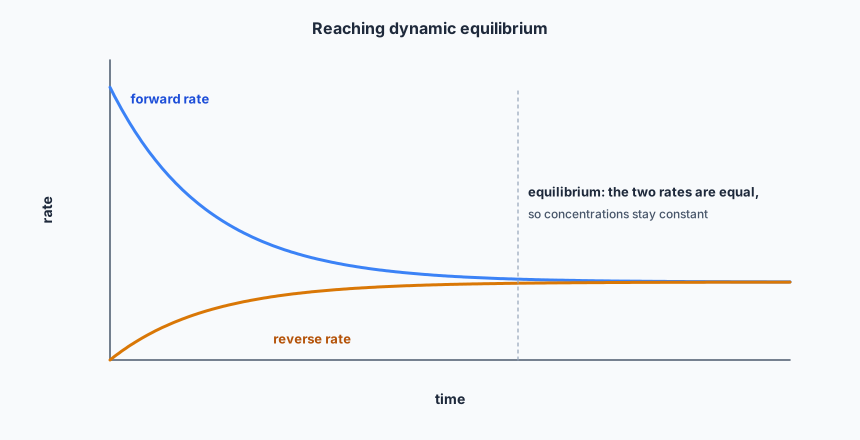
A reversible reaction can go both ways: products can react to re-form the reactants. The double-harpoon ⇌ shows it. Start with only reactants, and the forward reaction is fast at first and slows as they are used up; the reverse reaction starts at zero and speeds up as products build up. Eventually the two rates are equal.
That state is dynamic equilibrium: the rates of the forward and reverse reactions are equal, so the concentrations of reactants and products stay constant. It is dynamic because both reactions are still happening — molecules keep converting both ways — but no overall change can be seen. It needs a closed system, one that no substance can enter or leave: if a gaseous product escapes, the reverse reaction cannot keep pace and the reaction goes to completion instead.
Constant concentrations do not mean equal concentrations. The equilibrium mixture may be almost all products or almost all reactants; that balance is called the position of equilibrium.
Le Chatelier’s principle
If a change is made to a system at dynamic equilibrium, the position of equilibrium moves to minimise that change. Applied to each kind of change:
- Concentration. Add a reactant and the position moves to the right, using some of it up. Remove a product and it also moves right, to replace it.
- Pressure (reactions involving gases). Increase the pressure and the position moves to the side with fewer gas molecules, which reduces the pressure. If both sides have the same number of gas molecules, as in H2 + I2 ⇌ 2HI, pressure has no effect on the position.
- Temperature. Increase the temperature and the position moves in the endothermic direction, which absorbs heat. Decrease it and the position moves in the exothermic direction. The sign of ΔH is quoted for the forward reaction.
- Catalyst. A catalyst speeds up the forward and reverse reactions equally, so it has no effect on the position. Equilibrium is simply reached sooner.
Kc
For a general reaction aA + bB ⇌ cC + dD, the equilibrium constant in terms of concentrations is
Square brackets mean equilibrium concentration in mol dm−3; products go on top; each is raised to the power of its coefficient in the equation. Units are worked out by cancelling: for N2 + 3H2 ⇌ 2NH3, (mol dm−3)2 / (mol dm−3)4 = mol−2 dm6. When the powers cancel completely, as for H2 + I2 ⇌ 2HI, Kc has no units.
A large K means the equilibrium lies to the right (mostly products); a small K means it lies to the left.
Mole fractions, partial pressures and Kp
For gases it is often more natural to use pressures. In a mixture of gases, the mole fraction of a gas is its share of the total moles, and its partial pressure is the pressure it would exert on its own — its share of the total pressure:
The mole fractions add up to 1, and the partial pressures add up to the total pressure. The equilibrium constant in terms of partial pressures has the same shape as Kc:
Only gases appear in Kp. Its units come from the pressure unit used (Pa, kPa or atm), cancelled in the same way. You do not need the relationship between Kp and Kc, and calculations will never need a quadratic equation.
Calculating equilibrium amounts
Most calculations follow one layout. Write three rows under the equation: initial moles, change (in the ratio of the equation), and equilibrium moles. Then convert equilibrium moles into what the expression needs — concentrations (divide by volume) for Kc, partial pressures (mole fraction × total pressure) for Kp — and substitute.
What changes the value of K
This is examined as a statement, and it is simple: only temperature changes the value of an equilibrium constant. Changing a concentration or pressure moves the position, but the system re-settles with the same K. A catalyst changes neither the position nor K. For an exothermic forward reaction, raising the temperature decreases K; for an endothermic one it increases K.
Equilibria in industry
The Haber process makes ammonia:
- Pressure about 20 000 kPa (200 atm). Four gas molecules become two, so high pressure moves the position right and also increases the rate. Higher still would give more ammonia, but the cost of compressors and thick-walled plant, and the safety risk, outweigh the gain.
- Temperature about 450 °C. The forward reaction is exothermic, so a low temperature would give a higher yield — but the rate would be far too slow. The temperature is a compromise between yield and rate.
- Iron catalyst to increase the rate. It does not change the yield.
- Unreacted nitrogen and hydrogen are recycled, so although only about 15% is converted on each pass, almost all of it becomes ammonia in the end.
The Contact process makes sulfuric acid; its key step is
- Temperature about 450 °C — the same yield-against-rate compromise for an exothermic reaction.
- Pressure only slightly above atmospheric (about 100–200 kPa). Three gas molecules become two, so high pressure would help, but the conversion is already very high (over 99% after several passes over the catalyst), so the expense is not worth it.
- Vanadium(V) oxide, V2O5, catalyst.
- Excess air (oxygen) moves the position right and makes the most of the more valuable SO2.
7.2 Acids and bases
The acids and alkalis you must know: hydrochloric acid, HCl; sulfuric acid, H2SO4; nitric acid, HNO3; ethanoic acid, CH3COOH; sodium hydroxide, NaOH; potassium hydroxide, KOH; ammonia, NH3.
Brønsted–Lowry theory
A Brønsted–Lowry acid is a proton (H+) donor; a base is a proton acceptor. An acid can only behave as an acid if something accepts its proton, so every acid–base reaction is a proton transfer:
In the first, water is a base; in the second, it is an acid. Water can do both.
Strong and weak
A strong acid is fully dissociated into ions in aqueous solution (HCl, HNO3, H2SO4). A weak acid is only partially dissociated — an equilibrium lies well to the left:
Strong bases (NaOH, KOH) are fully dissociated; ammonia is a weak base. “Strong” describes the extent of dissociation, not the concentration — a dilute solution of a strong acid is still a strong acid.
Water has a pH of 7; acidic solutions are below 7 and alkaline solutions above. Compare solutions of the same concentration, say 0.10 mol dm−3, and a weak acid has a lower [H+] than a strong one, which shows up three ways:
- Higher pH, measured with a pH meter or universal indicator: about 2.9 for ethanoic acid against 1.0 for hydrochloric acid.
- Lower electrical conductivity, because there are fewer ions.
- Slower reaction with a reactive metal such as magnesium, or with a carbonate: fewer bubbles per second. The total volume of hydrogen is the same, because as H+ is used up the weak acid keeps dissociating until all of it has reacted.
Neutralisation, titration curves and indicators
Neutralisation is H+(aq) + OH−(aq) → H2O(l), and it forms a salt from the remaining ions: NaOH + HCl gives NaCl, 2KOH + H2SO4 gives K2SO4, NH3 + HNO3 gives NH4NO3.
A pH titration curve plots pH against the volume of alkali added to an acid (or the reverse). Every curve has a steep, near-vertical section at the equivalence point, where a tiny volume changes the pH sharply. What differs is where that section starts and stops:
- Strong acid, strong alkali — starts near pH 1, vertical section from about pH 3 to 11, equivalence at pH 7.
- Weak acid, strong alkali — starts higher (about pH 3), rises gently, then a shorter vertical section from about pH 7 to 11; equivalence above 7 (about 9).
- Strong acid, weak alkali — vertical section from about pH 3 to 7; equivalence below 7 (about 5); finishes lower (about pH 11).
- Weak acid, weak alkali — no vertical section, just a gradual change in slope around pH 7.
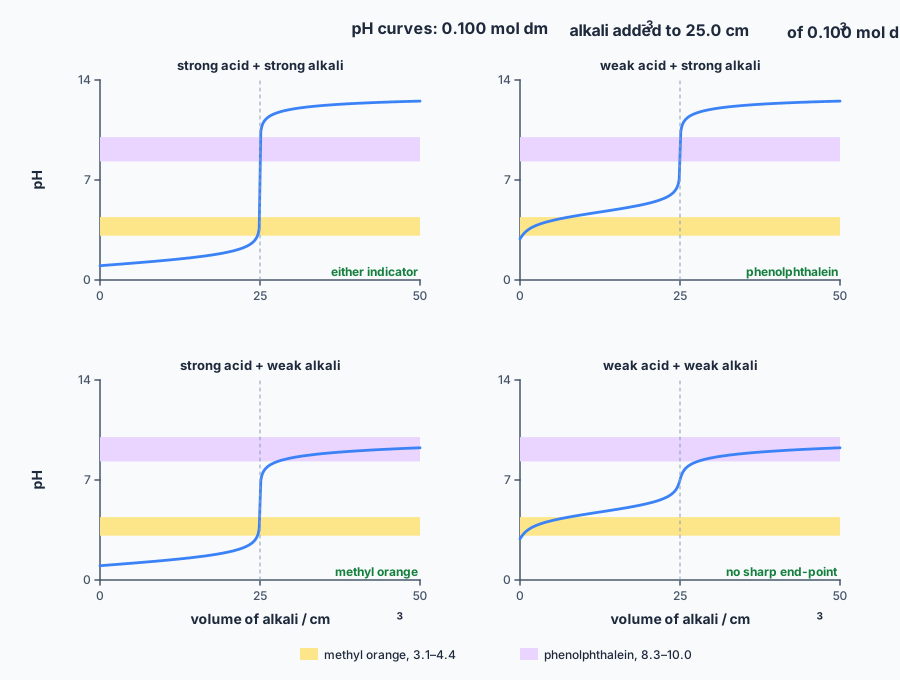
An indicator is suitable if its colour-change range lies entirely within the vertical section, because then a single drop takes it right through its change. The question will give you the ranges; for example methyl orange changes over about 3.1–4.4 and phenolphthalein over about 8.3–10.0. So:
- strong acid + strong alkali: either indicator;
- weak acid + strong alkali: phenolphthalein;
- strong acid + weak alkali: methyl orange;
- weak acid + weak alkali: no indicator gives a sharp end-point — use a pH meter.
✏️Worked example
(a) Build the table. 1.80 mol of SO3 formed, so by the 2 : 1 : 2 ratio 1.80 mol of SO2 and 0.90 mol of O2 were used.
Partial pressure = mole fraction × 200 kPa:
They add up to 200 kPa, as they must.
(b)
Units: kPa2 / (kPa2 × kPa) = kPa−1. (Full calculator values were carried through; rounding the partial pressures first would shift the third figure.)
(c)(i) No change. Increasing the pressure moves the position of equilibrium to the right, towards fewer gas molecules, but the mixture re-settles with the same value of Kp; only temperature changes an equilibrium constant. (ii) The forward reaction is exothermic, so raising the temperature moves the position to the left (the endothermic direction). There is less SO3 and more SO2 and O2 at equilibrium, so Kp decreases.
📝Practise
Work through these, then reveal the answer. Each question targets a different objective from the list above.
1. Explain what is meant by dynamic equilibrium, and why the reaction CaCO3(s) ⇌ CaO(s) + CO2(g) only reaches equilibrium in a closed container.
2. For 2NO2(g) ⇌ N2O4(g), ΔH = −57 kJ mol−1, brown NO2 is in equilibrium with colourless N2O4. Predict and explain what you would see if the mixture is (a) cooled; (b) compressed at constant temperature.
3. 1.00 mol of ethanoic acid and 1.00 mol of ethanol are mixed and left to reach equilibrium: CH3COOH + C2H5OH ⇌ CH3COOC2H5 + H2O. At equilibrium, 0.667 mol of ester is present. Calculate Kc.
4. 1.00 mol of H2 and 1.00 mol of I2 are sealed in a 1.00 dm3 flask. At the temperature used, Kc = 49 for H2 + I2 ⇌ 2HI. Calculate the equilibrium amount of HI.
5. Solutions of hydrochloric acid and ethanoic acid are both 0.10 mol dm−3. Describe three observations that would distinguish them, and explain the difference.
6. Sketch the titration curve for adding 0.10 mol dm−3 NaOH to 25.0 cm3 of 0.10 mol dm−3 CH3COOH, and choose between methyl orange (3.1–4.4) and phenolphthalein (8.3–10.0).
🔗Go deeper — other people’s work
These are external resources, not mine. If one stops working, tell me and everything above it on this page still stands.
- PhET — Reversible Reactions and Acid-Base Solutions, for dynamic equilibrium and strong versus weak acids at the particle level
- Chemguide (Jim Clark) — the equilibria and acid–base sections, including a page of titration curves drawn out for every combination
- Royal Society of Chemistry — resources on the Haber and Contact processes in industry