An introduction to A Level organic chemistry
🎯What you need to be able to do
- Recognise the A Level functional groups — arene, halogenoarene, phenol, acyl chloride, secondary and tertiary amines, amides and amino acids — and use their formulas.
- Name aliphatic compounds (including single rings up to six carbons) and simple aromatic compounds such as 3-nitrobenzoic acid and 2,4,6-tribromophenol.
- Use the terms electrophilic substitution and addition–elimination.
- Describe and explain the shape of benzene in terms of sp2 hybridisation, σ bonds and a delocalised π system.
- Describe the properties of enantiomers, plane-polarised light, optical activity and racemic mixtures, and explain why chirality matters in making drugs.
📚The chemistry
AS organic chemistry (topic 13) was almost entirely about chains. A Level adds the benzene ring, and with it a new kind of bonding and a new mechanism, plus a family of nitrogen compounds and the acyl chlorides. This page sets out the new vocabulary; topics 30–37 use it.
29.1 The new functional groups
A benzene ring is drawn as a hexagon with a circle inside, representing the delocalised electrons. A displayed formula is not expected for the ring itself.
Naming
- Cyclic compounds take cyclo-: cyclohexane, cyclohexanol, cyclopentene.
- Aromatic compounds are usually named as substituted benzenes: chlorobenzene, nitrobenzene, methylbenzene, ethylbenzene. Some have their own parent names: phenol (C6H5OH), benzoic acid (C6H5COOH), phenylamine (C6H5NH2).
- Numbering the ring: the carbon carrying the parent group is carbon 1; number round the ring to give the other substituents the lowest numbers. So 3-nitrobenzoic acid has the NO2 on the third carbon from the COOH; 2,4,6-tribromophenol has Br on both carbons next to the OH and on the one opposite.
- When the ring is a substituent, it is phenyl, C6H5–: phenylethanone (C6H5COCH3), phenyl ethanoate.
- Amides are named from the acid: CH3CONH2 is ethanamide; up to six carbons plus six on nitrogen.
29.2 Two new mechanism types
- Electrophilic substitution — the typical reaction of arenes. An electrophile attacks the electron-rich ring, and an H atom on the ring is replaced, so the ring keeps its delocalised system (topic 30).
- Addition–elimination — the typical reaction of acyl chlorides. A nucleophile adds to the δ+ carbonyl carbon, then HCl is eliminated, re-forming C=O (topic 33).
29.3 The structure of benzene
Benzene, C6H6, is a planar, regular hexagon of carbon atoms with a hydrogen on each, all bond angles 120°.
- Each carbon is sp2 hybridised: three sp2 orbitals form σ bonds to two neighbouring carbons and one hydrogen, all in one plane.
- Each carbon has one remaining p orbital, at right angles to the plane. The six p orbitals overlap sideways all round the ring, forming a delocalised π system: rings of electron density above and below the plane, shared by all six carbons.
- So all six C–C bonds are identical, with a length (0.139 nm) between that of a single bond (0.154 nm) and a double bond (0.134 nm). There are no alternating single and double bonds.
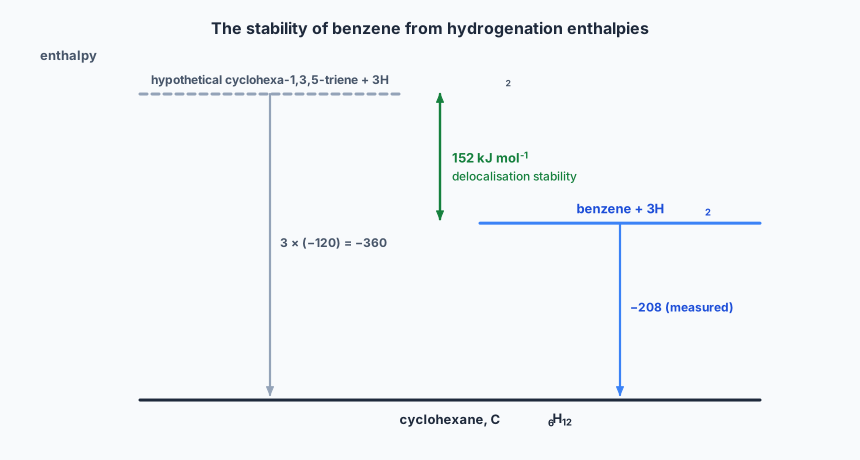
Delocalisation makes benzene much more stable than a hypothetical “cyclohexa-1,3,5-triene” with three separate C=C bonds. This extra stability is why benzene reacts by substitution, which keeps the ring intact, rather than by addition like alkenes (see the worked example).
29.4 Optical isomerism
You met chiral centres and enantiomers at AS. At A Level you need what makes enantiomers different, and why it matters.
- Two enantiomers have identical physical and chemical properties — the same melting point, boiling point, solubility and reactions with ordinary (non-chiral) reagents — except for two things: their effect on plane-polarised light, and their biological activity.
- Plane-polarised light vibrates in a single plane. Each enantiomer rotates the plane by the same angle in opposite directions, one clockwise and one anticlockwise. A substance that rotates the plane is optically active.
- A racemic mixture contains equal amounts of the two enantiomers. Their rotations cancel, so it is not optically active. Reactions that create a chiral centre from a planar starting material (like HCN adding to an aldehyde, topic 17) give racemic mixtures.
Chirality and drugs
Receptors and enzymes in the body are themselves chiral, so the two enantiomers of a drug can fit them differently — like a left hand in a right glove:
- Different biological activity: one enantiomer may be the active drug, while the other is inactive or has harmful side effects. The notorious example is thalidomide, one of whose enantiomers caused birth defects.
- Separating a racemic mixture into the pure enantiomers is difficult and expensive, because they have the same physical properties, and it wastes half the product.
- Chiral catalysts (often enzymes, or synthetic catalysts that are themselves a single enantiomer) can make only the wanted optical isomer, avoiding the separation, halving the waste and reducing side effects. The dose can be smaller too.
✏️Worked example
(a) Three C=C bonds, each releasing 120 kJ mol−1 on hydrogenation: 3 × (−120) = −360 kJ mol−1.
(b) Benzene releases only 208 kJ mol−1, which is 360 − 208 = 152 kJ mol−1 less. So benzene is 152 kJ mol−1 more stable (lower in energy) than a structure with three localised double bonds. This extra stability comes from the delocalised π system. An addition reaction would use up π electrons and destroy the delocalisation, losing that stability; substitution replaces an H atom and keeps the delocalised ring intact. So substitution is energetically favoured.
(c) The parent is benzoic acid (COOH on carbon 1), with nitro groups at 3 and 5: 3,5-dinitrobenzoic acid.
📝Practise
Work through these, then reveal the answer. Each question targets a different objective from the list above.
1. Name: (a) C6H5CH2CH3; (b) CH3CH2COCl; (c) CH3CH2CONH2; (d) a benzene ring with OH at C1 and Cl at C4.
2. Describe the bonding in benzene in terms of σ and π bonds.
3. How do the two enantiomers of a chiral compound differ, and how are they the same?
4. Explain why a racemic mixture has no effect on plane-polarised light.
5. Give two reasons why drug manufacturers try to make only one enantiomer of a chiral drug, and one way of doing so.
6. Classify each as electrophilic substitution, addition–elimination, electrophilic addition or nucleophilic substitution: (a) benzene + nitronium ion; (b) ethanoyl chloride + ethanol; (c) ethene + bromine; (d) bromoethane + hydroxide ion.
🔗Go deeper — other people’s work
These are external resources, not mine. If one stops working, tell me and everything above it on this page still stands.
- Chemguide (Jim Clark) — the pages on the structure of benzene and on optical isomerism
- ChemTube3D (University of Liverpool) — the benzene π system in 3D