Reaction kinetics
🎯What you need to be able to do
- Explain and use rate equation, order, overall order, rate constant, half-life, rate-determining step and intermediate.
- Use rate = k[A]m[B]n with orders 0, 1 or 2; deduce orders from concentration–time graphs, initial rates and half-lives; interpret rate–concentration graphs; construct a rate equation.
- Show that the half-life of a first-order reaction is constant, and use k = 0.693/t½.
- Calculate k from initial rates or half-life, with units.
- Link a multi-step mechanism to its rate equation: suggest a consistent mechanism, predict the order, and identify the rate-determining step, intermediates and catalysts.
- Describe how temperature affects the rate constant.
- Describe how heterogeneous catalysts (adsorption, bond weakening, desorption) and homogeneous catalysts (used then reformed) work, with the named examples.
📚The chemistry
26.1 Rate equations
The rate equation links the rate of a reaction to the concentrations of the reactants:
- m and n are the orders of reaction with respect to A and B — in this syllabus 0, 1 or 2. The overall order is m + n.
- k is the rate constant. It is constant at a fixed temperature, and it increases with temperature (more particles with energy ≥ Ea), which is how temperature raises the rate.
- Orders are found by experiment. They are not the coefficients in the balanced equation, except by coincidence.
What an order means: zero order in A — changing [A] has no effect on the rate; first order — doubling [A] doubles the rate; second order — doubling [A] quadruples the rate.
Units of k
Rearrange the rate equation and cancel. Rate is mol dm−3 s−1:
Finding orders from graphs
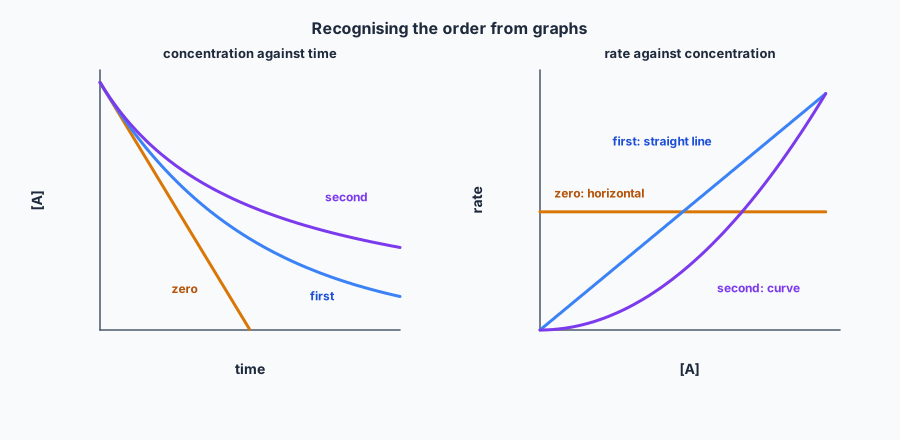
Concentration–time graphs (concentration of a reactant against time):
- Zero order: a straight line sloping down — constant rate until the reactant runs out.
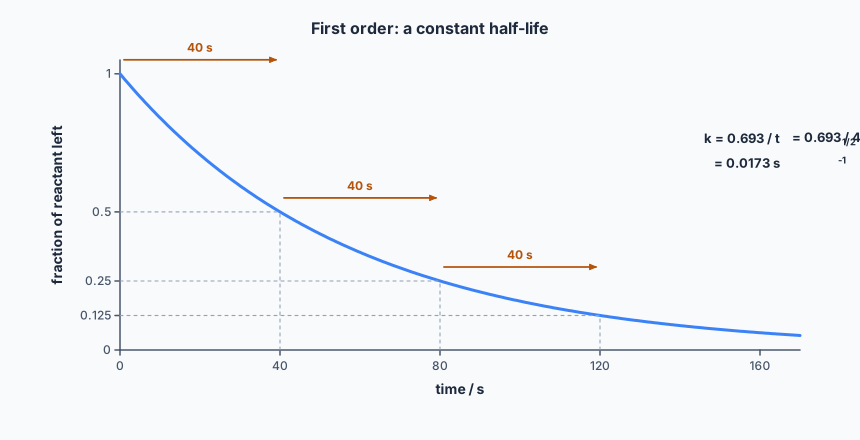
- First order: a curve with a constant half-life — the concentration halves in the same time whatever it starts at.
- Second order: a curve that is steep at first and levels off more, with successive half-lives getting longer.
Rate–concentration graphs (rate against concentration of one reactant):
- Zero order: a horizontal line.
- First order: a straight line through the origin; its gradient is k (if only one reactant is varied and others are constant).
- Second order: an upward curve through the origin (a parabola).
To get a rate from a concentration–time curve, draw a tangent and measure its gradient; the tangent at t = 0 gives the initial rate.
The initial rates method
Run the reaction several times, changing the starting concentration of one reactant at a time while keeping the others constant, and measure the initial rate each time. Compare pairs of experiments in which only one concentration changes: the factor by which the rate changes, compared with the factor by which the concentration changed, gives the order.
Half-life
The half-life, t½, is the time for the concentration of a reactant to fall to half its value. For a first-order reaction it is independent of the starting concentration — the defining feature of first order — and linked to k by
(0.693 is ln 2.) Measure two or three successive half-lives from a graph: if they are equal, the reaction is first order.
Mechanisms and the rate-determining step
Most reactions happen in several steps. The rate-determining step is the slowest step, and it controls the overall rate. The rate equation contains the species that take part in the rate-determining step (and in any steps before it), each to the power of the number of that species involved. Species that react only after the slow step do not appear in the rate equation — they are zero order.
- An intermediate is formed in one step and used up in a later one; it does not appear in the overall equation.
- A catalyst is used in one step and regenerated in a later one; it does not appear in the overall equation either, but it can appear in the rate equation.
The classic example is the SN1 hydrolysis of 2-bromo-2-methylpropane (topic 15): rate = k[(CH3)3CBr]. The OH− is zero order because it only reacts in the fast second step, after the slow ionisation. For primary halogenoalkanes (SN2), rate = k[RBr][OH−], because both are in the single step.
26.2 How catalysts work
Heterogeneous catalysts
The catalyst is in a different phase, usually a solid with gaseous reactants. Its action has three stages:
- Adsorption: reactant molecules form weak bonds to active sites on the catalyst surface. This holds them close together and in a favourable orientation.
- Bond weakening: bonding to the surface weakens bonds within the reactant molecules, lowering the activation energy, and the reaction takes place on the surface.
- Desorption: the product molecules break away from the surface, freeing the active sites for more reactant.
Examples: iron in the Haber process (N2 and H2 adsorb on iron, their bonds are weakened, NH3 desorbs); palladium, platinum and rhodium in catalytic converters, removing oxides of nitrogen (2CO + 2NO → 2CO2 + N2). A good catalyst adsorbs strongly enough to weaken bonds, but weakly enough for the products to desorb.
Homogeneous catalysts
The catalyst is in the same phase and works by being used in one step and reformed in a later step, providing a route with a lower activation energy. Two named examples:
- Oxides of nitrogen in the oxidation of atmospheric SO2 (topic 12): \[ \mathrm{SO_2 + NO_2 \rightarrow SO_3 + NO} \] \[ \mathrm{NO + \tfrac{1}{2}O_2 \rightarrow NO_2} \]
- Fe2+ or Fe3+ in the reaction of I− with S2O82−. The direct reaction, S2O82− + 2I− → 2SO42− + I2, is slow because both reactants are negative ions, which repel, giving a high activation energy. Iron ions provide a route in which every step is between oppositely charged ions: \[ \mathrm{S_2O_8^{2-} + 2Fe^{2+} \rightarrow 2SO_4^{2-} + 2Fe^{3+}} \] \[ \mathrm{2Fe^{3+} + 2I^{-} \rightarrow 2Fe^{2+} + I_2} \] Either Fe2+ or Fe3+ works, because each is regenerated in the other step. E⦵ values confirm both steps are feasible: +2.01 − 0.77 = +1.24 V and +0.77 − 0.54 = +0.23 V (topic 24).
✏️Worked example
Experiment 1: [A] 0.10, [B] 0.10 mol dm−3; rate 2.0 × 10⁻⁴ mol dm−3 s−1
Experiment 2: [A] 0.20, [B] 0.10; rate 8.0 × 10⁻⁴
Experiment 3: [A] 0.10, [B] 0.30; rate 6.0 × 10⁻⁴
(a) Deduce the order with respect to A and to B, and write the rate equation. (b) Calculate k, with units. (c) Predict the initial rate when [A] = 0.30 and [B] = 0.20 mol dm−3. (d) Suggest a two-step mechanism consistent with the rate equation and the overall equation.
(a) Experiments 1 and 2: [B] constant, [A] ×2, rate ×4 (8.0/2.0). 4 = 22, so second order in A. Experiments 1 and 3: [A] constant, [B] ×3, rate ×3, so first order in B.
(b) From experiment 1:
(c)
(d) The rate equation shows that two A and one B are involved up to and including the rate-determining step, and the overall equation also uses 2A + B. The simplest consistent mechanism has everything in the slow step, but three-particle collisions are unlikely, so a better one is a fast equilibrium followed by a slow step:
A2 is an intermediate. The steps add up to the overall equation, and the species reaching the slow step (2A via A2, plus B) match the orders.
📝Practise
Work through these, then reveal the answer. Each question targets a different objective from the list above.
1. A first-order reaction has a half-life of 40 s. Calculate k, and the fraction of reactant left after 120 s.
2. Sketch and describe the rate–concentration graphs for zero-, first- and second-order reactions.
3. The iodination of propanone, CH3COCH3 + I2 → CH3COCH2I + HI, catalysed by H+, has rate = k[CH3COCH3][H+]. What does this tell you about the mechanism?
4. Give the units of k for a reaction with rate = k[X][Y].
5. Describe how iron catalyses the reaction between nitrogen and hydrogen.
6. Explain why Fe2+ ions catalyse the reaction between peroxodisulfate ions and iodide ions, with equations.
🔗Go deeper — other people’s work
These are external resources, not mine. If one stops working, tell me and everything above it on this page still stands.
- Chemguide (Jim Clark) — the rate equations and orders pages, with the graph shapes for each order
- Royal Society of Chemistry — practical guides for the iodine clock and propanone iodination experiments