Chemical energetics
🎯What you need to be able to do
- Recognise exothermic (ΔH negative) and endothermic (ΔH positive) reactions, and draw and interpret reaction pathway diagrams showing ΔH and the activation energy.
- Define standard conditions and the standard enthalpy changes of reaction, formation, combustion and neutralisation.
- Explain enthalpy changes as the balance between breaking and making bonds, and calculate ΔHr from bond energies, knowing which values are exact and which are averages.
- Calculate enthalpy changes from experimental results using q = mcΔT and ΔH = −mcΔT/n.
- Apply Hess’s law to construct energy cycles and calculate enthalpy changes that cannot be measured directly, including from bond energy data.
📚The chemistry
5.1 Enthalpy change, ΔH
Enthalpy change, ΔH, is the heat energy transferred in a reaction at constant pressure. The sign is written from the point of view of the chemicals:
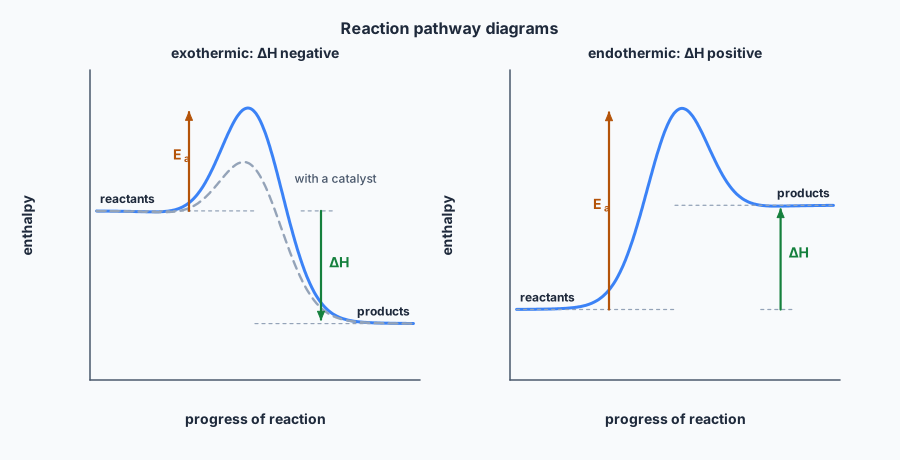
- Exothermic — energy is transferred to the surroundings; the products have less enthalpy than the reactants; ΔH is negative; the surroundings warm up. Combustion, neutralisation, respiration.
- Endothermic — energy is taken from the surroundings; the products have more enthalpy; ΔH is positive; the surroundings cool down. Thermal decomposition, photosynthesis, dissolving ammonium nitrate.
Reaction pathway diagrams
A reaction pathway diagram plots enthalpy against the progress of the reaction. Reactants and products are drawn as horizontal levels; the curve between them rises to a peak. Label two things:
- ΔH — an arrow from the reactant level to the product level (pointing down for exothermic, up for endothermic);
- the activation energy, Ea — an arrow from the reactant level up to the top of the peak. It is the minimum energy colliding particles must have to react.
Ea is always measured from the reactants, and is always positive, even for an exothermic reaction. A catalyst lowers the peak but leaves both levels, and so ΔH, unchanged.
Standard enthalpy changes
Enthalpy changes depend on conditions, so they are quoted under standard conditions, shown by the symbol ⦵: this syllabus takes those to be 298 K and 101 kPa, with every substance in its standard state (its normal physical state under those conditions) and solutions at 1 mol dm−3.
- Standard enthalpy change of reaction, ΔHr⦵ — the enthalpy change when the amounts shown in the equation react under standard conditions.
- Standard enthalpy change of formation, ΔHf⦵ — the enthalpy change when one mole of a compound is formed from its elements in their standard states under standard conditions. For water: H2(g) + ½O2(g) → H2O(l). The ΔHf of an element in its standard state is zero by definition.
- Standard enthalpy change of combustion, ΔHc⦵ — the enthalpy change when one mole of a substance is completely burned in oxygen under standard conditions. Always negative.
- Standard enthalpy change of neutralisation, ΔHneut⦵ — the enthalpy change when an acid and an alkali react to form one mole of water under standard conditions. For any strong acid with any strong alkali it is about −57 kJ mol−1, because the reaction is always H+ + OH− → H2O.
Notice what each definition fixes as “one mole”: the compound formed, the substance burned, the water formed. Fractions in equations such as ½O2 are therefore normal and correct.
Bond energies
Energy is transferred in reactions because bonds are broken and made. Breaking a bond needs energy (endothermic, ΔH positive); making a bond releases it (exothermic). If the bonds made are stronger than the bonds broken, the reaction is exothermic overall.
Some bond energies are exact and some are averages. The bond in H2 or HCl exists in only one molecule, so its energy has one value. A C–H bond, though, has a slightly different energy in methane, ethane and ethanol, depending on what else is attached; the data section gives an average over many compounds. The data section itself makes the distinction: diatomic molecules have exact values, polyatomic ones average values. So a ΔHr calculated from average bond energies is only approximate. It also assumes every substance is a gas, because bond energies are defined for the gaseous state.
Measuring enthalpy changes: calorimetry
Carry out the reaction in, or under, a known mass of water and measure its temperature change. The energy transferred to the water is
where m is the mass of water or solution being heated (in g, taking 1 cm3 of a dilute solution as 1 g), c = 4.18 J g−1 K−1 and ΔT is the temperature rise. Divide by the moles that reacted, and add the sign:
The minus sign is there because a temperature rise means the reaction released energy. Two standard set-ups:
- Reactions in solution (neutralisation, displacement, dissolving): mix in an insulated polystyrene cup with a lid. m is the total volume of the solutions.
- Combustion: burn a fuel in a spirit burner under a metal can of water; weigh the burner before and after. Heat losses to the air are large, so the value is always far less exothermic than the true one.
5.2 Hess’s law
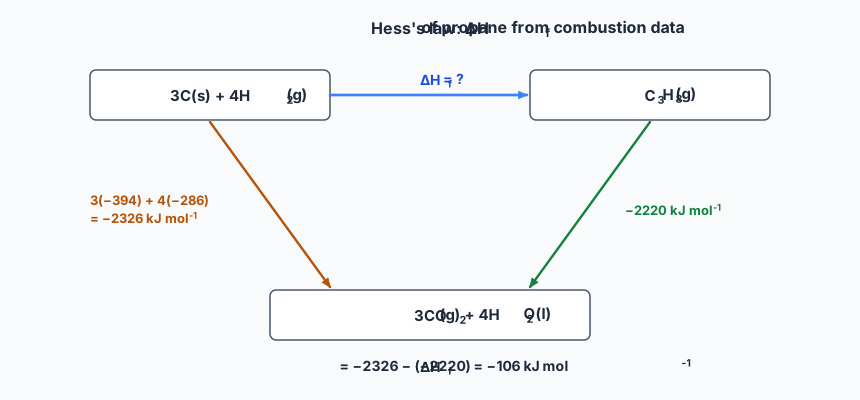
Hess’s law: the total enthalpy change for a reaction is independent of the route taken, provided the starting and finishing conditions are the same. It follows from conservation of energy. It lets you calculate enthalpy changes that cannot be measured directly — because the reaction is too slow, produces a mixture, or cannot be made to happen at all — by going round an energy cycle.
Two cycles cover most questions:
- From enthalpies of formation. Both reactants and products can be formed from the same elements, so \( \Delta H_\mathrm{r} = \sum \Delta H_\mathrm{f}(\text{products}) - \sum \Delta H_\mathrm{f}(\text{reactants}) \).
- From enthalpies of combustion. Both reactants and products burn to the same combustion products, so \( \Delta H_\mathrm{r} = \sum \Delta H_\mathrm{c}(\text{reactants}) - \sum \Delta H_\mathrm{c}(\text{products}) \) — the other way round.
Rather than memorise which way round, draw the cycle every time and follow the arrows: go with an arrow, add its ΔH; go against it, subtract. Remember to multiply each value by the number of moles in the equation.
A standard example: ΔHf of propane cannot be measured, because carbon and hydrogen do not simply combine to give propane. But all three burn. With ΔHc: C −394, H2 −286, C3H8 −2220 kJ mol−1:
✏️Worked example
(a) Energy transferred to the water:
Mr(C2H5OH) = 2(12.0) + 6(1.0) + 16.0 = 46.0, so n = 0.920 / 46.0 = 0.0200 mol.
(b) C2H5OH + 3O2 → 2CO2 + 3H2O. Ethanol contains 1 C–C, 5 C–H, 1 C–O and 1 O–H bond.
(c) The experimental value is much less exothermic because of heat losses: much of the energy from the flame heats the air and the can rather than the water, and some ethanol may burn incompletely (soot on the can) or evaporate from the wick. The bond-energy estimate differs because it uses average bond energies, not the values for the bonds in these particular molecules, and because it assumes ethanol and water are gases. Under standard conditions both are liquids, and condensing them releases extra energy — which is why the true value is more exothermic than the estimate.
📝Practise
Work through these, then reveal the answer. Each question targets a different objective from the list above.
1. Define the standard enthalpy change of formation, and write the equation it refers to for ethanol, C2H5OH(l).
2. 50.0 cm3 of 1.00 mol dm−3 HCl is mixed with 50.0 cm3 of 1.00 mol dm−3 NaOH in a polystyrene cup. The temperature rises by 6.8 K. Calculate the enthalpy change of neutralisation.
3. Use bond energies from the data section to estimate the enthalpy change for CH4(g) + 2O2(g) → CO2(g) + 2H2O(g). [C–H 410, O=O 496, C=O in CO2 805, O–H 460 kJ mol−1]
4. Sketch and label a reaction pathway diagram for an endothermic reaction, and show how a catalyst changes it.
5. Use these standard enthalpy changes of formation to calculate ΔHr for Fe2O3(s) + 3CO(g) → 2Fe(s) + 3CO2(g). [ΔHf / kJ mol−1: Fe2O3(s) −824, CO(g) −111, CO2(g) −394]
6. The enthalpy change for MgSO4(s) + 7H2O(l) → MgSO4·7H2O(s) cannot be measured directly. Explain why not, and how Hess’s law allows it to be found.
🔗Go deeper — other people’s work
These are external resources, not mine. If one stops working, tell me and everything above it on this page still stands.
- Chemguide (Jim Clark) — the energetics pages, with Hess’s law cycles drawn out step by step
- Royal Society of Chemistry — the practical guides for measuring enthalpy changes of neutralisation and combustion
- PhET — Energy Forms and Changes, for the idea of energy flowing between a system and its surroundings