Hydroxy compounds
🎯What you need to be able to do
- Describe the reaction of alcohols with acyl chlorides to form esters, using ethyl ethanoate.
- Recall how phenol is made from phenylamine via a diazonium salt.
- Recall the reactions of phenol with NaOH(aq), with Na(s), with diazonium salts in alkali, with dilute HNO3, and with bromine water.
- Explain the acidity of phenol, and the relative acidities of water, phenol and ethanol.
- Explain why phenol nitrates and brominates under much milder conditions than benzene, and that the OH group directs to the 2-, 4- and 6-positions.
- Apply the chemistry of phenol to other phenolic compounds such as naphthol.
📚The chemistry
32.1 Alcohols with acyl chlorides
At AS, esters were made from an alcohol and a carboxylic acid, a slow, reversible reaction needing a catalyst (topic 18). An acyl chloride does the same job far better:
Ethanoyl chloride and ethanol give ethyl ethanoate at room temperature, vigorously, with steamy fumes of HCl. The reaction is not reversible and needs no catalyst, so the yield is high. The mechanism is addition–elimination (topic 33).
32.2 Phenol
Phenol, C6H5OH, has an OH group bonded directly to a benzene ring. The ring and the OH change each other’s behaviour: the OH makes the ring far more reactive, and the ring makes the OH more acidic.
Making phenol
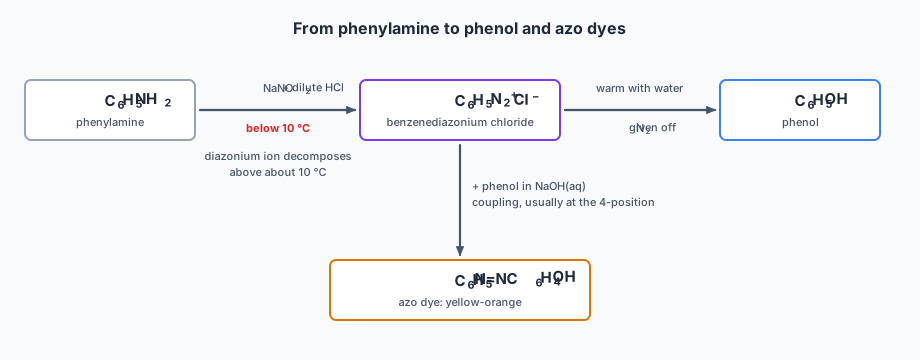
From phenylamine, in two stages:
- Diazotisation: react phenylamine with nitrous acid, HNO2, made in situ from NaNO2 and dilute HCl, below 10 °C. This forms a diazonium salt, benzenediazonium chloride: \[ \mathrm{C_6H_5NH_2 + HNO_2 + HCl \rightarrow C_6H_5N_2^{+}Cl^{-} + 2H_2O} \] The low temperature is essential: the diazonium ion is unstable and decomposes above about 10 °C.
- Warm the diazonium salt solution with water: nitrogen is given off and phenol forms. \[ \mathrm{C_6H_5N_2^{+} + H_2O \rightarrow C_6H_5OH + N_2 + H^{+}} \]
Phenol as an acid
- With NaOH(aq): phenol dissolves, forming sodium phenoxide. \[ \mathrm{C_6H_5OH + NaOH \rightarrow C_6H_5O^{-}Na^{+} + H_2O} \]
- With Na(s): fizzes, releasing hydrogen. \[ \mathrm{2C_6H_5OH + 2Na \rightarrow 2C_6H_5O^{-}Na^{+} + H_2} \]
Phenol is a weak acid — stronger than water and ethanol, but too weak to react with carbonates. That last point is a useful test: carboxylic acids fizz with sodium carbonate, phenols do not.
Why phenol is acidic: relative acidity
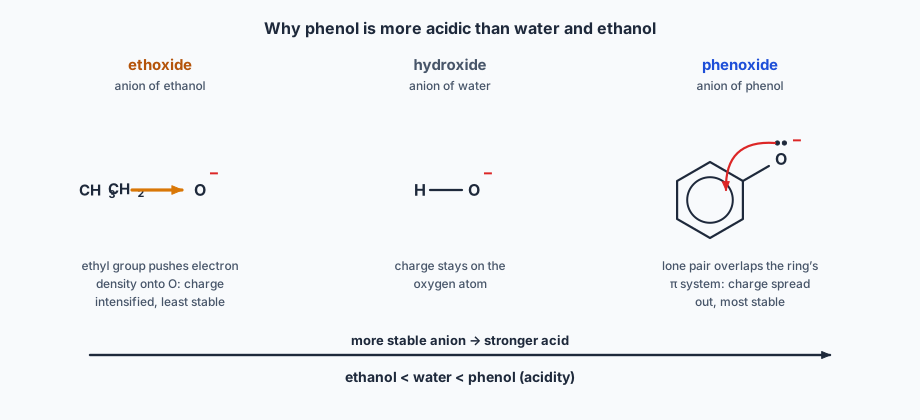
The strength of an acid depends on how stable its anion is. Compare the three anions:
- Phenoxide, C6H5O−: a lone pair on the oxygen overlaps with the delocalised π system of the ring, so the negative charge is spread over the ring. The charge is less concentrated on oxygen, the ion is more stable, and it has less tendency to recapture H+. So phenol dissociates more than water.
- Hydroxide, OH−: the charge stays on the oxygen, with nothing to spread it.
- Ethoxide, C2H5O−: the ethyl group is electron-donating, pushing extra electron density onto the oxygen and intensifying the charge. It is the least stable, so ethanol is the weakest acid (topic 16).
The ring reactions: much easier than benzene
The same lone-pair overlap works in the other direction too: it feeds electron density into the ring, which becomes much more attractive to electrophiles. The ring is activated, so phenol reacts under much milder conditions than benzene, and the OH group directs to the 2-, 4- and 6-positions.
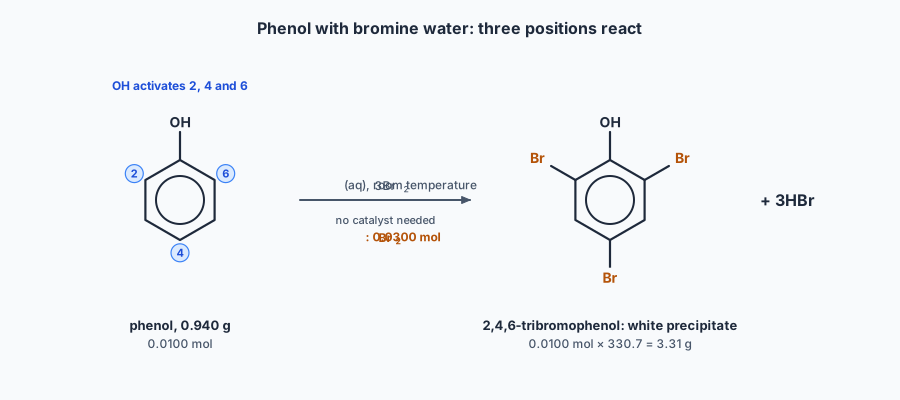
- Bromination: phenol decolourises bromine water at room temperature, with no catalyst, giving a white precipitate of 2,4,6-tribromophenol. The increased electron density in the ring is enough to polarise Br2 without a halogen carrier, and all three activated positions react. \[ \mathrm{C_6H_5OH + 3Br_2 \rightarrow C_6H_2Br_3OH + 3HBr} \] Benzene needs pure bromine and an AlBr3 catalyst, and substitutes only once.
- Nitration: phenol reacts with dilute nitric acid at room temperature, giving a mixture of 2-nitrophenol and 4-nitrophenol. \[ \mathrm{C_6H_5OH + HNO_3 \rightarrow HOC_6H_4NO_2 + H_2O} \] Benzene needs concentrated HNO3 and concentrated H2SO4 at 25–60 °C.
- Coupling with diazonium salts: in NaOH(aq), phenol (as phenoxide) reacts with a diazonium salt to form an azo compound, with the –N=N– group linking two rings, usually at the 4-position of the phenol: \[ \mathrm{C_6H_5N_2^{+} + C_6H_5OH \rightarrow C_6H_5N{=}NC_6H_4OH + H^{+}} \] The product is a brightly coloured (yellow-orange) azo dye; the extended delocalisation across both rings and the N=N link is what makes these compounds coloured.
Other phenols
Any compound with an OH on an aromatic ring behaves the same way. Naphthol (an OH on naphthalene, two fused benzene rings) dissolves in NaOH(aq) to form a naphthoxide, reacts with sodium, decolourises bromine water, and couples with diazonium salts in alkali to give intensely coloured azo dyes — 2-naphthol gives a red-orange dye, and is used as a test for diazonium ions.
✏️Worked example
(a) The orange bromine water is decolourised immediately and a white precipitate forms (with an antiseptic smell):
(b)
(c) A lone pair on the oxygen of the OH group overlaps with the delocalised π system, increasing the electron density of the ring, especially at the 2-, 4- and 6-positions. This electron-rich ring can polarise Br2 molecules by itself and attack them, so no halogen carrier is needed to make Br+. Benzene’s ring has lower electron density and cannot.
(d) Phenol reacts, forming sodium phenoxide and water, because it is acidic enough: the phenoxide ion is stabilised by delocalising its negative charge into the ring. Ethanol does not react with NaOH(aq): it is a weaker acid than water, because its ethyl group intensifies the negative charge on the ethoxide ion.
📝Practise
Work through these, then reveal the answer. Each question targets a different objective from the list above.
1. Compare making ethyl ethanoate from ethanol using (a) ethanoic acid and (b) ethanoyl chloride.
2. Give the reagents and conditions for converting phenylamine into phenol, and explain why the first stage is kept cold.
3. Arrange water, ethanol and phenol in order of acidity and explain the position of phenol.
4. Describe a chemical test to distinguish phenol from benzoic acid.
5. Name the products of nitrating phenol, give the conditions, and explain the difference from benzene.
6. 2-naphthol is added to a solution of benzenediazonium chloride in alkali. Predict what you would see, and name the type of product.
🔗Go deeper — other people’s work
These are external resources, not mine. If one stops working, tell me and everything above it on this page still stands.
- Chemguide (Jim Clark) — the phenol pages, including its acidity and ring reactions
- Royal Society of Chemistry — practical guide for making an azo dye