HomeLearning HubA Level ChemistryA2 31: Halogen compounds
A2 31

Halogen compounds

A Level · Organic chemistry · Paper 4 · builds on AS 15

A short topic with one big idea. A halogen attached directly to a benzene ring behaves completely differently from one on an alkyl chain: halogenoarenes resist the nucleophilic substitution that halogenoalkanes undergo so readily. Explaining why brings together bond strength, the delocalised ring and the lone pairs on the halogen.

🎯What you need to be able to do

  • Recall how halogenoarenes are made: an arene with Cl2 or Br2 and an AlCl3 or AlBr3 catalyst — benzene to chlorobenzene, methylbenzene to 2- and 4-chloromethylbenzene.
  • Explain the difference in reactivity between a halogenoalkane and a halogenoarene, using chloroethane and chlorobenzene.

📚The chemistry

Making halogenoarenes

By electrophilic substitution of the ring (topic 30), with the halogen and a halogen carrier (AlCl3 or AlBr3) at room temperature, without UV light:

\[ \mathrm{C_6H_6 + Cl_2 \rightarrow C_6H_5Cl + HCl} \quad \text{(chlorobenzene)} \] \[ \mathrm{C_6H_5CH_3 + Cl_2 \rightarrow ClC_6H_4CH_3 + HCl} \quad \text{(2- and 4-chloromethylbenzene)} \]

With methylbenzene the methyl group is 2,4-directing, so a mixture of the 2- and 4-isomers forms. In UV light the chlorine would go into the side chain instead, giving (chloromethyl)benzene — which is a halogenoalkane in behaviour, because its chlorine is on an sp3 carbon, not the ring.

Why chlorobenzene is so unreactive

Chloroethane is hydrolysed by warm aqueous sodium hydroxide within minutes (topic 15). Chlorobenzene does not react under those conditions at all; it needs extreme temperatures and pressures. And with aqueous silver nitrate, chloroethane slowly gives a white precipitate of AgCl, while chlorobenzene gives none. Three reasons work together:

  1. The C–Cl bond is stronger. A lone pair in a p orbital on the chlorine atom overlaps with the delocalised π system of the ring. This gives the C–Cl bond some double-bond character: it is shorter and stronger than the C–Cl bond in chloroethane, so it is harder to break.
  2. The C–Cl bond is less polar. Electron density from the chlorine is drawn into the ring, so the carbon attached to it is less δ+ and less attractive to a nucleophile.
  3. The ring repels nucleophiles. The electron-rich π cloud above and below the ring repels an approaching electron-rich nucleophile such as OH. And a nucleophile cannot attack from the back of the C–Cl bond (as in SN2), because that side is inside the ring.

The practical consequence: in a molecule with a halogen both on a chain and on a ring, warm aqueous NaOH replaces only the one on the chain.
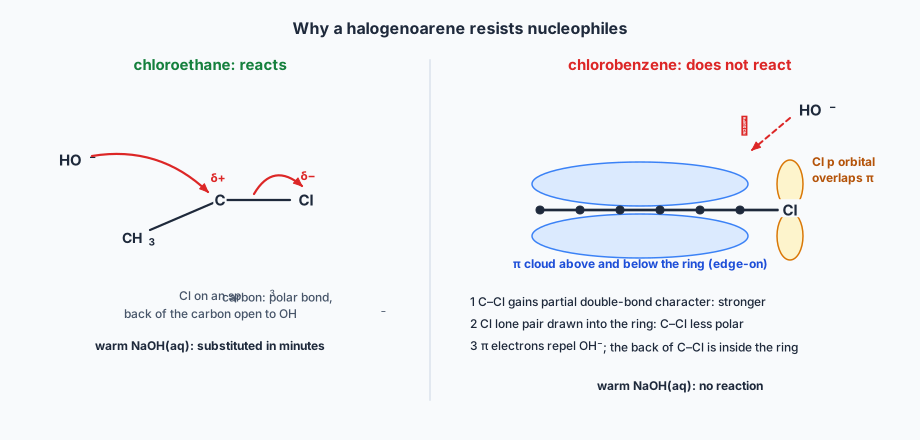
Two panels. Left: chloroethane, with a hydroxide ion attacking the delta-plus carbon from the side opposite the chlorine and the carbon-chlorine bond breaking; warm aqueous sodium hydroxide substitutes it in minutes. Right: chlorobenzene seen edge-on, with the pi electron cloud above and below the ring and a p orbital on the chlorine overlapping it. A hydroxide ion approaching is crossed out. Notes: the carbon-chlorine bond gains partial double-bond character, is less polar, and the pi electrons repel the nucleophile, whose line of attack would lie inside the ring.
Chloroethane is hydrolysed by warm NaOH(aq); chlorobenzene is not, because the Cl lone pair overlaps the ring’s π system.

✏️Worked example

Compound P, ClC6H4CH2Cl, has one chlorine on the ring (at the 4-position) and one on the side chain. (a) P is warmed with aqueous sodium hydroxide. Give the structure of the organic product and explain which chlorine reacts. (b) Describe what you would see if the reaction mixture were then acidified with dilute nitric acid and aqueous silver nitrate added. (c) Suggest how P could be made from methylbenzene in two steps.

(a) Only the side-chain chlorine is substituted, giving ClC6H4CH2OH ((4-chlorophenyl)methanol). The side-chain Cl is on an sp3 carbon, like a primary halogenoalkane, so it undergoes nucleophilic substitution. The ring chlorine is held by a stronger, less polar bond (its lone pair overlaps with the π system), and the ring’s π electrons repel the hydroxide ion, so it does not react.

(b) A white precipitate of silver chloride, from the chloride ions released by the side-chain substitution. (Nitric acid first neutralises the excess NaOH, which would otherwise precipitate silver oxide.)

(c) Step 1: Cl2 with an AlCl3 catalyst (ring substitution) gives 4-chloromethylbenzene (with the 2-isomer, which must be separated). Step 2: Cl2 in UV light (free-radical side-chain substitution) converts CH3 to CH2Cl.
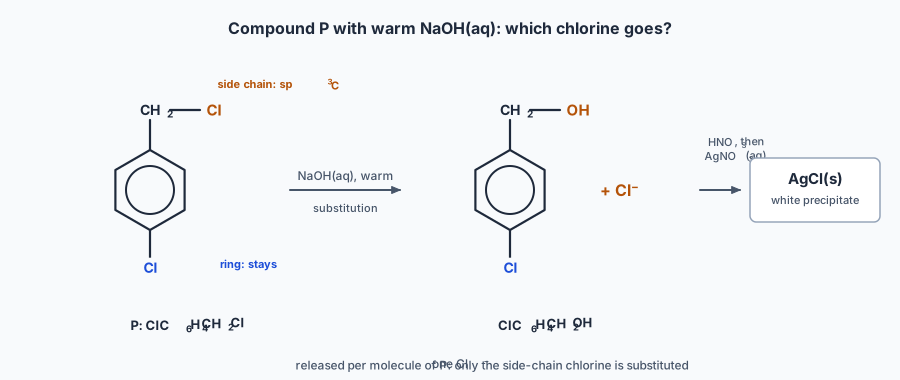
Compound P, a benzene ring with chlorine on the ring and a CH2Cl side chain at the opposite position. With warm aqueous sodium hydroxide only the side-chain chlorine is replaced, giving the ring-chlorinated CH2OH compound and a chloride ion. After acidifying with nitric acid, silver nitrate gives a white precipitate of silver chloride.
Part (a) and (b): one Cl is released per molecule, from the side chain only.
Check it. Count the chlorines: the product in (a) still has one, on the ring, and exactly one chloride ion has been released per molecule — which is what the silver nitrate test detects. If both chlorines had reacted, the product would be a diol with no chlorine at all.
Treating every C–Cl bond in a molecule the same. Where the halogen is attached decides its reactivity. A Cl on a ring carbon is a halogenoarene; a Cl on a CH2 next to the ring is a halogenoalkane. Exam molecules are built to test exactly this distinction.

📝Practise

Work through these, then reveal the answer. Each question targets a different objective from the list above.

1. Give the reagents and conditions to make chlorobenzene from benzene, and write the equation.
Chlorine with an AlCl3 (or FeCl3) catalyst, at room temperature, in the absence of UV light. C6H6 + Cl2 → C6H5Cl + HCl. Electrophilic substitution; AlCl3 generates the Cl+ electrophile.
2. Explain why the C–Cl bond in chlorobenzene is stronger than in chloroethane.
In chlorobenzene a lone pair of electrons in a p orbital on the chlorine overlaps with the delocalised π system of the benzene ring. The electrons are partly shared between the Cl and the ring carbon, giving the C–Cl bond partial double-bond character. It is therefore shorter and stronger than the ordinary single C–Cl bond in chloroethane, where no such overlap is possible.
3. Chloroethane and chlorobenzene are each warmed with aqueous ethanolic silver nitrate. Describe and explain the observations.
Chloroethane: a white precipitate of AgCl forms slowly, as water hydrolyses the C–Cl bond and releases Cl. Chlorobenzene: no precipitate, because its C–Cl bond is not broken: it is strengthened by overlap of the chlorine lone pair with the ring’s π system, is less polar, and the π electrons repel the nucleophile.
4. Name the products when methylbenzene reacts with chlorine (a) with AlCl3, in the dark; (b) in UV light.
(a) Electrophilic substitution in the ring: 2-chloromethylbenzene and 4-chloromethylbenzene (CH3 is 2,4-directing), plus HCl. (b) Free-radical substitution in the side chain: (chloromethyl)benzene, C6H5CH2Cl, and with more chlorine C6H5CHCl2 and C6H5CCl3.
5. Why can a hydroxide ion not attack chlorobenzene by the SN2 route?
In SN2 the nucleophile must approach the carbon from the side opposite the leaving group. In chlorobenzene that side of the carbon points into the middle of the ring, so there is no path for the nucleophile. In addition, the π electron cloud above and below the ring repels the negatively charged OH as it approaches.
6. Compound Q is C6H5CH2CH2Br. Predict its product with warm NaOH(aq), and whether the bromine behaves like that in bromobenzene.
The bromine is on a CH2 in the side chain, not on the ring, so Q behaves as a primary halogenoalkane. Warm NaOH(aq) substitutes it (SN2): product C6H5CH2CH2OH, 2-phenylethanol. Unlike bromobenzene, it reacts readily.

🔗Go deeper — other people’s work

These are external resources, not mine. If one stops working, tell me and everything above it on this page still stands.

  • Chemguide (Jim Clark) — the page comparing the reactivity of halogenoalkanes and halogenoarenes