States of matter
🎯What you need to be able to do
- Explain gas pressure in terms of molecules colliding with the walls of the container.
- State the assumptions of an ideal gas — zero particle volume and no intermolecular forces — and explain when real gases depart from them.
- Use pV = nRT in calculations, including finding Mr.
- Describe the lattice structures of giant ionic, simple molecular, giant molecular and giant metallic solids, using the named examples.
- Explain and predict melting point, boiling point, electrical conductivity and solubility from structure and bonding, and deduce the structure of a substance from its properties.
📚The chemistry
4.1 Gases and pV = nRT
Gas molecules move rapidly and randomly. Every time one hits a wall of its container it changes direction, so the wall exerts a force on it and it exerts an equal force on the wall. The pressure of a gas is the total force of these collisions with the container walls per unit area. More molecules, faster molecules or a smaller container all mean more collisions per second, and a higher pressure.
An ideal gas is a model with two assumptions:
- the molecules have zero volume — they are points;
- there are no intermolecular forces between them.
Real gases come closest to ideal behaviour at high temperature and low pressure. At high pressure the molecules are squeezed close together, so their own volume is no longer a negligible fraction of the total. At low temperature they move slowly enough for intermolecular attractions to matter. Gases with strong intermolecular forces (polar molecules, large molecules) deviate most; helium, small and with the weakest forces of all, is the most nearly ideal.
An ideal gas obeys
With R in J K−1 mol−1 the units must be SI throughout. That is the whole difficulty of this equation: the algebra is easy and the unit conversions are where the marks go.
Because n = m/M, the equation also gives the molar mass of a gas or a volatile liquid from one measurement of mass, volume, temperature and pressure:
4.2 Bonding and structure
A crystalline solid has a regular, repeating arrangement of particles — a lattice. What the particles are, and what holds them together, decides almost every physical property.
Giant ionic — sodium chloride, magnesium oxide
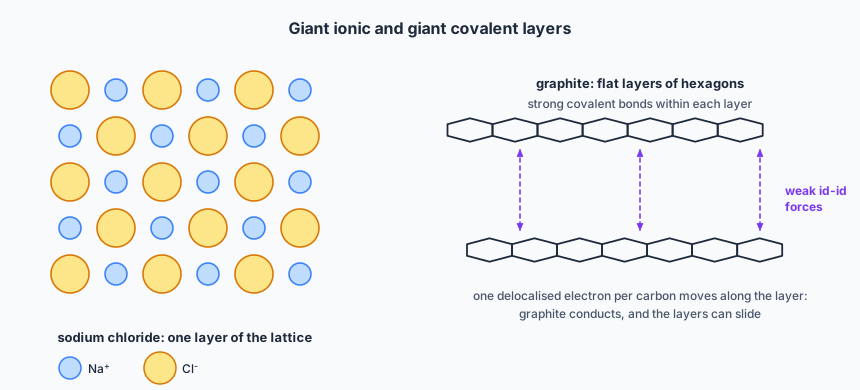
A three-dimensional lattice of alternating positive and negative ions, each surrounded by ions of the opposite charge. In NaCl each ion has six nearest neighbours of the other kind. Strong electrostatic attraction in every direction gives high melting points (MgO higher than NaCl, because its ions are 2+ and 2−). They conduct only when molten or dissolved, when the ions are free to move; in the solid the ions are fixed in place. Many are soluble in water, whose polar molecules surround and separate the ions, but insoluble in non-polar solvents. They are brittle: a shift of one layer brings like charges together, and they repel.
Simple molecular — iodine, C60, ice
Discrete molecules held in a lattice by weak intermolecular forces, while the atoms inside each molecule are held by strong covalent bonds. Melting separates molecules, which needs little energy, so melting and boiling points are low. There are no charged particles free to move, so they do not conduct. They tend to dissolve in non-polar solvents rather than water.
- Iodine: I2 molecules held by id-id forces; a dark grey solid that sublimes on gentle warming to a purple vapour.
- Buckminsterfullerene, C60: a football-shaped molecule of 60 carbon atoms in pentagons and hexagons. Although it is pure carbon, it is molecular: the molecules are held together only by id-id forces, so it is soft and sublimes far below the temperatures diamond or graphite can survive.
- Ice: H2O molecules held by hydrogen bonds in the open tetrahedral lattice described in topic 3.
Giant molecular (giant covalent) — diamond, graphite, silicon(IV) oxide
A lattice in which every atom is joined to its neighbours by covalent bonds, with no separate molecules. Melting means breaking covalent bonds, so melting points are very high, and these substances are insoluble in every common solvent.
- Diamond: each carbon bonded tetrahedrally to four others. Extremely hard; does not conduct, because every outer electron is in a localised bond.
- Graphite: each carbon bonded to three others in flat hexagonal layers. The fourth outer electron of each atom is delocalised across the layer, so graphite conducts electricity along the layers. The layers are held together only by weak id-id forces, so they slide over each other: graphite is soft and slippery, and used as a lubricant and in pencils. Its melting point is still very high, because melting means breaking the covalent bonds within the layers.
- Silicon(IV) oxide, SiO2: each silicon bonded tetrahedrally to four oxygens, each oxygen to two silicons. Hard, high-melting, non-conducting — the structure of sand and quartz.
Giant metallic — copper
A lattice of positive ions in a “sea” of delocalised electrons. The delocalised electrons can move, so metals conduct electricity when solid or molten. Melting points are generally high. Metals are malleable and ductile: layers of ions can slide past one another without breaking the bonding, because the delocalised electrons move with them. Copper, with these properties and a high conductivity, is used for electrical wiring. Metals do not dissolve in solvents (though reactive ones react with water).
Deducing structure from properties
- Conducts when solid → giant metallic (or graphite).
- Conducts only when molten or in solution, high melting point → giant ionic.
- Never conducts, very high melting point, insoluble → giant molecular.
- Never conducts, low melting point → simple molecular.
✏️Worked example
(a) Convert everything to SI units first.
(b) The empirical formula mass of C3H6O is 3(12.0) + 6(1.0) + 16.0 = 58.0. The measured Mr of 58.3 is one times that, within experimental error, so the molecular formula is C3H6O (propanone, for example).
(c) The ideal gas equation assumes no intermolecular forces. Close to its boiling point, a vapour is not ideal: attractions between molecules pull them together, so the volume measured is slightly smaller than an ideal gas would occupy. A smaller V gives a smaller n and therefore a larger Mr. (Some liquid failing to vaporise would have the opposite effect, lowering Mr.)
📝Practise
Work through these, then reveal the answer. Each question targets a different objective from the list above.
1. Calculate the volume, in dm3, occupied by 0.500 mol of an ideal gas at 27 °C and 200 kPa.
2. State the two assumptions of the ideal gas model, and explain why ammonia deviates from ideal behaviour more than nitrogen does at the same temperature and pressure.
3. Explain why graphite conducts electricity but diamond does not, although both are giant structures of carbon atoms.
4. Explain why sodium chloride conducts electricity when molten but not when solid.
5. Substance P melts at 1710 °C, is insoluble in water and hexane, and does not conduct electricity when solid or molten. Substance Q melts at 114 °C, dissolves in hexane but not in water, and does not conduct. Deduce the structure of each, giving an example.
6. 0.450 g of a gas occupies 350 cm3 at 20 °C and 98.0 kPa. Calculate its Mr, and suggest its identity if it is an element.
🔗Go deeper — other people’s work
These are external resources, not mine. If one stops working, tell me and everything above it on this page still stands.
- PhET — Gas Properties, to see pressure arise from collisions and to test pV = nRT one variable at a time
- Chemguide (Jim Clark) — the pages on ideal gases and on giant and simple structures
- ChemTube3D (University of Liverpool) — rotatable 3D models of the NaCl, diamond, graphite, SiO2 and C60 lattices