Hydrocarbons
🎯What you need to be able to do
- Describe the reactions of benzene and methylbenzene: halogenation with an AlCl3 or AlBr3 catalyst, nitration, Friedel–Crafts alkylation and acylation, side-chain oxidation to benzoic acid, and hydrogenation to a cyclohexane ring.
- Describe the electrophilic substitution mechanism, using nitrobenzene and bromobenzene, and explain why arenes substitute rather than add.
- Predict whether halogenation happens in the side chain or the ring.
- Describe the directing effects of –NH2, –OH, –R, –NO2, –COOH and –COR.
📚The chemistry
The benzene ring is electron-rich (its delocalised π system), so it attracts electrophiles, like an alkene. Unlike an alkene, it does not add them: it substitutes, because keeping the delocalised ring is worth about 150 kJ mol−1 of stability (topic 29). Benzene is also less reactive than an alkene: its π electrons are spread over six carbons rather than concentrated between two, so it needs a stronger electrophile, which is what the catalysts below provide.
The reactions of benzene and methylbenzene
Halogenation
Cl2 or Br2 with a halogen carrier catalyst, AlCl3 or AlBr3 (or FeBr3), at room temperature, in the absence of UV light:
Nitration
A mixture of concentrated HNO3 and concentrated H2SO4, at 25–60 °C. Above that, further nitration gives dinitrobenzene.
Friedel–Crafts alkylation and acylation
Both form a new C–C bond to the ring, using AlCl3 and heat:
Oxidation of the side chain
Heat with hot alkaline KMnO4, then acidify with dilute acid. The whole alkyl side chain, however long, is oxidised to a COOH group on the ring, giving benzoic acid. The ring itself is not attacked.
Hydrogenation
H2 with a Pt or Ni catalyst and heat adds across the ring, destroying the delocalisation and forming a cyclohexane ring. It needs harsher conditions than alkene hydrogenation.
The mechanism: electrophilic substitution
Every substitution follows the same three stages: generate the electrophile, attack the ring, lose H+ to restore it.
Nitration
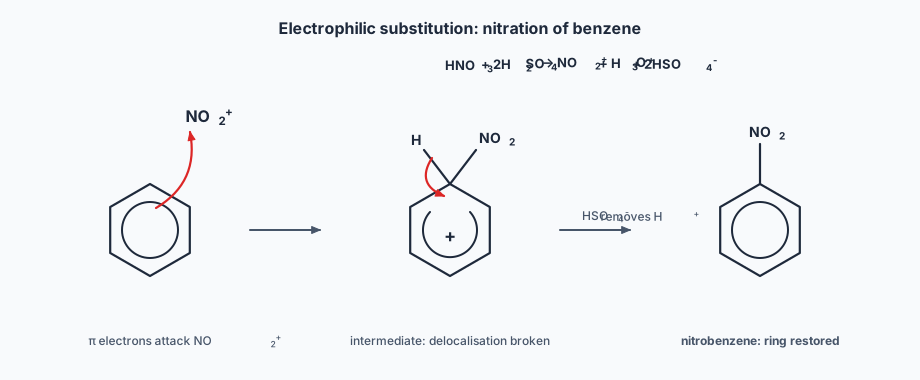
- Electrophile: the nitronium ion, NO2+, formed by the sulfuric acid: \[ \mathrm{HNO_3 + 2H_2SO_4 \rightarrow NO_2^{+} + H_3O^{+} + 2HSO_4^{-}} \]
- Attack: curly arrow from the delocalised π system (from the circle) to the N of NO2+. This forms an intermediate in which one carbon is sp3 (carrying both H and NO2) and the positive charge is spread over the other five carbons — draw it as a horseshoe (a partial ring, opening towards the sp3 carbon) with a + inside. The delocalisation is temporarily broken.
- Loss of H+: curly arrow from the C–H bond back into the ring. The H+ is removed (by HSO4−, regenerating H2SO4, which is therefore a catalyst), and the full delocalised ring is restored: nitrobenzene.
Bromination
- Electrophile: the halogen carrier polarises Br2 so strongly that it gives Br+: \[ \mathrm{Br_2 + AlBr_3 \rightarrow Br^{+} + AlBr_4^{-}} \]
- Attack: curly arrow from the π system to Br+, giving the horseshoe intermediate.
- Loss of H+: arrow from C–H into the ring; the H+ combines with AlBr4− to form HBr and regenerate AlBr3: \[ \mathrm{H^{+} + AlBr_4^{-} \rightarrow HBr + AlBr_3} \]
Friedel–Crafts reactions work the same way: AlCl3 generates CH3+ from CH3Cl, or CH3CO+ from CH3COCl.
Side chain or ring?
Methylbenzene has two places a halogen can go, and the conditions decide which:
- UV light (or boiling, no catalyst): free-radical substitution in the side chain, exactly as for an alkane (topic 14). C6H5CH3 + Cl2 → C6H5CH2Cl + HCl, giving (chloromethyl)benzene; further substitution gives C6H5CHCl2 and C6H5CCl3.
- AlCl3 catalyst, room temperature, no UV: electrophilic substitution in the ring, giving a mixture of 2-chloromethylbenzene and 4-chloromethylbenzene.
Directing effects
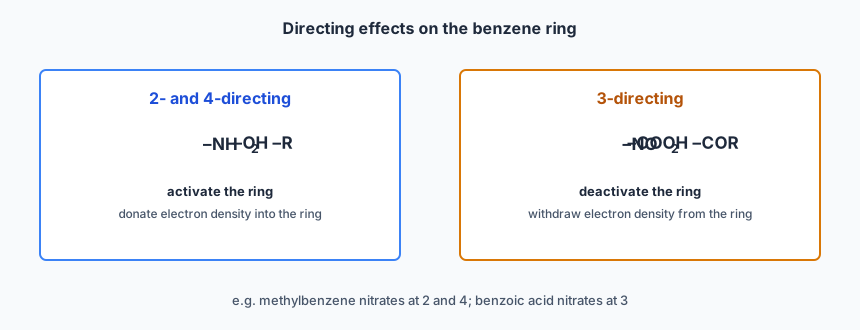
A group already on the ring decides where the next substituent goes:
The pattern to remember: groups that donate electron density into the ring (a lone pair on N or O, or an alkyl group’s inductive effect) direct to 2 and 4 and make the ring more reactive. Groups that withdraw electron density (containing a C=O or N=O attached to the ring) direct to 3 and make it less reactive. So nitrating methylbenzene gives 2- and 4-nitromethylbenzene, easily; nitrating benzoic acid gives 3-nitrobenzoic acid, more slowly.
✏️Worked example
(a) One benzene gives one nitrobenzene.
(b) Concentrated HNO3 and concentrated H2SO4, 25–60 °C. Above about 60 °C, further substitution occurs and 1,3-dinitrobenzene forms (NO2 is 3-directing), lowering the yield of nitrobenzene.
(c)(i) Ring substitution: 2-chloromethylbenzene and 4-chloromethylbenzene (CH3 is 2,4-directing). (ii) Side-chain substitution: (chloromethyl)benzene, C6H5CH2Cl. (iii) The whole ethyl side chain is oxidised: benzoic acid, C6H5COOH (and CO2). (iv) 3-nitrobenzoic acid (COOH is 3-directing).
📝Practise
Work through these, then reveal the answer. Each question targets a different objective from the list above.
1. Write an equation for the formation of the electrophile in the nitration of benzene, and describe the rest of the mechanism.
2. Explain why benzene needs a halogen carrier to react with bromine, while ethene does not.
3. Give reagents and conditions to make phenylethanone, C6H5COCH3, from benzene. Name the reaction.
4. Suggest a two-step synthesis of 3-nitrobenzoic acid from methylbenzene, and explain the order of the steps.
5. Predict the main product(s) of nitrating (a) phenylamine; (b) nitrobenzene.
6. Why does benzene undergo substitution rather than addition with bromine, when an alkene undergoes addition?
🔗Go deeper — other people’s work
These are external resources, not mine. If one stops working, tell me and everything above it on this page still stands.
- Chemguide (Jim Clark) — the arenes section, with electrophilic substitution mechanisms drawn for nitration, halogenation and Friedel–Crafts reactions
- ChemTube3D (University of Liverpool) — animated nitration of benzene