Nitrogen and sulfur
🎯What you need to be able to do
- Explain why nitrogen is unreactive, using the strength of its triple bond and its lack of polarity.
- Explain the basicity of ammonia in Brønsted–Lowry terms, the structure and formation of the ammonium ion, and how ammonia is displaced from ammonium salts.
- State the natural and man-made sources of nitrogen oxides, and explain how they are removed from vehicle exhausts by catalytic converters.
- Understand that NO and NO2 react with unburned hydrocarbons to form PAN, part of photochemical smog.
- Describe the role of NO and NO2 in acid rain, directly and as catalysts for the oxidation of sulfur dioxide.
📚The chemistry
This is the shortest inorganic topic, and the most environmental one. It uses ideas from earlier pages — bond energy (topic 3), Brønsted–Lowry acids and bases (topic 7), redox and homogeneous catalysis (topic 8) — and applies them to air pollution.
Why nitrogen is unreactive
Nitrogen makes up 78% of the air and does almost nothing. Two reasons:
- The N≡N triple bond is very strong, 944 kJ mol−1. Any reaction must begin by breaking or weakening it, so the activation energy of nitrogen’s reactions is very high.
- The molecule is non-polar. Both atoms are identical, so there is no δ+ or δ− end to attract a nucleophile or an electrophile, and nothing for a polar reagent to attack.
That is why ammonia synthesis needs 450 °C, 200 atmospheres and an iron catalyst.
Ammonia and the ammonium ion
Ammonia is a Brønsted–Lowry base: the lone pair on the nitrogen atom accepts a proton. In water it is a weak base, because the equilibrium lies to the left:
With an acid, the ammonium ion forms in an acid–base reaction — with hydrogen chloride gas, as white smoke of ammonium chloride:
In NH4+ the new N–H bond is a coordinate (dative covalent) bond: both electrons come from the nitrogen’s lone pair. Once it has formed, all four N–H bonds are identical. With four bonding pairs and no lone pair, the ion is tetrahedral, bond angle 109.5° (compared with 107° in pyramidal NH3).
Displacing ammonia from ammonium salts
Warm any ammonium salt with a base such as sodium hydroxide, and ammonia is released:
This is an acid–base reaction: NH4+ is the acid, donating a proton to OH−, the stronger base. It is also the test for the ammonium ion: the gas turns damp red litmus paper blue. Farmers need to know it too — spreading lime (a base) on soil at the same time as an ammonium fertiliser releases the nitrogen as ammonia gas.
Oxides of nitrogen
Nitrogen and oxygen do not react at normal temperatures, but they do in the extreme heat of a lightning strike (natural) and inside a car or aircraft engine or a power station furnace (man-made):
In the air, nitrogen monoxide is then oxidised to brown nitrogen dioxide:
Catalytic converters
A catalytic converter in a car exhaust removes nitrogen oxides together with carbon monoxide. Exhaust gases pass over a honeycomb coated with platinum, palladium and rhodium — a heterogeneous catalyst with a very large surface area. On the metal surface, the oxides of nitrogen are reduced to nitrogen while carbon monoxide is oxidised to carbon dioxide:
Both products are already present in air. Unburned hydrocarbons are oxidised to CO2 and H2O at the same time.
Photochemical smog and PAN
In sunlight, nitrogen oxides react with unburned hydrocarbons from vehicle exhausts to form peroxyacetyl nitrate, PAN. PAN is a component of photochemical smog, the brown haze over busy cities on sunny, still days. It irritates the eyes and lungs and damages plants. You do not need its structure or the reaction steps — just that NO and NO2 plus unburned hydrocarbons give PAN.
Acid rain
Rain is naturally slightly acidic (about pH 5.6) from dissolved carbon dioxide. Acid rain is more acidic than that, and nitrogen oxides contribute in two ways.
Directly: nitrogen dioxide reacts with water and oxygen to form nitric acid:
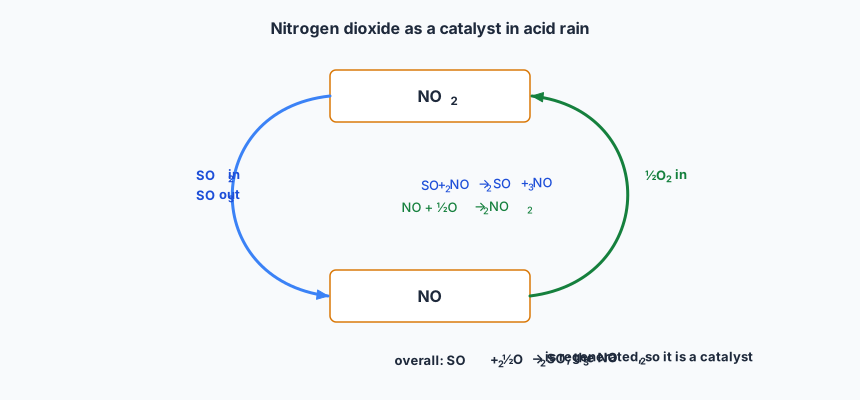
As a catalyst: nitrogen dioxide speeds up the oxidation of sulfur dioxide (from burning sulfur-containing fuels) to sulfur trioxide, and is regenerated:
Adding these two steps gives the overall reaction, SO2 + ½O2 → SO3: NO2 is used in the first step and re-formed in the second, so it is a homogeneous catalyst (all species are gases). The sulfur trioxide then dissolves in rain: SO3 + H2O → H2SO4.
Acid rain damages limestone buildings, leaches aluminium and nutrients from soils, harms trees, and lowers the pH of lakes enough to kill fish.
✏️Worked example
(a)
NH4+ donates a proton, so it is the acid; OH− accepts it, so it is the base.
(b) Mr(NH4Cl) = 14.0 + 4(1.0) + 35.5 = 53.5.
(c) Hold damp red litmus paper in the gas: it turns blue. Ammonia is the only common alkaline gas. (A glass rod dipped in concentrated hydrochloric acid also gives white smoke of NH4Cl.)
(d) NH3 has three bonding pairs and one lone pair. The lone pair repels more strongly than bonding pairs, closing the H–N–H angle to 107°. In NH4+ the lone pair has become the fourth (dative) bonding pair, so there are four equal bonding pairs and no lone pairs: the ion is tetrahedral, 109.5°.
📝Practise
Work through these, then reveal the answer. Each question targets a different objective from the list above.
1. Give two reasons why nitrogen gas is unreactive.
2. Explain, using the Brønsted–Lowry theory, why an aqueous solution of ammonia is alkaline.
3. Explain how nitrogen monoxide forms in a car engine, and why it does not form in the air around the car.
4. Write an equation for the removal of nitrogen monoxide and carbon monoxide in a catalytic converter, and state the type of catalysis.
5. Show, with equations, how nitrogen dioxide acts as a catalyst in the formation of acid rain.
6. What is PAN, and what conditions lead to its formation?
🔗Go deeper — other people’s work
These are external resources, not mine. If one stops working, tell me and everything above it on this page still stands.
- Chemguide (Jim Clark) — the pages on ammonia and ammonium ions, and on catalytic converters as heterogeneous catalysis
- Royal Society of Chemistry — resources on acid rain and air quality