Organic synthesis
🎯What you need to be able to do
- For a molecule with several functional groups, identify the groups using the reactions in the syllabus, and predict its properties and reactions.
- Devise multi-step synthetic routes using the reactions in the syllabus.
- Analyse a given route: the type of reaction, the reagents and conditions for each step, and possible by-products.
📚The chemistry
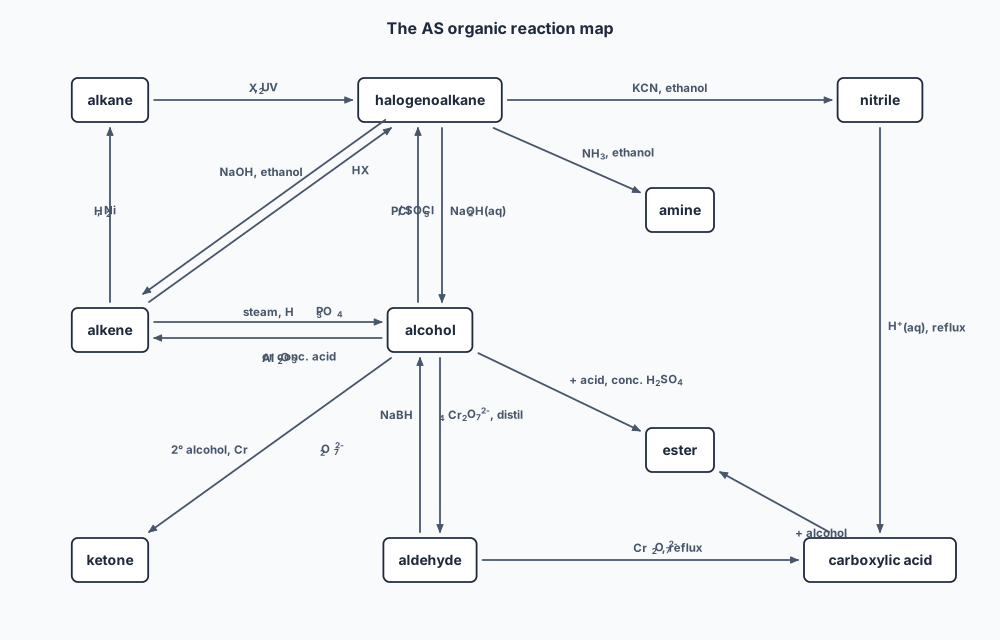
This topic has no new reactions. It asks you to use the ones from topics 14–19 together, which is why it carries so many marks on Paper 2 and why it rewards having every reaction at your fingertips. The map below is the whole AS toolkit on one page. Learn it as reagent + conditions + type, not just starting material and product.
The AS reaction map
Alkanes
- → halogenoalkane: Cl2 or Br2, UV light — free-radical substitution (gives a mixture).
- → shorter alkane + alkene: heat, Al2O3 — cracking.
Alkenes
- → alkane: H2, Pt or Ni, heat — addition (hydrogenation).
- → alcohol: H2O(g), H3PO4 catalyst — electrophilic addition.
- → halogenoalkane: HX(g), room temperature — electrophilic addition (Markovnikov).
- → dihalogenoalkane: X2, room temperature — electrophilic addition.
- → diol: cold dilute acidified KMnO4 — oxidation.
- → ketones / carboxylic acids / CO2: hot concentrated acidified KMnO4 — oxidative cleavage.
- → poly(alkene): addition polymerisation.
Halogenoalkanes
- → alcohol: NaOH(aq), heat — nucleophilic substitution.
- → nitrile (one more C): KCN in ethanol, heat — nucleophilic substitution.
- → amine: excess NH3 in ethanol, heat under pressure — nucleophilic substitution.
- → alkene: NaOH in ethanol, heat — elimination.
Alcohols
- → halogenoalkane: HX, or KCl + conc. H2SO4/H3PO4, or PCl3 + heat, or PCl5, or SOCl2 — substitution.
- primary → aldehyde: acidified K2Cr2O7, distil — oxidation.
- primary → carboxylic acid: acidified K2Cr2O7, reflux — oxidation.
- secondary → ketone: acidified K2Cr2O7 — oxidation.
- → alkene: heated Al2O3 or conc. acid — dehydration (elimination).
- → ester: carboxylic acid, conc. H2SO4, heat — condensation.
- → alkoxide + H2: Na(s).
Aldehydes and ketones
- → alcohol: NaBH4 or LiAlH4 — reduction.
- → hydroxynitrile (one more C): HCN, KCN catalyst, heat — nucleophilic addition.
- aldehyde → carboxylic acid: acidified K2Cr2O7, reflux — oxidation.
Carboxylic acids, esters and nitriles
- acid → ester: alcohol, conc. H2SO4, heat.
- acid → primary alcohol: LiAlH4 — reduction.
- acid → salt: reactive metal (+ H2), alkali (+ H2O), or carbonate (+ H2O + CO2).
- ester → acid + alcohol: dilute acid, heat (reversible); or dilute NaOH, heat (salt + alcohol), then acidify.
- nitrile → carboxylic acid: dilute acid, heat; or dilute NaOH, heat, then acidify — hydrolysis.
Molecules with several functional groups
Exam molecules often contain two or three functional groups. Treat each group independently: go through the molecule group by group and ask what each reagent does to each one. Most reagents are selective, and knowing which ones are is the skill being tested:
- NaBH4 reduces C=O in aldehydes and ketones, but not C=C, COOH or esters. LiAlH4 also reduces COOH.
- Bromine water reacts with C=C only.
- Tollens’ and Fehling’s react with aldehydes only.
- Sodium carbonate reacts with COOH only; sodium metal with any O–H (alcohol or acid).
- Acidified dichromate oxidises primary and secondary alcohols and aldehydes, leaving C=C, ketones and tertiary alcohols alone.
- Hot concentrated KMnO4 is not selective: it also oxidises alcohols and aldehydes, and cleaves C=C.
Devising a route
Work backwards from the target as well as forwards from the start:
- Compare the carbon skeletons. One carbon more? The route needs a nitrile (from KCN or HCN). Same number? You only need to change functional groups.
- Compare the functional groups and their positions. If the group has to move to a different carbon, go through an alkene: eliminate, then add back with Markovnikov orientation.
- Find a link. Halogenoalkanes and alcohols are the great intermediates: from either you can reach almost every other AS functional group.
- For each step, give the reagent, the conditions (reflux, distil, UV, pressure, solvent) and the structure of the intermediate.
Analysing a route
When you are given a route, name each step by type — addition, substitution, elimination, oxidation, reduction, hydrolysis, condensation — and by mechanism where there is one. Then look for by-products: the other isomer from Markovnikov addition, the alkene that competes with substitution, the carboxylic acid that forms if an aldehyde is not distilled off, the further-substituted products of free-radical substitution or of amine formation. Each one lowers the yield of the product you want.
✏️Worked example
(a) A primary alcohol (CH2OH), an alkene (C=C) and an aldehyde (CHO).
(b)(i) The C=C decolourises bromine water, orange → colourless. (ii) The aldehyde gives a silver mirror. (iii) The O–H of the alcohol reacts: effervescence of hydrogen.
(c) NaBH4 reduces only the aldehyde, to a primary alcohol; the C=C is untouched: HOCH2CH=CHCH2OH (but-2-ene-1,4-diol).
(d) Under reflux with excess oxidising agent, both the primary alcohol and the aldehyde are oxidised all the way to carboxylic acid groups; dichromate leaves the C=C: HOOCCH=CHCOOH (butenedioic acid).
(e) The OH must move from C1 to C2 on the same carbon skeleton, so go through an alkene. Step 1: dehydrate propan-1-ol with heated Al2O3 (or concentrated H3PO4) to propene (elimination). Step 2: steam with an H3PO4 catalyst (electrophilic addition). Markovnikov addition puts the OH on the middle carbon, giving propan-2-ol as the major product, via the more stable secondary carbocation. By-product: propan-1-ol, from the minor route through the primary carbocation.
📝Practise
Work through these, then reveal the answer. Each question targets a different objective from the list above.
1. Devise a three-step synthesis of propanoic acid from ethene.
2. Suggest a route from 1-bromopropane to propanone, naming the intermediates, and explain why it cannot be done in two steps.
3. Compound V is CH3COCH2CH2COOH. Predict the result with (a) sodium carbonate; (b) 2,4-DNPH; (c) Fehling’s solution; (d) alkaline aqueous iodine.
4. In the route: butan-2-ol → (step 1) → 2-bromobutane → (step 2) → 2-methylbutanenitrile, give the reagent and type of each step, and name a by-product of step 2.
5. How would you convert ethanol into ethyl ethanoate using ethanol as the only organic starting material?
6. Explain why free-radical substitution is a poor first step in a synthesis of pure 1-chloropropane from propane.
🔗Go deeper — other people’s work
These are external resources, not mine. If one stops working, tell me and everything above it on this page still stands.
- Chemguide (Jim Clark) — organic reaction summaries by functional group, useful to test yourself against this page’s map