The Periodic Table: chemical periodicity
🎯What you need to be able to do
- Describe the trends in atomic radius, ionic radius, melting point and electrical conductivity across period 3, and explain melting point and conductivity from structure and bonding.
- Write equations for the reactions of the period 3 elements with oxygen and chlorine, and of sodium and magnesium with water.
- Explain the oxidation numbers in the oxides and chlorides from the number of outer electrons.
- Describe the reactions of the oxides and chlorides with water, with the likely pH of each solution.
- Describe the acid–base behaviour of the oxides and hydroxides, including amphoteric aluminium oxide and hydroxide.
- Explain all of these trends in terms of bonding and electronegativity, and deduce the bonding in an oxide or chloride from its properties.
- Predict the properties of an element from its group, and identify an unknown element from its properties.
📚The chemistry
Period 3 runs from sodium to argon. Across it the elements change from reactive metals, through a giant covalent metalloid, to simple molecular non-metals, and their oxides and chlorides change from ionic and basic to covalent and acidic. Almost every fact on this page follows from one idea: electronegativity increases across the period, so bonding to oxygen or chlorine becomes less ionic and more covalent.
9.1 Physical properties across period 3
Atomic and ionic radius
Atomic radius decreases from Na to Cl: nuclear charge rises by one each step, electrons go into the same (third) shell, and shielding hardly changes, so the outer electrons are pulled closer (topic 1).
Ionic radii fall into two groups. The cations Na+, Mg2+, Al3+ have lost the third shell entirely, so they are much smaller than their atoms, and shrink further across the series as the nuclear charge rises on the same (2,8) arrangement. The anions P3−, S2−, Cl− keep three shells and gain electrons, so they are much larger, and they also shrink across the series. The biggest jump in the whole period is between Al3+ and P3−.
Melting point and conductivity
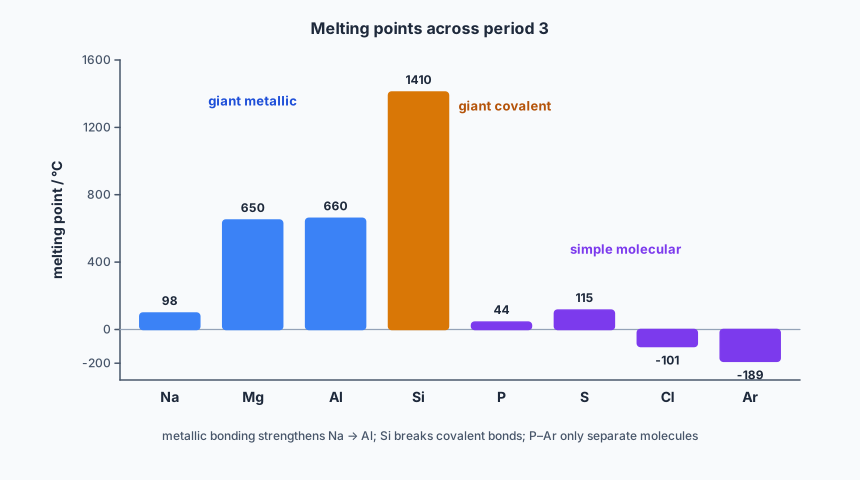
- Na → Al: metallic bonding gets stronger. Each atom contributes more delocalised electrons (1, 2, 3), and the ions are smaller and more highly charged, so the attraction between ions and the sea of electrons increases. Melting point rises, and so does electrical conductivity: more delocalised electrons per atom are available to carry charge. Aluminium conducts best.
- Si: giant covalent. Melting needs many strong covalent bonds broken, so its melting point is the highest in the period. Its electrons are held in bonds; it conducts only slightly — a semiconductor.
- P, S, Cl, Ar: simple molecular. Melting separates molecules held by weak id-id forces, so melting points are low. Their order follows the size of the molecule, because more electrons give stronger id-id forces: S8 (128 electrons) > P4 (60) > Cl2 (34) > Ar (18, single atoms). None of them conducts.
9.2 Chemical properties across period 3
Reactions of the elements
With oxygen (heated in air or oxygen):
Sodium burns with a yellow-orange flame and magnesium with a brilliant white flame, both giving white solids. White phosphorus catches fire spontaneously in air, giving clouds of white P4O10. Sulfur burns with a blue flame to give colourless, choking SO2; further oxidation to SO3 needs a catalyst (the Contact process, topic 7).
With chlorine (heated):
Sodium and magnesium give white ionic solids. Aluminium chloride forms as a pale yellow-white solid that sublimes (it exists as Al2Cl6). SiCl4 is a colourless liquid. PCl5, a pale yellow solid, needs excess chlorine; with less, PCl3 forms.
With water (sodium and magnesium only):
Sodium floats, melts into a ball and fizzes, giving a strongly alkaline solution (pH 13–14). Magnesium barely reacts with cold water, giving a weakly alkaline solution (about pH 9–10) over days; heated in steam it burns with a bright white glow.
Oxidation numbers in the oxides and chlorides
The highest oxidation number rises by one across the period because it equals the number of outer-shell (valence) electrons the element can use in bonding to the more electronegative oxygen or chlorine: sodium has one, sulfur six. Sulfur reaches +6 in SO3 but only +4 in SO2, where it uses four of its six. Period 3 elements can use all their outer electrons like this because they can expand their octet (topic 3).
The oxides with water
- Na2O: Na2O + H2O → 2NaOH. Reacts readily; pH 13–14.
- MgO: MgO + H2O → Mg(OH)2. Only slightly soluble; pH about 9.
- Al2O3 and SiO2: no reaction, insoluble; the water stays at pH 7. The ionic lattice of Al2O3 is too strong, and SiO2 is giant covalent.
- P4O10: P4O10 + 6H2O → 4H3PO4. Violent; pH about 0–1.
- SO2: SO2 + H2O → H2SO3 (sulfurous acid), pH about 2–3.
- SO3: SO3 + H2O → H2SO4, pH about 0–1.
Acid–base behaviour of the oxides and hydroxides
Basic — Na2O, MgO, NaOH and Mg(OH)2 react with acids to form salts and water:
Amphoteric — aluminium oxide and aluminium hydroxide react with both acids and bases:
The product with sodium hydroxide is sodium aluminate, containing the [Al(OH)4]− ion.
Acidic — P4O10, SO2 and SO3 react with bases:
Silicon dioxide is also acidic, but only reacts with hot, concentrated alkali: SiO2 + 2NaOH → Na2SiO3 + H2O.
The chlorides with water
- NaCl simply dissolves; the ions are hydrated. pH 7.
- MgCl2 dissolves, and the small, 2+ Mg ion attracts water enough for very slight hydrolysis: pH about 6.5.
- AlCl3 is hydrolysed. With a little water it fumes (HCl gas); in excess water it gives an acidic solution, pH about 3: AlCl3 + 3H2O → Al(OH)3 + 3HCl. The very small, highly charged Al3+ ion pulls electron density from its water ligands so strongly that they release H+.
- SiCl4 is hydrolysed completely, violently, with white fumes of HCl and a white solid: SiCl4 + 2H2O → SiO2 + 4HCl. pH about 1–2.
- PCl5 is hydrolysed violently: PCl5 + 4H2O → H3PO4 + 5HCl. pH about 1.
Explaining the trends
Across the period the difference in electronegativity between the element and oxygen or chlorine decreases, so the bonding changes from ionic to covalent:
- Ionic oxides (Na2O, MgO) contain the O2− ion, which is a strong base: O2− + H2O → 2OH−. So they are basic.
- Covalent oxides of non-metals (P4O10, SO2, SO3) react with water to form acids. So they are acidic.
- Aluminium oxide sits in between: ionic, but with its bonding given considerable covalent character by the small, highly charged Al3+ ion — hence amphoteric.
- Ionic chlorides (NaCl, MgCl2) dissolve without reacting. Covalent chlorides (AlCl3, SiCl4, PCl5) are hydrolysed by water, releasing HCl.
The same pattern works in reverse as evidence. A chloride with a high melting point that dissolves to a neutral solution and conducts when molten is ionic; one that is a volatile liquid, fumes in moist air and gives an acidic solution is covalent.
9.3 Periodicity beyond period 3
Elements in the same group have the same outer-electron arrangement, so they behave similarly, and the trends down a group (atoms larger, lower ionisation energy, lower electronegativity) let you predict how strongly. You may be asked to predict an element’s properties: germanium, below silicon in Group 14, should form GeO2 and GeCl4, with GeCl4 a covalent liquid hydrolysed by water, and should be a semiconductor. Or to work the other way and deduce the identity of an unknown element from data — its oxide’s pH, its chloride’s volatility, the formulas of its compounds (which give its maximum oxidation number, and so its group), and its ionisation energies.
✏️Worked example
(a) A volatile liquid chloride that is hydrolysed to a white solid and acid is silicon tetrachloride, SiCl4. (PCl5 is a solid, and its hydrolysis gives no precipitate.)
(b) SiCl4 is a simple molecular covalent compound: the Si–Cl bonds are strong, but the molecules are held to one another only by weak id-id forces, which little energy overcomes. Sodium chloride is a giant ionic lattice; melting it means overcoming the strong electrostatic attraction between oppositely charged ions throughout the lattice. The difference comes from electronegativity: Na (0.9) and Cl (3.0) differ by 2.1, giving ionic bonding; Si (1.9) and Cl differ by only 1.1, giving covalent bonding.
(c) Mr(SiCl4) = 28.1 + 4(35.5) = 170.1.
HCl + NaOH react 1 : 1, so n(NaOH) = 0.01999 mol:
📝Practise
Work through these, then reveal the answer. Each question targets a different objective from the list above.
1. Explain why the melting point rises from sodium to aluminium but falls sharply from silicon to phosphorus.
2. Write equations to show that aluminium hydroxide is amphoteric.
3. Describe what you would observe, and state the approximate pH of the final solution, when each of these is added to water: (a) Na2O; (b) Al2O3; (c) SO3. Write equations where a reaction occurs.
4. Explain why the maximum oxidation number of the period 3 elements in their chlorides rises from +1 in NaCl to +5 in PCl5.
5. Oxide Y has a very high melting point, does not conduct when molten, is insoluble in water and dissolves only in hot concentrated sodium hydroxide. Deduce its structure and identity, and write an equation for the reaction with NaOH.
6. Germanium is below silicon in Group 14. Predict the formula of its chloride, the bonding in it, and what happens when the chloride is added to water.
🔗Go deeper — other people’s work
These are external resources, not mine. If one stops working, tell me and everything above it on this page still stands.
- Chemguide (Jim Clark) — the period 3 pages, one each for the elements, oxides, chlorides and physical properties
- Royal Society of Chemistry — the interactive periodic table, which plots melting point, radius and electronegativity across any period