Group 17
🎯What you need to be able to do
- Describe the colours of chlorine, bromine and iodine and the trend in their volatility, and explain volatility with id-id forces.
- Describe and explain the trend in the bond strength of the halogen molecules.
- Describe the halogens’ relative reactivity as oxidising agents, and their reactions with hydrogen.
- Describe and explain the relative thermal stabilities of the hydrogen halides.
- Describe the halide ions’ relative reactivity as reducing agents, and their reactions with silver ions followed by ammonia, and with concentrated sulfuric acid.
- Interpret the reactions of chlorine with cold and hot sodium hydroxide as disproportionation.
- Explain the use of chlorine in water purification.
📚The chemistry
The halogens have seven outer electrons, ns2 np5, and exist as diatomic molecules, X2. They react by gaining one electron to form X− ions, so they are oxidising agents. That is the mirror image of Group 2, and so is the trend: down Group 17 the atoms get larger, the incoming electron is further from the nucleus and more shielded, and it is attracted less strongly. So reactivity and oxidising power decrease down the group.
11.1 Physical properties
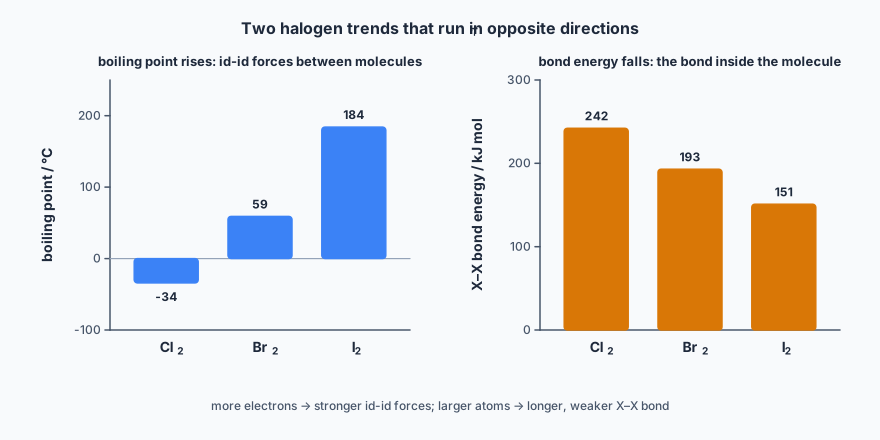
Volatility decreases down the group (boiling points rise). Halogen molecules are non-polar, so the only forces between them are id-id forces. Down the group the molecules have more electrons (Cl2 34, Br2 70, I2 106), which makes larger instantaneous dipoles possible, so the id-id forces are stronger and more energy is needed to separate the molecules.
Bond strength decreases down the group: Cl–Cl 242, Br–Br 193, I–I 151 kJ mol−1. The atoms are larger, so the bond is longer and the shared pair is further from both nuclei and more shielded; it is attracted less strongly. (Fluorine, at 158, breaks the pattern, because its small atoms bring the lone pairs close enough to repel; you do not need to explain this.)
Notice that the two trends run opposite ways: iodine has the weakest covalent bond but the strongest intermolecular forces. Boiling point is about the forces between molecules; bond strength is about the bond inside one.
11.2 The halogens and the hydrogen halides
Oxidising power
A more reactive halogen displaces a less reactive one from solutions of its halide:
In water, bromine is yellow-orange and iodine brown; shaking with a non-polar solvent such as cyclohexane makes the result clearer, because iodine dissolves in it with a violet colour and bromine orange. Chlorine oxidises both bromide and iodide; bromine oxidises only iodide; iodine oxidises neither. Oxidising power: Cl2 > Br2 > I2.
Reactions with hydrogen
- Fluorine reacts explosively, even in the cold and dark.
- Chlorine reacts explosively in sunlight (or when ignited), slowly in the dark.
- Bromine needs heating (about 300 °C) with a platinum catalyst.
- Iodine reacts only slowly on continuous heating, and the reaction is reversible — it never goes to completion.
Reactivity falls down the group for two reasons: the halogen is a weaker oxidising agent, and the H–X bond formed is weaker, so less energy is released.
Thermal stability of the hydrogen halides
Thermal stability decreases down the group. HCl does not decompose even at high temperatures; HBr decomposes slightly when strongly heated, giving some brown bromine vapour; HI decomposes easily — a red-hot wire plunged into it produces violet iodine vapour. The reason is bond strength: H–Cl 431, H–Br 366, H–I 299 kJ mol−1. As the halogen atom gets larger, the H–X bond is longer and weaker, so it needs less energy to break.
11.3 The halide ions
Reducing power
Halide ions act as reducing agents by losing an electron. Down the group the ion is larger, so the outer electron is further from the nucleus and more shielded, and is lost more easily. Reducing power: I− > Br− > Cl− — the reverse of the halogens’ oxidising power. You see it most clearly with concentrated sulfuric acid, below.
With silver ions, then ammonia
Acidify the solution with dilute nitric acid (to remove carbonate ions, which would also give a precipitate), then add silver nitrate solution:
- Chloride — white precipitate of AgCl; dissolves in dilute aqueous ammonia.
- Bromide — cream precipitate of AgBr; insoluble in dilute ammonia, dissolves in concentrated ammonia.
- Iodide — yellow precipitate of AgI; insoluble even in concentrated ammonia.
The colours shade into one another, so the ammonia is what makes the test reliable. (The precipitates dissolve because ammonia forms a soluble complex ion with silver; you do not need its formula.)
With concentrated sulfuric acid
Add concentrated sulfuric acid to a solid sodium halide. First, every halide undergoes the same acid–base reaction, making the hydrogen halide (steamy fumes in moist air):
What happens next depends on how strong a reducing agent the halide is:
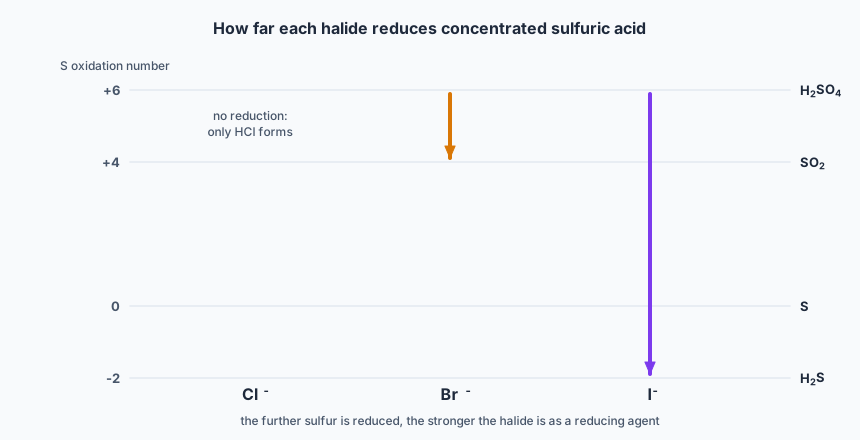
- Chloride: HCl is too weak a reducing agent to reduce sulfuric acid. You see only steamy fumes of HCl. No redox.
- Bromide: some HBr reduces the sulfuric acid (S +6 → +4): \[ \mathrm{2HBr + H_2SO_4 \rightarrow Br_2 + SO_2 + 2H_2O} \] You see steamy fumes and orange-brown fumes of bromine, with colourless, choking SO2.
- Iodide: HI is the strongest reducing agent and reduces sulfur further, to +4, 0 and −2: \[ \mathrm{2HI + H_2SO_4 \rightarrow I_2 + SO_2 + 2H_2O} \] \[ \mathrm{6HI + H_2SO_4 \rightarrow 3I_2 + S + 4H_2O} \] \[ \mathrm{8HI + H_2SO_4 \rightarrow 4I_2 + H_2S + 4H_2O} \] You see purple fumes and a black solid (iodine), a yellow solid (sulfur), and smell bad eggs (hydrogen sulfide).
The further the sulfur is reduced, the stronger the reducing agent — this is the evidence for the trend in reducing power.
11.4 The reactions of chlorine
With sodium hydroxide: disproportionation
In the cold reaction chlorine goes from 0 to −1 in NaCl (reduced) and to +1 in sodium chlorate(I), NaClO (oxidised). In the hot reaction it goes to −1 and to +5, in sodium chlorate(V), NaClO3. The same element is both oxidised and reduced, so both are disproportionation reactions (topic 6). The cold reaction is how household bleach, a solution of NaClO, is made.
Water purification
Chlorine is added to drinking water in small amounts to kill bacteria. It reacts with the water, again by disproportionation (0 → −1 and +1):
The active species that kill bacteria are HOCl (chloric(I) acid) and the ClO− ion, both of which are strong oxidising agents.
✏️Worked example
(a) A cream precipitate soluble only in concentrated ammonia is silver bromide, so X is bromine and the salt is NaBr (Mr 102.9).
(b) Steamy fumes (HBr), then orange-brown fumes of bromine; the colourless SO2 has a choking smell.
(c) Bromine goes from −1 in HBr to 0 in Br2: it is oxidised, so HBr (the bromide) is the reducing agent. Sulfur goes from +6 in H2SO4 to +4 in SO2: it is reduced, so sulfuric acid is the oxidising agent. The first reaction involves no change in oxidation number — it is an acid–base reaction.
📝Practise
Work through these, then reveal the answer. Each question targets a different objective from the list above.
1. Explain why iodine is a solid at room temperature while chlorine is a gas.
2. Chlorine water is added to aqueous potassium iodide, and the mixture is shaken with cyclohexane. Describe what you would see and write an ionic equation.
3. Explain why hydrogen iodide decomposes when a hot wire is placed in it, but hydrogen chloride does not.
4. Concentrated sulfuric acid is added to solid sodium iodide. Give the oxidation numbers of sulfur in each of the reduction products, and explain what this shows about iodide ions.
5. Chlorine reacts with hot, concentrated sodium hydroxide. Write the equation and use oxidation numbers to show that this is disproportionation.
6. Explain, with equations, how chlorine kills bacteria in drinking water.
🔗Go deeper — other people’s work
These are external resources, not mine. If one stops working, tell me and everything above it on this page still stands.
- Chemguide (Jim Clark) — the Group 7 pages, including the halide ions with concentrated sulfuric acid, set out step by step
- Royal Society of Chemistry — practical guides for halogen displacement and the silver halide tests