Polymerisation
🎯What you need to be able to do
- Describe the formation of polyesters from a diol with a dicarboxylic acid or dioyl chloride, and from a hydroxycarboxylic acid.
- Describe the formation of polyamides from a diamine with a dicarboxylic acid or dioyl chloride, from an aminocarboxylic acid, and from amino acids.
- Deduce the repeat unit of a condensation polymer from its monomers, and identify the monomers from a section of polymer.
- Predict the type of polymerisation from the monomers, or from a section of polymer.
- Recognise that poly(alkene)s are inert and hard to biodegrade, that some polymers are photodegradable, and that polyesters and polyamides can be hydrolysed.
📚The chemistry
AS polymers were addition polymers: alkene monomers joining with no other product (topic 20). Condensation polymers are made from monomers with two functional groups each, which react to form ester or amide links, and a small molecule — water or HCl — is eliminated at every link.
35.1 Polyesters
Ester links, –COO–, form between –COOH (or –COCl) and –OH groups.
- A diol and a dicarboxylic acid: each end of each monomer forms an ester link, eliminating water. The standard example is PET (Terylene), from benzene-1,4-dicarboxylic acid and ethane-1,2-diol: \[ \mathrm{n\,HOOCC_6H_4COOH + n\,HOCH_2CH_2OH \rightarrow {-}\!\left[OCC_6H_4COOCH_2CH_2O\right]_n\!{-} + 2n\,H_2O} \] The repeat unit is –OC–C6H4–COO–CH2CH2–O–.
- A diol and a dioyl chloride: the same polymer forms faster, at room temperature, eliminating HCl instead of water.
- A hydroxycarboxylic acid: one monomer carrying both groups can link to itself. 2-hydroxypropanoic (lactic) acid gives poly(lactic acid), PLA: \[ \mathrm{n\,HOCH(CH_3)COOH \rightarrow {-}\!\left[OCH(CH_3)CO\right]_n\!{-} + n\,H_2O} \]
Polyamides
Amide links, –CONH–, form between –COOH (or –COCl) and –NH2 groups.
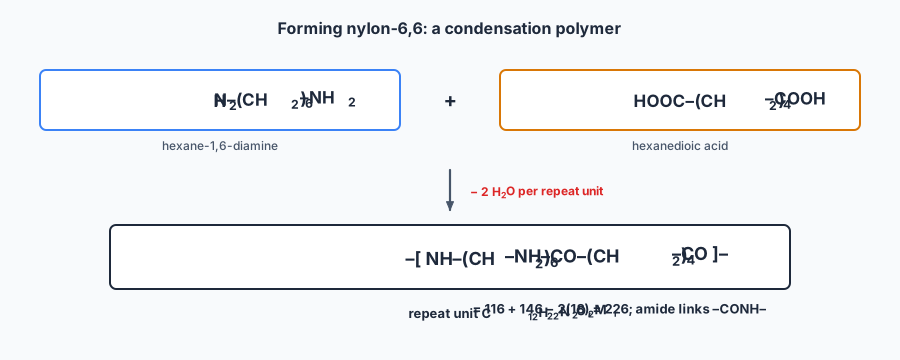
- A diamine and a dicarboxylic acid: nylon-6,6 from hexane-1,6-diamine and hexanedioic acid (the numbers count the carbons in each monomer): \[ \mathrm{n\,H_2N(CH_2)_6NH_2 + n\,HOOC(CH_2)_4COOH \rightarrow {-}\!\left[NH(CH_2)_6NHCO(CH_2)_4CO\right]_n\!{-} + 2n\,H_2O} \]
- A diamine and a dioyl chloride (e.g. hexanedioyl dichloride): faster, eliminating HCl. Kevlar is made from benzene-1,4-diamine and benzene-1,4-dicarbonyl dichloride this way.
- An aminocarboxylic acid: 6-aminohexanoic acid polymerises with itself to nylon-6, repeat unit –NH(CH2)5CO–.
- Amino acids: joining by peptide bonds gives polypeptides and proteins (topic 34). A protein is a natural polyamide.
Repeat units and monomers
From monomers to repeat unit: remove the atoms lost in the condensation (OH from the acid and H from the alcohol or amine for water; Cl and H for HCl), join the ends with an ester or amide link, and draw one of each monomer’s residue in the bracket, with continuation bonds at both ends. For two different monomers, the repeat unit contains one of each.
From a polymer section back to monomers:
- Find the ester (–COO–) or amide (–CONH–) links.
- Break each link between the C=O carbon and the O or N.
- Add OH to the C=O end (giving COOH, or Cl for a dioyl chloride) and H to the O or N end (giving OH or NH2).
35.2 Addition or condensation?
- A monomer with a C=C double bond (and no second reactive group) → addition polymerisation. The polymer’s main chain is all carbon, and there is no other product.
- Monomers with two reactive functional groups (OH, COOH, COCl, NH2) → condensation polymerisation. The main chain contains ester or amide links, and water or HCl is eliminated.
Looking at a polymer section: if the main chain is only carbon, it is an addition polymer; if it contains –COO– or –CONH–, it is a condensation polymer.
35.3 Degradable polymers
- Poly(alkene)s are chemically inert: their chains of strong, non-polar C–C and C–H bonds give nothing for water, acids, alkalis or enzymes to attack, so they are very difficult to biodegrade.
- Some polymers are photodegradable: they contain groups (such as C=O) that absorb ultraviolet light, and the absorbed energy breaks bonds in the chain, so the polymer breaks down in sunlight.
- Polyesters and polyamides can be hydrolysed: their ester and amide links are broken by acidic or alkaline hydrolysis (the reverse of condensation), giving back the monomers or their salts. That makes them biodegradable, given time — PLA, made from lactic acid from plant sugars, is used for compostable packaging for this reason.
✏️Worked example
(a) The repeat unit is –NH(CH2)6NHCO(CH2)4CO–, C12H22N2O2:
Check against the monomers: hexane-1,6-diamine (116) + hexanedioic acid (146) − 2 H2O (36) = 226.
(b) The chain contains ester links, –COO–, so it is a polyester, made by condensation. Breaking each ester link and adding H to the O ends and OH to the C=O ends gives ethane-1,2-diol, HOCH2CH2OH, and hexanedioic acid, HOOC(CH2)4COOH.
(c) Nylon-6,6 contains amide links, which are hydrolysed by hot aqueous acid, breaking the chain back into hexanedioic acid and the salt of hexane-1,6-diamine. Poly(propene) is an addition polymer whose chain is made only of strong, non-polar C–C and C–H bonds, with no polar link for water to attack, so it is inert.
📝Practise
Work through these, then reveal the answer. Each question targets a different objective from the list above.
1. Write the repeat unit of the polyester formed from butane-1,4-diol and benzene-1,4-dicarbonyl dichloride, and name the other product.
2. Identify the monomer(s) in –NHCH(CH3)CONHCH2CONHCH(CH3)CO–, and name the type of polymer.
3. Predict the type of polymerisation for each monomer (or pair): (a) CH2=CHCN; (b) H2N(CH2)5COOH; (c) HO(CH2)2OH with HOOC(CH2)2COOH.
4. Draw the repeat unit of the polymer made from 3-hydroxybutanoic acid, CH3CH(OH)CH2COOH.
5. Explain what is meant by a photodegradable polymer.
6. Describe the products of hydrolysing PET with hot aqueous sodium hydroxide.
🔗Go deeper — other people’s work
These are external resources, not mine. If one stops working, tell me and everything above it on this page still stands.
- Chemguide (Jim Clark) — the condensation polymers pages on polyesters and polyamides
- Royal Society of Chemistry — the “nylon rope trick” practical, making nylon from a diamine and a dioyl chloride