Halogen compounds
🎯What you need to be able to do
- Recall how halogenoalkanes are made from alkanes, alkenes and alcohols, with reagents and conditions.
- Classify halogenoalkanes as primary, secondary or tertiary.
- Describe nucleophilic substitution by aqueous NaOH, by KCN in ethanol and by NH3 in ethanol under pressure, and the silver nitrate test for the halogen.
- Describe elimination with NaOH in ethanol to form an alkene.
- Describe the SN1 and SN2 mechanisms, including the inductive effect of alkyl groups, and recall which classes react by which.
- Explain the different reactivities of halogenoalkanes in terms of C–X bond strength.
📚The chemistry
Making halogenoalkanes
- From alkanes — free-radical substitution with Cl2 or Br2 in UV light (topic 14). Gives a mixture.
- From alkenes — electrophilic addition of HX(g) at room temperature, or of X2 (which gives a dihalogenoalkane).
- From alcohols — substitution of the OH group by a halogen. Several
reagents do it:
- HX(g), or HCl made in situ from KCl with concentrated H2SO4 or concentrated H3PO4: ROH + HCl → RCl + H2O;
- PCl3 and heat: 3ROH + PCl3 → 3RCl + H3PO3;
- PCl5 at room temperature: ROH + PCl5 → RCl + POCl3 + HCl (steamy fumes — a test for an OH group);
- SOCl2: ROH + SOCl2 → RCl + SO2 + HCl. Both by-products are gases, so the product is easy to purify.
Primary, secondary and tertiary
Classify by the carbon that carries the halogen: count the alkyl groups attached to that carbon.
(Halogenomethanes, CH3X, have none and behave like primary ones.)
Nucleophilic substitution
Halogens are more electronegative than carbon, so the C–X bond is polar: Cδ+–Xδ−. A nucleophile is attracted to the δ+ carbon, forms a new bond to it using its lone pair, and the halogen leaves as a halide ion. Four reactions are named:
- NaOH(aq), heat (under reflux) → alcohol. This is also called hydrolysis. \[ \mathrm{CH_3CH_2Br + OH^{-} \rightarrow CH_3CH_2OH + Br^{-}} \]
- KCN in ethanol, heat → nitrile. The chain gets one carbon longer, which makes this reaction valuable in synthesis. \[ \mathrm{CH_3CH_2Br + CN^{-} \rightarrow CH_3CH_2CN + Br^{-}} \] The product is propanenitrile: the C of the CN group counts in the name.
- NH3 in ethanol, heated under pressure (in a sealed tube) → amine. Excess ammonia is used, because the amine formed is itself a nucleophile and would react further. \[ \mathrm{CH_3CH_2Br + 2NH_3 \rightarrow CH_3CH_2NH_2 + NH_4Br} \]
- Aqueous silver nitrate in ethanol — water acts as the nucleophile, slowly releasing the halide ion, which then precipitates with Ag+. The colour of the precipitate identifies the halogen: AgCl white, AgBr cream, AgI yellow (topic 11). For bromoethane: \[ \mathrm{CH_3CH_2Br + H_2O \rightarrow CH_3CH_2OH + H^{+} + Br^{-}} \] \[ \mathrm{Ag^{+}(aq) + Br^{-}(aq) \rightarrow AgBr(s)} \] Ethanol is the solvent because halogenoalkanes do not mix with water.
Elimination
Change the solvent to ethanol and hydroxide ions act as a base instead of a nucleophile: they remove H+ from the carbon next to the C–X, and HX is lost, forming a C=C double bond.
Substitution and elimination always compete. Aqueous conditions favour substitution (alcohol); ethanolic conditions and higher temperature favour elimination (alkene). Tertiary halogenoalkanes eliminate more readily than primary ones. With an unsymmetrical secondary or tertiary halogenoalkane, elimination can give more than one alkene.
The two mechanisms
SN2 — primary halogenoalkanes
Substitution, Nucleophilic, bimolecular — one step, involving two species.
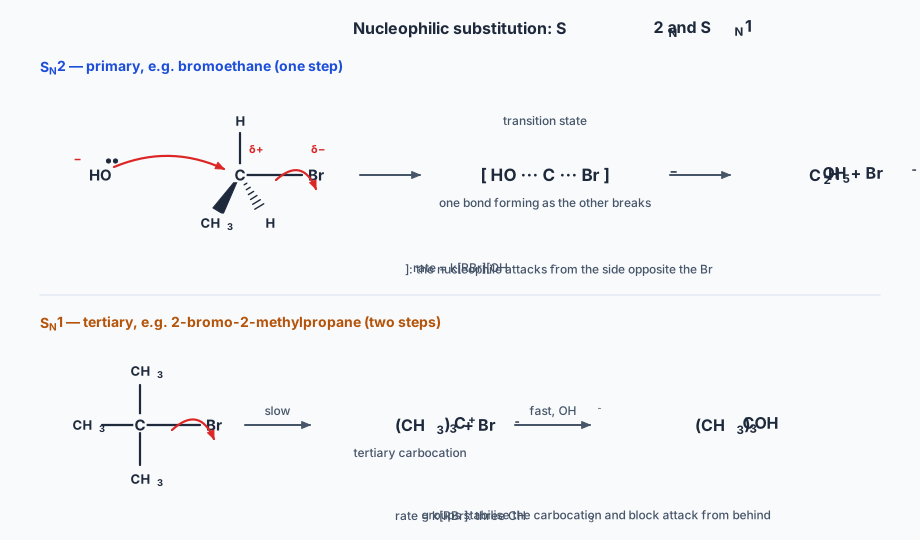
- The OH− approaches the δ+ carbon from the side opposite the halogen. Curly arrow from a lone pair on the O of OH− to the carbon; curly arrow from the C–Br bond to the Br.
- For an instant there is a transition state in which the carbon is partly bonded to both OH and Br (drawn with dashed bonds and an overall negative charge in square brackets); the other three groups are flattened into a plane.
- The C–Br bond breaks as the C–O bond forms: product alcohol + Br−. The molecule is turned inside out, like an umbrella in the wind.
The rate depends on both the halogenoalkane and the hydroxide concentration.
SN1 — tertiary halogenoalkanes
Substitution, Nucleophilic, unimolecular — two steps.
- Slow step: the C–Br bond breaks heterolytically on its own (curly arrow from the C–Br bond to Br), forming a tertiary carbocation, (CH3)3C+, and Br−.
- Fast step: OH− attacks the planar carbocation (curly arrow from its lone pair to C+), forming (CH3)3COH.
The rate depends only on the halogenoalkane, because only it is involved in the slow step.
Why the class decides the mechanism
- Tertiary → SN1. Three alkyl groups are electron-donating (positive inductive effect): they stabilise the carbocation, so it forms readily. They are also bulky, so they physically block a nucleophile approaching from behind (steric hindrance), which rules out SN2.
- Primary → SN2. A primary carbocation would have only one alkyl group to stabilise it, so it is too unstable to form; but the carbon is uncrowded, so the nucleophile can reach it from behind.
- Secondary → a mixture of both, depending on the structure and the conditions.
Reactivity and the C–X bond
From the data section, C–Cl 340, C–Br 280, C–I 240 kJ mol−1. Reactivity increases from chloroalkanes to iodoalkanes. You might expect the opposite, because the C–Cl bond is the most polar and so the carbon the most δ+. But experiment shows that iodoalkanes react fastest, so bond strength, not polarity, controls the rate: the weaker the C–X bond, the lower the activation energy for breaking it.
The silver nitrate experiment shows this directly. Warm equal amounts of 1-chloro-, 1-bromo- and 1-iodobutane with aqueous ethanolic AgNO3 in a water bath: the yellow AgI precipitate appears first, the cream AgBr next, and the white AgCl much later.
✏️Worked example
(a) CH3CH2CH2CH2Br + NaOH → CH3CH2CH2CH2OH + NaBr
(b) 1-bromobutane is primary, so it reacts by SN2. A curly arrow from a lone pair on the oxygen of OH− goes to the δ+ carbon, attacking from the side opposite the bromine; simultaneously a curly arrow goes from the C–Br bond to the bromine. Through a single transition state, [HO···C···Br]−, the C–O bond forms as the C–Br bond breaks, releasing Br−.
(c) The product is 2-methylpropan-2-ol, (CH3)3COH, by SN1. The bromine is on a tertiary carbon: the C–Br bond first breaks on its own to give the tertiary carbocation (CH3)3C+, which is stabilised by the electron-donating inductive effect of three methyl groups; OH− then attacks it. SN2 is blocked because the three methyl groups crowd the back of the carbon.
(d) Some bromobutane undergoes elimination to but-1-ene instead of substitution; reaction may be incomplete; and product is lost when the butanol is separated from the aqueous layer, dried and distilled.
📝Practise
Work through these, then reveal the answer. Each question targets a different objective from the list above.
1. Give two different reagents that convert propan-2-ol into 2-chloropropane, with an equation for each.
2. Classify as primary, secondary or tertiary: (a) 2-chlorobutane; (b) 1-iodo-2-methylpropane; (c) 2-bromo-2-methylbutane.
3. State the reagents and conditions, and name the product, when 1-bromopropane reacts with (a) KCN; (b) NH3; (c) NaOH to give an alkene.
4. Describe the SN1 mechanism for the hydrolysis of 2-bromo-2-methylpropane, and explain why this compound reacts this way.
5. Predict the order in which precipitates appear when 1-chlorobutane, 1-bromobutane and 1-iodobutane are warmed separately with aqueous ethanolic silver nitrate, and explain the order.
6. 2-bromobutane is heated with NaOH in ethanol. Name the organic products, and explain why there is more than one.
🔗Go deeper — other people’s work
These are external resources, not mine. If one stops working, tell me and everything above it on this page still stands.
- Chemguide (Jim Clark) — the nucleophilic substitution pages, with SN1 and SN2 drawn out
- ChemTube3D (University of Liverpool) — animated SN2, showing the inversion at the carbon
- Royal Society of Chemistry — the practical guide for comparing halogenoalkane hydrolysis rates with silver nitrate