Carboxylic acids and derivatives
🎯What you need to be able to do
- Recall how benzoic acid is made from methylbenzene.
- Describe how carboxylic acids are converted into acyl chlorides with PCl3 and heat, PCl5 or SOCl2.
- Recognise that methanoic acid and ethanedioic acid can be oxidised further, to carbon dioxide.
- Describe and explain the relative acidities of carboxylic acids, phenols and alcohols, and of chlorine-substituted carboxylic acids.
- Recall how esters are made from acyl chlorides (ethyl ethanoate, phenyl benzoate).
- Describe the reactions of acyl chlorides with water, alcohols, phenol, ammonia and amines, and the addition–elimination mechanism.
- Explain the relative ease of hydrolysis of acyl chlorides, alkyl chlorides and aryl chlorides.
📚The chemistry
33.1 Carboxylic acids
Making benzoic acid
Heat an alkylbenzene such as methylbenzene with hot alkaline KMnO4, then acidify with dilute acid (topic 30): C6H5CH3 + 3[O] → C6H5COOH + H2O.
Making acyl chlorides
The OH of the carboxyl group is replaced by Cl — the same three reagents that convert alcohols to chloroalkanes:
Acids that can be oxidised further
Most carboxylic acids resist oxidation, but two do not:
- Methanoic acid, HCOOH, contains an H–C=O group, like an aldehyde. It is oxidised to CO2 and H2O by Fehling’s or Tollens’ reagent (giving a brick-red precipitate or silver mirror, the only acid that does), or by acidified KMnO4 or K2Cr2O7: HCOOH + [O] → CO2 + H2O.
- Ethanedioic acid, HOOCCOOH, is oxidised by warm acidified KMnO4 to carbon dioxide: HOOCCOOH + [O] → 2CO2 + H2O. This is the basis of the manganate(VII)–ethanedioate titration (topic 28).
Acidity: acids, phenols and alcohols
Each is judged by the stability of its anion:
- Carboxylate ion, RCOO−: the negative charge is delocalised over two oxygen atoms (both C–O bonds become identical). Two electronegative atoms share the charge, so the ion is very stable, and carboxylic acids are the strongest of the group — strong enough to react with carbonates.
- Phenoxide ion: the charge is delocalised into the ring, but the ring’s carbon atoms are much less electronegative than oxygen, so this spreads the charge less effectively. Phenol is weaker than carboxylic acids (topic 32).
- Alkoxide ion: no delocalisation, and the alkyl group’s electron-donating effect intensifies the charge. Alcohols are the weakest.
Chlorine-substituted acids
Replacing H atoms in the alkyl group with chlorine makes the acid stronger (approximate pKa values; sources differ slightly, and a question will give its own):
Chlorine is electronegative: it withdraws electron density from the carboxylate group through the chain (a negative inductive effect). This spreads out the negative charge on the carboxylate ion and stabilises it, so the acid dissociates more. More chlorine atoms mean more withdrawal and a stronger acid. The effect also weakens with distance: a Cl on the carbon next to COOH strengthens the acid more than one further along the chain (2-chlorobutanoic acid is stronger than 4-chlorobutanoic acid).
33.2–33.3 Acyl chlorides and esters
An acyl chloride, RCOCl, is the most reactive derivative of a carboxylic acid. The carbonyl carbon is bonded to two electronegative atoms, O and Cl, which both pull electron density away from it, so it is strongly δ+. Acyl chlorides react rapidly at room temperature with nucleophiles, always releasing steamy fumes of HCl:
- Water — hydrolysis to the carboxylic acid (violent, fuming): \[ \mathrm{CH_3COCl + H_2O \rightarrow CH_3COOH + HCl} \]
- Alcohol — an ester: \[ \mathrm{CH_3COCl + C_2H_5OH \rightarrow CH_3COOC_2H_5 + HCl} \quad \text{ethyl ethanoate} \]
- Phenol — an ester. Phenols do not form esters well with carboxylic acids, so an acyl chloride is the way to make them: \[ \mathrm{C_6H_5COCl + C_6H_5OH \rightarrow C_6H_5COOC_6H_5 + HCl} \quad \text{phenyl benzoate} \]
- Ammonia — a primary amide (the HCl then reacts with excess ammonia to form NH4Cl): \[ \mathrm{CH_3COCl + NH_3 \rightarrow CH_3CONH_2 + HCl} \quad \text{ethanamide} \]
- Primary or secondary amine — a substituted amide: \[ \mathrm{CH_3COCl + CH_3NH_2 \rightarrow CH_3CONHCH_3 + HCl} \quad \text{N-methylethanamide} \]
The addition–elimination mechanism
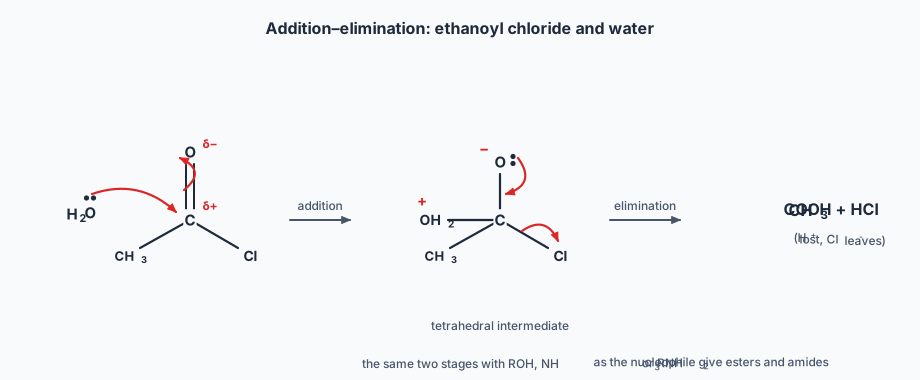
All five reactions follow the same two stages. For ethanoyl chloride with water:
- Addition: curly arrow from a lone pair on the O of water to the δ+ carbonyl carbon; curly arrow from the C=O π bond to the oxygen. This gives a tetrahedral intermediate, with O− and a positively charged OH2+ group.
- Elimination: curly arrow from a lone pair on O− back to reform the C=O bond; curly arrow from the C–Cl bond to Cl, which leaves as Cl−. Then H+ is lost from the OH2+, and it combines with Cl− to form HCl.
With an alcohol, ammonia or an amine the nucleophile is ROH, NH3 or RNH2 instead; the steps are identical.
Ease of hydrolysis
- Acyl chlorides are hydrolysed by cold water, instantly. The carbonyl carbon is very δ+ (bonded to both O and Cl), and it is planar and unhindered, so the nucleophile can easily attack by addition.
- Alkyl chlorides need warm aqueous alkali (or are hydrolysed slowly by water, as in the silver nitrate test). Their carbon is less δ+ (only one electronegative atom), and attack requires breaking a C–Cl bond at the same time (topic 15).
- Aryl chlorides are not hydrolysed under normal conditions: the C–Cl bond is strengthened by overlap with the ring’s π system, and the π electrons repel nucleophiles (topic 31).
✏️Worked example
(a) A violent reaction at room temperature, with steamy (white) fumes of HCl:
(b) Both products are acids. n(CH3COCl) = 3.93 / 78.5 = 0.0501 mol, giving 0.0501 mol of CH3COOH and 0.0501 mol of HCl, each of which reacts 1 : 1 with NaOH.
(c)(i) Propyl ethanoate, CH3COOCH2CH2CH3. (ii) Phenyl ethanoate, CH3COOC6H5. (iii) N-ethylethanamide, CH3CONHC2H5.
(d) The chlorine atom is electronegative and withdraws electron density from the COO− group of the anion. This spreads the negative charge further and stabilises the chloroethanoate ion, so the acid dissociates more readily: a larger Ka (pKa 2.86 against 4.76).
📝Practise
Work through these, then reveal the answer. Each question targets a different objective from the list above.
1. Give three reagents that convert benzoic acid into benzoyl chloride, with an equation for one.
2. Explain why methanoic acid gives a silver mirror with Tollens’ reagent but ethanoic acid does not.
3. Place in order of increasing acidity, and explain: CH3COOH, CCl3COOH, CH2ClCOOH, C6H5OH.
4. Describe the mechanism for the reaction of ethanoyl chloride with methanol.
5. Compare what happens when water is added to ethanoyl chloride, chloroethane and chlorobenzene, and explain.
6. Explain why phenyl benzoate is made from benzoyl chloride and phenol rather than from benzoic acid and phenol.
🔗Go deeper — other people’s work
These are external resources, not mine. If one stops working, tell me and everything above it on this page still stands.
- Chemguide (Jim Clark) — the acyl chlorides section, with the addition–elimination mechanism for each nucleophile