Nitrogen compounds
🎯What you need to be able to do
- Recall how primary and secondary amines are made: from halogenoalkanes with ammonia or amines, and by reducing amides and nitriles.
- Describe amide formation from acyl chlorides, and explain the basicity of amines.
- Describe making phenylamine from benzene, its reaction with bromine water and with nitrous acid, and the relative basicities of ammonia, ethylamine and phenylamine.
- Describe azo coupling and the use of azo compounds as dyes.
- Describe the hydrolysis and reduction of amides, and explain why amides are much weaker bases than amines.
- Describe the acid–base properties of amino acids, zwitterions and the isoelectric point; peptide bond formation; and interpret electrophoresis.
📚The chemistry
34.1 Primary and secondary amines
An amine is a derivative of ammonia with one or more H atoms replaced by alkyl or aryl groups: primary RNH2, secondary R2NH, tertiary R3N.
Making them
- Halogenoalkane + ammonia in ethanol, heated under pressure (sealed tube) → primary amine (topic 19).
- Halogenoalkane + primary amine in ethanol, heated in a sealed tube → secondary amine: CH3CH2Br + CH3NH2 → CH3CH2NHCH3 + HBr. This is why excess ammonia is used when a primary amine is wanted.
- Reduction of an amide with LiAlH4: the C=O becomes CH2. CH3CONH2 + 4[H] → CH3CH2NH2 + H2O.
- Reduction of a nitrile with LiAlH4 or H2/Ni: CH3CN + 4[H] → CH3CH2NH2. A route that adds a carbon (via KCN) and ends in an amine.
Basicity
Like ammonia, amines are Brønsted–Lowry bases: the lone pair on nitrogen accepts a proton. In water they give alkaline solutions:
and they react with acids to form salts: CH3CH2NH2 + HCl → CH3CH2NH3+Cl−.
With acyl chlorides, ammonia and amines form amides at room temperature, by addition–elimination (topic 33), a condensation reaction that eliminates HCl.
34.2 Phenylamine and azo compounds
Making phenylamine
- Nitrate benzene: concentrated HNO3 and H2SO4, 25–60 °C → nitrobenzene.
- Reduce with tin and concentrated HCl, heated under reflux: \[ \mathrm{C_6H_5NO_2 + 6[H] \rightarrow C_6H_5NH_2 + 2H_2O} \] In the acid, the product is present as its salt, C6H5NH3+.
- Add NaOH(aq) to release the free amine from its salt: C6H5NH3+ + OH− → C6H5NH2 + H2O.
Reactions of phenylamine
- Bromine water, room temperature: decolourised, with a white precipitate of 2,4,6-tribromophenylamine. Like OH in phenol, the NH2 lone pair feeds electron density into the ring and activates the 2-, 4- and 6-positions. \[ \mathrm{C_6H_5NH_2 + 3Br_2 \rightarrow C_6H_2Br_3NH_2 + 3HBr} \]
- Nitrous acid (NaNO2 + dilute HCl) below 10 °C → the benzenediazonium salt, C6H5N2+Cl−; warming it with water gives phenol and nitrogen (topic 32).
Azo compounds
Benzenediazonium chloride couples with phenol in NaOH(aq) to form an azo compound, containing the azo group, –N=N–, linking two aromatic rings. Because delocalisation extends over both rings and the N=N, these compounds absorb visible light and are brightly coloured: they are widely used as dyes. Other azo dyes are made the same way, by coupling different diazonium salts with different phenols or aromatic amines (for example with naphthol, giving red dyes).
Relative basicity: ethylamine > ammonia > phenylamine
Basicity depends on how available the nitrogen’s lone pair is to accept a proton:
- Ethylamine: the ethyl group is electron-donating (positive inductive effect), which increases the electron density on nitrogen and makes the lone pair more available. Stronger base than ammonia.
- Ammonia: no alkyl groups; the reference point.
- Phenylamine: the lone pair on nitrogen overlaps with the delocalised π system of the ring, so it is partly delocalised into the ring and less available to accept a proton. Much weaker base than ammonia.
34.3 Amides
Amides, RCONH2, are made from an acyl chloride with ammonia (primary amide) or a primary amine (secondary amide, RCONHR′), at room temperature.
- Hydrolysis with aqueous acid (heat): the carboxylic acid and the ammonium salt. \[ \mathrm{CH_3CONH_2 + H_2O + HCl \rightarrow CH_3COOH + NH_4Cl} \]
- Hydrolysis with aqueous alkali (heat): the carboxylate salt and ammonia gas. \[ \mathrm{CH_3CONH_2 + NaOH \rightarrow CH_3COONa + NH_3} \]
- Reduction with LiAlH4: the C=O is reduced to CH2, giving an amine.
Amides are much weaker bases than amines — effectively neutral. The lone pair on nitrogen is delocalised over the N–C=O group, drawn towards the very electronegative carbonyl oxygen. It is therefore not available to accept a proton.
34.4 Amino acids
An α-amino acid has an NH2 and a COOH on the same carbon: H2NCH(R)COOH, where R varies from one amino acid to another (H in glycine, CH3 in alanine).
Zwitterions and the isoelectric point
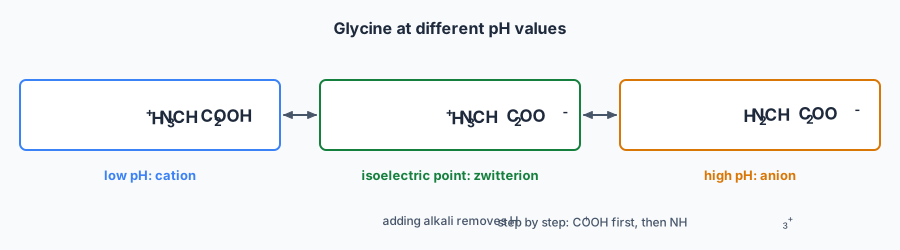
The molecule contains both an acidic group and a basic group, so it can transfer a proton internally, from COOH to NH2, forming a zwitterion: an ion with both a positive and a negative charge but no overall charge.
Solid amino acids exist as zwitterions, which is why they are crystalline solids with high melting points and are soluble in water. In solution, the form depends on the pH:
- in acid (low pH): the COO− takes an H+, giving a cation, +H3NCH(R)COOH;
- in alkali (high pH): the NH3+ loses an H+, giving an anion, H2NCH(R)COO−;
- at the isoelectric point, the pH at which the amino acid exists mainly as the zwitterion, it has no overall charge. Each amino acid has its own isoelectric point (glycine about 6.0; those with extra acidic side chains lower, extra basic side chains higher).
Peptides
The COOH of one amino acid reacts with the NH2 of another in a condensation reaction, eliminating water and forming an amide (peptide) bond, –CONH–. Two amino acids give a dipeptide, three a tripeptide. Two different amino acids can join in two orders, giving two different dipeptides: glycine + alanine gives Gly-Ala (H2NCH2CONHCH(CH3)COOH) and Ala-Gly.
Electrophoresis
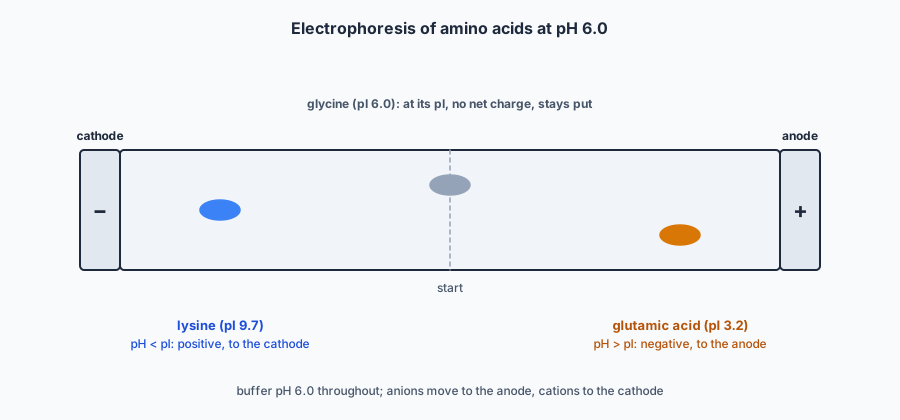
A mixture is placed in the middle of a gel soaked in a buffer of known pH, and a potential difference is applied. Each species moves according to its charge at that pH:
- if the pH is above its isoelectric point, the amino acid is negative (anion) and moves towards the positive electrode (anode);
- if the pH is below its isoelectric point, it is positive (cation) and moves towards the negative electrode (cathode);
- at its isoelectric point it has no net charge and does not move.
How far it moves depends on its charge and size: smaller and more highly charged ions move faster. So a dipeptide typically moves less far than an amino acid with the same charge. The separated spots are made visible with a developing agent (ninhydrin) and identified by comparison with standards.
✏️Worked example
(a)
- Glycine: pH 6.0 is its isoelectric point, so it is a zwitterion with no net charge and stays at the start.
- Lysine: pH 6.0 is below its isoelectric point, so it is protonated and positive: it moves towards the cathode (negative electrode).
- Glutamic acid: pH 6.0 is above its isoelectric point, so it has lost a proton and is negative: it moves towards the anode (positive electrode).
(b) At pH 1 (acid): +H3NCH2COOH. At pH 12 (alkali): H2NCH2COO−.
(c) ethylamine > ammonia > phenylamine > ethanamide. In ethanamide the nitrogen lone pair is delocalised over the N–C=O group towards the electronegative oxygen, so it is almost unavailable to accept a proton — ethanamide is essentially neutral, weaker even than phenylamine.
📝Practise
Work through these, then reveal the answer. Each question targets a different objective from the list above.
1. Give two ways of making propylamine, CH3CH2CH2NH2, one of which starts from a two-carbon compound.
2. Outline the preparation of phenylamine from benzene, with reagents and conditions.
3. Explain why phenylamine is a weaker base than ammonia, and ethylamine a stronger one.
4. Write equations for the hydrolysis of propanamide by (a) dilute HCl; (b) NaOH(aq).
5. Draw the two dipeptides that can form from glycine and alanine, and name the bond formed.
6. Explain why amino acids have high melting points and dissolve in water, whereas most organic compounds of similar size are liquids.
🔗Go deeper — other people’s work
These are external resources, not mine. If one stops working, tell me and everything above it on this page still stands.
- Chemguide (Jim Clark) — the amines and amino acids sections, including basicity and zwitterions
- Royal Society of Chemistry — resources on electrophoresis and on making azo dyes