Atomic structure
🎯What you need to be able to do
- Describe the atom as a tiny, dense nucleus of protons and neutrons with electrons in shells in the mostly empty space around it, and give the relative charge and mass of each particle.
- Use atomic (proton) number and mass (nucleon) number to count the protons, neutrons and electrons in any atom or ion.
- Predict how beams of protons, neutrons and electrons travelling at the same speed behave in an electric field.
- Explain the trends in atomic and ionic radius across a period and down a group.
- Define isotopes, use the notation AZX, and explain why isotopes share chemical properties but differ in mass and density.
- Use shells, sub-shells and orbitals to write full, shorthand and electrons-in-boxes configurations for atoms and ions from hydrogen to krypton, and sketch s and p orbitals.
- Define first ionisation energy, write equations for successive ionisation energies, and explain the trends using nuclear charge, radius, shielding and spin-pair repulsion.
- Use successive ionisation energy data to deduce an element’s configuration and its group.
📚The chemistry
1.1 Particles in the atom
Almost all of an atom is empty space. Its mass is concentrated in a nucleus roughly 105 times smaller than the atom itself, containing protons and neutrons. The electrons occupy shells in the space around it. So the mass of an atom is almost all in the nucleus, and its positive charge is all in the nucleus, while its negative charge is spread through the volume of the atom.
The atomic number (proton number, Z) is the number of protons; it defines the element. The mass number (nucleon number, A) is protons plus neutrons. In a neutral atom the number of electrons equals Z; an ion has lost electrons (positive) or gained them (negative) — the nucleus is unchanged.
So 56Fe3+ has 26 protons, 56 − 26 = 30 neutrons and 26 − 3 = 23 electrons; 32S2− has 16 protons, 16 neutrons and 16 + 2 = 18 electrons.
Beams in an electric field
Fire beams of the three particles at the same velocity between two charged plates:
- Neutrons are uncharged, so they pass straight through, undeflected.
- Protons are positive, so they curve towards the negative plate.
- Electrons are negative, so they curve towards the positive plate — and much more sharply than the protons. The size of the charge is the same, but the electron’s mass is about 1/1836 of the proton’s, so the same force gives it a far greater acceleration.
The deflection is proportional to charge ÷ mass. That one ratio answers every version of this question: an ion with twice the charge is deflected twice as much, and an ion with twice the mass is deflected half as much.
Atomic and ionic radius
- Across a period atomic radius decreases. The nuclear charge rises by one each step, but the electrons are being added to the same shell, so shielding barely changes. The larger effective pull draws the outer shell in.
- Down a group atomic radius increases: each element has one more occupied shell, further from the nucleus and shielded by more inner electrons. The extra nuclear charge is more than cancelled.
- Positive ions are smaller than their atoms. Na+ has lost its whole outer shell (3s), and the remaining electrons are pulled in more tightly by an unchanged nucleus.
- Negative ions are larger than their atoms. Cl− has the same nuclear charge as Cl but one more electron, so electron–electron repulsion increases and the shell expands.
- Across period 3 the ions fall into two families: Na+ > Mg2+ > Al3+ (same electron arrangement as neon, rising nuclear charge), then a jump up to the much larger P3− > S2− > Cl−, which have an extra shell.
1.2 Isotopes
Isotopes are atoms of the same element with the same number of protons but different numbers of neutrons. They are written AZX: 3517Cl and 3717Cl both have 17 protons, with 18 and 20 neutrons.
- Same chemical properties, because chemistry is decided by electrons. Isotopes have the same number of electrons in the same configuration, so they form the same bonds and undergo the same reactions.
- Different physical properties — for this syllabus, mass and density. The extra neutrons add mass without adding volume, so a sample of the heavier isotope is denser. Heavy water, D2O, is about 11% denser than H2O.
1.3 Electrons, energy levels and orbitals
Electrons occupy shells labelled by the principal quantum number n = 1, 2, 3… Each shell contains sub-shells (s, p, d), and each sub-shell is made of orbitals. An orbital is a region in which there is a high probability of finding an electron, and it holds at most two electrons, with opposite spins.
Shell 1 has only 1s; shell 2 has 2s and 2p; shell 3 has 3s, 3p and 3d. The order of increasing energy is
The one surprise is that 4s fills before 3d, because in the atoms where it matters 4s is slightly lower in energy. Electrons go into the lowest available sub-shell; within a sub-shell they occupy orbitals singly first, with parallel spins, and pair up only when every orbital has one. Pairing costs energy because two electrons in the same orbital repel.
Iron (Z = 26), three ways:
- Full: 1s2 2s2 2p6 3s2 3p6 3d6 4s2
- Shorthand: [Ar] 3d6 4s2
- Electrons in boxes: [Ar] then five 3d boxes holding ↑↓ ↑ ↑ ↑ ↑ and one 4s box holding ↑↓ — one pair and four unpaired electrons in 3d.
Two elements break the pattern, and are asked about constantly: chromium is [Ar] 3d5 4s1 and copper is [Ar] 3d10 4s1. A half-filled or completely filled 3d sub-shell is a lower-energy arrangement than the one you would predict.
When a transition element forms a positive ion, the 4s electrons are removed first, even though 4s filled first. Fe2+ is [Ar] 3d6, not [Ar] 3d4 4s2; Fe3+ is [Ar] 3d5.
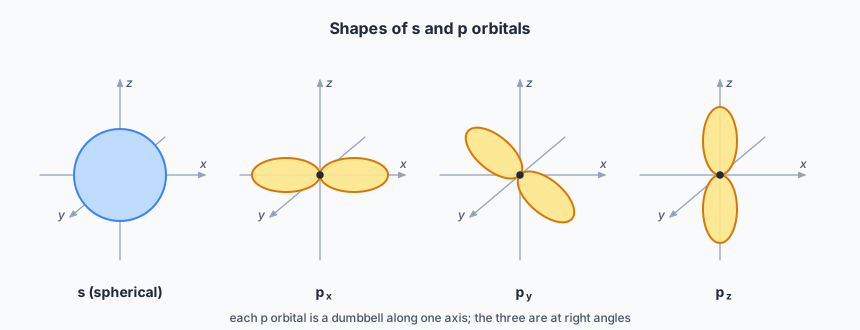
Shapes. An s orbital is spherical. A p orbital is dumbbell-shaped, two lobes either side of the nucleus, and the three p orbitals of a sub-shell lie along the x, y and z axes at right angles to one another. Sketch them that way.
A free radical is a species with one or more unpaired electrons — Cl•, CH3•, and also NO2. You will meet radicals again in organic chemistry.
1.4 Ionisation energy
The first ionisation energy is the energy required to remove one electron from each atom in one mole of gaseous atoms to form one mole of gaseous 1+ ions. Every part of that sentence is a marking point, and so are the state symbols in the equation:
The second ionisation energy removes an electron from each 1+ ion: Na+(g) → Na2+(g) + e−. Always one electron at a time, always gaseous. Ionisation energies are always endothermic: you are pulling a negative electron away from a positive nucleus that attracts it.
Four factors decide how large an ionisation energy is:
- Nuclear charge — more protons, stronger attraction, higher IE.
- Atomic or ionic radius — the further the electron is from the nucleus, the weaker the attraction.
- Shielding — inner shells and sub-shells repel the outer electron and reduce the pull it feels.
- Spin-pair repulsion — an electron sharing an orbital is repelled by its partner and is easier to remove.
Trends
Down a group, first IE decreases: the outer electron is in a shell further from the nucleus and more shielded, and that outweighs the extra protons.
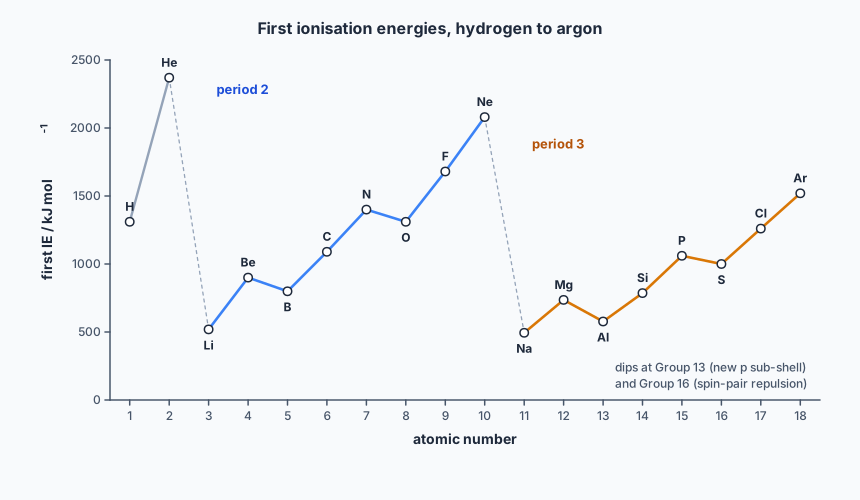
Across a period, first IE rises overall: nuclear charge increases while the electron is removed from the same shell with similar shielding. Two dips interrupt the rise, and explaining them is a standard question. In period 3 (values in kJ mol−1 from the data section):
- Mg 736 → Al 577. Aluminium’s outer electron is in a 3p sub-shell, higher in energy than magnesium’s 3s and partly shielded by the 3s electrons, so it is easier to remove despite the extra proton.
- P 1060 → S 1000. Phosphorus has three unpaired 3p electrons. In sulfur the fourth 3p electron must pair in an orbital already occupied, and the spin-pair repulsion makes it easier to remove.
The same two dips appear in period 2 (Be → B and N → O). The large drop from one period to the next (Ne 2080 → Na 494) is the start of a new shell.
Successive ionisation energies
Successive ionisation energies of one element always increase, because each electron is removed from an ion that is increasingly positive and smaller. The useful information is in the big jumps: a large jump means the next electron is coming from a shell closer to the nucleus. Count the electrons removed before the first big jump and you have the number of outer-shell electrons — the group number (for groups 1–2 and 13–18, counting the outer s and p electrons).
✏️Worked example
(a) The third ionisation energy removes an electron from each gaseous 2+ ion:
(b) Look at each IE divided by the one before it: 1820/577 = 3.2, 2740/1820 = 1.5, 11 600/2740 = 4.2. The jumps from the first to the second and second to third are modest; the jump to the fourth is much the largest. So three electrons come off relatively easily and the fourth comes from an inner shell. X has three outer electrons and is in Group 13; in period 3 that is aluminium, [Ne] 3s2 3p1. The fourth electron comes from the 2p sub-shell, one shell nearer the nucleus and far less shielded.
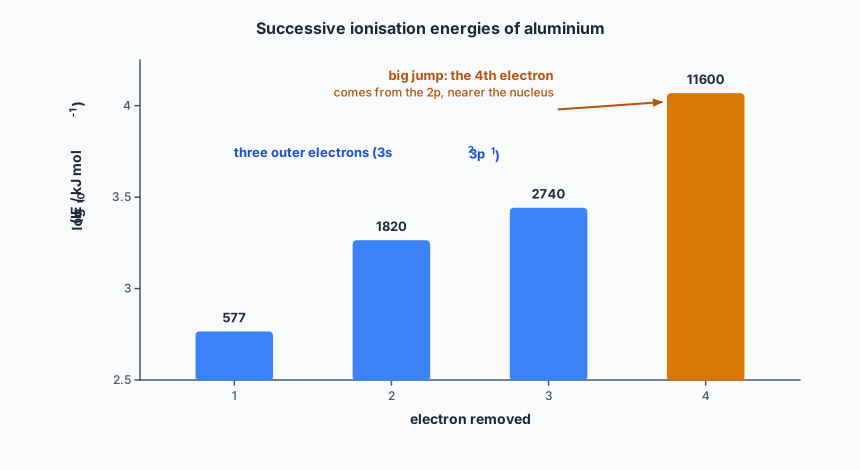
(c) The element before aluminium is magnesium, [Ne] 3s2. Aluminium’s first electron is removed from the 3p sub-shell, which is higher in energy than 3s and is shielded by the 3s electrons, so it is held less strongly even though aluminium has one more proton. First IE falls from 736 to 577 kJ mol−1.
📝Practise
Work through these, then reveal the answer. Each question targets a different objective from the list above.
1. State the numbers of protons, neutrons and electrons in 34S2−, 40Ca2+ and 2H+.
2. A beam containing protons, electrons and neutrons, all at the same velocity, passes between two oppositely charged plates. Describe and explain what happens to each.
3. Write the full electronic configurations of Cr, Cu+ and Fe3+, and state how many unpaired electrons each has.
4. Explain why the first ionisation energy of oxygen (1310 kJ mol−1) is lower than that of nitrogen (1400 kJ mol−1), although oxygen has more protons.
5. Explain why 35Cl and 37Cl react identically with sodium, but a sample of 37Cl2 gas is denser than a sample of 35Cl2 at the same temperature and pressure.
6. The first six ionisation energies of an element Y, in kJ mol−1, are 786, 1580, 3230, 4360, 16 100 and 19 800. Deduce the group of Y and explain your reasoning. Y is in period 3; identify it.
🔗Go deeper — other people’s work
These are external resources, not mine. If one stops working, tell me and everything above it on this page still stands.
- PhET — Build an Atom and Isotopes and Atomic Mass, for counting protons, neutrons and electrons interactively
- Chemguide (Jim Clark) — the atomic orbitals and ionisation energy pages, which go a little further than the syllabus and explain the 4s/3d ordering carefully
- Royal Society of Chemistry — the interactive periodic table, which plots first ionisation energy and atomic radius against atomic number