An introduction to organic chemistry
🎯What you need to be able to do
- Define a hydrocarbon, and recognise alkanes and the functional groups of the AS homologous series.
- Interpret and use general, structural, displayed and skeletal formulas, and deduce molecular and empirical formulas from them.
- Name simple aliphatic compounds systematically, up to six carbon atoms.
- Use the vocabulary of organic reactions and mechanisms: homologous series, saturated/unsaturated, homolytic/heterolytic fission, free radical, nucleophile, electrophile, the reaction types, [O] and [H], and curly arrows.
- Describe molecules as straight-chain, branched or cyclic, and explain shapes, bond angles and σ/π bonding from sp, sp2 and sp3 hybridisation.
- Describe structural isomerism (chain, positional, functional group) and stereoisomerism (geometrical and optical); identify chiral centres and cis/trans isomers; deduce the isomers of a given formula.
📚The chemistry
This page is the grammar of organic chemistry. None of it is hard, but every later organic topic assumes it, and Paper 1 tests it directly: naming, counting isomers, spotting chiral centres and classifying reactions are reliable marks once the rules are fixed.
13.1 Formulas, functional groups and names
A hydrocarbon is a compound of carbon and hydrogen only. Alkanes are the simplest hydrocarbons, with only single bonds and no functional group. A functional group is the atom or group of atoms that gives a family of compounds its characteristic chemical reactions. The AS families, with R and R′ standing for alkyl groups:
Four ways to write a formula
- General formula — the formula for every member of a homologous series: alkanes CnH2n+2, alkenes CnH2n, alcohols CnH2n+1OH.
- Structural formula — the minimum detail to show the structure unambiguously: CH3CH2CH2OH for propan-1-ol, not C3H7OH (which could also be propan-2-ol); CH3CHCHCH3 for but-2-ene.
- Displayed formula — every atom and every bond drawn out, including O–H and each C–H.
- Skeletal formula — carbon chains as zig-zag lines, each corner and end a carbon; hydrogens on carbon are omitted; every other atom and the H of a functional group (as in OH) is shown.
From any of these you should be able to count atoms to get the molecular formula, then divide by the highest common factor for the empirical formula (topic 2).
Naming
Systematic names are built from three parts, for chains up to six carbons (six plus six for esters):
- Stem from the longest chain containing the functional group: meth- (1), eth- (2), prop- (3), but- (4), pent- (5), hex- (6).
- Suffix for the main functional group: -ane, -ene, -ol, -al, -one, -oic acid, -nitrile, and for amines -amine (propylamine). Halogens and alkyl branches are prefixes: chloro-, bromo-, iodo-, methyl-, ethyl-.
- Numbers to give positions, counting from the end that gives the functional group the lowest number: pent-2-ene, not pent-3-ene; 2-methylbutane. Several identical groups take di-, tri-: 1,2-dibromoethane.
The carbon of an aldehyde, carboxylic acid or nitrile group is always carbon 1, so no number is needed: propanal, propanoic acid. Nitriles count the C of C≡N in the stem: CH3CH2CN is propanenitrile. Esters are named alkyl alkanoate, with the alcohol part first: CH3COOCH2CH3 is ethyl ethanoate.
13.2 The vocabulary of reactions
- Homologous series — a family with the same functional group and general formula, in which each member differs from the next by CH2, with similar chemical properties and a gradual trend in physical properties.
- Saturated — only single C–C bonds. Unsaturated — contains C=C (or C≡C).
- Homolytic fission — a covalent bond breaks and each atom takes one electron, forming two free radicals: Cl–Cl → 2Cl•. Heterolytic fission — one atom takes both electrons, forming a cation and an anion.
- Free radical — a species with an unpaired electron. Free-radical reactions go through initiation (radicals formed), propagation (a radical reacts to form a product and another radical) and termination (two radicals join).
- Nucleophile — an electron-pair donor, attracted to a δ+ carbon: OH−, CN−, NH3, H2O. Electrophile — an electron-pair acceptor, attracted to electron-rich regions such as C=C: H+, Brδ+, carbocations.
- Reaction types — addition (two molecules become one), substitution (one atom or group replaces another), elimination (a small molecule is removed, leaving a double bond), hydrolysis (a bond broken by reaction with water), condensation (two molecules join with loss of a small molecule such as water), oxidation and reduction.
- In organic redox equations [O] stands for one oxygen atom from an oxidising agent and [H] for one hydrogen atom from a reducing agent: CH3CH2OH + [O] → CH3CHO + H2O.
A mechanism type combines the attacking species with the reaction type: free-radical substitution (alkanes, topic 14), electrophilic addition (alkenes, topic 14), nucleophilic substitution (halogenoalkanes, topic 15) and nucleophilic addition (carbonyls, topic 17).
Curly arrows
A curly arrow shows the movement of a pair of electrons. The syllabus is precise about it: the arrow must start at a bond or at a lone pair and point to where the pair ends up — an atom (forming a new bond) or between two atoms. An arrow starting from a negative charge sign, or from an atom with no lone pair drawn, does not score. Show partial charges (δ+, δ−) on polar bonds, full charges on ions, and the lone pair on any nucleophile.
13.3 Shapes, and σ and π bonds
Organic molecules are straight-chain, branched or cyclic (a ring, as in cyclohexane). The shape around each carbon follows from its hybridisation (topic 3):
- sp3 — four σ bonds, tetrahedral, 109.5°. Every carbon in an alkane.
- sp2 — three σ bonds and one π, trigonal planar, 120°. Each carbon of C=C and the carbon of C=O. In ethene all six atoms lie in one plane: the molecule is planar, because the p orbitals must be parallel to overlap.
- sp — two σ and two π, linear, 180°. The carbon of C≡N in a nitrile.
13.4 Isomerism
Isomers have the same molecular formula but a different arrangement of atoms.
Structural isomerism — different structural formulas
- Chain — different carbon skeleton: butane and 2-methylpropane.
- Positional — same skeleton and group, different position: propan-1-ol and propan-2-ol; but-1-ene and but-2-ene.
- Functional group — different functional group: propanal and propanone (C3H6O); ethanol and methoxymethane. Alkenes and cycloalkanes share CnH2n too.
Stereoisomerism — same structural formula, different arrangement in space
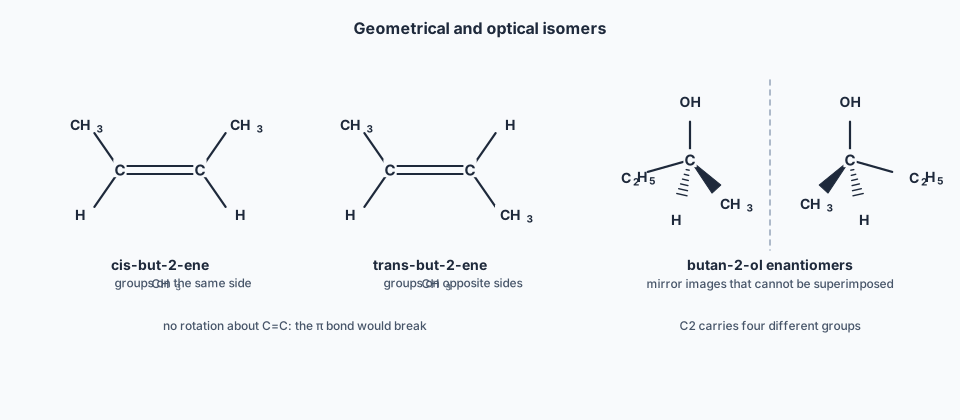
Geometrical (cis/trans) isomerism happens in alkenes because there is restricted rotation about the C=C bond: rotating one end would break the sideways overlap of the π bond. It needs two different groups on each carbon of the double bond. In cis-but-2-ene the two CH3 groups are on the same side; in trans they are on opposite sides. But-1-ene has two H atoms on one carbon, so it has no geometrical isomers. Rings restrict rotation too, so substituted cycloalkanes can show cis/trans isomerism. (E/Z names are accepted but not required.)
Optical isomerism arises from a chiral centre: a carbon atom bonded to four different atoms or groups. The molecule then exists as two optical isomers (enantiomers) — non-superimposable mirror images, like a left and a right hand. Butan-2-ol, CH3CH(OH)CH2CH3, has a chiral centre at C2 (bonded to H, OH, CH3 and C2H5). A molecule may contain more than one chiral centre. To find them, check every sp3 carbon: any carbon with two identical groups (CH2, CH3, or two identical chains) is not chiral.
✏️Worked example
(a) C4H8 fits CnH2n: either one C=C or one ring. Work systematically — straight-chain alkenes, branched alkenes, then rings:
- but-1-ene, CH2=CHCH2CH3 — the reference compound.
- cis-but-2-ene and trans-but-2-ene, CH3CH=CHCH3 — positional isomers of but-1-ene, and geometrical isomers of each other (each C of C=C carries H and CH3).
- 2-methylpropene, (CH3)2C=CH2 — a chain isomer. No cis/trans: both groups on one carbon are CH3.
- cyclobutane and methylcyclopropane — functional group isomers (a ring instead of C=C).
That is six isomers in all.
(b) C4H8 ÷ 4 = CH2.
(c) In 2-bromobutane, CH3CHBrCH2CH3, carbon 2 is bonded to H, Br, CH3 and CH2CH3 — four different groups. It is a chiral centre, so 2-bromobutane exists as two enantiomers.
📝Practise
Work through these, then reveal the answer. Each question targets a different objective from the list above.
1. Name: (a) CH3CH(CH3)CH2OH; (b) CH3COCH2CH3; (c) CH3CH2COOCH3; (d) CH3CHBrCH2CH2CH3.
2. Distinguish between homolytic and heterolytic fission, using the Br–Br bond as an example.
3. Classify each as a nucleophile or an electrophile, with a reason: OH−, NO2+, NH3, H+.
4. Describe the shape around each carbon in propene, CH2=CHCH3, giving bond angles and the numbers of σ and π bonds in the molecule.
5. Explain why but-2-ene has geometrical isomers but but-1-ene does not.
6. Identify the chiral centres, if any, in (a) propan-2-ol; (b) 2-hydroxypropanoic acid, CH3CH(OH)COOH; (c) 3-methylhexane.
🔗Go deeper — other people’s work
These are external resources, not mine. If one stops working, tell me and everything above it on this page still stands.
- Chemguide (Jim Clark) — the naming and isomerism pages, with many worked naming examples
- ChemTube3D (University of Liverpool) — rotatable models of cis/trans isomers and of enantiomers, to see why they cannot be superimposed