Chemical bonding
🎯What you need to be able to do
- Define electronegativity, explain what controls it and its trends, and use Pauling differences to predict whether a bond is ionic or covalent.
- Define and describe ionic, metallic, covalent and coordinate (dative) bonding, including the named examples and molecules with an expanded octet.
- Describe covalent bonds as σ and π overlap of orbitals and use sp, sp2 and sp3 hybridisation.
- Define bond energy and bond length, and use them to compare the reactivity of molecules.
- Use VSEPR theory to state, explain and predict the shapes and bond angles of molecules and ions.
- Describe id-id, pd-pd and hydrogen bonding; use hydrogen bonding to explain the anomalous properties of water; explain bond polarity and molecular dipoles.
- Draw dot-and-cross diagrams for ionic, covalent and coordinate bonding, including expanded octets and odd-electron species.
📚The chemistry
3.1 Electronegativity
Electronegativity is the power of an atom to attract electrons to itself — specifically, the pair of electrons in a covalent bond. It depends on the same three things as ionisation energy: nuclear charge (more protons, more pull), atomic radius (a bonding pair closer to the nucleus is pulled harder) and shielding by inner shells and sub-shells.
- Across a period it increases: nuclear charge rises, radius falls, and shielding hardly changes. Fluorine is the most electronegative element of all (4.0 on the Pauling scale).
- Down a group it decreases: each element has an extra shell, so the bonding pair is further away and more shielded.
The difference in electronegativity between two bonded atoms predicts the bond type. No difference gives a non-polar covalent bond (Cl–Cl); a moderate difference gives a polar covalent bond (H–Cl, 3.0 − 2.1 = 0.9); a large difference — as a working rule, more than about 1.8 — gives an ionic bond (NaCl, 3.0 − 0.9 = 2.1). Pauling values are given in the data section and in the question when you need them.
3.2–3.3 Ionic and metallic bonding
Ionic bonding is the electrostatic attraction between oppositely charged ions. Electrons transfer from metal to non-metal, and in the solid each ion is surrounded by ions of the opposite charge in a giant lattice. In sodium chloride, Na (2,8,1) gives one electron to Cl (2,8,7), forming Na+ and Cl−, each with a noble-gas arrangement. Magnesium oxide transfers two electrons, forming Mg2+ and O2−; the doubled charges make the attraction far stronger, which is why MgO melts at about 2850 °C and NaCl at 801 °C. In calcium fluoride each Ca gives one electron to each of two F atoms: Ca2+ and 2F−.
Metallic bonding is the electrostatic attraction between positive metal ions and delocalised electrons. The outer electrons are not attached to any one atom but move through the whole lattice. The more electrons each atom contributes, and the smaller and more highly charged the ions, the stronger the bonding.
3.4 Covalent and coordinate bonding
A covalent bond is the electrostatic attraction between the nuclei of two atoms and a shared pair of electrons. Both nuclei attract the same pair, and that is what holds them together. The syllabus names H2, O2, N2, Cl2, HCl, CO2, NH3, CH4, C2H6 and C2H4; you should be able to draw every one. O2 and C2H4 contain double bonds, N2 a triple bond, CO2 two double bonds.
Expanded octets. Elements in period 3 and beyond have empty 3d orbitals close in energy to 3s and 3p, so they can use more than four electron pairs around the central atom. Sulfur in SO2 has two S=O double bonds and a lone pair (ten electrons around S). Phosphorus in PCl5 has five bonding pairs; sulfur in SF6 has six. Period 2 elements cannot do this: nitrogen never forms NCl5, because it has no 2d sub-shell.
A coordinate (dative covalent) bond is a covalent bond in which both shared electrons come from the same atom. The donor needs a lone pair; the acceptor needs an empty orbital. Two examples are named:
- NH3 + HCl → NH4Cl. The lone pair on nitrogen is donated to an H+, forming NH4+. Once formed, the four N–H bonds are identical — you cannot tell which was the dative one.
- Al2Cl6. In AlCl3 the aluminium has only six outer electrons. At lower temperatures two molecules join: a lone pair on a chlorine of each molecule is donated to the aluminium of the other, forming two Cl→Al dative bonds that bridge the two Al atoms.
Draw a dative bond as an arrow from donor to acceptor.
σ and π bonds, and hybridisation
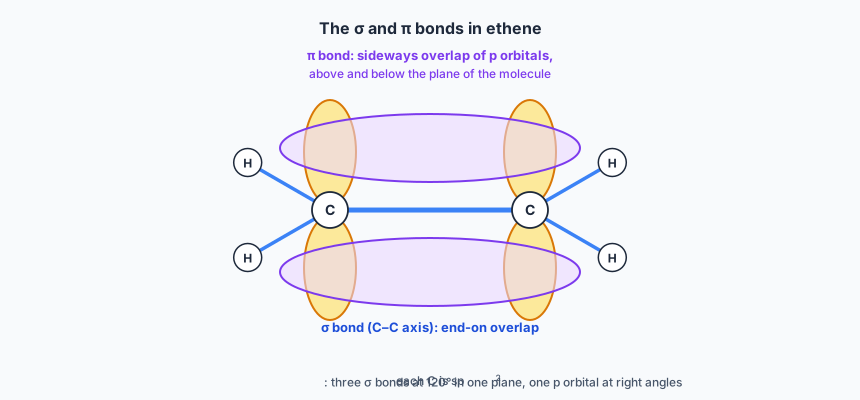
A σ (sigma) bond forms by direct, end-on overlap of orbitals along the line between the two nuclei. Every single bond is a σ bond. A π (pi) bond forms by the sideways overlap of adjacent p orbitals, giving electron density above and below the σ bond. A double bond is one σ plus one π; a triple bond is one σ plus two π.
The π bond is the weaker of the two, because sideways overlap is less effective. The data section shows it: C=C is 610 kJ mol−1, less than twice C–C (2 × 350 = 700). That weakness is why alkenes react by breaking their π bond.
Hybridisation explains the geometry. The s and p orbitals of the central atom mix to form a set of equivalent hybrid orbitals:
- sp3 — one s + three p → four hybrids pointing to the corners of a tetrahedron, 109.5° apart. Carbon in CH4 and C2H6: four σ bonds.
- sp2 — one s + two p → three hybrids in a plane, 120° apart, with one unhybridised p orbital at right angles. Carbon in C2H4: three σ bonds, and the leftover p orbitals on the two carbons overlap sideways to form the π bond.
- sp — one s + one p → two hybrids at 180°, with two unhybridised p orbitals. Carbon in HCN: two σ bonds (to H and N) and two π bonds to N. N2 is the same: one σ and two π.
Bond energy, bond length and reactivity
Bond energy is the energy required to break one mole of a particular covalent bond in the gaseous state. Bond length is the internuclear distance between two covalently bonded atoms. In general, the shorter the bond, the stronger it is, and the stronger the bonds in a molecule, the less reactive it is.
- N2 has a triple bond of 944 kJ mol−1. That is why nitrogen is so unreactive, and why the Haber process needs an iron catalyst and high temperature.
- The hydrogen halides get longer and weaker down the group: H–Cl 431, H–Br 366, H–I 299 kJ mol−1. HI is the easiest to decompose into its elements; a hot wire will do it.
3.5 Shapes of molecules
VSEPR (valence shell electron pair repulsion) theory: electron pairs around a central atom repel each other and arrange themselves as far apart as possible. The method is always the same:
- Count the outer electrons on the central atom; add one for each negative charge, subtract one for each positive charge.
- Work out how many are used in bonds and how many are left as lone pairs.
- Count the regions of electron density. A double or triple bond counts as one region, like a single bond.
- Arrange the regions as far apart as possible, then name the shape from the positions of the atoms only.
- Adjust the angle: lone pair–lone pair repulsion > lone pair–bond pair > bond pair–bond pair, so each lone pair squeezes the bond angle by about 2.5°.
The seven named shapes:
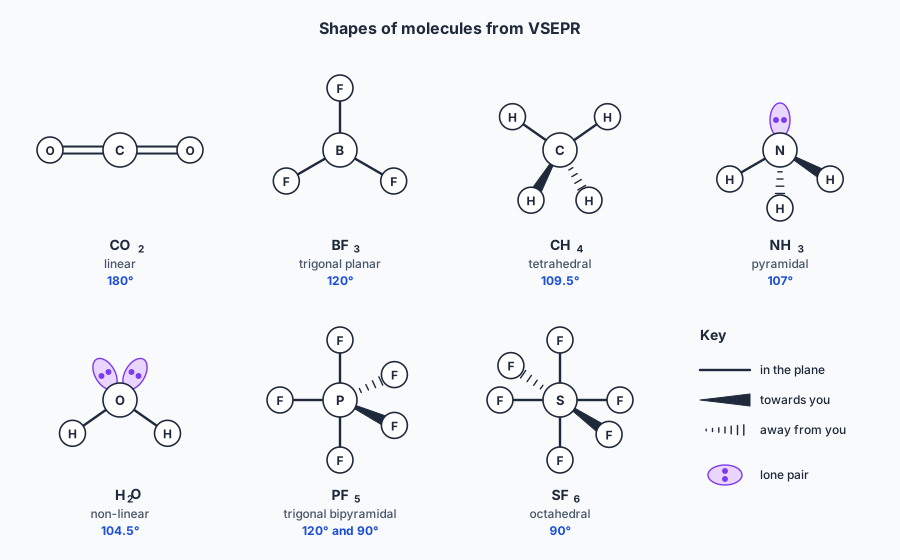
You are expected to predict the shapes of analogous species: NH4+ is tetrahedral like CH4; PH3 is pyramidal like NH3; H2S is non-linear like H2O; SiCl4 is tetrahedral.
3.6 Intermolecular forces
Cambridge uses van der Waals’ forces as the generic name for all intermolecular forces — the forces between molecules other than those from bond formation. There are two types in this syllabus:
- Instantaneous dipole–induced dipole (id-id), also called London dispersion forces. Electrons are always moving, so at any instant the electron cloud may be uneven, creating a temporary dipole. That induces a dipole in a neighbouring molecule, and the two attract. They act between all molecules. They get stronger with more electrons (bigger molecules) and with more surface contact: pentane (a straight chain) boils at 36 °C, its branched isomer 2,2-dimethylpropane at 10 °C.
- Permanent dipole–permanent dipole (pd-pd), between polar molecules. The δ+ end of one molecule attracts the δ− end of the next.
Hydrogen bonding is a special, strong case of pd-pd attraction. It happens when hydrogen is bonded to a highly electronegative atom — in this syllabus, N–H and O–H groups. The H carries a large δ+ and is attracted to a lone pair on an N or O atom of another molecule. Draw it with the lone pair shown and the O–H···O atoms in a straight line.
Ionic, covalent and metallic bonds are, in general, much stronger than any intermolecular force. Boiling a molecular liquid breaks intermolecular forces, not covalent bonds: water boils to H2O molecules, not to hydrogen and oxygen.
Polarity and dipoles
A bond between atoms of different electronegativity is polar: the more electronegative atom is δ−. Whether the molecule has a dipole depends on its shape. If polar bonds are arranged symmetrically, their dipoles cancel: CO2 (linear) and CCl4 (tetrahedral) have polar bonds but no overall dipole. H2O (non-linear), NH3 (pyramidal) and CHCl3 (one H among three Cl) are polar molecules.
Why water is strange
Each water molecule has two H atoms and two lone pairs, so it can form up to four hydrogen bonds. That explains the three anomalies the syllabus lists:
- High melting and boiling points. H2O boils at 100 °C, while H2S, a bigger molecule with more electrons, boils at about −60 °C. Extra energy is needed to break the hydrogen bonds.
- High surface tension. Molecules at the surface are pulled inwards by hydrogen bonds to the molecules below.
- Ice is less dense than liquid water. In ice, every molecule forms four hydrogen bonds in a tetrahedral arrangement, holding the molecules in an open lattice with a lot of empty space. On melting, some hydrogen bonds break and the molecules pack more closely. So ice floats.
3.7 Dot-and-cross diagrams
Show the electrons of one atom as dots and the other as crosses, outer shells only unless asked. For ionic compounds draw separate ions in square brackets with the charge outside, e.g. [Na]+ and [Cl]− with eight electrons, seven dots and one cross. For covalent molecules put the shared pairs in the overlap of the circles and show every lone pair. For a dative bond the shared pair is two of the same symbol.
You may be asked for species with an expanded octet (PCl5, SF6, SO2) or an odd number of electrons, such as NO or NO2, where one atom ends up with an unpaired electron — a free radical, as in topic 1.
✏️Worked example
(a) PCl3. Phosphorus is in Group 15: 5 outer electrons. Three form bonds to Cl, leaving 2 = one lone pair. Four regions of electron density take up a tetrahedral arrangement; with one position occupied by the lone pair, the atoms form a trigonal pyramid. The lone pair repels more strongly than the bonding pairs, closing the angle from 109.5° to about 107° — the same as NH3.
(b) SO2. Sulfur has 6 outer electrons. Each S=O double bond uses 2 of them, so 4 are used and 2 are left: one lone pair. There are three regions (two double bonds, each counting as one, plus the lone pair), arranged trigonal planar. The atoms alone make a non-linear (bent) shape. The lone pair squeezes the angle slightly below 120°: about 119°.
(c) ICl4−. Iodine has 7 outer electrons, plus 1 for the negative charge = 8. Four form bonds to Cl, leaving 4 = two lone pairs. Six regions take an octahedral arrangement. The two lone pairs go opposite each other (180° apart) to minimise lone pair–lone pair repulsion, leaving the four Cl atoms in one plane: square planar, 90°.
(d) Each P–Cl bond is polar (Cl 3.0 is more electronegative than P 2.2). The molecule is pyramidal, not symmetrical, so the three bond dipoles do not cancel: PCl3 is polar, with the Cl atoms at the δ− side.
📝Practise
Work through these, then reveal the answer. Each question targets a different objective from the list above.
1. Explain why electronegativity increases across period 3 from sodium to chlorine.
2. State the number of σ and π bonds in (a) ethene, C2H4, and (b) hydrogen cyanide, HCN. Describe how the π bond in ethene forms, and give the hybridisation of each carbon.
3. Explain, in terms of intermolecular forces, why ethanol (Mr 46) boils at 78 °C but propane (Mr 44) boils at −42 °C.
4. Describe the bonding in Al2Cl6, and explain why AlCl3 forms this dimer.
5. Explain why ice is less dense than liquid water.
6. Predict the shape and bond angle of (a) the NH4+ ion; (b) the NH2− ion; (c) PCl6−.
🔗Go deeper — other people’s work
These are external resources, not mine. If one stops working, tell me and everything above it on this page still stands.
- PhET — Molecule Shapes, which lets you add bonds and lone pairs and watch the shape and angles change
- Chemguide (Jim Clark) — the bonding section, including the pages on hybridisation and on intermolecular forces
- ChemTube3D (University of Liverpool) — rotatable 3D models of orbitals, hybrids and molecular shapes