Characteristics and classification of living organisms
🎯What you need to be able to do
- Describe the seven characteristics of living organisms.
- Define a species, describe the binomial system, and construct and use dichotomous keys.
- State the features used to classify animals and plants, the vertebrate groups and the arthropod groups.
- State the features of the five kingdoms, of ferns and flowering plants, and of viruses EXTENDED.
- Explain how classification reflects evolutionary relationships, and how DNA base sequences are used EXTENDED.
📚The biology
The characteristics of living organisms
A car moves, “breathes” air and gets rid of waste gases, but it does not grow or reproduce, so it is not alive. Learn the definitions word for word: examiners look for “permanent” and “dry mass” in growth, and “waste products of metabolism” in excretion.
Species, naming and keys
Organisms are classified into groups by the features they share. A species is a group of organisms that can reproduce to produce fertile offspring. A horse and a donkey can breed, but the mule they produce is infertile, so they are different species.
The binomial system is an internationally agreed system in which each species has a two-part scientific name: the genus then the species. The Bali starling is Leucopsar rothschildi: genus Leucopsar, species rothschildi. The genus has a capital letter; the whole name is written in italics (or underlined by hand).
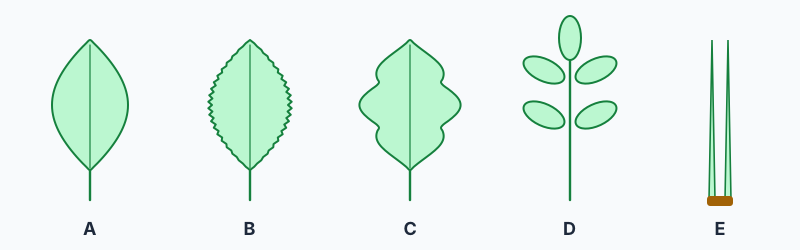
A dichotomous key identifies organisms by a series of questions, each with exactly two answers, based on features you can see.
Features of animals and plants
Animals are multicellular, have no cell walls and no chlorophyll, and feed on other organisms. Plants are multicellular, have cell walls made of cellulose and chloroplasts, and make their food by photosynthesis. The main vertebrate groups:
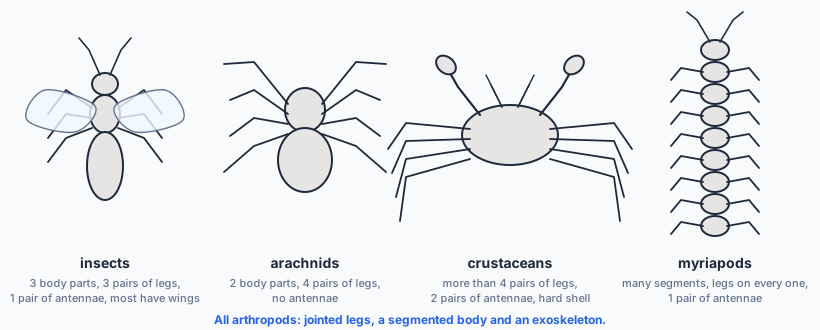
Arthropods are invertebrates with jointed legs, a segmented body and an exoskeleton. There are four groups:
The five kingdoms EXTENDED
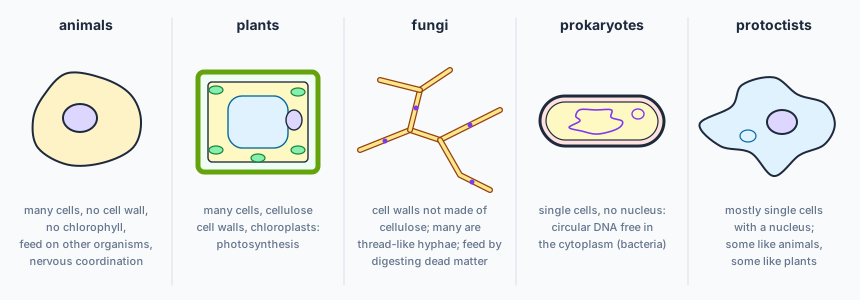
EXTENDED Fungi have a nucleus and cell walls (not of cellulose) but no chlorophyll; they feed by secreting enzymes on to dead or living material and absorbing the products. Yeast is a single-celled fungus. Prokaryotes (bacteria) are single cells with a cell wall, circular DNA and plasmids but no nucleus. Protoctists are mostly single-celled organisms with a nucleus; some (like Amoeba) are animal-like, others (like algae) contain chloroplasts.
EXTENDED Within the plant kingdom:
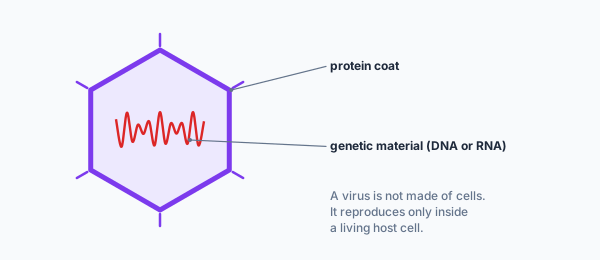
EXTENDED Viruses are not placed in any kingdom: they are not cells. A virus is a protein coat surrounding genetic material.
Classification and evolution EXTENDED
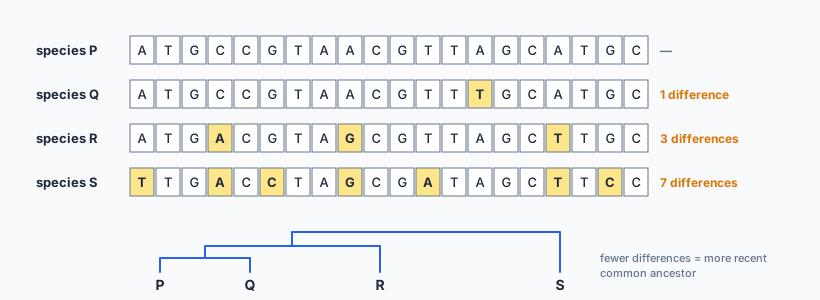
Classification systems aim to reflect evolutionary relationships. The sequence of bases in DNA is now used to classify organisms: groups that share a more recent common ancestor have DNA base sequences that are more similar than groups that share only a distant ancestor.
✏️Worked example
(a) One correct key (each step splits the group into two using a visible feature):
- Leaf divided into separate leaflets … D. Leaf not divided … go to 2.
- Leaf long, thin and needle-like … E. Leaf broad and flat … go to 3.
- Edge of leaf lobed (deep, rounded bulges) … C. Edge not lobed … go to 4.
- Edge of leaf toothed … B. Edge smooth … A.
(b) Species Q: its sequence differs from P’s at only 1 base (R at 3, S at 7), so P and Q share the most recent common ancestor.
📝Practise
In the style of the multiple-choice and theory papers. EXTENDED marks Supplement content.
1. (Multiple choice.) Which is the definition of growth? A: an increase in the number of cells. B: a permanent increase in size and dry mass. C: an increase in mass due to water uptake. D: the development of adult features.
2. (Theory.) A horse and a donkey can mate and produce a mule, but mules cannot reproduce. Explain whether horses and donkeys belong to the same species. [2]
3. (Theory.) The Komodo dragon is Varanus komodoensis. State the genus, and give one advantage of using the binomial system rather than common names. [2]
4. (Theory.) An animal has moist skin without scales and lays jelly-covered eggs in water; its young breathe using gills. Name its vertebrate group. [1]
5. (Theory.) An arthropod has two body parts, eight jointed legs and no antennae. Name its group, and state one feature shared by all arthropods. [2]
6. (Theory.) EXTENDED Name the kingdom of (a) a single-celled organism with circular DNA and no nucleus, (b) a mushroom. [2]
7. (Theory.) EXTENDED A plant has leaves with parallel veins and flowers with parts in threes. Is it a monocotyledon or a dicotyledon? Give one other feature you would expect. [2]
8. (Theory.) EXTENDED State the two structural features of a virus and explain why viruses are not placed in any of the five kingdoms. [3]
🔗Go deeper — other people’s work
These are external resources, not mine. If one stops working, tell me and everything above it on this page still stands.
- Natural History Museum — identification keys for leaves, insects and other groups
- OneZoom — an explorable tree of life showing how groups are related