Monohybrid inheritance
🎯What you need to be able to do
- Describe inheritance, genotype, phenotype, homozygous, heterozygous, pure-breeding, dominant and recessive.
- Interpret pedigree diagrams; use genetic diagrams and Punnett squares to predict 1 : 1 and 3 : 1 ratios.
- Explain a test cross; describe codominance and the ABO blood groups EXTENDED.
- Describe sex linkage, with red-green colour blindness, and use genetic diagrams for codominance and sex linkage EXTENDED.
📚The biology
Vocabulary
Genetic diagrams
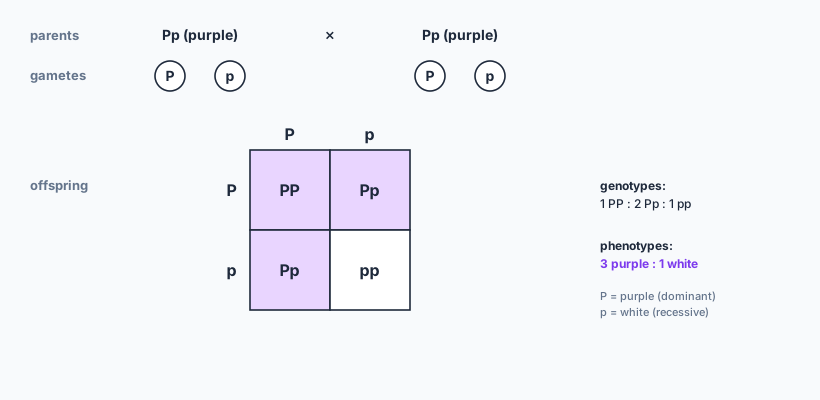
Set out a genetic diagram in the same steps every time: parental phenotypes, parental genotypes, gametes (circled), offspring genotypes (Punnett square), offspring phenotypes, ratio. A 1 : 1 ratio comes from heterozygous × homozygous recessive (Pp × pp).
Ratios are predictions of probability. With small numbers of offspring the actual numbers often differ from the ratio, because fertilisation is random.
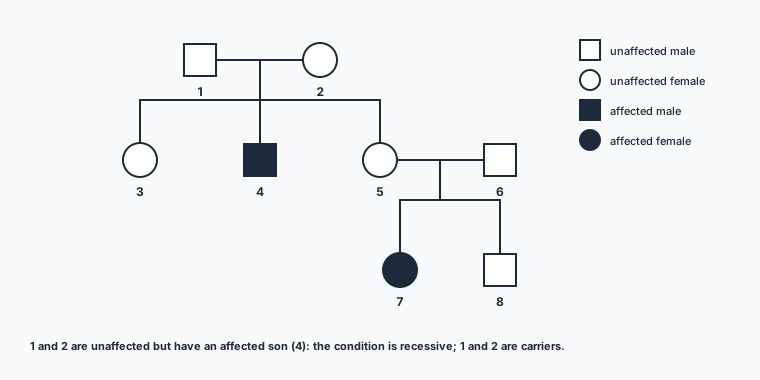
Pedigree diagrams
The test cross EXTENDED
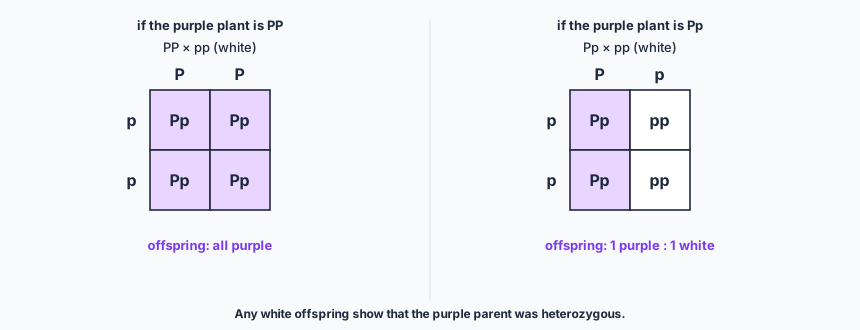
EXTENDED An organism showing the dominant phenotype could be homozygous or heterozygous. Crossing it with a homozygous recessive individual reveals which: all offspring with the dominant phenotype means it is homozygous; any recessive offspring (about half) mean it is heterozygous.
Codominance and blood groups EXTENDED
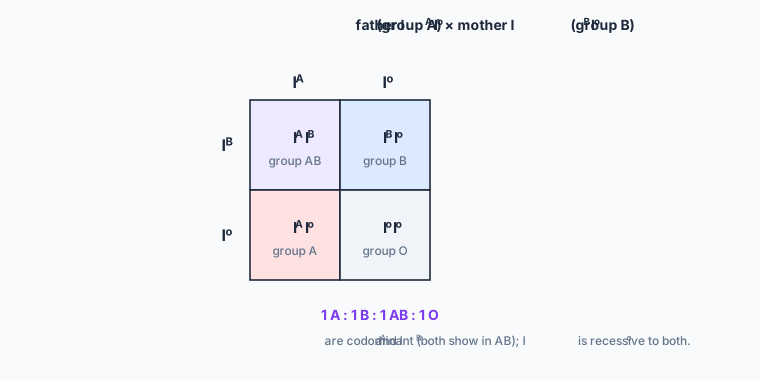
EXTENDED In codominance both alleles in a heterozygous organism contribute to the phenotype. The ABO blood groups are controlled by three alleles: IA and IB are codominant, and both are dominant to Io. So IAIA and IAIo are group A; IBIB and IBIo are group B; IAIB is group AB; IoIo is group O.
Sex linkage EXTENDED
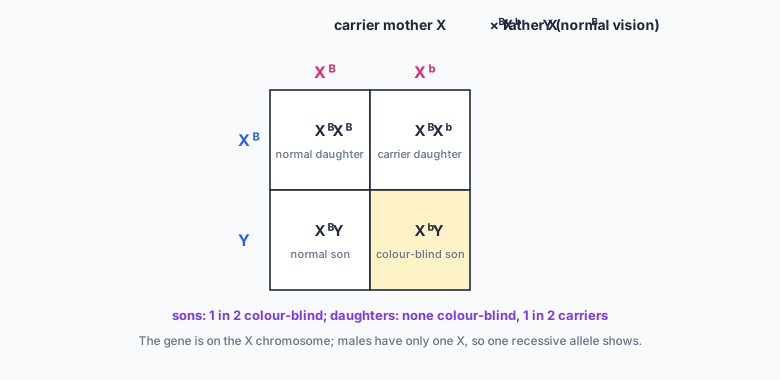
EXTENDED A sex-linked characteristic is one where the gene responsible is on a sex chromosome, which makes it more common in one sex than the other. Red-green colour blindness is caused by a recessive allele on the X chromosome. Males have only one X, so a single recessive allele (XbY) causes colour blindness; females need two (XbXb), so it is much more common in males.
✏️Worked example
(a) Person 4 is affected: nn. Person 1 is unaffected but has an affected son: Nn.
(b) Nn × Nn; gametes N, n and N, n; offspring NN, Nn, Nn, nn; one in four is nn: probability 0.25 (25%, 1 in 4).
(c) Cross it with a white-flowered plant (pp). If all the offspring are purple, it is PP (pure-breeding); if some are white, it is Pp.
📝Practise
In the style of the multiple-choice and theory papers. EXTENDED marks Supplement content.
1. (Multiple choice.) An organism with genotype Tt is described as: A: homozygous dominant. B: homozygous recessive. C: heterozygous. D: pure-breeding.
2. (Theory.) In pea plants, round seeds (R) are dominant to wrinkled (r). Give the phenotype of a plant with genotype Rr, and of one with rr. [2]
3. (Theory.) A heterozygous round-seeded plant is crossed with a wrinkled-seeded plant. Draw a genetic diagram and give the expected ratio. [4]
4. (Theory.) From a cross of two heterozygous plants, 120 seeds are produced. Predict how many are wrinkled. [2]
5. (Theory.) Explain why two homozygous recessive parents cannot have a child with the dominant phenotype. [2]
6. (Theory.) EXTENDED A man of blood group AB and a woman of group O have children. State the possible blood groups of the children. [3]
7. (Theory.) EXTENDED A colour-blind man (XbY) and a woman who is not a carrier (XBXB) have children. What proportion of their daughters are carriers? [2]
8. (Theory.) EXTENDED Explain why red-green colour blindness is more common in males. [2]
🔗Go deeper — other people’s work
These are external resources, not mine. If one stops working, tell me and everything above it on this page still stands.
- Learn Genetics (University of Utah) — Punnett squares and pedigrees, interactive
- Colour Blind Awareness — how colour blindness is inherited