Enzymes
🎯What you need to be able to do
- Describe a catalyst and describe enzymes as proteins that act as biological catalysts in all metabolic reactions.
- Explain why enzymes are needed, and describe enzyme action in terms of the active site’s shape being complementary to the substrate.
- Investigate and describe the effects of temperature and pH, using the terms optimum and denaturation.
- Explain enzyme action, specificity and the effects of temperature and pH in detail EXTENDED.
📚The biology
Enzymes as catalysts
A catalyst is a substance that increases the rate of a chemical reaction and is not changed by the reaction. Enzymes are proteins that act as biological catalysts in all metabolic reactions. Without them, reactions at body temperature would be far too slow to sustain life.
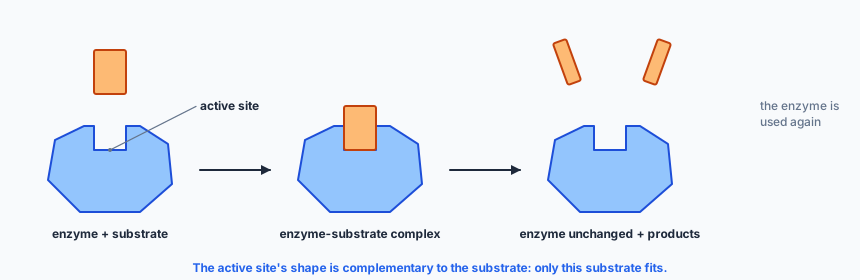
EXTENDED The substrate binds to the active site, forming an enzyme-substrate complex; the reaction happens and the products are released. Enzymes are specific: each active site has a shape complementary to only one substrate (or a few similar ones), so amylase breaks down starch but not protein.
Temperature
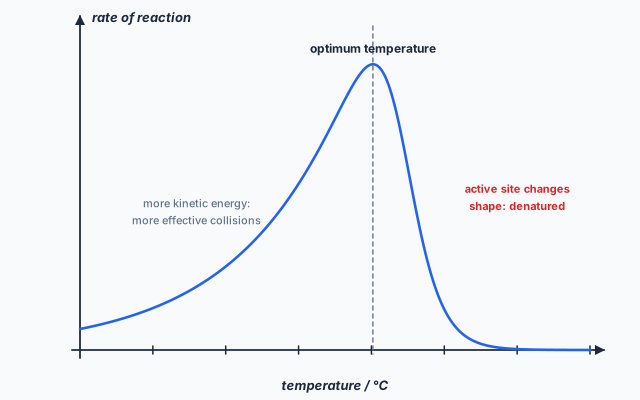
As temperature rises the rate increases, up to the optimum temperature. Above the optimum the enzyme is denatured: its active site changes shape, so the substrate no longer fits. Denaturation is permanent. At low temperatures the enzyme works slowly but is not denatured.
EXTENDED Up to the optimum, enzyme and substrate molecules have more kinetic energy, move faster, and so there are more frequent effective collisions and more enzyme-substrate complexes form. Above it, bonds holding the enzyme’s shape break: the shape and fit of the active site are lost.
pH
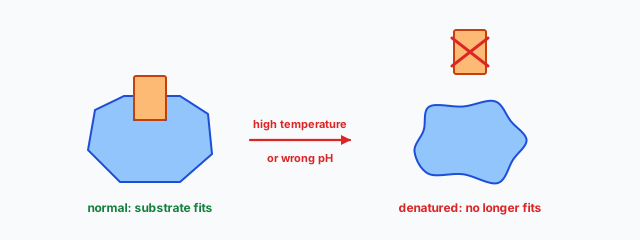
Each enzyme has an optimum pH. Moving far from it changes the shape of the active site, and the enzyme is denatured.
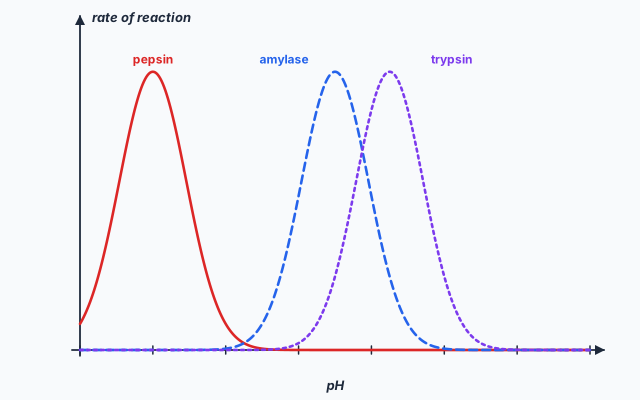
EXTENDED Changes in pH affect the bonds that hold the enzyme in shape, changing the shape and fit of the active site and causing denaturation.
Investigating enzyme activity
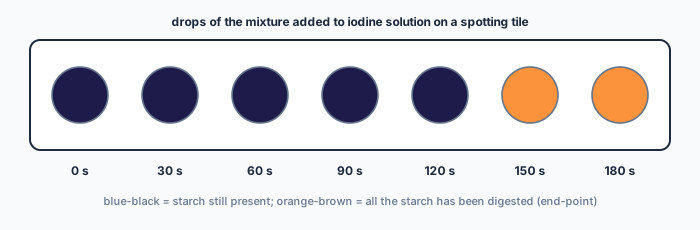
Amylase digests starch. Mix amylase with starch suspension in a water bath, and every 30 s put a drop of the mixture on to iodine solution on a spotting tile. When the drop no longer turns blue-black, all the starch is gone: that time is the end-point.
✏️Worked example
(a) \( 1 \div 90 = 0.011 \) per second (s−1).
(b) Between 30 °C and 50 °C (the fastest measured was 40 °C, but the true optimum could be either side of it).
(c) The amylase was denatured: its active site changed shape, so starch could no longer fit and was not digested.
(d) The molecules have more kinetic energy and move faster, so there are more frequent effective collisions between enzyme and substrate, and more enzyme-substrate complexes form per second.
📝Practise
In the style of the multiple-choice, theory and practical papers. EXTENDED marks Supplement content.
1. (Multiple choice.) What is a catalyst? A: a substance that slows a reaction and is used up. B: a substance that increases the rate of a reaction and is not changed by it. C: a protein that is changed by the reaction. D: the product of a reaction.
2. (Theory.) Explain why living organisms need enzymes. [2]
3. (Theory.) Two tubes of the same enzyme are kept at 5 °C and 80 °C, then both are moved to 37 °C. Predict what happens to the activity of each, and explain. [3]
4. (Theory.) Pepsin digests protein in the stomach. Suggest why pepsin stops working when the stomach contents enter the small intestine. [2]
5. (Practical.) In the starch–amylase investigation, state two variables that must be kept constant, and explain why the tubes are kept in a water bath. [3]
6. (Theory.) EXTENDED Explain why lipase breaks down fats but not starch. [2]
7. (Theory.) EXTENDED Put these in order to describe enzyme action: products released; substrate collides with the active site; enzyme-substrate complex forms; reaction occurs. [1]
8. (Theory.) EXTENDED Explain, in terms of shape and fit, why an enzyme’s activity falls at a pH far from its optimum. [2]
🔗Go deeper — other people’s work
These are external resources, not mine. If one stops working, tell me and everything above it on this page still stands.
- Royal Society of Biology — the effect of temperature on amylase, a class practical
- Learn Genetics (University of Utah) — animations of enzymes and active sites