Nutrient cycles and populations
🎯What you need to be able to do
- Describe the carbon cycle: photosynthesis, respiration, feeding, decomposition, fossilisation and combustion.
- Describe the nitrogen cycle and the roles of microorganisms in it EXTENDED.
- Define population, community and ecosystem; state the factors affecting the rate of population growth.
- Identify the phases of a sigmoid growth curve; explain each phase in terms of limiting factors EXTENDED.
📚The biology
The carbon cycle
Energy flows through an ecosystem, but the elements in living things are recycled. Carbon is taken out of the air as carbon dioxide by photosynthesis and returned to it by respiration and combustion.
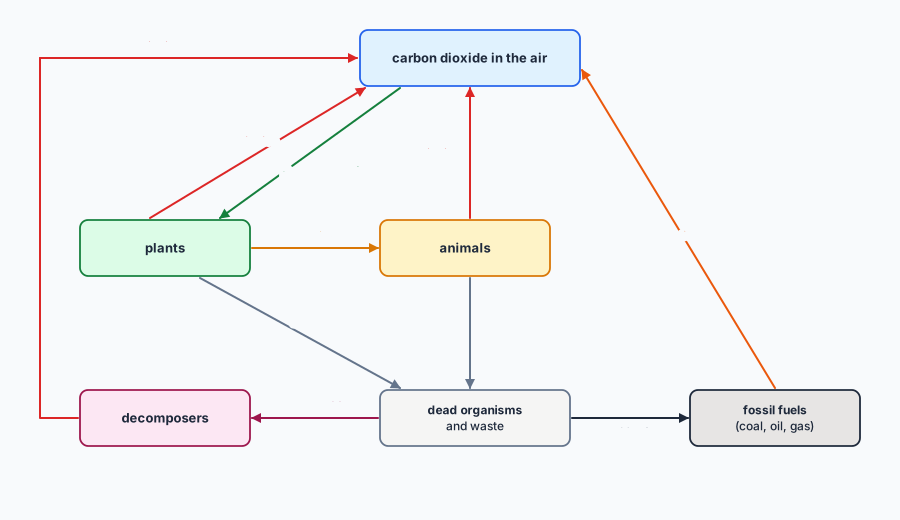
Cutting down forests (less photosynthesis) and burning fossil fuels (more combustion) both raise the carbon dioxide concentration of the air (topic 20).
The nitrogen cycle EXTENDED
Nitrogen gas makes up about 78% of the air, but plants and animals cannot use it directly. Plants take in nitrogen as nitrate ions through their roots and use it to make amino acids and proteins; animals get theirs by eating proteins.
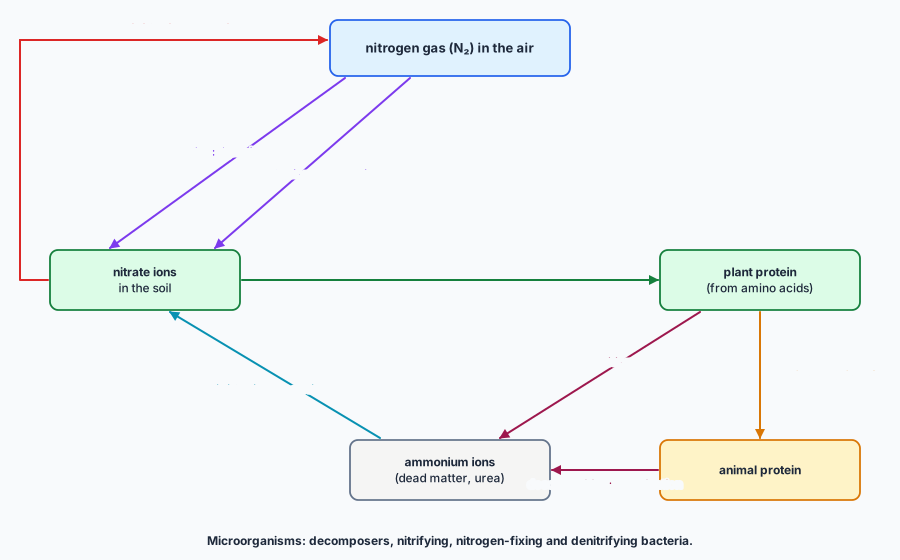
- Nitrogen fixation: nitrogen gas is converted to nitrogen compounds by lightning or by nitrogen-fixing bacteria (some live free in the soil, others in the root nodules of legumes such as peas and beans).
- Absorption: plants absorb nitrate ions and use them to make amino acids, then proteins.
- Feeding and digestion: animals eat plants and digest the protein to amino acids, which they build into their own proteins.
- Deamination: excess amino acids are deaminated in the liver; the nitrogen leaves in urea.
- Decomposition: decomposers break down proteins and urea in dead organisms and waste into ammonium ions.
- Nitrification: nitrifying bacteria convert ammonium ions to nitrate ions. They need oxygen, so this is fast in well-aerated soil.
- Denitrification: denitrifying bacteria convert nitrate ions back into nitrogen gas. They thrive in waterlogged soil, with little oxygen.
Populations
The rate at which a population grows depends on the food supply, competition (for food, space, light, mates), predation and disease. A population grows when births (and immigration) exceed deaths (and emigration).
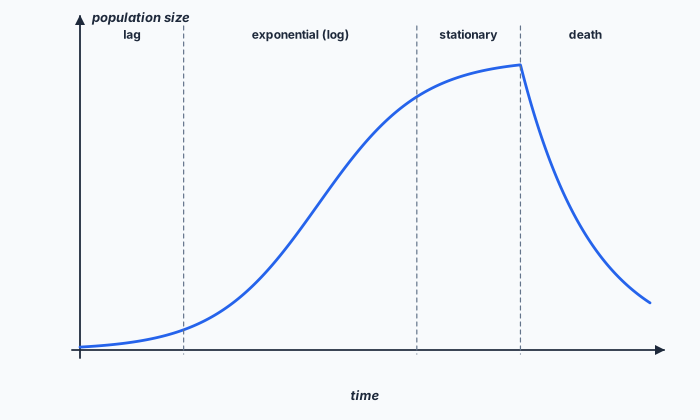
- Lag phase: few individuals; they are adjusting, growing and maturing before reproducing, so numbers rise slowly.
- Exponential (log) phase: EXTENDED plenty of food and space, little competition, predation or disease; births far exceed deaths, so the population doubles at a regular rate.
- Stationary phase: EXTENDED limiting factors take effect — food runs short, competition increases, waste builds up; birth rate equals death rate.
- Death phase: EXTENDED food is used up or toxic waste (e.g. ethanol for yeast) accumulates, so the death rate exceeds the birth rate.
✏️Worked example
(a) \( 20 \to 40 \to 80 \to 160 \to 320 \): the population doubled 4 times (\( 320 / 20 = 16 = 2^4 \)), about once a week.
(b) Stationary phase: the surface is covered, so there is competition for space and light; mineral ions such as nitrate are used up. Birth rate now equals death rate.
(c) In the dark there is no photosynthesis, so no carbon dioxide is removed, while the duckweed, and decomposers acting on dead plants, still respire and release carbon dioxide.
📝Practise
In the style of the multiple-choice and theory papers. EXTENDED marks Supplement content.
1. (Multiple choice.) Which process removes carbon dioxide from the atmosphere? A: combustion. B: decomposition. C: photosynthesis. D: respiration.
2. (Theory.) Explain how carbon in the body of a dead rabbit can become part of a grass plant. [3]
3. (Theory.) Define a community and an ecosystem. [2]
4. (Theory.) State four factors that affect the rate of growth of a population. [2]
5. (Theory.) EXTENDED Farmers plough waterlogged fields to let air into the soil. Explain how this can increase the nitrate in the soil. [3]
6. (Theory.) EXTENDED Explain why farmers grow bean plants in a field and then plough them into the soil before planting maize. [3]
7. (Theory.) EXTENDED Yeast is grown in a flask of sugar solution. Explain the death phase of its growth curve. [2]
8. (Theory.) EXTENDED Explain the lag phase and the exponential phase of a population growth curve. [4]
🔗Go deeper — other people’s work
These are external resources, not mine. If one stops working, tell me and everything above it on this page still stands.
- BBC Bitesize — the carbon and nitrogen cycles
- HHMI BioInteractive — population growth models