Human influences on ecosystems
🎯What you need to be able to do
- Describe how humans have increased food production; give the advantages and disadvantages of monocultures and intensive livestock production.
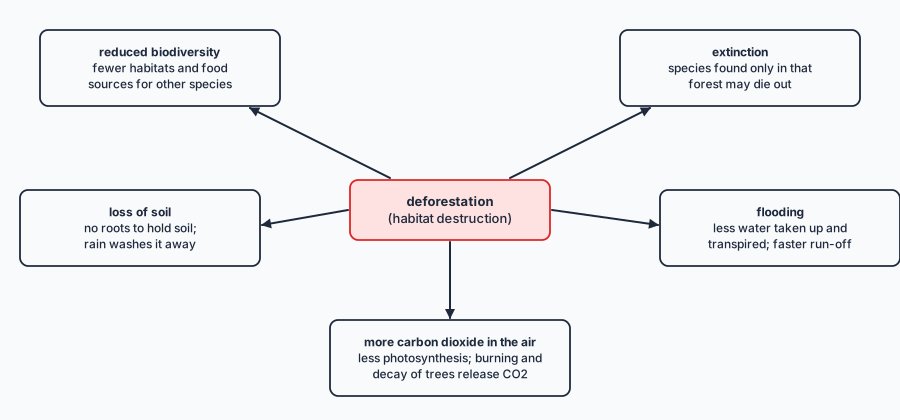
- Describe biodiversity and the reasons for habitat destruction; explain the undesirable effects of deforestation.
- Describe the effects of sewage, fertilisers, plastics, methane and carbon dioxide; explain eutrophication EXTENDED.
- Describe sustainable resources and the conservation of endangered species; explain how forests and fish stocks are conserved, and the risks of a small population EXTENDED.
📚The biology
Food supply
Humans have increased food production using:
A monoculture is a large area growing a single crop (oil palm, wheat, rice).
- Advantages: machinery can plant, spray and harvest efficiently; high yield of one product; cheap food.
- Disadvantages: low biodiversity (habitats removed); pests and diseases spread quickly through one species, so more pesticide is used; the same minerals are removed from the soil every year, so more fertiliser is needed; fewer jobs for local people.
Intensive livestock production keeps many animals (chickens, pigs, cattle) indoors in a small space, with controlled food and temperature.
- Advantages: less energy lost in movement and keeping warm, so more of the food becomes meat, milk or eggs; cheaper products; less land used.
- Disadvantages: disease spreads easily, so antibiotics are used (resistant bacteria, topic 15); animal welfare concerns; large amounts of waste may pollute rivers; much crop land is needed to grow their feed; livestock produce methane.
Habitat destruction
Biodiversity is the number of different species that live in an area. Habitats are destroyed to make space for housing, crop plants and livestock; by the extraction of natural resources (mining, logging); and by freshwater and marine pollution. By altering food chains and webs (removing a species, or introducing one), humans can also harm habitats.
Pollution
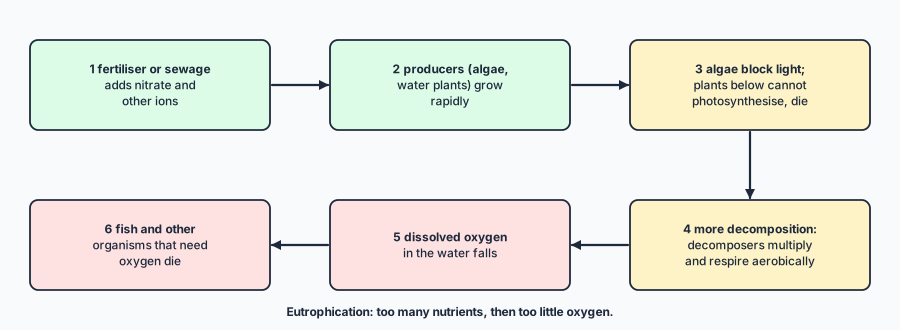
Untreated sewage and excess fertiliser entering rivers and lakes add nutrients (nitrate, phosphate) and cause eutrophication; sewage also carries pathogens (e.g. cholera). EXTENDED The process of eutrophication:
Non-biodegradable plastics are not broken down by decomposers, so they persist. In water, animals become entangled or swallow plastic (turtles mistake bags for jellyfish) and starve; small fragments enter food chains. On land, plastic litter traps and chokes animals and can release toxic chemicals into the soil.
Conservation
A sustainable resource is one which is produced as rapidly as it is removed from the environment, so that it does not run out. Forests and fish stocks can be conserved and managed sustainably.
Organisms become endangered or extinct because of climate change, habitat destruction, hunting, overharvesting, pollution and introduced species. Endangered species can be conserved by monitoring and protecting species and habitats, education, captive breeding programmes and seed banks.
EXTENDED Why conserve? To maintain or increase biodiversity, reduce extinction, protect vulnerable ecosystems, and maintain ecosystem functions: nutrient cycling, and resources such as food, drugs, fuel and genes. Captive breeding programmes may use artificial insemination (sperm from a male, perhaps in another zoo, is placed in the female) and in vitro fertilisation (eggs fertilised outside the body and the embryo placed in a female, possibly of a related species), so that animals that will not or cannot mate still reproduce, and genes are mixed between populations.
✏️Worked example
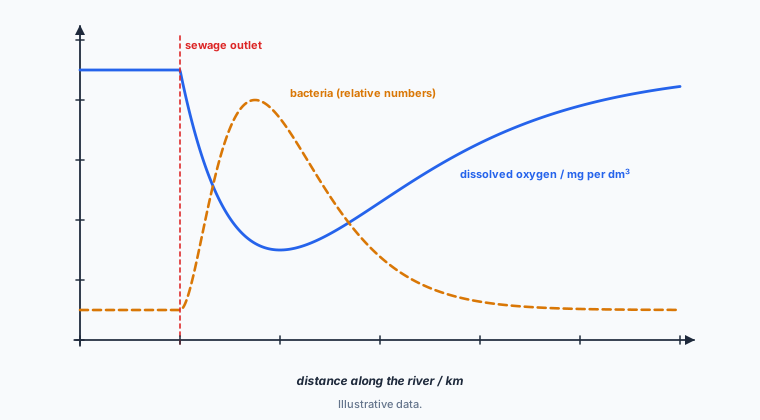
(a) Oxygen falls from 9.0 to 3.0 mg/dm3: \( \tfrac{9.0 - 3.0}{9.0} \times 100 = 67\% \) (66.7%).
(b) Sewage provides organic matter as food for the bacteria (decomposers), so they reproduce rapidly.
(c) The bacteria respire aerobically as they decompose the sewage, using up dissolved oxygen faster than it is replaced. Further downstream the sewage has been broken down, so there are fewer bacteria using oxygen, and oxygen dissolves from the air and is released by photosynthesis of plants and algae.
📝Practise
In the style of the multiple-choice and theory papers. EXTENDED marks Supplement content.
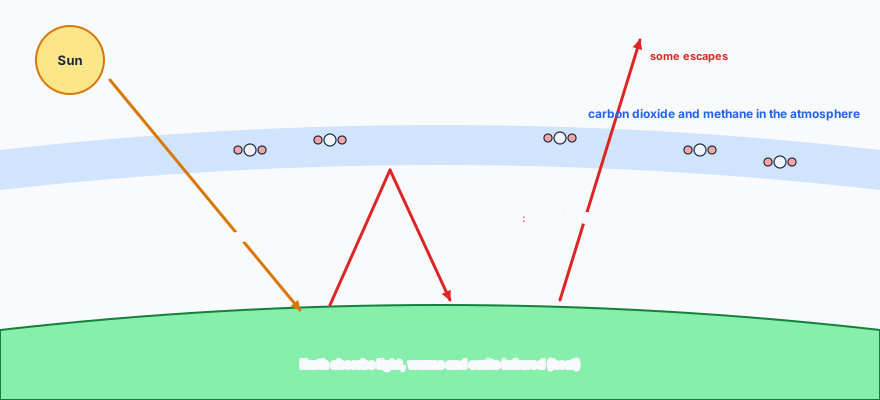
1. (Multiple choice.) Which gas is released by rice paddy fields and landfill sites and adds to the enhanced greenhouse effect? A: methane. B: nitrogen. C: oxygen. D: sulfur dioxide.
2. (Theory.) Give one advantage and two disadvantages of growing oil palm as a monoculture. [3]
3. (Theory.) Explain why removing trees from a hillside can lead to flooding in a town below. [2]
4. (Theory.) Describe two effects of discarded plastic bags on marine animals. [2]
5. (Theory.) Define a sustainable resource, and describe two ways an endangered bird species could be conserved. [3]
6. (Theory.) EXTENDED Explain how quotas and replanting help to conserve a forest. [2]
7. (Theory.) EXTENDED Give three reasons for conservation programmes. [3]
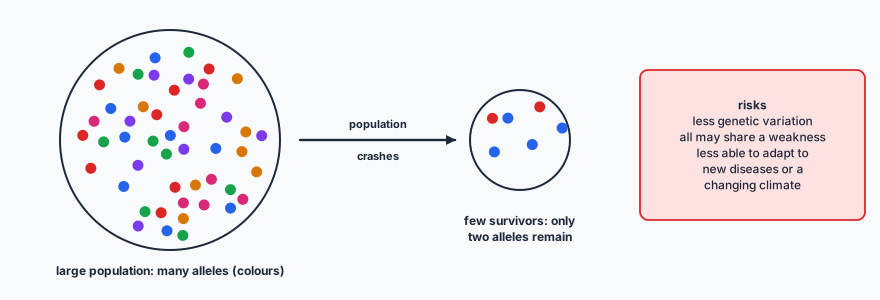
8. (Theory.) EXTENDED Fewer than 80 Javan rhinos survive in the wild. Explain why their small population size puts the species at risk. [3]
🔗Go deeper — other people’s work
These are external resources, not mine. If one stops working, tell me and everything above it on this page still stands.
- IUCN Red List — the status of endangered species worldwide
- NASA Climate Kids — the greenhouse effect explained