Chemical digestion and absorption
🎯What you need to be able to do
- Describe chemical digestion and its role; state the functions of amylase, proteases and lipase and where they are secreted and act.
- Describe the functions of hydrochloric acid in gastric juice.
- Describe the digestion of starch and protein in detail, and explain the role of bile in neutralising acid EXTENDED.
- State where nutrients and water are absorbed; explain villi and microvilli; describe a villus EXTENDED.
📚The biology
Chemical digestion
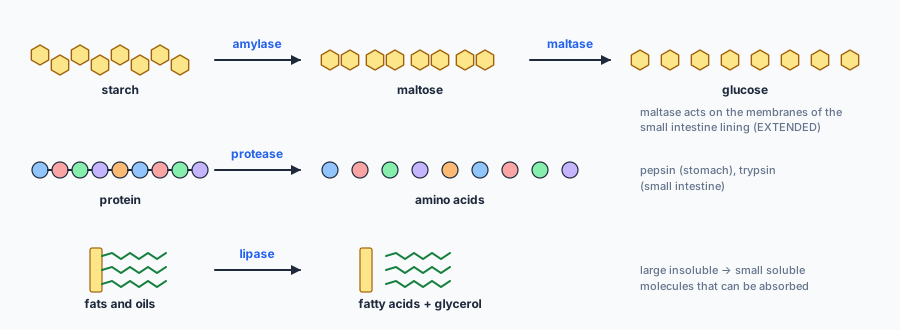
Chemical digestion is the breakdown of large insoluble molecules into small soluble molecules. Only small soluble molecules can be absorbed into the blood.
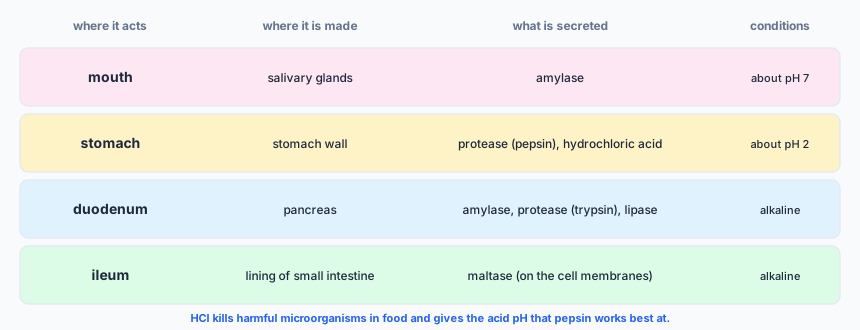
The hydrochloric acid in gastric juice kills harmful microorganisms in food and provides the acidic pH at which the stomach protease works best.
EXTENDED In detail:
- EXTENDED Starch: amylase breaks starch down to maltose; maltase then breaks maltose down to glucose on the membranes of the epithelium lining the small intestine.
- Protein: pepsin breaks down protein in the acidic conditions of the stomach; trypsin breaks down protein in the alkaline conditions of the small intestine.
- Bile is alkaline: it neutralises the acidic mixture of food and gastric juice entering the duodenum, providing a suitable pH for the enzymes there (and it emulsifies fats, 7a).
Absorption
The small intestine is where nutrients are absorbed. Most water is also absorbed there; some is absorbed in the colon.
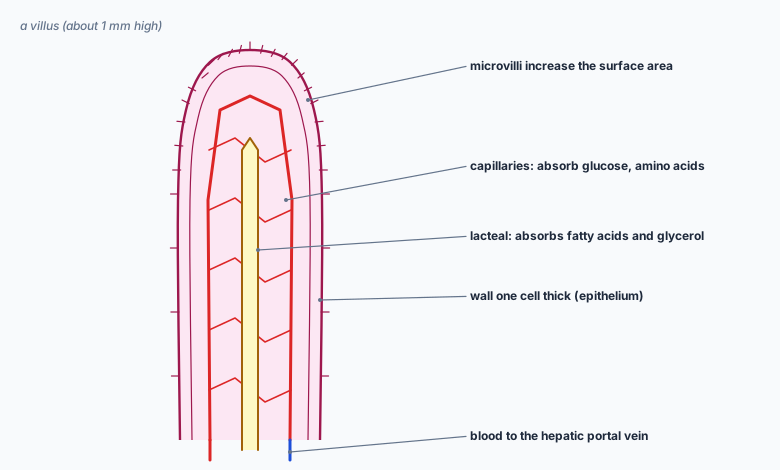
- EXTENDED Villi and microvilli greatly increase the internal surface area, so absorption is faster.
- The wall of each villus is one cell thick: a short distance for diffusion.
- A dense network of capillaries absorbs glucose and amino acids and carries them away, keeping a steep concentration gradient; the blood goes to the liver in the hepatic portal vein.
- The lacteal, part of the lymphatic system, absorbs fatty acids and glycerol.
✏️Worked example
(a) Lipase; the pancreas; fatty acids and glycerol.
(b) The food arriving from the stomach is acidic. Bile is alkaline and neutralises it; without bile the pH in the duodenum would stay low, far from trypsin’s alkaline optimum.
(c) Villi and microvilli give a large surface area; the wall is one cell thick, so the diffusion distance is short; a good blood supply carries glucose away, maintaining a steep concentration gradient.
📝Practise
In the style of the multiple-choice and theory papers. EXTENDED marks Supplement content.
1. (Multiple choice.) Which enzyme breaks down protein? A: amylase. B: lipase. C: protease. D: maltase.
2. (Theory.) Explain why starch must be digested before it can be absorbed. [2]
3. (Theory.) State two functions of hydrochloric acid in the stomach. [2]
4. (Theory.) Name the organ that secretes amylase in each place: (a) the mouth, (b) the duodenum. [2]
5. (Theory.) Name the region where most water is absorbed, and one other region where some is absorbed. [2]
6. (Theory.) EXTENDED Describe the complete digestion of starch to glucose, naming both enzymes and where each acts. [3]
7. (Theory.) EXTENDED Pepsin and trypsin are both proteases. Explain why they work in different parts of the gut. [2]
8. (Theory.) EXTENDED Name the vessel in a villus that absorbs fatty acids and glycerol, and the vessels that absorb glucose. [2]
🔗Go deeper — other people’s work
These are external resources, not mine. If one stops working, tell me and everything above it on this page still stands.
- Royal Society of Biology — modelling digestion and absorption with Visking tubing
- BBC Bitesize — enzymes in digestion