Chromosomes, genes, mitosis and meiosis
🎯What you need to be able to do
- State that chromosomes are made of DNA containing genes; define gene and allele; describe the inheritance of sex with X and Y chromosomes.
- Explain how the base sequence of a gene determines a protein, and outline protein synthesis EXTENDED.
- Describe haploid and diploid nuclei, and state that human diploid cells have 23 pairs EXTENDED.
- Describe mitosis and its roles, stem cells, and meiosis EXTENDED.
📚The biology
Chromosomes, genes and alleles
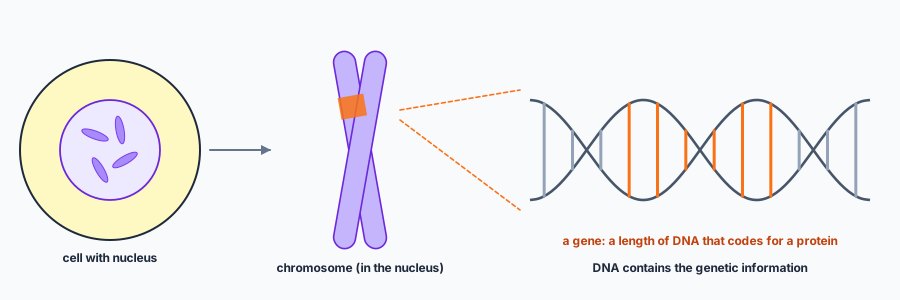
Chromosomes are made of DNA, which contains genetic information in the form of genes. A gene is a length of DNA that codes for a protein. An allele is an alternative form of a gene (for example, the gene for eye colour has alleles for brown and for blue).
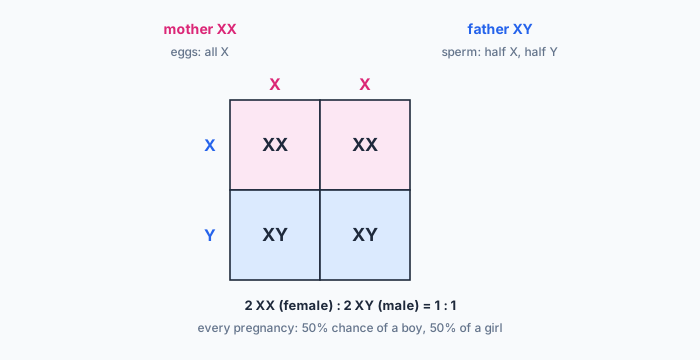
How genes control cells EXTENDED
EXTENDED The sequence of bases in a gene determines the sequence of amino acids in a specific protein. Different sequences of amino acids give proteins different shapes, and so different functions. By controlling which proteins are made — enzymes, membrane carriers, receptors for neurotransmitters — DNA controls how the cell works.
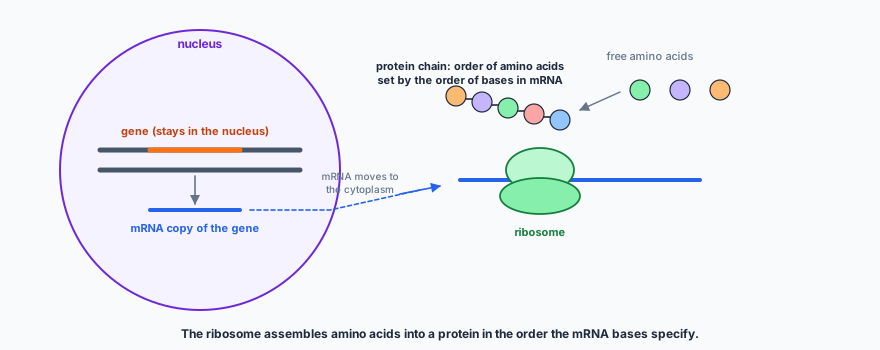
- EXTENDED the gene coding for the protein remains in the nucleus;
- messenger RNA (mRNA) is a copy of a gene; it is made in the nucleus and moves to the cytoplasm;
- the mRNA passes through ribosomes, which assemble amino acids into protein molecules;
- the specific sequence of amino acids is determined by the sequence of bases in the mRNA.
EXTENDED Most body cells contain the same genes, but many genes in a particular cell are not expressed: each cell makes only the proteins it needs. A red blood cell precursor expresses the haemoglobin gene; a stomach cell expresses the pepsin gene.
EXTENDED A haploid nucleus contains a single set of chromosomes; a diploid nucleus contains two sets. In a diploid cell there is a pair of each type of chromosome; a human diploid cell has 23 pairs (46 chromosomes).
Mitosis and meiosis EXTENDED
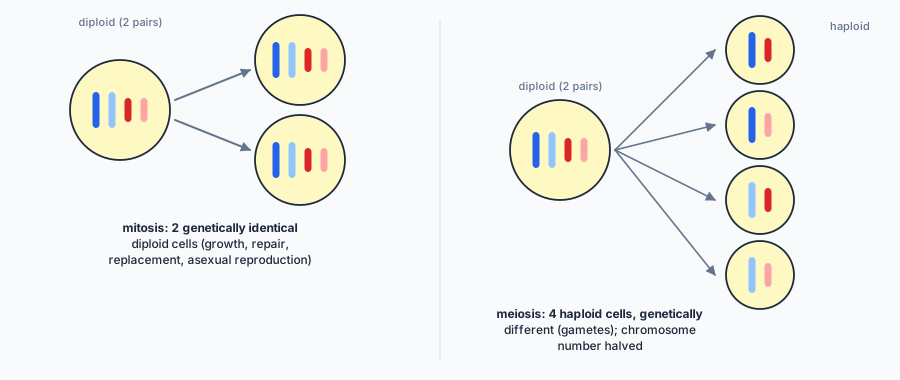
- EXTENDED Mitosis is nuclear division giving rise to genetically identical cells. It is used for growth, repair of damaged tissues, replacement of cells and asexual reproduction. The chromosomes are exactly replicated before mitosis; during it the copies separate, so each daughter cell keeps the same chromosome number.
- Stem cells are unspecialised cells that divide by mitosis to produce daughter cells that can become specialised for specific functions.
- Meiosis is involved in producing gametes. It is a reduction division: the chromosome number is halved from diploid to haploid, and the cells produced are genetically different.
✏️Worked example
(a) Gene: a length of DNA that codes for a protein. Allele: an alternative form of a gene.
(b) 0.5 (50%, 1 in 2). Each fertilisation is independent: half the father’s sperm carry X and half Y, whatever happened before.
(c) Only some genes are expressed in each cell; each cell makes only the proteins it needs, so different genes are switched on in skin and nerve cells.
(d) Sperm: 39 (made by meiosis, haploid). Repair cells: 78 (made by mitosis).
📝Practise
In the style of the multiple-choice and theory papers. EXTENDED marks Supplement content.
1. (Multiple choice.) What are chromosomes made of? A: protein only. B: DNA. C: starch. D: amino acids only.
2. (Theory.) State the sex chromosomes of a human male and of a human female. [2]
3. (Theory.) Draw a genetic diagram to show that the ratio of male to female offspring is expected to be 1 : 1. [3]
4. (Theory.) EXTENDED Explain how a change in the base sequence of a gene could stop an enzyme working. [3]
5. (Theory.) EXTENDED State where in the cell (a) mRNA is made, (b) proteins are assembled. [2]
6. (Theory.) EXTENDED Give three roles of mitosis. [3]
7. (Theory.) EXTENDED State two differences between mitosis and meiosis. [2]
8. (Theory.) EXTENDED Describe what a stem cell is. [2]
🔗Go deeper — other people’s work
These are external resources, not mine. If one stops working, tell me and everything above it on this page still stands.
- yourgenome — animations of DNA, genes and protein synthesis
- Learn Genetics (University of Utah) — interactive cell division