Energy flow, food chains and ecological pyramids
🎯What you need to be able to do
- State that the Sun is the principal energy source and describe energy flow through organisms to the environment.
- Construct and interpret food chains and webs; define producer, consumer, herbivore, carnivore, decomposer and trophic level.
- Describe human impacts through overharvesting and introduced species; draw and interpret pyramids of numbers and biomass.
- Draw pyramids of energy; explain inefficient energy transfer, short food chains and why eating crops is more efficient EXTENDED.
📚The biology
Energy flow
The Sun is the principal source of energy input to biological systems. Light energy is converted by producers into chemical energy in organic molecules; this chemical energy passes along food chains, and is eventually transferred to the environment as heat. Energy flows through an ecosystem — it is not recycled — while nutrients cycle (19b).
Food chains and food webs
A food chain shows the transfer of energy from one organism to the next, beginning with a producer. A food web is a network of interconnected food chains.
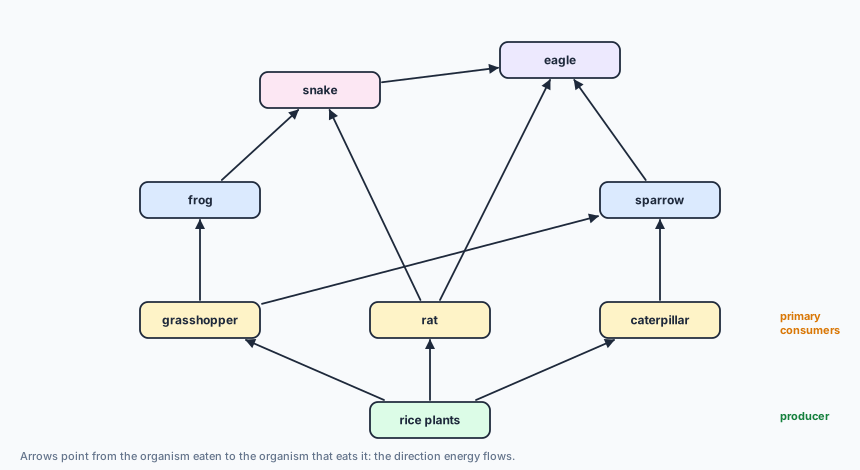
Human impacts. Overharvesting a food species (such as overfishing) reduces the food for the next level, whose numbers fall, while the species it ate may increase. An introduced foreign species may have no predators and outcompete or eat native species (for example cane toads in Australia).
Ecological pyramids
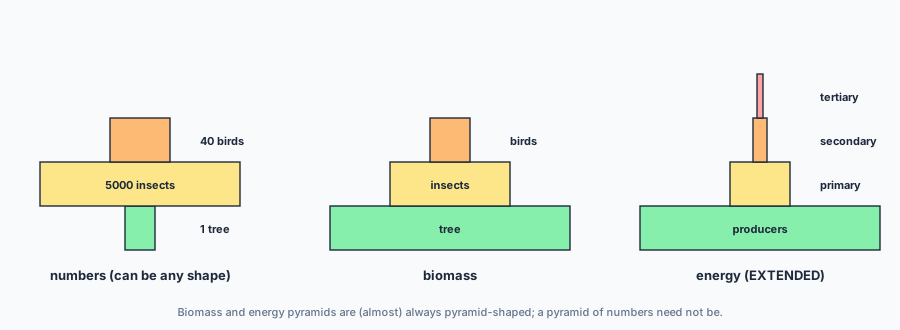
A pyramid of biomass is often more useful than a pyramid of numbers because it takes account of the size of the organisms. EXTENDED A pyramid of energy is better still: it shows the energy actually transferred over time, is always pyramid-shaped, and allows fair comparisons between ecosystems.
Why energy transfer is inefficient EXTENDED
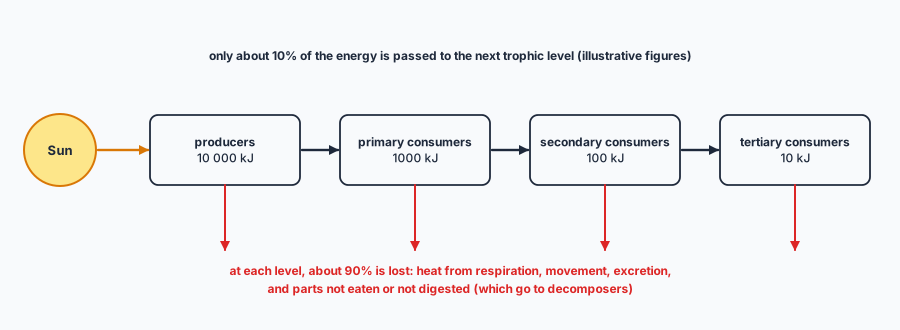
- EXTENDED Energy is lost at each level: not all of an organism is eaten (roots, bones); not all that is eaten is digested (lost in faeces); much is used in respiration and lost as heat; some is lost in excretion.
- Food chains usually have fewer than five trophic levels because too little energy is left to support another level.
- It is more energy-efficient for humans to eat crop plants than livestock fed on crops: eating the crop directly removes one trophic level and its roughly 90% loss, so the same land feeds many more people.
✏️Worked example
(a) Secondary consumer: frog, snake or sparrow (any that eats a primary consumer). Herbivore: grasshopper, rat or caterpillar.
(b) Rats and frogs may increase, because fewer are eaten; more rats may eat more rice; eagles may eat more rats and sparrows instead of snakes.
(c) \( \tfrac{2250}{25\,000} \times 100 = 9\% \).
📝Practise
In the style of the multiple-choice and theory papers. EXTENDED marks Supplement content.
1. (Multiple choice.) What is the principal source of energy for most food chains? A: the soil. B: the Sun. C: producers. D: decomposers.
2. (Theory.) Define a decomposer and give one example. [2]
3. (Theory.) In the chain seaweed → sea urchin → sea otter → shark, give the trophic level of the sea otter. [1]
4. (Theory.) Explain why a pyramid of numbers for oak tree → caterpillars → birds is not pyramid-shaped. [2]
5. (Theory.) Give one advantage of a pyramid of biomass over a pyramid of numbers. [1]
6. (Theory.) EXTENDED Give three ways energy is lost between one trophic level and the next. [3]
7. (Theory.) EXTENDED Explain why food chains rarely have more than five trophic levels. [2]
8. (Theory.) EXTENDED Explain why more people can be fed from a field of soya eaten directly than from the same field used to feed cattle. [3]
🔗Go deeper — other people’s work
These are external resources, not mine. If one stops working, tell me and everything above it on this page still stands.
- HHMI BioInteractive — food web and trophic cascade animations
- BBC Bitesize — food chains, webs and pyramids