Movement into and out of cells
🎯What you need to be able to do
- Describe diffusion, state where its energy comes from, and investigate the factors that affect it.
- Describe the roles of water as a solvent; state what osmosis is and investigate it with Visking tubing and plant tissue.
- Describe osmosis in terms of water potential and explain turgid, turgor pressure, plasmolysis and flaccid EXTENDED.
- Describe active transport; explain its importance and the role of protein carriers EXTENDED.
📚The biology
Diffusion
Diffusion is the net movement of particles from a region of their higher concentration to a region of their lower concentration (down a concentration gradient), as a result of their random movement. The energy comes from the kinetic energy of the random movement of molecules and ions, so it needs no energy from the cell. Some substances diffuse into and out of cells through the cell membrane: oxygen and carbon dioxide in gas exchange, glucose and urea in solution.
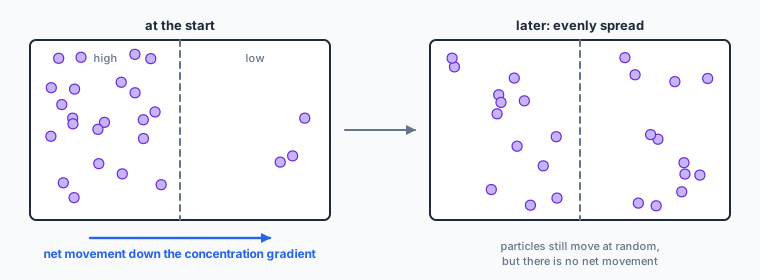
The rate of diffusion increases with a larger surface area, a higher temperature (more kinetic energy), a steeper concentration gradient, and a shorter distance. This is why exchange surfaces such as alveoli and villi are large, thin and have a good blood supply.
Water and osmosis
Water is the solvent in which substances are carried: digested food molecules dissolve in it for absorption (digestion), urea and excess ions leave in solution in urine (excretion), and blood plasma and xylem sap carry dissolved substances around organisms (transport).
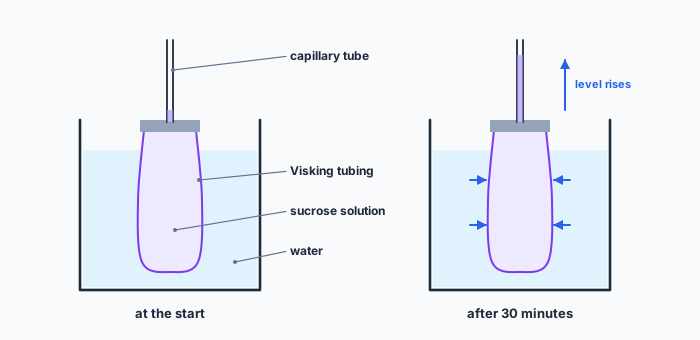
Water moves into and out of cells by osmosis, the diffusion of water through a partially permeable membrane such as the cell membrane. Visking (dialysis) tubing is partially permeable: water molecules pass through it, but sucrose molecules are too large.
Plants are supported by the pressure of water inside their cells pressing outwards on the cell wall. If they lose too much water, the cells become soft and the plant wilts.
EXTENDED Osmosis is the net movement of water molecules from a region of higher water potential (dilute solution) to a region of lower water potential (concentrated solution), through a partially permeable membrane.
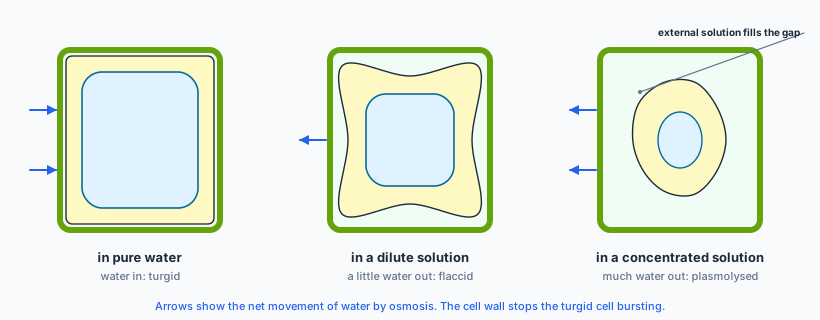
- EXTENDED Turgid: a cell full of water. The vacuole swells and the cytoplasm presses on the wall — this outward pressure is turgor pressure. The wall stops the cell bursting.
- Flaccid: the cell has lost water and turgor pressure; it is soft.
- Plasmolysis: so much water is lost that the cell membrane and cytoplasm pull away from the cell wall.
- Animal cells have no wall: in pure water a red blood cell swells and bursts; in a concentrated solution it shrinks.
EXTENDED Water potential explains how organisms take up and lose water: root hair cells have a lower water potential than the soil water, so water enters them; cells in a leaf lose water to the air spaces.
Active transport
Active transport is the movement of particles through a cell membrane from a region of lower concentration to a region of higher concentration (against a concentration gradient), using energy from respiration.
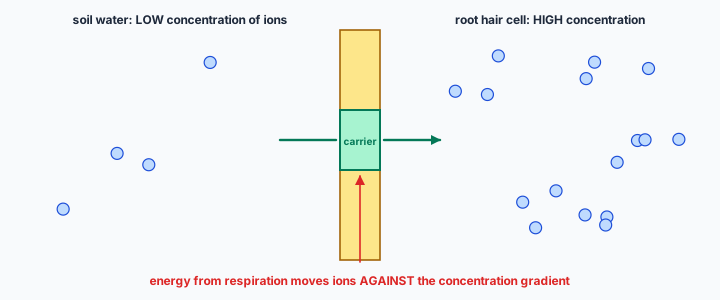
EXTENDED Active transport lets cells take in molecules or ions that are scarcer outside than inside: root hairs absorb mineral ions from dilute soil water this way. Protein carriers in the membrane move the molecules or ions across. Anything that stops respiration (lack of oxygen, a poison) stops active transport.
✏️Worked example
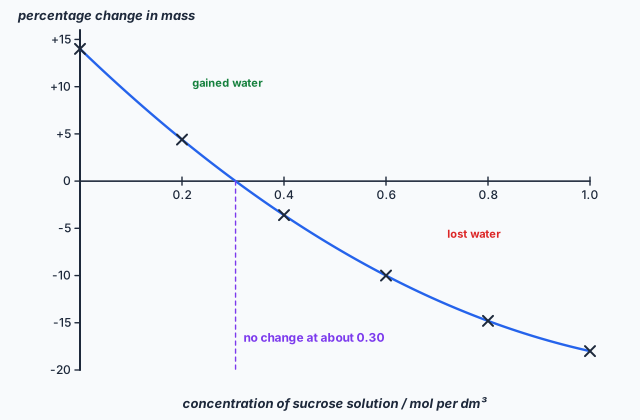
(a) Pure water is more dilute than the cell contents, so water entered the carrot cells by osmosis through the partially permeable cell membranes.
(b) About 0.30 mol per dm³, where the curve crosses 0% change: there is no net movement of water, so the water potential of the solution equals that of the cells.
(c) The pieces started with different masses; a percentage lets them be compared fairly.
📝Practise
In the style of the multiple-choice, theory and practical papers. EXTENDED marks Supplement content.
1. (Multiple choice.) Where does the energy for diffusion come from? A: respiration in the cell. B: ATP from mitochondria. C: the kinetic energy of the random movement of particles. D: active transport.
2. (Theory.) Explain why oxygen diffuses from the alveoli into the blood. [2]
3. (Practical.) Cubes of pink agar with sides 1 cm and 2 cm are placed in acid, which turns the agar colourless as it diffuses in. (a) Calculate the surface area to volume ratio of each cube. (b) Predict which becomes colourless first, and explain. [4]
4. (Theory.) Give one example each of water acting as a solvent in digestion, excretion and transport. [3]
5. (Theory.) A plant that has not been watered wilts. Explain how water normally supports the plant. [2]
6. (Theory.) EXTENDED A plant cell is placed in concentrated salt solution. Use the term water potential to explain what happens, and name the state of the cell. [3]
7. (Theory.) EXTENDED Root hair cells are treated with a chemical that stops respiration. Explain why their uptake of nitrate ions falls, but their uptake of water does not stop. [3]
8. (Theory.) State the difference between diffusion and active transport in terms of concentration gradient and energy. [2]
🔗Go deeper — other people’s work
These are external resources, not mine. If one stops working, tell me and everything above it on this page still stands.
- PhET “Diffusion” — change temperature and particle mass and watch net movement
- Royal Society of Biology — osmosis in plant tissue, a class practical