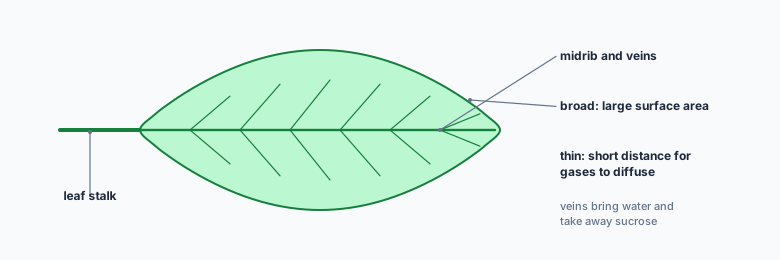
State that most leaves have a large surface area and are thin, and explain how this helps photosynthesis.
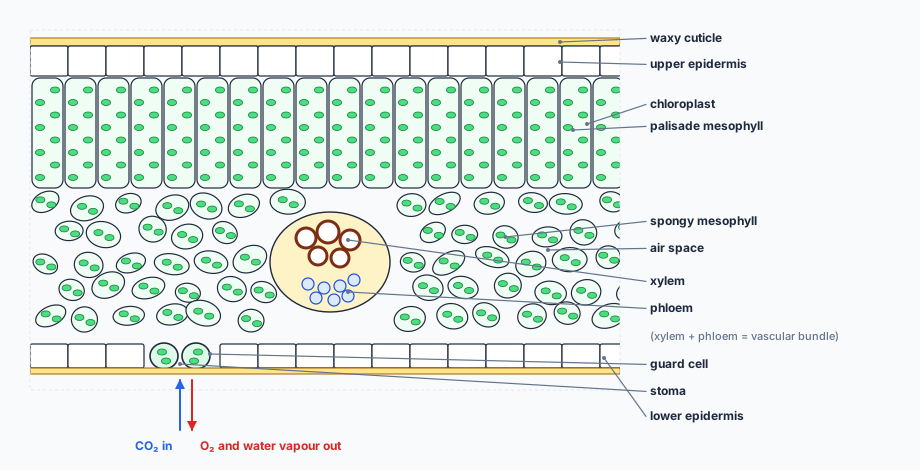
Identify in diagrams and images: chloroplasts, cuticle, guard cells and stomata, upper and lower epidermis, palisade mesophyll, spongy mesophyll, air
spaces, vascular bundles, xylem and phloem.
Explain how these structures adapt the leaf for photosynthesis.
📚The biology
This whole topic is Core. It builds directly on photosynthesis (6a): every feature of a leaf either brings in the raw materials, captures light, or removes
the products.
The outside of a leaf
A large surface area absorbs more light and carbon dioxide; being thin means gases diffuse only a short distance to the cells.
Inside a leaf
Most chloroplasts are in the palisade layer, near the upper surface where the light is. Stomata are mostly in the lower epidermis.
waxy cuticle: waterproof; reduces water loss, and is transparent so light passes through
upper epidermis: thin, transparent cells with no chloroplasts, so light reaches the palisade layer
palisade mesophyll: tall cells packed with chloroplasts, near the top where light is brightest; the main site of photosynthesis
spongy mesophyll: rounded cells with air spaces between them; the large internal surface lets gases diffuse into and out of cells
air spaces: let carbon dioxide diffuse to the mesophyll cells and oxygen diffuse out
stomata: pores, mostly in the lower epidermis, that let carbon dioxide in and oxygen and water vapour out
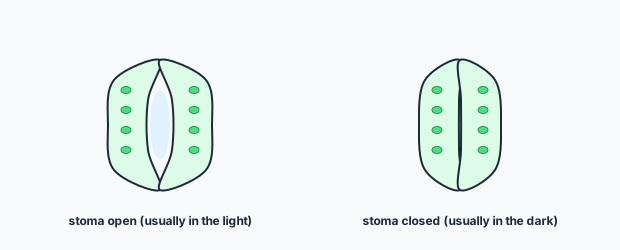
guard cells: a pair around each stoma that open and close it
xylem: brings water and mineral ions (magnesium, nitrate) to the leaf
phloem: carries away the sucrose and amino acids made in the leaf
Xylem and phloem run together in vascular bundles — the veins you can see on the leaf. In a leaf the xylem is on the upper side of
the bundle and the phloem on the lower side.
Guard cells contain chloroplasts, unlike other epidermis cells. Stomata usually open in the light, when carbon dioxide is needed, and close in the dark.
✏️Worked example
(a) Explain why the palisade mesophyll is the main site of photosynthesis. [2]
(b) Explain how the spongy mesophyll is adapted for gas exchange. [2]
(c) Suggest why most stomata are on the lower surface of a leaf. [1]
(a) Its cells are packed with chloroplasts, and it is near the upper surface, so it receives the most light.
(b) It has large air spaces between the cells, giving a large internal surface area, so carbon dioxide can diffuse quickly to the cells and
oxygen can diffuse out.
(c) The lower surface is shaded and cooler, so less water is lost by evaporation through the stomata.
Check it. Each answer links a structure to its function with “so”. “It has lots of chloroplasts” alone is a
description; the mark is for saying what that achieves.
Epidermis cells and chloroplasts. Ordinary epidermis cells have none (so light passes through); only the guard cells do. Saying the upper
epidermis photosynthesises loses the mark.
📝Practise
In the style of the multiple-choice and theory papers.
1. (Multiple choice.) Which layer of a leaf contains the most chloroplasts? A: upper epidermis. B: palisade mesophyll. C: spongy mesophyll. D: lower epidermis.
B.
2. (Theory.) State the function of the waxy cuticle and explain why it must be transparent. [2]
It reduces water loss (it is waterproof). It must let light through to the mesophyll cells for photosynthesis.
3. (Theory.) Name the tissue in a vein that (a) brings water to the leaf, (b) carries sucrose away from it. [2]
(a) Xylem. (b) Phloem.
4. (Theory.) Explain why leaves are broad and thin. [2]
Broad: a large surface area to absorb light and carbon dioxide. Thin: gases have only a short distance to diffuse to and from the cells.
5. (Theory.) A plant’s stomata close on a hot, dry afternoon. Suggest one advantage and one disadvantage of this for the plant. [2]
Advantage: less water vapour is lost, so the plant does not wilt. Disadvantage: less carbon dioxide enters, so the rate of photosynthesis falls.
6. (Theory.) Guard cells are the only cells in the epidermis that contain chloroplasts. Suggest one reason why the other epidermis cells have none. [1]
So that light passes straight through them to the palisade cells below.
7. (Theory.) Explain how the shape and position of palisade mesophyll cells adapt them for photosynthesis. [3]
They are near the upper surface, where light is brightest; tall and tightly packed in a single layer, so many fit side by side to absorb as much light as possible; they contain many chloroplasts.
🔗Go deeper — other people’s work
These are external resources, not mine. If one stops working, tell me and
everything above it on this page still stands.
Science and Plants for Schools (SAPS) — looking at stomata with nail-varnish impressions
BBC Bitesize — leaf structure, with labelled micrographs