Transport in plants
🎯What you need to be able to do
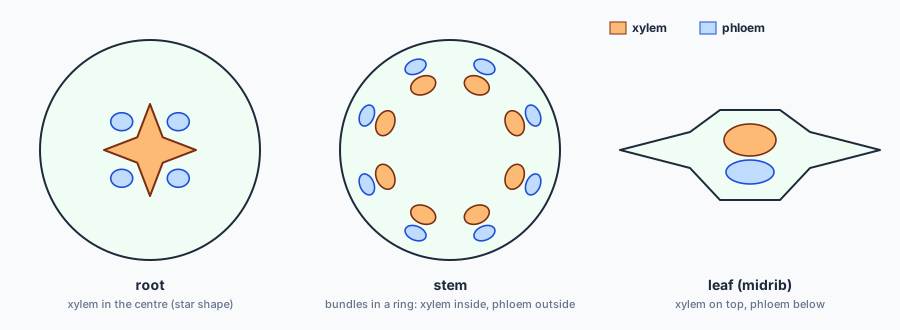
- State the functions of xylem and phloem and identify their positions in roots, stems and leaves; relate xylem structure to function EXTENDED.
- Identify root hair cells and outline the pathway of water through the plant; investigate it with a stain.
- Describe transpiration and investigate the effects of temperature and wind speed on its rate.
- Explain transpiration pull, the effects of temperature, wind and humidity, and wilting EXTENDED.
- Describe translocation, sources and sinks EXTENDED.
📚The biology
Xylem and phloem
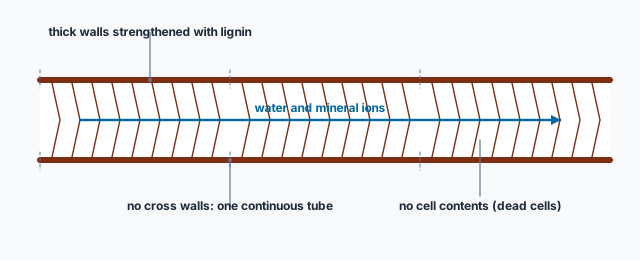
EXTENDED Xylem vessels are adapted to carry water: thick walls strengthened with lignin support the plant and stop the vessel collapsing; there are no cell contents; and the cells are joined end to end with no cross walls, forming one long, continuous tube.
Water uptake
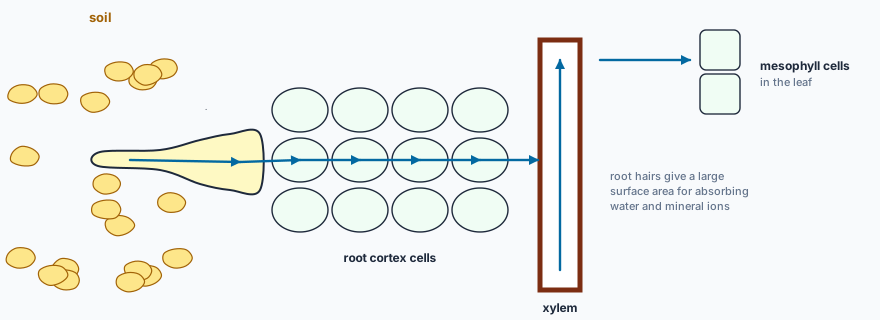
Root hair cells absorb water (by osmosis) and mineral ions (by active transport, topic 3). Their long extensions give a large surface area, increasing uptake. Water then passes through the root cortex cells, into the xylem, up the stem and into the mesophyll cells of the leaves.
To show the pathway, stand a leafy shoot in water containing a dye (a suitable stain) for a few hours, then cut sections of the stem and leaves: only the xylem is stained.
Transpiration
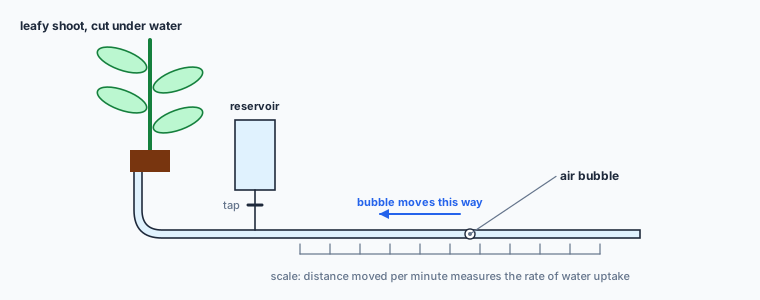
Transpiration is the loss of water vapour from leaves. Water evaporates from the surfaces of the mesophyll cells into the air spaces, then diffuses out of the leaf through the stomata as water vapour. Its rate is estimated with a potometer, which actually measures water uptake (a little water is used by the plant rather than lost).
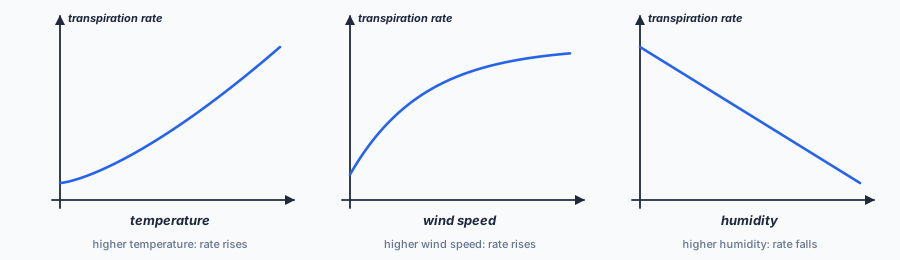
EXTENDED The rate depends on:
- EXTENDED Surface area: the interconnecting air spaces between mesophyll cells give a large internal surface for evaporation; more and larger stomata let more vapour out.
- Temperature: water molecules have more kinetic energy, so evaporation and diffusion are faster.
- Wind speed: moving air removes water vapour from around the leaf, keeping a steep concentration gradient.
- Humidity: moist air lowers the concentration gradient between the air spaces and the air outside, so the rate falls.
EXTENDED Transpiration pull. As water evaporates from the leaves, water is drawn out of the xylem to replace it. This pulls up a column of water molecules, which are held together by forces of attraction between water molecules. If more water is lost than is taken up, the cells lose turgor, become flaccid, and the plant wilts.
Translocation EXTENDED
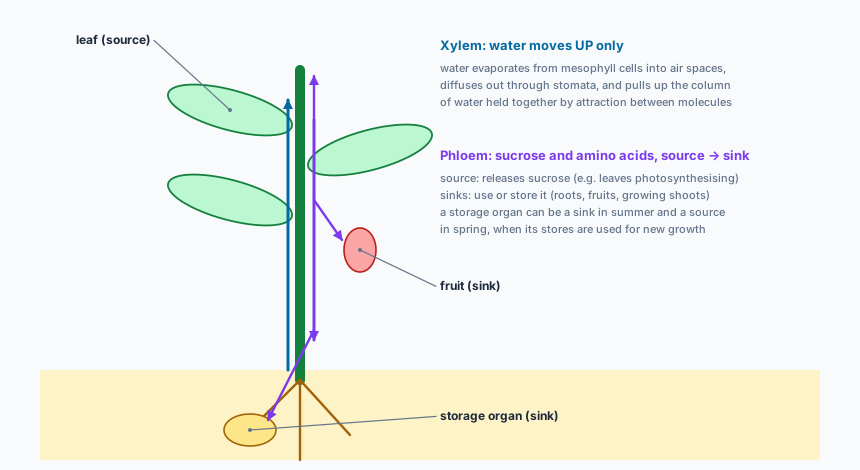
EXTENDED Translocation is the movement of sucrose and amino acids in the phloem from sources (parts that release sucrose or amino acids, such as photosynthesising leaves) to sinks (parts that use or store them, such as roots, fruits and growing shoots). The same organ can change role: a potato tuber is a sink while it stores starch in summer, and a source in spring, when its stores are broken down and sent to the new shoots.
✏️Worked example
(a) To stop water evaporating from the soil, so all the mass lost is water vapour lost from the plant.
(b) C lost more: at a higher temperature water molecules have more kinetic energy, so more water evaporates from the mesophyll cell surfaces and water vapour diffuses out of the stomata faster.
(c) The bag traps water vapour, raising the humidity around the leaves; the concentration gradient between the air spaces and the air outside is smaller, so less water vapour diffuses out.
(d) Some water is lost from the stem (and the cut surfaces) even without leaves.
📝Practise
In the style of the multiple-choice, theory and practical papers. EXTENDED marks Supplement content.
1. (Multiple choice.) What does the phloem transport? A: water and mineral ions. B: sucrose and amino acids. C: water and sucrose. D: mineral ions and amino acids.
2. (Theory.) In a cross-section of a root, state where the xylem is found. [1]
3. (Theory.) Explain how root hairs are adapted for absorbing water. [2]
4. (Theory.) Describe how water leaves a leaf during transpiration. [3]
5. (Practical.) Explain why a potometer only gives an estimate of the rate of transpiration. [1]
6. (Theory.) EXTENDED Explain how water moves up the xylem to the top of a tall tree. [3]
7. (Theory.) EXTENDED Explain why a plant wilts on a hot, dry day. [3]
8. (Theory.) EXTENDED A developing seed and a mature leaf are joined by phloem. State which is the source and which the sink, and explain. [2]
🔗Go deeper — other people’s work
These are external resources, not mine. If one stops working, tell me and everything above it on this page still stands.
- Science and Plants for Schools (SAPS) — making and using a simple potometer
- BBC Bitesize — transport systems in plants