How do economists approach the world?
🎯What you need to be able to do
- Explain the role of positive economics: logic, hypotheses, models and theories, ceteris paribus, empirical evidence and refutation.
- Explain the role of normative economics and value judgments in policy making, and distinguish equity from equality.
- Outline how economic thought developed from the 18th to the 21st century, and connect each school to the topics where it reappears.
📚The economics
Positive economics
Positive economics deals with statements about what is, was or will be. They can be tested against evidence and shown to be true or false. “Raising the tax on cigarettes reduces the number of cigarettes smoked” is positive: you may disagree, but data can settle it.
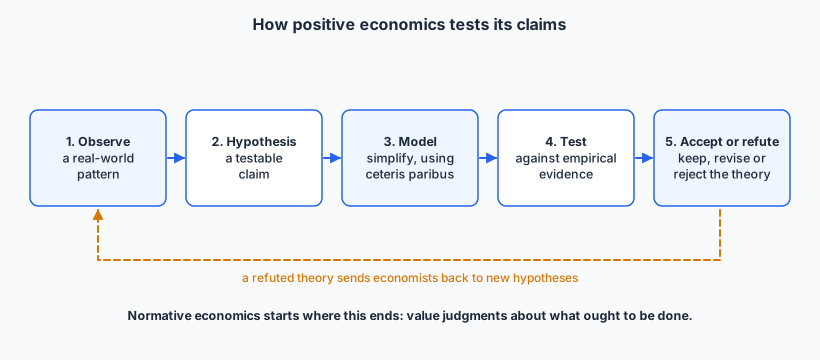
- Logic: reasoning step by step from assumptions to conclusions. If people buy less when prices rise, and a tax raises the price, then a tax reduces purchases.
- Hypothesis: a testable prediction, such as “a 10% rise in the minimum wage reduces youth employment”.
- Model: a simplified representation of reality (the PPC, demand and supply, AD/AS). Models leave out detail on purpose, so that the relationship being studied is visible.
- Theory: a hypothesis that has survived repeated testing, such as the law of demand.
- Ceteris paribus (“other things being equal”): the assumption that only one factor changes at a time. A demand curve shows the effect of price ceteris paribus: income, tastes and other prices are held constant.
- Empirical evidence: real-world data used to test hypotheses. Economists usually cannot run controlled experiments on whole economies, so they compare countries, periods or groups, or use natural experiments.
- Refutation: a theory can never be proved true once and for all, but one clear contradiction can show it is false. Theories are kept until the evidence refutes them.
Normative economics
Normative economics deals with statements about what ought to be. They contain value judgments and cannot be tested: “the government should tax cigarettes more heavily” depends on how you weigh public health against personal freedom and the burden on poor smokers. Words like should, ought, fair, too high and better usually signal a normative statement.
Policy making is always normative in the end. Positive economics can tell a minister what a policy will probably do; deciding whether those results are worth it requires value judgments about goals such as efficiency, equity and sustainability.
Everyone has the same: the same income, the same wealth, the same access. It is positive: you can measure it (the Gini coefficient, 3.4).
Fairness. It is normative: people disagree about what is fair. Most would call it fair for a surgeon to earn more than a trainee, so equity need not mean equality; many would call it unfair for a child’s schooling to depend on parental income.
Economic thought in its historical context
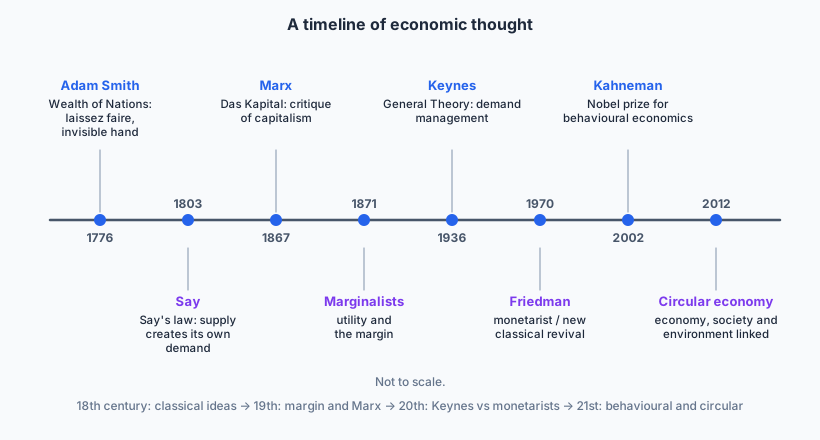
18th century: Adam Smith and laissez faire
Adam Smith’s The Wealth of Nations (1776) argued that individuals pursuing their own self-interest in competitive markets are led, as if by an invisible hand, to produce what society wants. He emphasized the division of labour and specialization as the source of rising productivity. From this comes laissez faire (“let it be”): the view that governments should interfere as little as possible in markets. Smith himself saw important roles for government: defence, justice and public works. Later: the price mechanism (2.3) and specialization in trade (4.1).
19th century: the classical economists, the margin and Marx
- Classical macroeconomics and Say’s law. Jean-Baptiste Say argued that supply creates its own demand: producing goods generates incomes that are spent on other goods, so a general, long-lasting shortage of demand is impossible. Markets, left alone, return to full employment. This is the ancestor of the monetarist/new classical LRAS (3.2).
- Classical microeconomics: utility and the margin. In the 1870s, Jevons, Menger and Walras shifted attention to utility (satisfaction) and decisions made at the margin: is one more unit worth its cost? Marshall later combined this into the demand and supply diagram. The ideas of diminishing marginal utility (2.1) and marginal cost (2.2) come from here.
- The Marxist critique. Karl Marx (Das Kapital, 1867) argued that capitalism is unstable and unjust: owners of capital extract profit from the labour of workers, wealth concentrates, and crises recur. His ideas shaped the planned economies of the 20th century and still inform debates about inequality (2.12).
20th century: Keynes, macroeconomic policy and the counter-revolution
- The Keynesian revolution. The Great Depression of the 1930s, with mass unemployment lasting years, contradicted Say’s law. John Maynard Keynes (The General Theory, 1936) argued that aggregate demand can stay too low for a long time, so an economy can be stuck below full employment, and that governments should boost demand by spending and running deficits.
- The rise of macroeconomic policy. After 1945, governments accepted responsibility for managing demand to keep unemployment low (fiscal policy).
- The monetarist/new classical counter-revolution. In the 1970s, stagflation (high inflation and high unemployment together) undermined Keynesian policy. Milton Friedman and the monetarists argued that inflation is caused by too much money, that government intervention often makes things worse, and that markets adjust to full employment in the long run. Policy shifted towards controlling inflation, independent central banks and supply-side policies.
21st century: other disciplines, behaviour and the environment
- Dialogue with psychology: behavioural economics. Researchers such as Daniel Kahneman (Nobel prize 2002) and Richard Thaler (2017) showed that people use rules of thumb, are influenced by framing and struggle with self-control. This challenges the assumption of rational consumers and gave governments “nudges” as a policy tool (2.4, HL).
- Interdependence of economy, society and environment. Climate change, biodiversity loss and inequality have pushed economists to treat the economy as part of society and nature, not separate from them.
- The circular economy. A traditional “linear” economy takes resources, makes products and throws them away. A circular economy designs out waste: products are reused, repaired, remanufactured and recycled, so output can grow without using ever more finite resources. Bali’s ban on single-use plastic bags, polystyrene and straws is a small step in this direction (4.7).
✏️Worked example
(a) “Indonesia’s fuel subsidies cost the government more when world oil prices rise.”
(b) “Fuel subsidies are unfair because richer households with cars benefit most.”
(c) “Richer households with cars receive a larger share of fuel subsidy spending than poorer households.”
(d) “The government should replace fuel subsidies with cash transfers to poor families.”
(a) Positive. It describes a cause and effect that can be checked with budget data: the subsidy covers the gap between the world price and the fixed pump price, so a higher world price means a bigger gap.
(b) Normative. “Unfair” is a value judgment about equity. The fact behind it may be true, but whether it is unfair depends on values.
(c) Positive. This is the testable claim hidden inside (b). Household spending surveys can confirm or refute it.
(d) Normative. “Should” recommends a policy. Positive economics can predict its effects (on poverty, the budget, fuel use), but choosing it involves weighing those effects.
📝Practise
Work through these on paper, then reveal the answer.
1. Explain what is meant by ceteris paribus, and why economists use it.
2. Distinguish between equity and equality, with an example.
3. Explain why a theory in economics can be refuted but never finally proved.
4. Explain how the experience of the 1930s led to the Keynesian revolution.
5. Explain one way behavioural economics challenges earlier economic thinking.
6. Explain what is meant by a circular economy, and why it links to the key concept of sustainability.
🔗Go deeper — other people’s work
These are external resources, not mine. If one stops working, tell me and everything above it on this page still stands.
- Robert Heilbroner, The Worldly Philosophers — the classic readable history of Smith, Marx, Keynes and others.
- Ellen MacArthur Foundation — clear explanations and case studies of the circular economy.
- The Nobel Prize website — popular-science summaries of the prizes to Kahneman (2002), Ostrom (2009) and Thaler (2017).