Demand management: fiscal policy
🎯What you need to be able to do
- Explain sources of government revenue (direct and indirect taxes, sales of goods and services by state-owned enterprises, sales of government assets) and types of expenditure (current, capital, transfer payments).
- Explain the goals of fiscal policy: low and stable inflation, low unemployment, a stable environment for long-term growth, reducing business-cycle fluctuations, equitable income distribution, external balance.
- Draw AD/AS diagrams showing expansionary and contractionary fiscal policy in both the Keynesian and monetarist/new classical models.
- Evaluate fiscal policy: constraints (political pressure, time lags, sustainable debt) and strengths (targeting sectors, effectiveness in deep recession).
- HL Calculate the Keynesian multiplier and its effect on GDP; explain crowding out with a diagram; explain automatic stabilizers.
📚The economics
Government revenue and expenditure
Direct taxes on income, profits and wealth; indirect taxes on spending (VAT, excise on tobacco and fuel); sales of goods and services by state-owned enterprises (profits and dividends from Pertamina, PLN, state banks); sale of government assets (privatization). Also non-tax revenue such as natural resource royalties.
Current expenditure: day-to-day spending on wages of teachers, nurses and civil servants, medicines, maintenance. Capital expenditure: investment in roads, ports, schools, hospitals, dams. Transfer payments: pensions, unemployment benefits, cash transfers; they redistribute income and are not payment for output.
If spending exceeds revenue in a year, the government runs a budget deficit, financed by borrowing; if revenue exceeds spending, a surplus. Accumulated deficits form government debt (3.3).
Goals of fiscal policy
Fiscal policy shares the macro goals of monetary policy (low and stable inflation, low unemployment, a stable environment for growth, smoothing the business cycle, external balance) and adds one monetary policy cannot easily reach: an equitable distribution of income, through progressive taxes, transfers and public services (3.4).
Expansionary and contractionary fiscal policy
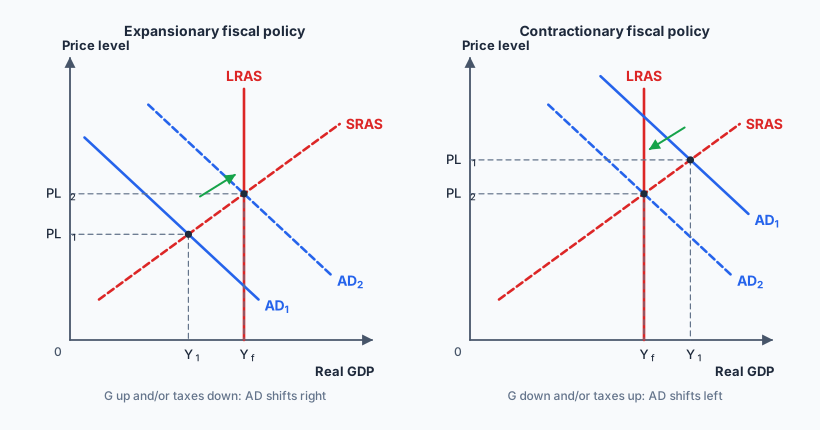
increase government spending and/or cut taxes. G rises directly; lower income taxes raise disposable income and C; lower business taxes raise I. AD shifts right, closing a deflationary gap, but the budget deficit grows. During the pandemic, Indonesia’s PEN recovery programme and cash transfers are an example.
cut government spending and/or raise taxes. AD shifts left, closing an inflationary gap and reducing the deficit (“fiscal consolidation” or austerity). Politically unpopular.
The two schools disagree about how much fiscal policy can achieve:
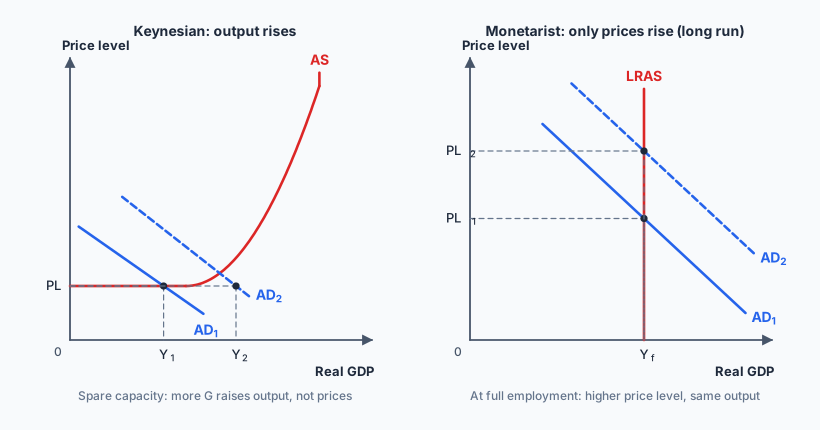
- Keynesian: in a recession there is plenty of spare capacity, so higher G raises real output and employment with little inflation, and the multiplier magnifies the effect. Governments should actively use fiscal policy.
- Monetarist/new classical: the economy returns to full employment anyway; in the long run higher AD just raises the price level (vertical LRAS). Deficits also crowd out private investment. Fiscal policy should aim for balanced budgets and sound finances.
The Keynesian multiplier HL
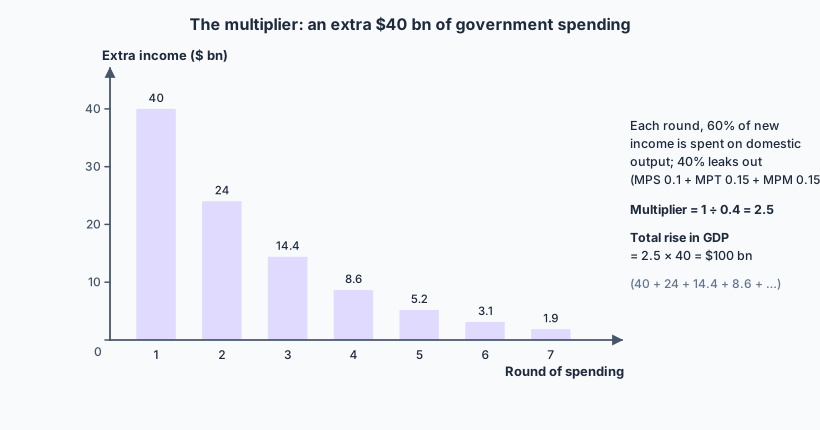
An injection of spending (G, I or X) raises national income by more than the initial amount, because one person’s spending is another’s income. When the government pays construction firms, workers receive wages and spend part of them, those shopkeepers spend part of that, and so on. At each round some income leaks out as saving, taxes and imports.
- MPC (marginal propensity to consume) is the fraction of extra income spent on domestic output; MPS, MPT and MPM are the fractions of extra income saved, taxed and spent on imports. MPC + MPS + MPT + MPM = 1.
- The larger the leakages, the smaller the multiplier. Open economies that import a lot, and economies with high taxes, have smaller multipliers.
- The multiplier also works in reverse: a fall in investment or exports reduces GDP by a multiple.
Crowding out HL
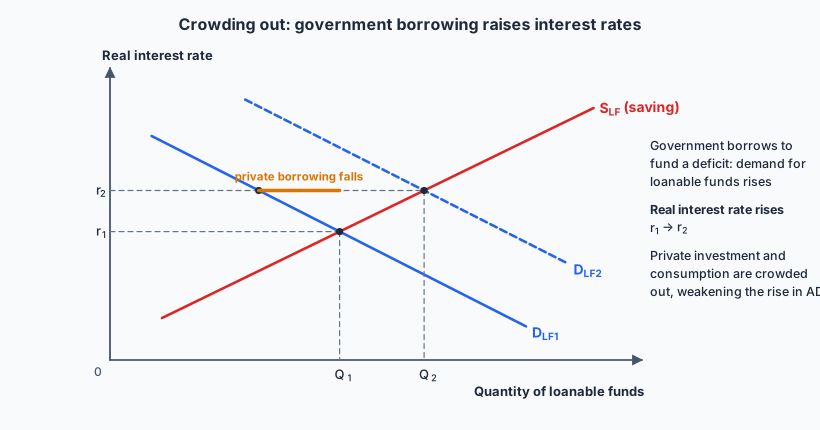
If the government borrows to fund a deficit, it competes with private firms and households for the available supply of loanable funds (savings). Demand for loanable funds rises, real interest rates rise, and some private investment and consumption that would have happened is crowded out. So the net rise in AD is smaller than the rise in G. Monetarists see crowding out as strong; Keynesians argue it is weak in a recession, when saving is plentiful and private investment is low anyway.
Automatic stabilizers HL
Some fiscal effects happen automatically, without any new decision:
- Progressive income taxes: in a boom, incomes rise and people move into higher tax bands, so tax revenue rises faster than income, slowing spending growth. In a recession, tax payments fall faster than income, cushioning disposable income.
- Unemployment benefits: spending rises automatically as unemployment rises in a recession, supporting consumption, and falls in a boom.
They reduce the size of fluctuations with no time lag for decision-making. They are weaker in countries with small formal tax bases and limited benefit systems.
How effective is fiscal policy?
Constraints:
- Political pressure: governments find it easy to spend and cut taxes before elections, hard to do the reverse in a boom, so fiscal policy is often too loose (a deficit bias).
- Time lags: recognizing the problem, passing a budget, and implementing projects (infrastructure takes years) mean stimulus may arrive after the recession is over.
- Sustainable debt: countries with high debt, or which borrow in foreign currencies, face rising interest costs and credit-rating downgrades; Indonesia’s legal 3%-of-GDP deficit ceiling limits room for stimulus.
- HL Crowding out reduces the net effect on AD.
- Tax cuts may be saved rather than spent if confidence is low; leakages reduce the multiplier.
Strengths:
- Can target specific sectors and regions (tourism in Bali after the pandemic, infrastructure in eastern Indonesia) and specific groups (cash transfers to the poor), and can promote equity.
- Effective in a deep recession, when monetary policy is stuck at low interest rates and confidence is low: government spending directly creates demand whatever households and firms do.
- Capital spending on infrastructure and education also raises long-run productive capacity (a supply-side effect, 3.7).
- HL Automatic stabilizers work without lags.
✏️Worked example HL
(a) Calculate the MPC (on domestic output) and the multiplier.
(b) The government raises spending on infrastructure by $40 bn. Calculate the eventual change in GDP.
(c) Real GDP is $2000 bn and potential output $2080 bn. Calculate the change in government spending needed to close the deflationary gap.
(a) Leakages = 0.10 + 0.15 + 0.15 = 0.40, so MPC = 1 − 0.40 = 0.60.
(b) ΔGDP = 2.5 × 40 = $100 bn (40 + 24 + 14.4 + 8.64 + …).
(c) The gap is 2080 − 2000 = $80 bn. Required ΔG = 80 ÷ 2.5 = $32 bn.
📝Practise
Tagged questions are modelled on a real IB question from that session, with our own wording, numbers and context.
1. [2 marks, Paper 2 style] Define the term transfer payments.
2. [10 marks, Paper 1 (a) — modelled on November 2022 SL Paper 1 Q2(a)] Explain how fiscal policy can be used to narrow income inequality and to smooth the business cycle.
3. HL [Paper 3 style] MPS = 0.2, MPT = 0.2, MPM = 0.1. Exports fall by $15 bn. Calculate the multiplier and the change in GDP.
4. [10 marks, Paper 1 (a) — modelled on May 2024 HL Paper 1 Q2(a)] With reference to the multiplier, explain how a road-building programme could raise real GDP by more than its cost.
5. [15 marks, Paper 1 (b) — modelled on November 2022 SL Paper 1 Q2(b)] Using real-world examples, discuss the case for a large government stimulus package during a recession.
Case for: directly raises AD (diagram), multiplier (HL), effective when monetary policy is limited at low rates and confidence is weak; can target sectors; capital spending adds supply-side benefits. Examples: 2009 stimulus packages; pandemic support programmes in 2020–21.
Limitations: time lags; political pressure; debt sustainability and deficit rules; crowding out; tax cuts saved; leakages via imports; monetarists argue only prices rise in the long run.
Judgment: most effective in deep recessions, with fiscal space, well-targeted and temporary; less so in highly indebted or very open economies.
6. [15 marks, Paper 1 (b) — modelled on May 2024 SL Paper 1 Q2(b)] Using real-world examples, compare fiscal policy and supply-side policy as ways of cutting a country’s unemployment.
Distinguish types of unemployment. Fiscal policy is effective against cyclical unemployment (AD shifts right, diagram), and targeted spending (training, public works) can help structural unemployment.
Alternatives: monetary policy (quicker to change, but weak at the zero bound); supply-side policies for structural and frictional unemployment (education, retraining, labour-market flexibility, better job matching).
Evaluation: fiscal constraints (lags, debt, crowding out); risk of inflation near full capacity; depends on the type of unemployment. Judgment: fiscal policy is most effective for cyclical unemployment in a recession, but structural unemployment needs supply-side measures.
🔗Go deeper — other people’s work
These are external resources, not mine. If one stops working, tell me and everything above it on this page still stands.
- Kementerian Keuangan (Ministry of Finance) — APBN Kita, the monthly report on Indonesia’s state budget.
- IMF Fiscal Monitor — deficits, debt and fiscal policy across countries.
- Khan Academy — Fiscal policy and The multiplier.