Economic integration
🎯What you need to be able to do
- Explain preferential trade agreements: bilateral, regional and multilateral (the WTO).
- Distinguish free trade areas, customs unions and common markets; explain monetary union.
- Evaluate the advantages of trading blocs (larger markets and economies of scale, employment opportunities with free movement of labour, bargaining power, political stability) and the disadvantages (loss of sovereignty, challenge to multilateral negotiations).
- Explain the objectives and functions of the WTO and the factors limiting its influence.
- HL Explain trade creation and trade diversion; evaluate the advantages and disadvantages of monetary union.
📚The economics
Preferential trade agreements
A preferential trade agreement gives member countries better access to each other’s markets than to non-members’ (lower tariffs on some or all goods).
between two countries: the Indonesia–Australia Comprehensive Economic Partnership Agreement (IA-CEPA, in force 2020); the Indonesia–EU agreement (CEPA) concluded in 2025.
among countries in a region: ASEAN Free Trade Area; the Regional Comprehensive Economic Partnership (RCEP, in force 2022), linking ASEAN with China, Japan, South Korea, Australia and New Zealand.
among many countries through the World Trade Organization, whose rules apply to its 166 members.
Trading blocs
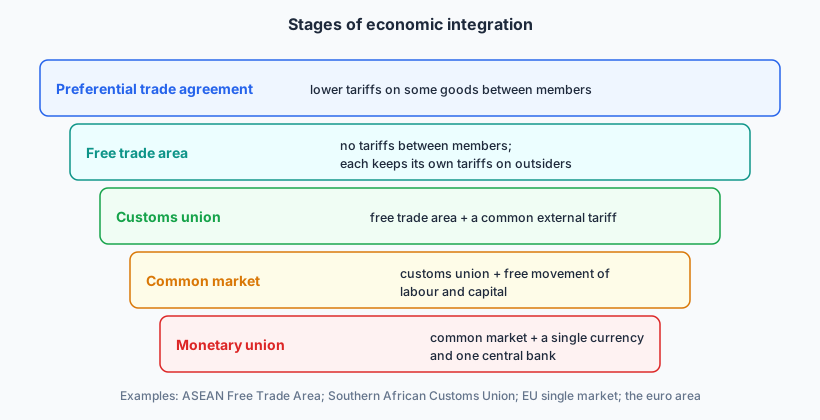
- Free trade area (FTA): members remove trade barriers among themselves but keep their own tariffs on non-members. Rules of origin stop outsiders routing goods through the member with the lowest tariff. Examples: ASEAN Free Trade Area (AFTA), USMCA.
- Customs union: an FTA plus a common external tariff on non-members, so members negotiate trade deals as a group. Example: the Southern African Customs Union.
- Common market: a customs union plus free movement of factors of production: labour and capital. Example: the EU single market.
Advantages and disadvantages of trading blocs
HL trade creation; greater access to markets, allowing economies of scale; with freedom of labour, greater employment opportunities; stronger bargaining power in multilateral negotiations (the EU negotiates as one); greater political stability and cooperation (a founding aim of the EU after 1945); more competition and FDI inflows.
HL trade diversion; loss of sovereignty over trade policy (and, in a common market, over migration and regulation; a major issue in the UK’s 2016 Brexit vote); challenge to multilateral trading negotiations: regional deals divert energy from the WTO and create a “spaghetti bowl” of overlapping rules; adjustment costs for industries exposed to competition from partners.
Trade creation and trade diversion HL
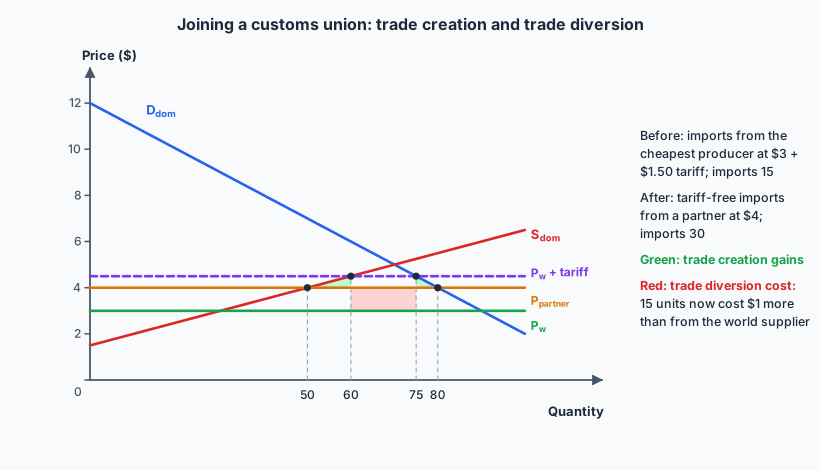
- Trade creation: joining a bloc replaces higher-cost domestic production with lower-cost imports from a member, and consumers buy more at the lower price. An efficiency gain.
- Trade diversion: joining a bloc replaces imports from a lower-cost non-member (which still faces the common external tariff) with imports from a higher-cost member. An efficiency loss.
Monetary union
A monetary union is a common market with a single currency and a common central bank setting one monetary policy for all members. The euro area (more than twenty EU countries, with the European Central Bank) is the main example. HL advantages and disadvantages:
no exchange-rate risk or transaction costs of converting currencies between members, encouraging trade and investment; price transparency, increasing competition; possibly lower interest rates and inflation through a credible central bank; greater political integration.
loss of independent monetary policy: one interest rate for all, even when members are in different phases of the business cycle; loss of the exchange rate as an adjustment tool (a struggling member cannot devalue); fiscal rules limit national budgets; asymmetric shocks hit some members hard (Greece in the 2010–12 debt crisis); switching costs.
The World Trade Organization (WTO)
Objectives and functions: the WTO (1995, successor to the GATT) aims to liberalize trade under agreed rules. It administers trade agreements; provides a forum for negotiations (trade rounds); settles disputes between members; monitors trade policies; and supports developing countries. Core principles: non-discrimination (the most-favoured-nation rule: a concession to one member must go to all) and national treatment.
Factors limiting its influence:
- Difficulty of reaching agreement on services and primary products: decisions need consensus among 166 members; the Doha Round (from 2001) stalled over agricultural subsidies and services liberalization.
- Unequal bargaining power: rich countries have more negotiators and influence; developing countries argue that rules favour rich countries, which keep farm subsidies while demanding open markets.
- The Appellate Body of the dispute settlement system has been unable to hear appeals since 2019, because the US blocked appointments.
- The growth of regional agreements and unilateral tariffs bypasses the WTO.
✏️Worked example HL
Before: price $4.50; Qs = 60, Qd = 75; imports = 15 from the world producer. After: price $4; Qs = 50, Qd = 80; imports = 30 from the partner.
Trade diversion: the original 15 units now cost $4 instead of $3 (the tariff revenue was a transfer, not a cost): 15 × ($4 − $3) = $15.
Trade creation: production effect ½ × (60 − 50) × 0.50 = $2.50; consumption effect ½ × (80 − 75) × 0.50 = $1.25; total $3.75.
Here trade diversion ($15) outweighs trade creation ($3.75), so joining reduces efficiency, although consumers gain from the lower price.
📝Practise
Tagged questions are modelled on a real IB question from that session, with our own wording and context.
1. [2 marks, Paper 2 style] Define the term customs union.
2. [10 marks, Paper 1 (a) — modelled on November 2022 HL Paper 1 Q3(a)] Explain how membership of a common market affects workers and firms in ways that membership of a free trade area does not.
3. [15 marks, Paper 1 (b) — modelled on November 2023 HL Paper 1 Q3(b)] Using real-world examples, examine the effects on a small economy of joining a regional trade agreement such as RCEP.
4. [15 marks, Paper 1 (b) — modelled on November 2024 HL Paper 1 Q3(b)] Using real-world examples, discuss whether ASEAN countries would benefit from adopting a single currency.
5. Explain two factors that limit the influence of the WTO.
6. [15 marks, Paper 1 (b) — modelled on November 2022 HL Paper 1 Q3(b)] Using real-world examples, evaluate the economic consequences of a country leaving a common market.
🔗Go deeper — other people’s work
These are external resources, not mine. If one stops working, tell me and everything above it on this page still stands.
- ASEAN Secretariat — the ASEAN Economic Community blueprint and trade statistics.
- WTO — Understanding the WTO, a free online guide.
- European Central Bank — explainers on how the euro area’s single monetary policy works.